¡Homemade Tortillas!


“Hey guys; you’ve written a couple times that we can find homemade tortilla recipes right here on your blog; I’ve looked and can’t find any – Where are they at?”

Ummm, well this is embarrassing… that’s a really good question; I coulda sworn they were here somewhere… Alright, I admit defeat, so here they are!

Unless you live near a source of fresh tortillas made daily, you owe it to yourself to build your own. The difference between store bought and fresh is night and day.

Ingredients are super simple and so is the process, although it certainly takes a good few reps to be able to turn out tortillas that look as good as what you buy; (Monica is our go-to roller for that very reason). As with all things cooking, the quality of what you use profoundly affects the finished product, so chose carefully.

Equipment needs are minimal; you can get by with just a rolling pin and a nice heavy frying pan. If you make corn tortillas with any frequency, you’ll want to consider buying a press. They come in really handy, are fun to use and a very cool tool to boot. Flour tortillas must be rolled, not pressed, so a good pin helps immensely; the thin, wooden kind that tapers towards the ends is best as far as we’re concerned. Finally, a comal, the traditional, sideless cast iron cooking surface will do a great job; they’re cheap and easy to find.
Here are our favorite recipes and methods.


Flour Tortillas
3 Cups unbleached, white flour
4 Ounces Unsalted Butter
1 Teaspoon Sea Salt
1/2 Teaspoon Baking Powder
1 Cup Hot Water

You can substitute either lard or canola oil for the butter if you prefer; each will impart a subtle taste difference, so try them all and pick your fave.

In a mixing bowl, combine the flour, salt and baking powder thoroughly.

Melt the butter and add to the dry mix. Use your fingers to massage the butter into the mix until thoroughly incorporated.

Add water and mix by hand until the dough forms a ball.

Cover the dough with plastic wrap and allow to rest for at least a half hour; you can refrigerate the dough for up to a day if need be.

Divide the dough and roll it into 12 equal balls. On a lightly floured surface, roll each ball out until it forms a nice circle roughly 6″ to 8″ across, depedning on how thick you like your tortillas.

In your pan or comal over medium high heat, cook the tortillas until you see that nice brown blistering form on each side. Stack your finished wrapped tortillas in aluminum foil to keep them warm.

Corn Tortillas
2 Cups Masa Harina
1.25 to 1.50 Cups hot Water

In a mixing bowl, combine the Masa and water by hand and blend until you get a nice, consistent dough that does not stick to your hands. You don’t want the dough too dry, either; shoot for a dough that holds together, isn’t sticky, but feels moist to the hand.

Roll the dough into 12 equal balls and allow to sit for about 10 minutes.

Whether you use a pin or a press, cut a gallon plastic storage bag into two equal sheets and place a ball of dough between them, then press or roll to roughly 6″ around.

Cooking process is exactly the same as for flour. Each side will get 30 to 60 seconds of cooking time.

Enjoy!

E & M

Soups On!


If We had to pick one thing that separates really good restaurant quality food from most home cooked stuff more than any other, it wouldn’t be unreasonable to vote for making good stock.

Now, that’s a process that scares some folks, and it shouldn’t. Making stock need not be super laborious or scary. We’ll show you a very effective, relatively quick and easy method.

So, first things first, what is stock, and especially, what is stock vis a vis broth? In simplest terms, stock comes from bones, while broth comes from meat. Think of stock as the root of superior soup, sauce, or maybe risotto. I’ve heard broth spoken of as seasoned stock, and that’s not far off the mark. That said, there is certainly an enhanced mouth feel and richness to stock, brought forth by the gelatin released from bones, that you just don’t get anywhere else. Certainly, what you make at home from great ingredients will always beat the pants off anything store bought and stock is no exception: When you want to pull out the stops and make a personal culinary statement, make it in house.

The first and most important step to take toward home stock production is to not throw out the bones, carcass, etc of your last wonderful roast, chicken, turkey, etc – Keep ’em and freeze ’em and set ’em aside for future use. If you get meat in volume as we do, You can ask for beef/veal/etc bones from your provider: If you hunted your own, save that stuff you might otherwise throw out and put it to good use; be it beef, chicken, grouse, pheasant, bambi, moose, buffalo, etc, they’ll all make fine stock, (And making stock is also a great opportunity to clean out the ol’ freezer).

In many restaurants, ‘Dark Chicken Stock’ has replaced veal stock as the go-to root of great soup, sauce, etc. If you’ve read that on a menu or seen it online, I bet you wondered what the heck they were talking about, right? The sole difference between light and dark chicken stock is whether or not the bones have been roasted; same goes for beef, veal, etc. Roasting yields a deeper, richer flavor profile.

So, let’s do some up and see where it takes us.

For this exercise, we chose beef, since down there in our freezer there were a couple of packets marked ‘soup bones’. Unwrapping those guys, I found a bunch of meat on some beautiful big hunks of bone, so I trimmed that off and set it aside for marinating; more on that in a sec. And FYI for your nice big stock pot full of finished product, you’ll want a couple pounds of bones to work with.

Preheat your oven to 325 F, and set dem bones in a baking pan. Now it’s mirepoix time, an essential component of great stock. You’ll want a mix of roughly 50% onion to 25% each of carrot and celery. You can whack all of that into nice big chunks, then toss everything into the baking pan with the bones. Give everybody a nice drizzle of extra virgin olive oil, and a bit of salt and pepper.

 photo 3015B2BB-9354-4C4A-A900-6C512E8602BB-398-0000002682E2CCA3.jpg

Toss the whole shebang into your preheated oven and let ’em get it on. Leave the mix in until you start to see light browning on the bones and veggies, about 1.5 to 2 hours.

While your bones are roasting, turn your attention to the meat. If your bones had generous flesh attached as ours did, use it; you don’t need any fancy cut, in fact, the cruder the better – Time and marination will make that stuff fork tender in the end run, believe me. We went for a simple marinade of:

2 cups red wine
2 Tablespoons olive oil
1 clove garlic, rough chopped
1 Sprig fresh rosemary
A shake and a grind of Sea Salt & Black Pepper

Place everything into a glass dish and refrigerate overnight.

 photo E6D4D96C-F993-4DF2-BB39-9E3B39DC7557-398-00000026876B5E29.jpg

Back to the bones and mirepoix. Fill a stock pot with a gallon of nice, clean water over high heat. Toss in everything from your baking pan. Add a couple of Bay leaves. Once the mix starts to boil, crank the heat down to a nice, slow simmer and let things take their course. You’ll lose some volume to evaporation, and that’s just fine. Leave the pot on over that low heat all day; at least 6 hours and up to 8 is just fine.

Remove your pot from the stove, cover and refrigerate overnight, (Or stick it out on the back porch if its cold out).

In the morning, you’ll find a nice, gooey layer of fat has formed on the top of your pot. Carefully ladle that off and discard. Now, using a sieve or a chinoise, remove all the chunky stuff from the liquid.

 photo D371D12C-C4C7-41F9-9E73-E405B7D7966D-398-0000002692C6BD54.jpg

You should end up with something that looks about like this:

 photo 392F7F45-3EFA-4562-B453-F5519E46F5F3-398-000000268CAC0B70.jpg

Now we’re gonna do some reasonable clarification. You’ll need that sieve or chinoise, plus a decent chunk of cheese cloth; if you don’t have any handy, most grocery stores sell it. If all you find is the very loose weave stuff that looks like badly spun spider web, no worries, it’ll work fine so long as you have a length of a few feet, which is what most packages contain. Take the cheese cloth and fold it into a nice, thick blanket and line your sieve with that. Carefully pour your rough stock through, then do it again and again; you want to get maybe 5 or 6 pours through your home-made filter, so go slow and let that cheese cloth absorb all the crusties. When you’re done, your stock will look like this

 photo E2ECAE17-6C4A-4EE8-9750-1556F38718E1-398-000000268FB7BF64.jpg

Maybe not textbook perfect, but when you take up a spoonful of that lovely stuff and it looks kinda like this, screw the textbook…

 photo 7811D1DB-6873-4624-B84F-73F1503F8842-398-000000269958193B.jpg

That, friends and neighbors, is beautiful stock.

You can stop right there and move on to making soup, or you can freeze the stuff for future use, or you can put it back on the stove and simmer some more, reducing it by roughly 50% and end up with some truly wonderful glace, that thick, flavorful, intense root for sauces, soups and all kinds of experiments. If you go the glace route, try freezing the results in an ice cube tray; then, when you need a little something to really kick up a sauce or soup or stew, you just pop out a cube or two and viola, instance intense flavor…

So there you have it, serious homemade goodness; you can do this with veggies, fish, chicken, turkey, pork, beef, whatever floats your boat – So, what kind are y’all gonna make first?

The Tzatziki of the Lambs


We did a show for the boys recently, the idea being for the male of the species to somehow convince the female to cook for him. Now if that works…

The Greek wanted something Greek of course, so I suggested a nice roasted leg of lamb with Tzatziki, so we’ll cover that here.

If you’ve never had Tzatziki sauce before, you’ve got a real treat in store. Tzatziki is, hands down, one of the finest uses for cucumber. In Greek cooking it’s often served with lamb as we suggest, but I’m here to tell y’all that Tzatziki is excellent on eggs, fantastic on flat bread, pleasant on poultry, and beautiful on burgers; in other words, like hot sauce, it’s good on durn near everything!

Whip up a batch and enjoy!

 photo Tzatziki_zpseee80e70.jpg


Classic Tzatziki Sauce

1 8 oz container of Greek Yogurt, (You can use regular too)
1 med cucumber
2 Tablespoons Extra Virgin Olive Oil
1 fresh lemon
1 teaspoon Dill, (You can also use mint)
2 cloves Garlic
Salt to taste

Line a colander or strainer with paper towel and drain your yogurt for around 30 minutes, (Critical step to avoid runny Tzatziki, and even more so if you’re not using Greek yoghurt).

Peel, seed and grate the cucumber.

Juice the lemon and reserve.

Do a fine chiffenade on the dill or mint.

Peel and mince the garlic.

Combine everything in a non-reactive bowl and mix well by hand, (Blending or processing makes your yogurt break down).
Refrigerate covered for 2 to 3 hours.
Serve chilled

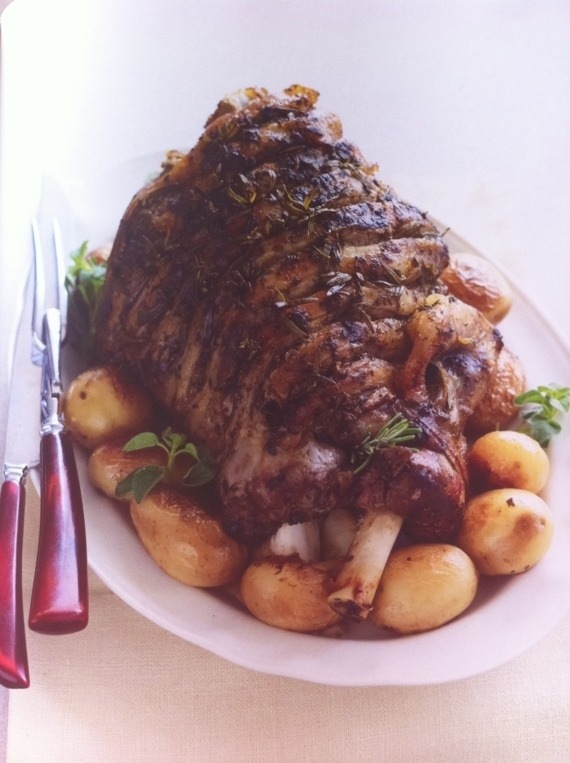
Real Deal Greek Roast Leg of Lamb

Disclaimer; I’m Scots, Welsh, and Dutch, and M carries German and Norse blood. We’ll lay claim to this being a genuine interpretation of a classic by way of the truly born and raised Greek cooks who we kind enough to share their passion.

A fair number of folks in this country don’t care for lamb because they find it gamey. It can be, but we’re here to say that the rest of the meat eating world can’t be all wrong. Great lamb comes from choosing good meat, to proper preparation and cooking, and that’s what we’ll relate here.

My Greek pals will tell you that lamb is always cooked to well done, a key consideration in avoiding funky, off-putting flavors.

Be sure to trim the lions share of the fat prior to roasting as well. This recipe will provide a fine feast for 6 to 8.

5 lbs bone-in leg of lamb
16 – 24 small new potatoes, (Variety of your choice, or mix and match)
2 tablespoons olive oil
12 cloves garlic
Zest of two lemons, grated
2 tablespoons Oregano
2 tablespoons Rosemary
1/2 cup extra virgin Olive Oil
1 cup dry Red Wine
3/4 cup fresh Lemon Juice
1 tablespoon Dijon Mustard
salt and Pepper to taste

Wash the lamb thoroughly and pat dry with paper towel

Peel and dice 8 cloves of the garlic and toss them into a non-reactive bowl large enough to hold all the ingredients.

Add 4 teaspoons each of oregano and rosemary, a 1/4 cup of the olive oil, the wine, and the lemon zest and juice.

Place lamb in the bowl, rubbing it in and turning to coat well on all sides; cover and refrigerate overnight.

Crush remaining cloves of garlic and combine with the mustard and the rest of the oregano and rosemary.

Remove lamb from marinade and reserve all the marinade.

With the tip of a paring knife, poke a bunch of holes into the lamb on all surfaces.

Hand rub the garlic-herb-mustard mixture thoroughly over the lamb, pressing into incisions as much as you can.

Gently coat the lamb with 2 Tablespoons of olive oil and sprinkle liberally with salt and pepper.

Preheat oven to 350 F.

Place the lamb on a rack in a shallow roasting pan.

Toss potatoes in the reserved marinade from the lamb with 2 additional tablespoons of olive oil added; coat thoroughly. Pour everything into the roasting pan, all around the lamb.

Roast uncovered for 90 minutes, then turn the lamb so that it develops a nice crust on both sides. Toss the potatoes to recoat them with the marinade as well. Roast for another 45 minutes, (total roasting time – 2 hours and 15 minutes).

And as our Greek pals insist, serve nice and hot, with plenty of fresh, crusty bread, a big ol’ salad of onions, peppers, tomatoes and olives in vinaigrette, and plenty of red wine.

εύγευστος! (Delicious!), right Greek?

Enjoy!

20130125-102550.jpg

Sloppy Day!


To us, comfort food is a thing that really just shouldn’t be messed with all whole bunch. Macaroni and cheese is supposed to be killer, not wimpy, right? If I wanted super healthy, I wouldn’t make spaghetti carbonara…

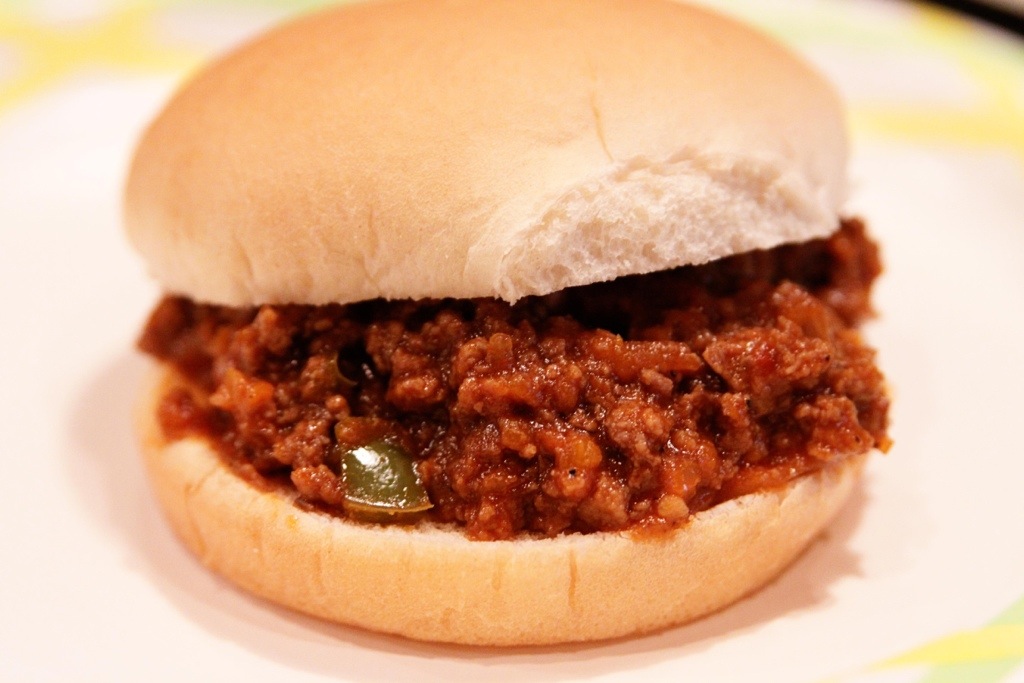
So when it comes to the ultimate, nasty, messy, satisfying thing known as The Sloppy Joe, terms such as ‘low calorie’ and ‘deconstructed’ just don’t wash. If you’re making sloppy joes, they gotta be sloppy and that means the classic, original ketchup version.

Now, if you do want to get artsy fartsy, (or just make a better sloppy mess), you can poke around this blog and find house made ketchup and burger buns, and of course you can and should blend, season and grind your own meat, too.

That said, here’s the drill:

1 pound lean ground beef, or beef/pork blend
1/2 small sweet Onion, fine diced
1/4 green bell Pepper, fine diced
1 1/2 Cups Tomato Ketchup
1 – 2 teaspoons Worcestershire sauce
Salt and Pepper to taste
Optional: 1 teaspoon dark brown sugar

In a sauté pan over medium high heat, sauté the onions and bell pepper until the onion starts to look translucent, about 3-4 minutes.

Add ground meat to the pan and cook through, stirring regularly, until meat is browned thoroughly.

Pour off fat from the pan, and then add ketchup, Worcestershire, salt and pepper to taste. Ketchup is quite sweet, but if you feel you need a bit more, go ahead and add the sugar.

Reduce heat to low and simmer, stirring occasionally, for about 10 minutes until the mixture beins to thicken.

Serve piping hot on lightly toasted buns.

20130107-193956.jpg

Variations:

Adults and enlightened kids might like traditional burger fixin’s as well, like crisp lettuce, fresh tomato, dill pickles, and sharp cheddar or Swiss cheese.

Add a shot of smoked paprika, smoked salt, smoked pepper, barbecue sauce, or liquid smoke if you want a little more mojo.

Add 1 – 2 finely diced jalapeño, Serrano, or Hatch chiles for a spicier take on the theme.

Serve with house made fries or potato salad for a real treat!

Enjoy.

New Years Fondue


Few dishes are more festive than a great fondue. The method invites the creative use of leftovers, so dive into the freezer or fridge. Fondue is also a great ‘Hobo Stew’ dish, so invite your guests to bring their favorite dippers, or an alternate fondue to expand the fun.

Cheeses for fondue need to be varieties that melt well and yield a smooth, creamy consistency. The noble Swiss variants used here are famous for their good behavior in a fondue, and their light, nutty flavor. Cheddar and Jack also do very well, so experiment and find your favorite.

Bread is the traditional primary dunk, but by no means the end of the road! Venison, pheasant, meat balls, and sausage tortellini are great treats, as are crisp apples, grapes, broccoli, roasted potatoes, and snap peas. The sky and your taste buds are the limit!

Classic Cheese Fondue
3/4 pound each Gruyère and Emmentaler cheese, grated
3/4 cup dry white wine
1 teaspoon freshly squeezed lemon juice
1 tablespoon flour
1 tablespoon butter
3 Tablespoons tart Cherry Juice or Kirsch
1 small clove fresh garlic
Sea salt, Black Pepper and Smoked Paprika to taste

Pour wine and lemon juice into a non-reactive sauce pan over medium heat and bring to a simmer. Add the cheeses slowly and stir constantly until each batch melts and incorporates thoroughly. Reduce heat to medium-low and stir occasionally.

Melt butter in a small pan, then add flour and incorporate, then add cherry juice and thoroughly blend to a smooth paste.

Add the paste to the cheese mixture and blend thoroughly. Press garlic, and add salt, pepper and paprika to taste. Reduce heat to warm and stir now and then until ready to serve.

A fondue pot is best for service, but not necessary, ’cause its gonna go quick!

Cube bread, slice fruit and veggies and arrange on a tray. Thoroughly cook meat, poultry or pasta through and keep warm until served.

20121231-112236.jpg

M and I wish y’all a wonderful, prosperous 2013 filled with great food, family and friends!

“Drop the last year into the silent limbo of the past.
Let it go, for it was imperfect,
and thank God that it can go.”
Brooks Atkinson