Gundy’s Rosemary Sauce


Some of y’all are aware, (At least i hope ya are), that I’m the resident cook on The Big Wild radio show. Hosts Gundy and The Greek, and Producer Jon hook up with a steady stream of really fine interviews with outdoor big names every week, followed by my little chunk, know as On The Fire. It’s a gas to do, especially since the gang rarely tells me what I’m doing until seconds before we’re on air, (Seriously! They think its fun, and I do too!).

Well for fans and newcomers alike, you might not know that Gundy is a purty dang good cook himself. We chat off air about ingredients and recipes pretty much every week. The other day, he told me about this one. I asked for permission to share, which Dan generously agreed, so here you go – Like all great culinary surprises, it’s remarkably simple in content, and wonderfully subtle and complex in taste.

A little thing like a different variety of balsamic brings on a whole new character, as will various versions of the sweetener, (Try dark brown sugar, light brown, honey, or agave nectar, for example). Experiment and come up with your personal fave. Our favorite variation so far substituted powdered smoke from Butcher and Packer for the liquid smoke and agave nectar for the sugar, then added the juice of a fresh lemon and a pinch of salt: It’s that kind of wonderful thing to play with.

Gundy himself wrote, “I don’t always make it the same way cuz I don’t have a recipe.” That’s the best kind, far as we’re concerned. Just remember to write it down if you come up with chemistry that really knocks your socks off. Dan uses it for fish, but this rocks on poultry, pork, or roasted veggies: For those, you might want to up the vinegar and smoke ratios a bit.

Gundy’s Rosemary Sauce

1/2 Cup Balsamic Vinegar
1/2 Cup Brown Sugar
Capful of Liquid Smoke
Sprig of fresh Rosemary
6 – 10 Montmorency Cherries

Gundy notes that, “I have found that a real good balsamic vinegar is overkill. Regular balsamic from the grocery store is thinner and not a waste of great vinegar.” You can certainly put a touch of a really fine balsamic in with the lighter stuff if you want a more complex flavor note.

If you can’t find the cherries themselves, you could substitute a tablespoon or two of sour cherry juice.

In a sauce pan, bring the vinegar to a rolling boil.

Add the sugar and stir to dissolve.

Stir in the liquid smoke.

Reduce heat to low, toss in the Rosemary and allow to simmer for 7 to 10 minutes. keep a sharp eye on it, as the sauce reduces quickly.

In the last minute of cooking, toss in the cherries and stir to incorporate.

If you try this with Salmon, Dan says The Commandant, (AKA, the lovely Mrs. Gunderson), “likes to have a thin layer of sauce spread over non -skin side of salmon. I throw it on a plank and grill it covered for 10 minutes or so. The sauce permeates the salmon. Don’t use too much or it overwhelms the fish. Just enough to darken the meat a bit. You will have some left over. Throw the twig on top for show.”

Gundy has honored me more than once, saying on the show, “Do what this guy tells you, it’ll be great.”

Back at ya, my friend!

E & M

Homemade 4th


What American comfort food is rootsier than a burger? And what holiday is more deserving of a great burger than July 4th? I rest my case…

Of course a great burger needs great sides, so I suggest you head out and source some local corn on the cob and second, build a nice, fresh spud salad with olive oil, fresh citrus and vinegar, for a lighter take on potato salad that we’ll amp up with some fresh herbs.

If you’ve ever had a truly amazing burger at a local joint, I’ll bet you 10 to 1 that they either grind their own beef, or have their regular supplier do that for them: Custom ground and seasoned burger, done fresh, is what separates Holy Crud from Ho Hum in Burgerland.

At the market I found nice chuck steaks for $4 a pound, (They were marked ‘For marinating’); that’ll be the heart and soul of our burgers. The relatively high fat content coupled with nice big chunks of meat is gonna be great, but it does need a little help to put it over the top; I went with aged, Choice Tenderloin, which I found for $9 and change a pound, which ain’t bad, (And we’re only buying a half pound so…). I ended up with a mix of roughly 2:1 Chuck to Tenderloin.

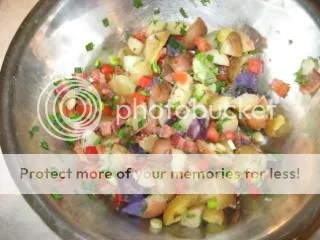
I found a really nice medley of red, white, and blue baby potatoes that’ve not only pretty but real tasty.

Back home, I stuck the beef into the freezer for a little bit. Any time you’re grinding meat, making sausage, etc, you want your protein as cold as you can get it; this will help keep the fat in a proper matrix while you work with and, more importantly, cold keeps your food out of the temperature danger zone, thereby avoiding making you and your loved ones sick; always a plus, that, eh?

I set up the grinder attachment on the ol’ KitchenAid, cut the beef up into strips manageable for the hopper and got to seasoning. As with sausage making, you can season ground meat before or after you grind it; I prefer doing so before, because you get a more even distribution of spice as the meat is grinding. For these burgers, I went with Hawaiian flaked salt, fresh ground pepper blend, (Black, red, white, green; our go-to mix), onion powder, celery seed, granulated garlic, smoked paprika, and a dash of Worcestershire. I seasoned with a fairly light hand, because we just want to accent the meat’s great flavor, not blow it out of the water… So into the grinder she goes, using the coarser of the two plates I have available. I gave the freshly ground burger a few tosses to make sure everything was well blended, then covered it and stuck it in the fridge to think about things for a while.

While the burger was incorporating all those flavors, I put the spuds on to boil. Just a note on water; it’s sad to say that not all tap water is created equally these days, (Especially coming from a kid who grew up drinking from streams and lakes and even garden hoses!) My bottom line on cooking with stuff is simple; if it does not look, taste, feel and smell right, do not cook with it! The concept of taking, say, a nasty bottle of wine and cooking with it because it wasn’t good enough to drink also applies to a thing as elemental as water. If yours doesn’t taste good to drink, do what we did and get a decent filter for your kitchen tap; from home brewed coffee to things you boil for dinner, everything will taste better.

A trip out to the herb garden offered Garlic Chives and Cilantro, to which I added fine diced green onion, red bell pepper, and fresh tomato: All that, plus a few pieces of local Apple smoked bacon will go into our spud salad.

For the salad dressing, I squeezed the juice from one lime and one lemon, and then added a couple tablespoons of grapefruit juice; I whisked some nice extra virgin olive oil into that at a roughly 2:1 ratio, added a dash of sal de mere, fresh ground pepper, and celery seed, and there you have it. I quartered the spuds, put everything into a stainless bowl to mix and then into a ceramic bowl, covered in the fridge, for a good hour to allow everything to blend: As M rightly points out, stuff like this salad are gonna be great tonight but much better tomorrow; like good soup or stew, salads marrying a bunch of wonderful flavors are gonna be at their prime about 24 hours later…

For the burgers, I formed thin, wide patties, then cut up some of my stash of 2 year old WSU Creamery White Gold Cheddar and placed a nice layer of that in the middle of one patty, (use whatever cheese most floats your boat.) Then we assemble; a layer of burger, then cheese, then burger, seal and plump up the edges of each so we have a nice round patty of uniform thickness throughout. I let them hang in the fridge for 30 minutes or so to marry flavors further.

The burgers hit the grill over nicely glowing coals for about 4 minutes each side, with the cover on and vents wide open. I put the buns in a warm oven with a little dish of water to get nice, moist heat going. Finally, I sliced onion, tomato and pulled some lettuce leaves. M got condiments out and we were good to go.

At the point that she turned to me, burger in hand, with that serious knit-brow look and said, “This is, without a doubt, the best burger you’ve ever made; seriously…” I considered my mission a success… pair yours up with great local beer, and a Happy 4th to one and all!

BONUS: Here’s a link to another variation on the home ground burger, as well as our recipe fore house made buns!

¡Homemade Tortillas!


“Hey guys; you’ve written a couple times that we can find homemade tortilla recipes right here on your blog; I’ve looked and can’t find any – Where are they at?”

Ummm, well this is embarrassing… that’s a really good question; I coulda sworn they were here somewhere… Alright, I admit defeat, so here they are!

Unless you live near a source of fresh tortillas made daily, you owe it to yourself to build your own. The difference between store bought and fresh is night and day.

Ingredients are super simple and so is the process, although it certainly takes a good few reps to be able to turn out tortillas that look as good as what you buy; (Monica is our go-to roller for that very reason). As with all things cooking, the quality of what you use profoundly affects the finished product, so chose carefully.

Equipment needs are minimal; you can get by with just a rolling pin and a nice heavy frying pan. If you make corn tortillas with any frequency, you’ll want to consider buying a press. They come in really handy, are fun to use and a very cool tool to boot. Flour tortillas must be rolled, not pressed, so a good pin helps immensely; the thin, wooden kind that tapers towards the ends is best as far as we’re concerned. Finally, a comal, the traditional, sideless cast iron cooking surface will do a great job; they’re cheap and easy to find.
Here are our favorite recipes and methods.


Flour Tortillas
3 Cups unbleached, white flour
4 Ounces Unsalted Butter
1 Teaspoon Sea Salt
1/2 Teaspoon Baking Powder
1 Cup Hot Water

You can substitute either lard or canola oil for the butter if you prefer; each will impart a subtle taste difference, so try them all and pick your fave.

In a mixing bowl, combine the flour, salt and baking powder thoroughly.

Melt the butter and add to the dry mix. Use your fingers to massage the butter into the mix until thoroughly incorporated.

Add water and mix by hand until the dough forms a ball.

Cover the dough with plastic wrap and allow to rest for at least a half hour; you can refrigerate the dough for up to a day if need be.

Divide the dough and roll it into 12 equal balls. On a lightly floured surface, roll each ball out until it forms a nice circle roughly 6″ to 8″ across, depedning on how thick you like your tortillas.

In your pan or comal over medium high heat, cook the tortillas until you see that nice brown blistering form on each side. Stack your finished wrapped tortillas in aluminum foil to keep them warm.

Corn Tortillas
2 Cups Masa Harina
1.25 to 1.50 Cups hot Water

In a mixing bowl, combine the Masa and water by hand and blend until you get a nice, consistent dough that does not stick to your hands. You don’t want the dough too dry, either; shoot for a dough that holds together, isn’t sticky, but feels moist to the hand.

Roll the dough into 12 equal balls and allow to sit for about 10 minutes.

Whether you use a pin or a press, cut a gallon plastic storage bag into two equal sheets and place a ball of dough between them, then press or roll to roughly 6″ around.

Cooking process is exactly the same as for flour. Each side will get 30 to 60 seconds of cooking time.

Enjoy!

E & M

Soups On!


If We had to pick one thing that separates really good restaurant quality food from most home cooked stuff more than any other, it wouldn’t be unreasonable to vote for making good stock.

Now, that’s a process that scares some folks, and it shouldn’t. Making stock need not be super laborious or scary. We’ll show you a very effective, relatively quick and easy method.

So, first things first, what is stock, and especially, what is stock vis a vis broth? In simplest terms, stock comes from bones, while broth comes from meat. Think of stock as the root of superior soup, sauce, or maybe risotto. I’ve heard broth spoken of as seasoned stock, and that’s not far off the mark. That said, there is certainly an enhanced mouth feel and richness to stock, brought forth by the gelatin released from bones, that you just don’t get anywhere else. Certainly, what you make at home from great ingredients will always beat the pants off anything store bought and stock is no exception: When you want to pull out the stops and make a personal culinary statement, make it in house.

The first and most important step to take toward home stock production is to not throw out the bones, carcass, etc of your last wonderful roast, chicken, turkey, etc – Keep ’em and freeze ’em and set ’em aside for future use. If you get meat in volume as we do, You can ask for beef/veal/etc bones from your provider: If you hunted your own, save that stuff you might otherwise throw out and put it to good use; be it beef, chicken, grouse, pheasant, bambi, moose, buffalo, etc, they’ll all make fine stock, (And making stock is also a great opportunity to clean out the ol’ freezer).

In many restaurants, ‘Dark Chicken Stock’ has replaced veal stock as the go-to root of great soup, sauce, etc. If you’ve read that on a menu or seen it online, I bet you wondered what the heck they were talking about, right? The sole difference between light and dark chicken stock is whether or not the bones have been roasted; same goes for beef, veal, etc. Roasting yields a deeper, richer flavor profile.

So, let’s do some up and see where it takes us.

For this exercise, we chose beef, since down there in our freezer there were a couple of packets marked ‘soup bones’. Unwrapping those guys, I found a bunch of meat on some beautiful big hunks of bone, so I trimmed that off and set it aside for marinating; more on that in a sec. And FYI for your nice big stock pot full of finished product, you’ll want a couple pounds of bones to work with.

Preheat your oven to 325 F, and set dem bones in a baking pan. Now it’s mirepoix time, an essential component of great stock. You’ll want a mix of roughly 50% onion to 25% each of carrot and celery. You can whack all of that into nice big chunks, then toss everything into the baking pan with the bones. Give everybody a nice drizzle of extra virgin olive oil, and a bit of salt and pepper.

 photo 3015B2BB-9354-4C4A-A900-6C512E8602BB-398-0000002682E2CCA3.jpg

Toss the whole shebang into your preheated oven and let ’em get it on. Leave the mix in until you start to see light browning on the bones and veggies, about 1.5 to 2 hours.

While your bones are roasting, turn your attention to the meat. If your bones had generous flesh attached as ours did, use it; you don’t need any fancy cut, in fact, the cruder the better – Time and marination will make that stuff fork tender in the end run, believe me. We went for a simple marinade of:

2 cups red wine
2 Tablespoons olive oil
1 clove garlic, rough chopped
1 Sprig fresh rosemary
A shake and a grind of Sea Salt & Black Pepper

Place everything into a glass dish and refrigerate overnight.

 photo E6D4D96C-F993-4DF2-BB39-9E3B39DC7557-398-00000026876B5E29.jpg

Back to the bones and mirepoix. Fill a stock pot with a gallon of nice, clean water over high heat. Toss in everything from your baking pan. Add a couple of Bay leaves. Once the mix starts to boil, crank the heat down to a nice, slow simmer and let things take their course. You’ll lose some volume to evaporation, and that’s just fine. Leave the pot on over that low heat all day; at least 6 hours and up to 8 is just fine.

Remove your pot from the stove, cover and refrigerate overnight, (Or stick it out on the back porch if its cold out).

In the morning, you’ll find a nice, gooey layer of fat has formed on the top of your pot. Carefully ladle that off and discard. Now, using a sieve or a chinoise, remove all the chunky stuff from the liquid.

 photo D371D12C-C4C7-41F9-9E73-E405B7D7966D-398-0000002692C6BD54.jpg

You should end up with something that looks about like this:

 photo 392F7F45-3EFA-4562-B453-F5519E46F5F3-398-000000268CAC0B70.jpg

Now we’re gonna do some reasonable clarification. You’ll need that sieve or chinoise, plus a decent chunk of cheese cloth; if you don’t have any handy, most grocery stores sell it. If all you find is the very loose weave stuff that looks like badly spun spider web, no worries, it’ll work fine so long as you have a length of a few feet, which is what most packages contain. Take the cheese cloth and fold it into a nice, thick blanket and line your sieve with that. Carefully pour your rough stock through, then do it again and again; you want to get maybe 5 or 6 pours through your home-made filter, so go slow and let that cheese cloth absorb all the crusties. When you’re done, your stock will look like this

 photo E2ECAE17-6C4A-4EE8-9750-1556F38718E1-398-000000268FB7BF64.jpg

Maybe not textbook perfect, but when you take up a spoonful of that lovely stuff and it looks kinda like this, screw the textbook…

 photo 7811D1DB-6873-4624-B84F-73F1503F8842-398-000000269958193B.jpg

That, friends and neighbors, is beautiful stock.

You can stop right there and move on to making soup, or you can freeze the stuff for future use, or you can put it back on the stove and simmer some more, reducing it by roughly 50% and end up with some truly wonderful glace, that thick, flavorful, intense root for sauces, soups and all kinds of experiments. If you go the glace route, try freezing the results in an ice cube tray; then, when you need a little something to really kick up a sauce or soup or stew, you just pop out a cube or two and viola, instance intense flavor…

So there you have it, serious homemade goodness; you can do this with veggies, fish, chicken, turkey, pork, beef, whatever floats your boat – So, what kind are y’all gonna make first?

Kinda Corny…


We love house made corned beef and pastrami, fine examples of easy to make and highly satisfying charcuterie. I was somewhat dumbfounded when a reader noted “Why bother? It’s cheap to buy at the store?”

Weeeellllllll, the why bother part is because what you make at home will always, with a bit of practice and patience, be far superior to anything store bought. As for the cheaper part, I seriously doubt it, given that you can use very inexpensive cuts of meat, and the processing cost comes from your hands, not your pocket.

House made provides you the luxury of choosing the cut and origin of meat to use, as well as customizing your spice/pickling/corning blend. Just because the common version is corned beef doesn’t mean you can’t use venison, pheasant, moose, or elk; you can and should, in fact, and if some purist insists that what you made isn’t the real thing, well, all the more for us… And just as we all have favorites for BBQ rubs, you’ll develop a similar hankering for your own special spice blends for corning.

We hear a lot of questions regarding the term ‘corned’; it came into common use in the 16th Century and stems from the Anglo-Saxon word for grain or granule, referring to the salt used to cure or pickle. It’s a bit of a stretch, I know, but suffice it to say that ‘corn’ was a catch-all term for any local grain, and in a pinch, salt would qualify, (Sorry, couldn’t resist…)

The next most common question we hear is ‘What’s the difference between corned beef and Pastrami?’ The answer is, not as much as you might think. It has to do with the most common cuts used and the curing process. While either variety can be made with brisket or round, pastrami is sometimes made from the plate cut as well. As for process, either can be made by wet brining, though pastrami is fairly often done with a dry rub in the first stage of curing, then pepper crusted and lightly smoked. These are generalizations, of course; the end product varies as widely as the fancy of the makers.

Having grown up in Massachusetts, I am very fond of New England Boiled Dinner, that ethereal combination of corned beef, cabbage, potatoes and carrots, daubed liberally with fresh horseradish. If you’ve never tried it, you should. I also absolutely adore the Reuben sandwich, which, as blasphemous as it may sound, I make with either corned beef or pastrami.

If you get interested in the art of meat curing, AKA charcuterie, you’ll find a myriad of resources online and if you’d like a great reference volume to add to your cookbook library, check out Ruhlman and Polcyn’s Charcuterie.

So, all fact checking and history aside, how do you make this stuff? We’ll focus on corned beef this time and save pastrami for another day.

You’ll need a brine solution and a spice blend. If any or all of this seems overwhelming, go the easy route and grab a pre-blended pickling spice from one of the suppliers listed in our links; down the line, for all things pickling, you can and should do a bit of study and build your own signature blend.

The recipes here will work for a 2 to 3 pound corned beef; you can scale up or down as you like, but this is a very manageable starter size.

For the Brine:

1/2 Gallon nice, clean water
1 Cup Sea Salt, (Do not use iodized!)
1/4 Cup Dark Brown Sugar
3 teaspoons Curing Salt (AKA Pink Salt, or sodium nitrite)
2 Tablespoons Pickling Spice

Set water in a saucepan over high heat and bring to a boil. Toss in salt, sugar, curing salt and spices and boil until all granules are dissolved. Remove from heat, transfer to a mixing bowl and set over an ice bath for a rapid cool.

Once the brine has cooled to room temperature, place your meat in a glass container big enough to have it covered by at least an inch or two of brine. If you just don’t have a suitable container, you can use a doubled large zip lock bag.

Cover the meat with brine as noted above, at least an inch or two above the meat. If your cut tries to float, you’ll need to weigh it down so it remains completely submerged. If you go the ziplock route, squish all the air out and put the bags in a pan in case of a blowout.

 photo E0DF1E5C-082C-4DFA-9BF2-457AB46A2859-1159-000000BEB923B5DE.jpg

Put your bounty into the fridge where it will live for the next 6 or 7 days. Make a note to self to flip the meat daily, to make sure everything gets a nice, even brine soaking.

On the appointed day, pull your corned meat out of the fridge, and rinse it gently in very cold water.

 photo 7A52148C-EC24-41A4-A53D-B3515E3FC932-1159-000000BD20CBC3DC.jpg

Put the meat into a pan just big enough to hold the cut. Cover with water to about 2″ above the meat. Add another tablespoon of your pickling spices to the pot, bring the heat up to high until you reach a rolling boil, then reduce to a simmer and cook until fork tender, about 2 to 3 hours.

 photo 021DFCB1-3628-44AB-8D36-D742733EF143-1159-000000BD2742E1B8.jpg

Remove the meat from the pot, set on a cutting board and allow to rest for at least 10 minutes before slicing. Your finished product will last a good 5 to 7 days in the fridge, (As if it’ll survive that long…)

 photo 42A0A5C0-0D74-4B30-8632-63D22FC41E4A-1159-000000BD2C6183DE.jpg

Toss potatoes, onions, carrots and cabbage into your reserved boiling liquid until they’re just fork tender, and then enjoy that New England Boiled Dinner!

E & M

Smoked Guacamole


Smoked Guacamole
Here’s a great twist on the standard chip fodder. The lightly smoked components add a really savory, distinct note to a wonderful dip.

2 ripe Avocados.
1 medium Onion.
1 firm Tomato.
1-3 cloves Garlic.
½ fresh Grapefruit.
5 – 8 sprigs fresh Cilantro.
Juice of 1 – 2 fresh Limes.
Salt, Pepper and Chile flake to taste.

Build a small charcoal pile, then spread the coals to a thin, even layer.

Prepare some smoking wood of your choice by soaking it in water for about half an hour, then placing that on top of the hot coals.

Cut all ingredients to be smoked in half, and leave the skins on the halved avocado.

Load the grill with the avocados skin side up, and allow them to grill for a minute or two, then flip them to skin side down.

Add the onion, garlic and grapefruit to the grill, then close the cover and damper the vents so the air flow is minimal, allowing the smoke to work low and slow for about thirty minutes.

* NOTE: We didn’t smoke or grill the tomatoes, (Which were very fresh at the time), ‘cause they get too mushy, but my big Sis pointed out, post production, that green tomatoes are a thing of beauty, which is absolutely true: So try that option if you like, ’cause we’re sure gonna!

Allow the grilled/smoked stuff to cool. Dice the tomato, onion, avocado and garlic, then combine in a non-reactive bowl and mix well. Add chiffenaded cilantro, juice from one lime, and squeeze juice from ¼ of the grapefruit.

Add salt, pepper and chile flake to taste, and add additional lime and/or grapefruit juice as desired – When you get the balance right, you’ll have a nice, tangy citrus counterpoint to the smoky veggies.

20130306-085201.jpg