what does this have to do with cooking? Everything and nothing. Bear with me please.
Do you know what? It’s the little things that matter. That’s where life is. It’s knowing that M is sleeping soundly in a lovely old Dublin hotel. It’s going for a walk with this dawg who’s been the best we’ve ever been blessed with and looking at a low fog starting to settle into the San Juans, across Hales Passage.
It’s coming back and finding both kitties at the door to greet us. It’s feeding the crew, sharing 30 seconds of love with the rotten Tortie, 5 minutes with the ol’ boy cat, and sitting down beside that 14 year old dog while he chows down.
It’s that air off the bay. It’s gathering a dozen amazing tomatoes for dinner.
It’s all that. Don’t let all the loud noise and terrible crap the news spews distract you.
Everything is connected. We are all part of it. Never, ever take that for granted. As Warren Zevon said, once he knew for sure he was dying – enjoy every sandwich. So with that said, I believe I will.
The New York Times cooking app is a wealth of inspiration – great ideas from one of the greatest food towns in the world can’t be anything but good. Last week, Sam Sifton spoke to something that I’ve preached over and over here – When you find a recipe you love and make it a few times, you’re bound to make changes by preference or expedience. Either way, what you land on becomes yours, and that’s as it should be.
Sam offered Eric Kim’s Gochujang Buttered Noodles, and then wrote of the variations he’s done with it – He subbed ssamjang for gochujang and frozen dumpling for the noodles, and another version with lap cheong Chinese sausage over Korean rice cakes.
He finished the piece with this exhortation – ‘So this weekend, I put the challenge to you. Make Eric’s dish as he intended, or take it in whatever direction your pantry allows and your taste desires. Cook in confidence. It’s just butter, garlic, spice, sweetness, umami and starch. Perfection every time.’ So I did.
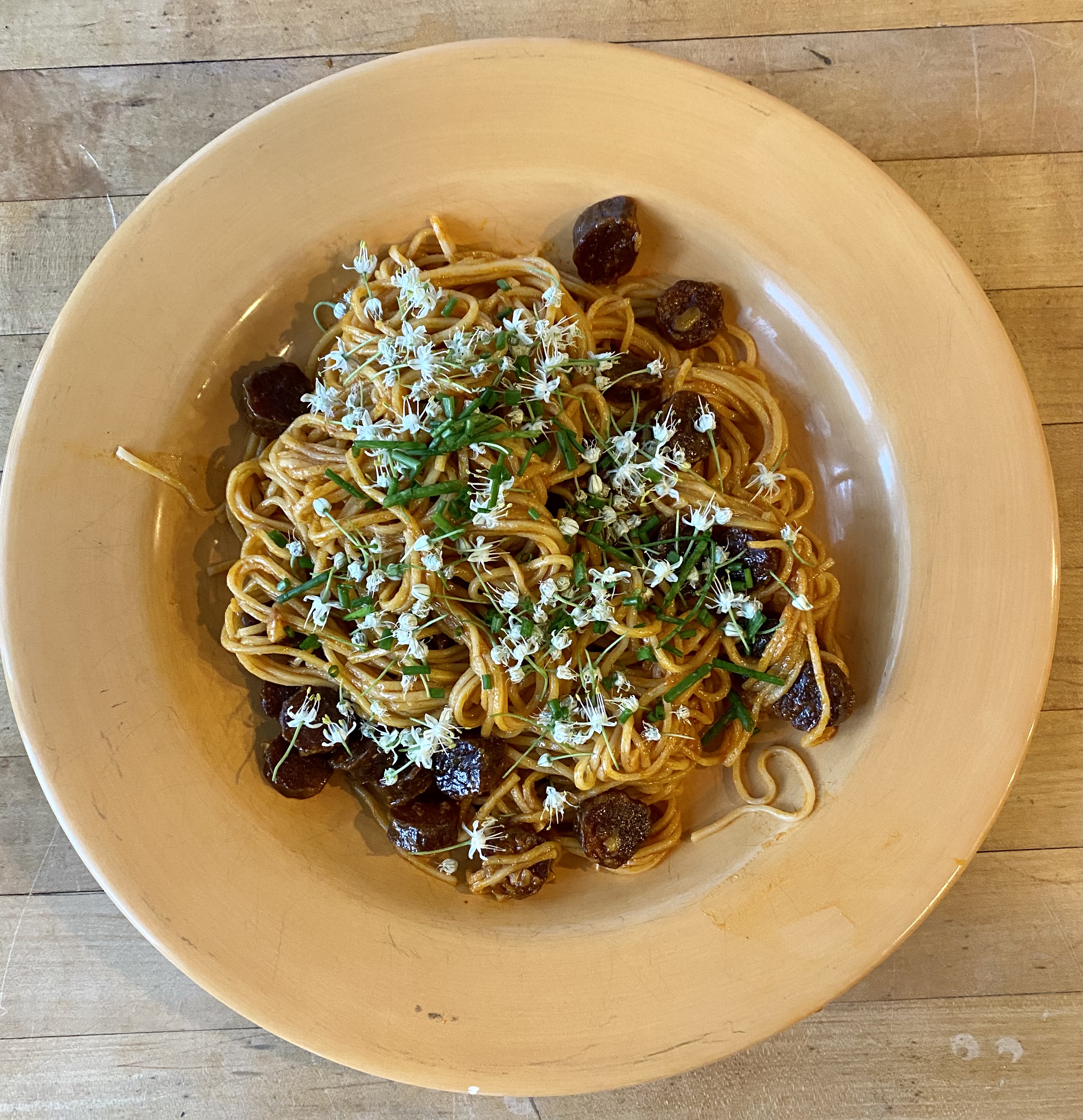
What I used was a lovely exercise in utilitarianism – I mentioned what I had in mind to the family, and suggestions for this and that came back to me. As Sam points out, this is a can’t lose dish, and whatever you do to it is gonna rock – so I’m passing the challenge off to y’all. Dive in and let me know what you come up with – for the record, I sent a thank you to Sam, along with a pic of the finished dish.
Notes –
As Sam noted in his piece, make sure you find Gochujang paste, not sauce – you want the purest essence of those lovely sun dried chiles you can find – the sauce version tends to add a bunch of stuff you don’t want or need. Note that gochujang can be downright nuclear, so read the label and ask your grocer how hot the stuff you’re contemplating is. I buy what’s labeled as Medium Hot, and it’s still got plenty of kick – when it’s combined with great vinegar and honey, it’s stunningly good.
Use the best vinegar you’ve got – Erik Kim recommends sherry or rice for the dish. For the former, find a genuine Spanish Jerez, one that carries the D.O.C. symbol. It’s far cheaper than balsamic, and is truly delightful stuff. If you opt for the latter, make sure it doesn’t say Seasoned on the label – that’s got added sugar you don’t want. I went with the best thing I have – a smoky, subtle 10 year old handmade Baoning Chinese vinegar.
I garnished with sweet onion flowers and chives fresh from the garden – Use what you have and love, it’ll be perfect! Eric recommends thinly sliced scallion or finely chopped cilantro on his dish.
If you opt for lap cheong sausage, it should be fully cooked when you buy it – but make sure that’s the case!
A Riff on Eric Kim’s Gochujang Buttered Noodles
12 Ounces dried Ramen Noodles
8-12 cloves fresh Garlic
6 Ounces Unsalted Butter
1/4 Cup Gochujang Paste
1/4 Cup Honey
1/4 Cup Rice Vinegar
Salt and ground Pepper to taste
Optional: 8 Ounces Chinese Lap Cheong Sausage
Garnishes as you please
Peel, end trim, and mince garlic.
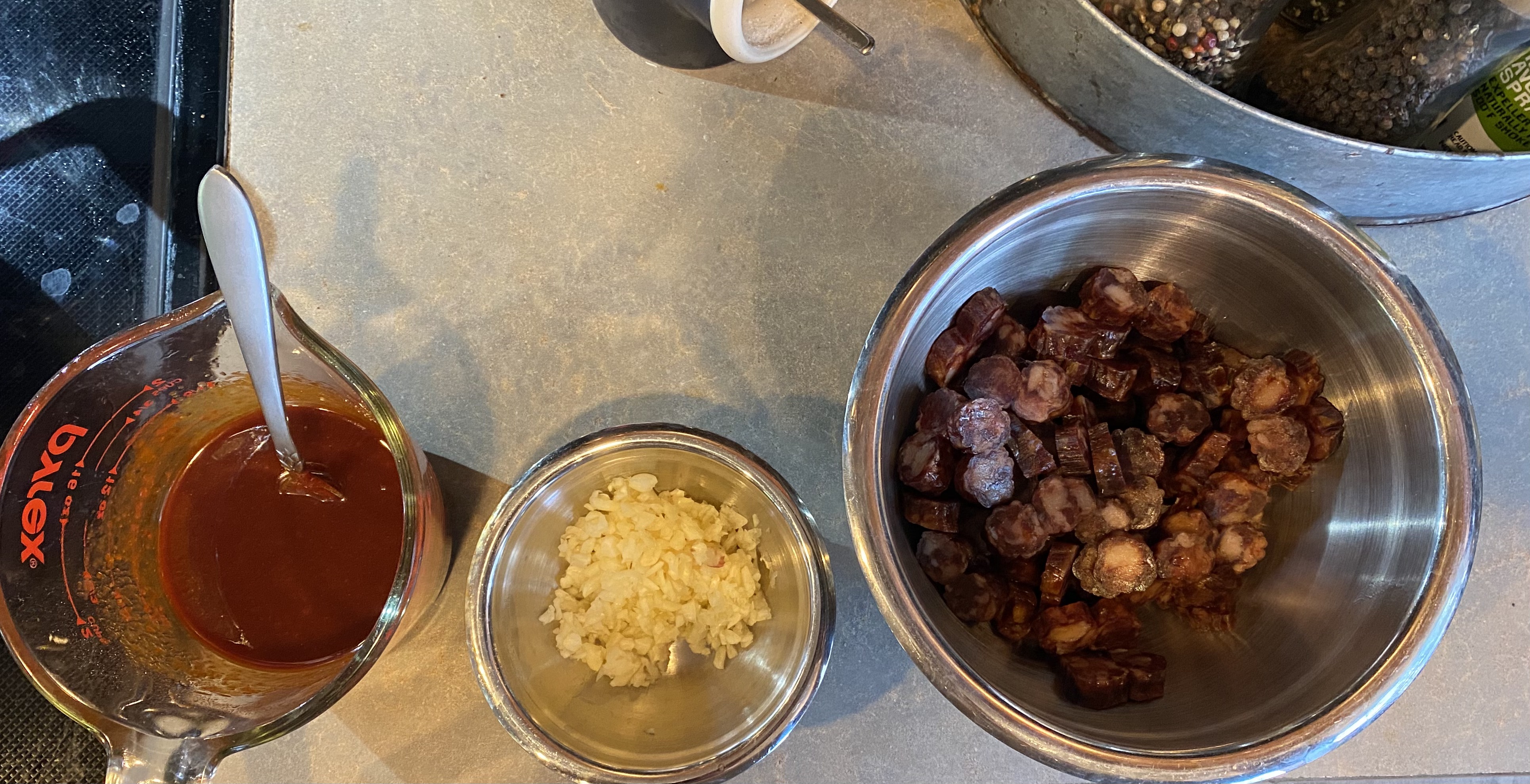
In a glass measuring cup, combine gochujang, honey and vinegar – whisk with a fork to thoroughly incorporate.
If adding sausage, slice into roughly 1/4” thick rounds and place in a bowl for service.
Prep garnish and place in a small bowl for service.
In a stock pot over high heat, boil noodles in salted water, per directions for whatever you’re using.
In a heavy sauté pan over medium low heat, add 4 ounces of butter and heat until melted.
Check noodles – turn off burner, transfer to a colander to drain, reserving 1 cup of pasta water.
Put drained noodles back into the pot, and place pot on the still hot burner (don’t turn it back on – residual heat is all we need here).
Add the garlic and sauté until soft, about 2-3 minutes.
Add gochujang/honey/vinegar and whisk to thoroughly incorporate.
Cook sauce for 3-5 minutes until it’s notably reduced and thickened.
Add sauce and remaining 2 ounces of butter to the hot noodles and stir to thoroughly coat and incorporate everything. Add splashes of pasta water until you get the consistency you like.
Season lightly with salt and pepper to taste.
Serve it up with your garnishes, devour, and make yum yum noises.
Up here in the Great Pacific Northwet, we’re a major source of berries – rasp, cran, blue, black, straw, you name it – the land between Bellingham and the Canadian border is heavy with fields just starting to release their bounty. In the weirdness that is modern agriculture, most of our berries get shipped out of state, but you can sure find them here when they’re ready to rock – and farm stands, markets, and CSAs beat the pants off the grocery store any time.
You can and should plan to enjoy those for all the standard berry fare – snacking, cobblers and crumbles, pies, smoothies, and so on – but it’s also time to consider a few uses that might not be as mainstream, but certainly are delicious.
Berry infused vinegars are easy to make, and the results are delightful. This is a great project to consider some less than obvious parings for what you infuse, to whit, berries and herbs. Got blueberries? Consider cinnamon basil or lemon thyme, or just good old navel orange. For raspberries, pair with lemon verbena or mint. Strawberries go great with rosemary or oregano. Blackberries shine when paired with lemon thyme or lemon basil.
Take fruit and vinegar a step farther and make your own from all this glorious harvest. Straight up berry vinegars are incredible, and very doable at home. Here too pairings can be employed – vanilla with strawberry, nutmeg with raspberry, blueberry and a little cacao – use your pantry and your imagination, and next winter, you’ll be a happy camper.
Let us not forget gastriques – if there’s a sauce made for berries to strut their stuff, this is it – this lovely sweet and sour stuff pairs well with almost any protein, to salads and grilled veggies. They’re easy to make, infinitely variable, and perfect for summer fare.
And with many thanks to Christy – don’t forget that berries of all kinds make fabulous shrubs, too! From single to mixed berry formulations, you’re sure to come up with a winner to call your own.
Tribal Sister and avid follower Christy sent me this a while back –
Can you enlighten me about ratios/proportions in a dish I make? I frequently make a chile rellenos casserole because I have lots of poblanos and it’s an easy dish that can be spicey or mild. Every time I look at various recipes I can never decide what I should do about ratios in the egg-milk part. Basically, it’s a layer of poblano, topped with a protein, cheese and then covered with a mix of eggs, milk, and flour. Sometimes baking powder is added and usually additional cheese is added to the mixture before pouring over. I am looking for that sweet spot where it’s not too eggy–not a quiche or frittata–but not too watery. The poblanos need to shine through. Maybe you can explain the dynamics of this to me so I can fix some proportions in my mind – an inquiring mind wishes to know!
Chris further related that the ratios she’d found varied from 1/2 cups to 2 cup of milk, anywhere from 2 to 8 eggs, and 2 tablespoons to 1/2 cup of flour – She happens to be a Phd Archeologist and a hell of a fine cook, so no wonder that wild a statistical swing rocked her boat a bit!
I gave her letter another read, and doing so revealed more problems with this potential recipe than just the egg/milk ratio. I’ve made plenty of rellenos in several regional styles, but had never tackled relleno casserole, so naturally, I was hooked. What followed was an interesting lesson in recipe development that I thought would be fun to share here.
The exercise begins with the problem Chris wants fixed – 1. what ratio of egg/milk/flour will yield a relleno casserole that most closely duplicates a solo relleno, and 2. One that’s not too watery, and 3. one that lets the chile be foremost in the taste profile.
Next comes the further issues I identified in her notes, namely – 1. Why are some cooks adding baking powder, and 2. Why is the egg/milk/flour mixture being added last? Those two things needed to be thought out and addressed as well.
A look at a bunch of recipes revealed exactly what frustrates Chris – All over the place, and generally very eggy – way more of a frittata/quiche-like thing than any relleno variant I’m aware of. Why that happens is anyone’s guess – either preference or an assumption that things need to be done that way to work out, is mine.
To decide what to do took some reflection on the parent dish, the noble chile relleno. While there are variations in filling and coating, one thing remains true – Virtually all variations honor the chile and make it forward in the overall taste profile of the dish. Fillings might be anything from just cheese, to meat, meat and cheese, veggies, and combinations thereof.
Rellenos are shallow fried, and coatings vary from none to fairly fluffy mixes reminiscent of tempura. In between, you might find just egg and cornmeal, egg and flour, and the well known three stage dredge of egg/milk/flour. The fluffy coating variants explain where the baking powder option in some casseroles comes from – it’s deployed to help produce a light and airy coating – as such, it really has no place in a casserole – it’s not going to do what it’s intended to in this dish.
Next question for me was, is some form of egg/milk/flour mix necessary? My immediate answer was yes, because there is a place for the flavor note, and maybe just a hint of crunch that a proper mix and volume would offer, if deployed properly – and pouring whatever coating mix is used on top of a casserole is not the right place to deploy it. What that leads to is permeating everything throughout the casserole with an eggy mix, yielding exactly what Chris and I don’t want.
The coating mix should be on the bottom of the dish, where direct and latent heat will allow a thin layer to crisp up a bit, emulating the solo relleno. And the rest of the mix should go atop of the poblano layers, right where it should be for taste and effect, and about midway through the casserole. Finally, the volume of coating mix shouldn’t be excessive – it should be just enough to coat the poblanos.
As for watery casserole, the culprit there is going to be meat and veggies that don’t get properly prepared to work in the dish – the poblanos need to be thoroughly blistered, which does take appreciable moisture out of them without drying them out. Any other veggies need to be sautéed long enough to reduce their moisture content as well. I think milk of any kind will add too much water to the mix, so issued cream. Eggs needs to be fresh, or they too will add excess moisture. Finally, crappy chorizo and/or cheese will add water to the mix, so avoid those outright.
So, what else to put in there? To me, just meat, cheese and chiles is kinda pedestrian in a casserole – I want veggies, too. I settled on onion, garlic, some hot chiles, and tomato – all of those show up in various relleno recipes, so they’re spot on here, too.
Initially, I told Chris I was going to think of the proper ratio as a gravy, and as fate would have it, that was wrong. Working this recipe up to the point where everyone in the house said ‘damn,’ and the leftovers were better than the first night took three tries to get right.
The first swing suffered from too much batter, and lousy chorizo. The second one was OK, but watery – it suffered from old poblanos, and too much water in the veggie mix. All this was solved in v. 3.0 with fresh, local chorizo seco, proper pre-sautéing of most of the veggie mix, and physically squeezing excess juice out of the fresh tomatoes.
For chorizo seco, (the drier, often spicier cousin of the regular stuff), and good Mexican cheeses, (I used a 50%-50% blend of Oaxaca and Asadero cheeses for the dish), I’ll bet dimes to dollars there’s a good Latin grocery or two near you. If that’s not the case, I’ll recommend 90%-10% ground beef with homemade chorizo seasoning, (also provided herein) – that’ll give you the flavor without excess grease. For cheese, I’d go with 50%-50% Monterey Jack and Sharp Cheddar. Finally, your poblanos gotta be fat and sassy – a thick, juicy chile is an absolute must for this dish.
Urban’s Chile Relleno Casserole
5-6 large, fresh Poblano Chiles
1 Pound fresh Chorizo Seco (or alternative- see above)
1 Pound Melting Cheese Blend, (see above)
1 small yellow Onion
2-3 hot Chiles (Jalapeño, Fresno, or Serrano)
3 cloves fresh Garlic
1 teaspoon Mexican Oregano
2 Roma Tomatoes
1/2 Cup 1/2 & 1/2
2 Eggs
2 Tablespoons All Purpose Flour
1 Tablespoon Avocado Oil
Kosher Salt
Ground Black Pepper
Place poblanos on a baking pan under a broiler, 2 rack spots from top.
Blister poblanos, turning regularly to make sure they’re evenly seared.
Remove from oven and allow to cool enough to handle.
Peel, end trim and dice 1 packed cup of onion and the hot chiles.
Peel, end trim and mince garlic.
Slice tomatoes in half, end trim, gut, and dice.
Uncase chorizo, or prep alt. beef (see below for seasoning)
Grate cheeses and combine.
Combine cream, eggs and flour in a small mixing bowl, and whisk vigorously to fully incorporate.
In a sauté pan over medium heat, add a tablespoon of avocado oil and allow to heat through. Add onion, hot chiles, garlic, and oregano, a pinch of salt and a few twists of pepper.
Sauté until onions start to turn translucent, about 3-4 minutes. Remove veggie mix from heat and transfer to a small mixing bowl to cool.
Gently remove blistered skins from poblanos, then cut poblanos in half down the natural sides, leaving nice big slabs of chile.
In sauté pan over medium heat, add chorizo or beef and sauté, stirring steadily, until roughly 3/4 cooked through. If you’re using beef, add 2-4 tablespoons of chorizo seasoning to 1 pound of beef and cook. Transfer to a mixing bowl, discarding any excess liquid.
Set up your mise en place in prep for assembly.
Preheat oven to 350° F and set a rack with a baking sheet in the middle slot.
In a large casserole dish (9” x 11” or thereabouts), pour a thin layer of the coating mix, and swirl to evenly cover the bottom of the dish.
Lay down a solid layer of poblanos over the coating mix.
Add the chorizo or beef and spread in an even layer.
Add about half the cheese blend and spread evenly.
Add second layer of poblanos, covering completely.
Pour the rest of the coating mix onto the second poblano layer, to even;y cover the filling.
Add the sautéed veggies and spread evenly.
Hand squeeze any excess juice out of the diced tomatoes, and spread evenly.
Add the rest of the cheese blend and spread evenly.
Bake at 350° for 45 minutes, until topping cheese is bubbling and nicely browned.
Remove from oven and allow to rest for 10 minutes.
Serve over a bed of cabbage and lettuce, and maybe a few other renegade veggies, with ice cold cerveza Mexicana, and maybe some fresh tortilla chips to chase the naughty bits with.
Urban’s Go To Mexican Chorizo Seasoning
2 Tablespoons Granulated Garlic
2 Tablespoons Red Hatch Chile Powder
1 Tablespoon Smoked Paprika
2 teaspoons Sweet Paprika
2 teaspoons Mexican Oregano
2 teaspoons Smoked Salt
1 teaspoon Cumin Seed
1 teaspoon ground Black Pepper
Grind any and all whole spices to a smooth powder, then combine all ingredients.
Store in clean glass with a airtight lid, out of direct sunlight.
I’ve often said that I’d write about food and cooking even if nobody read it. While that’s true, people do read what I write, and then they go onto make what I’ve written about. Some faithfully reproduce my recipes, and some, be still my heart, go on to make them their own – that seriously floats my boat.
To those why find mistakes and point them out to me, thank you – I’m my own editor, and sometimes I miss – I genuinely appreciate the help!
So here’s to the folks who make my stuff and let me know – especially during these trying times, y’all make me very happy indeed.
If you’ve cooked from this site, show your work, please! If you find something that works better or you like more, share that too.
Blessings.
Nancy Swenson did up Chicken ala Diane, prompting her Hubs, Steve to say, ‘you can make that again!’
Jenny Lynn Talton-Proulx rain with the Clafoutis et Flaugnarde post and turned out her own amazing blueberry version – Here’s what she had to say about it – “Today’s flaugnarde. Local fresh-picked blueberries. Changed the recipe slightly: Used 4 cups of blueberries, 1/2 cup sugar, put cast iron pan in oven to pre-heat while I pulled together the ingredients. When ready to assemble, pulled pan out and added 2 T butter and a layer of organic corn meal, then the layer of chopped pecans, the blueberries, and the custard mix. Put in oven for 25 minutes. Switched around and baked for another 25. Let it cool completely then ran a knife around the perimeter onto a plate. Then flipped it right side up onto another plate and dusted with powdered sugar. It is so freaking good and Mario loves it. Made a stabilized whipped cream to top it all off!”
We love ribs, especially when M does them up. This time around, we decided to do something we don’t do very often – a wet treatment, as opposed to a dry rub – Our usual go to. A citrus fennel glaze is what we came up with.
Citrus Fennel Glazed Spare Ribs
The sauce is the star here, and for good reason. It’s a grade A example of the organic way M and I arrive at a dish, based largely on what we’ve got on hand, and often initiated by a single thing – In this case, a left over blood orange was the spark – a leftover that had given up its zest for an earlier meal.
Initially, we were leaning toward a Chinese style rub, then veered off on a tangent. M found that blood orange and wondered aloud if we couldn’t do something with that. A short brainstorming session yielded what you see herein. This sauce could be used on a lot of things, from chicken or beef, to Brussels sprouts or carrots.
While this might seem like alchemy, I assure you, it’s not. Often, when we’re brainstorming things, I’ll whip out our copy of The Flavor Bible, a book that you aughta have in your kitchen, if you don’t already. You’ll find a wealth of parings and affinities therein that truly can and will spark your imagination and creativity.
And I can’t stress enough to be bold in endeavors like this – If you like stuff, and you think that stuff might go well together, then try it. If you’re at all nervous about committing to a full blown recipe, then cut off a little piece of this and a little piece of that, pop them your mouth, and see what you think. If it’s good, go with it. If it’s not, search elsewhere. That, in a nutshell, is how you build your own ideas into culinary reality.
We used a rack of spare ribs, but you can do any cut of rib you like, (Baby Back, St. Louis, Rib Tips, County Style, or beef ribs.)
Preheat oven to 250° F and set a rack in the middle slot.
Season ribs with sea salt and fresh ground pepper, (we use our go to seasoning salt for pretty much everything).
Wrap the ribs tightly in aluminum foil, fat side up and dull side of the foil facing out.
Set the package on a baking sheet, or the bottom of a broiler pan, and cook low and slow for about 2 hours, until the rib meat is very tender.
Citrus Fennel glaze is great for a bunch of dishes
Citrus-Fennel Glaze
Juice from one fat and happy blood orange.
1/4 Cup Orange Marmalade
1/3 Cup chopped fresh Fennel bulb
2 small cloves Garlic
1/4 to 1/2 teaspoon Tabasco chile flake, (Use any chile variety you like here)
1 Tablespoon butter
1 Teaspoon Arrowroot.
Remove ribs from oven, set a rack on a high slot, and increase temperature to 375° F.
In a sauté pan over medium heat, melt butter, then add fennel and sauté for a couple minutes until it has notably softened.
Add garlic and sauté another minute until raw garlic smell dissipates.
Reduce heat to medium low.
Add orange juice, marmalade, and chile flake, stir well to incorporate.
Cook, stirring constantly, for 2-3 minutes, until the sauce is quite liquid, (that’d be the marmalade relaxing a bit.)
Add half the arrow root and stir to incorporate. Allow the sauce to cook for another minute or so. Sauce will thicken slightly – Add the rest of the arrow root if you want things a bit thicker.
Unwrap the ribs, and flip them meat side up onto the pan. Baste or pour sauce liberally onto the ribs in an even layer.
Uncover your ribs and flip them meaty side up for glazing
Return the ribs to the oven on the high rack, and cook for about 10 minutes, until the sauce is bubbling and starting to caramelize.
Beautiful salad!
We served ours with an gratin potatoes, a lovely green salad, and fresh, crusty bread. They were falling off the bone tender, and the sauce was a perfect foil to the richness of the meat.










 UrbanMonique