
Well, if you’ve been following the Housemade fourth posts, over here at Big Wild Food, there’s one page with all the links; save you some finger stress…
Have a safe and happy fourth, y’all.

E & M
Maybe a meal, maybe not…
Well, if you’ve been following the Housemade fourth posts, over here at Big Wild Food, there’s one page with all the links; save you some finger stress…
Have a safe and happy fourth, y’all.
E & M
If you’re from New England, you know about the B&M company, not to be confused with the huge British food conglomerate. A lot of folks, even locals, think that B&M is a Massachusetts based enterprise, but it ain’t so. Way back in 1867, George Burnham, started a canning business, was then joined by Charles Morrill, and Burnham & Morrill was born. B&M has been a fixture in Portland, Maine at One Bean Pot Circle, ever since. Their rightfully famous beans are still slow cooked in brick ovens, and their brown bread is the one, as far as I’m concerned. Their cans are filled with batter and the bread is baked in the cans, and that’s just how you do it.
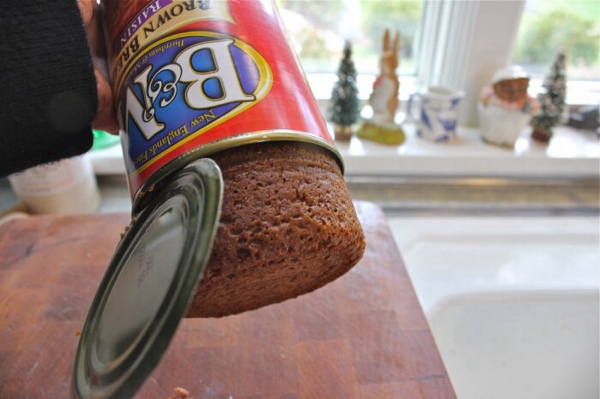
If you’ve never tried it, do. Served with ham, baked beans, and cole slaw, you got your traditional Saturday Night Suppah.
8 1/2 ounces Buttermilk
6 ounces dark Molasses, (by weight)
2 1/2 Ounces Whole Wheat Flour
2 1/2 Ounces Rye Flour
2 1/2 ounces Yellow Corn Meal
1/2 teaspoon Baking Soda
1/2 teaspoon Baking Powder
2″ fresh Vanilla Bean, (or 1 teaspoon Vanilla extract)
1/2 teaspoon freshly ground Allspice
1/2 teaspoon Orange Zest
1/2 teaspoon Sea Salt
2 empty 26 ounce metal cans with one end of each cut off.
Move a rack to the bottom third of the oven and heat the oven to 325° F.
Choose an oven safe pot or dish deep enough so that you can fill it with water to about halfway up the sides of the cans. Boil enough water on the stove top to fill that pot or dish.
Lightly coat the insides of the cans with vegetable oil.
In a mixing bowl, combine wheat flour, rye flour, cornmeal, baking soda, baking powder, allspice, and salt.
Add the molasses, buttermilk, vanilla and zest to the dry ingredients and thoroughly combine.
Divide the batter evenly between the prepared cans. Cover the top of each can with a double thickness of aluminum foil and tie securely with kitchen string. Place the cans in your deep pan and slide that into the preheated oven.

Carefully fill the pan with boiling water to about halfway up the sides of the cans.
Bake for 70 to 75 minutes. At seventy minutes, remove the foil tops. When the edges of the bread begin to pull away from the sides of the cans, you’re there.
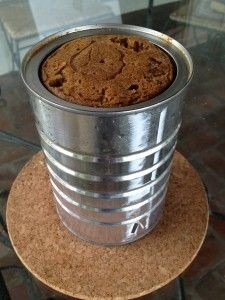
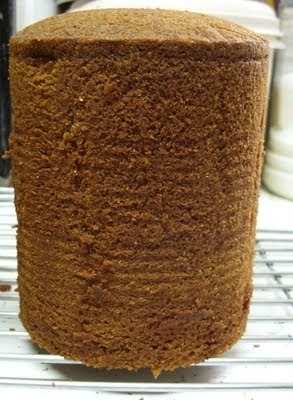
Remove the cans from the oven, place on a wire rack to cool for 1 hour before sliding the bread out of the cans. If the bread is a bit sticky, a thin bladed knife run around the can will free it up.
Don’t forget to have plenty of fresh, local butter on hand…
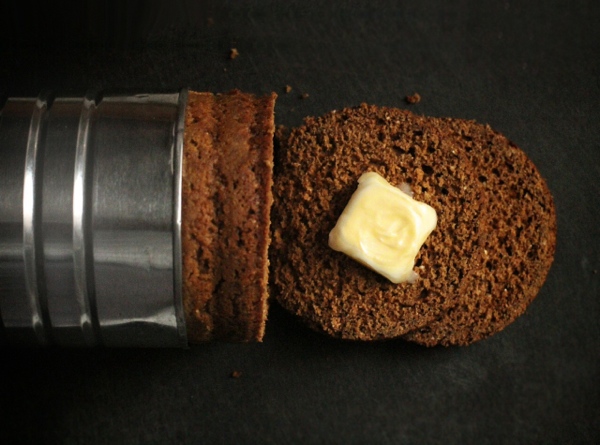
For those of you who don’t know, I’m an unabashed Yankee; I was born and raised about 18 miles north of Boston, in Concord, Mass. In that neck of the woods, a Saturday Night Suppah more often than. Or included baked beans, brown bread and freshly made cole slaw. Cabbage is much maligned, methinks, and shouldn’t be. New England is a place where it is celebrated in many dishes, and I carry that tradition to this day.
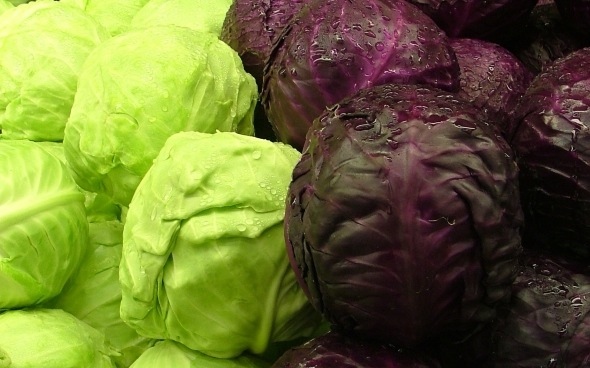
Slaw can be as simple or as complex as you like, but it general, a few truly fresh ingredients do the trick best. Cole slaw dressing from the store, with very, very few exceptions, is utter crap, filled with nasty fats, sweeteners, thickeners and preservatives you really and truly want no part of. House made is always best, period: Here’s how I do my favorite version.
For the veggie mix,
Green or Red Cabbage
Sweet Onion
1 small Carrot
Small handful Celery Leaves
1 Clove fresh Garlic
Sea Salt
Fresh ground Pepper
Rinse and slice roughly 1/8 head of cabbage very thinly (about 1/8″), across the grain. Cut into more or less bite size pieces.
Cut 2 or 3 slices of sweet onion the same way.
Rinse and use a peeler to shave the carrot into very thin strips, then cut down to bite size as above.
Chiffonade the celery leaves, and mince the garlic.
Combine all in a non-reactive mixing bowl, season liberally with salt and pepper and toss to blend.
For the dressing,
1 Cup real Mayonnaise, (Homemade is always best)
1 Tablespoon Agave Nectar
1 teaspoon Malt Vinegar
Sea Salt
Fresh ground Pepper
Combine mayo, agave and vinegar and whisk to blend. Season lightly with salt and pepper to taste.
Combine dressing nod veggie mix and blend thoroughly. Place slaw in an airtight container and refrigerate for at least 2 hours, (and up to overnight), before serving, to allow flavors to marry and develop.
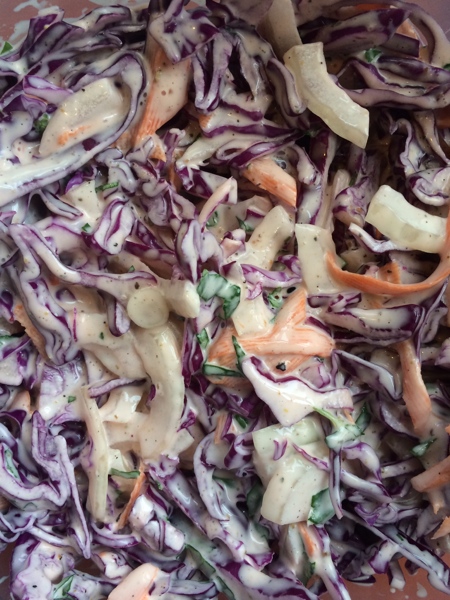
I love potato sald, not the least because you can make a big ol’ batch and it’ll just get better for the couple of days it survives. I often get asked for my recipes, so here they are, mayo based and vinaigrette. Both of these are best made at least 8 hours before service, or over it, so the flavors can do their business.
Citrus Vinaigrette Potato Salad
10-12 medium Potatoes, (I like to mix white, yellow, red & blue for special occasions).
2 Slices thick cut, smoked Bacon
2-3 Green Onions
1/2 Red Bell Pepper, (Orange or yellow are fine too)
3-4 stalks Cilantro
5-6 stalks Garlic Chive, (Use one clove garlic and a small wedge of shallot as an alt.)
1/2 teaspoon Dill Weed
1/4 teaspoon Celery Seed
1 fresh Lime
1 fresh Lemon
1 Tablespoon Apple Cider Vinegar
Extra Virgin Olive Oil
Sea Salt
Fresh ground Pepper
Rinse and boil potatoes until fork tender, but not mushy.
Fry bacon until nice and crisp; set in paper towels to soak up excess grease.
Plunge spuds into ice water and shock for about a minute. Transfer to a colander and allow to thoroughly drip dry while you continue prep.
Rinse, remove ends, tops, seeds, etc and dice green onions and red pepper. Chiffonade cilantro and garlic chives.
Cut potatoes into roughly 1/2″ chunks. Dice bacon.
Combine potatoes, bacon, onions, red pepper, garlic chive, and cilantro in a large mixing bowl and combine well. Season with salt and pepper as you see fit.
Juice lemon and lime into a small mixing bowl. Add vinegar, then add enough oil to achieve a 3:1 oil to citrus/vinegar ratio. Add dill weed and celery seed and whisk to incorporate.
Pour dressing over salad and mix thoroughly. Cover and refrigerate for at least 4 hours and up to overnight.
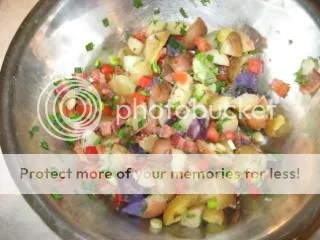
While the oil based salad is light and herby, when I make may based salad, I’m looking for unctuous, creamy goodness.
Mayo Based Spud Salad
10-12 medium potatoes
1/2 Sweet Onion
3 Hard Boiled Eggs
15-20 medium Black Olives
2-3 Dill Pickles
1-2 cloves Garlic
1 Tablespoon Capers
1 to 1 1/2 Cups Real Mayo
1 Tablespoon Dijon Mustard
1 teaspoon Creamed Horseradish
Sea Salt
Fresh ground Black Pepper
Rinse and boil potatoes until fork tender, but not mushy.
Boil eggs until hard boiled, about 10 minutes.
Plunge spuds and eggs into ice water and shock for about a minute.
Transfer to a colander and allow to thoroughly drip dry while you continue prep.
Rinse, skin and fine dice onion, olives, and pickles.
Mince garlic and capers.
Cut potatoes and eggs into roughly 1/2″ chunks.
Combine potatoes, eggs, opinion, olives, capers, pickles and garlic in a large mixing bowl; season with salt and pepper.
In a small mixing bowl, combine mayo, mustard, and horseradish thoroughly.
Spoon dressing onto salad and gently incorporate thoroughly. Cover and refrigerate for at least 4 hours and up to overnight.

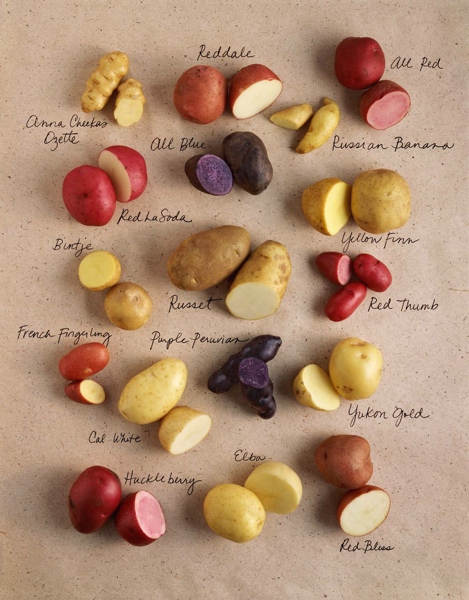
I love potatoes, and you should too. This fancy sounding dish is actually simple as simple can be, the sign of a truly wonderful, timeless dish. Great with breakfast, brunch or dinner, the minimalist approach lets the flavor of the spuds shine. Yukon Golds are perfect for Anna; they crisp up beautifully and have that to die for creamy center we all love.
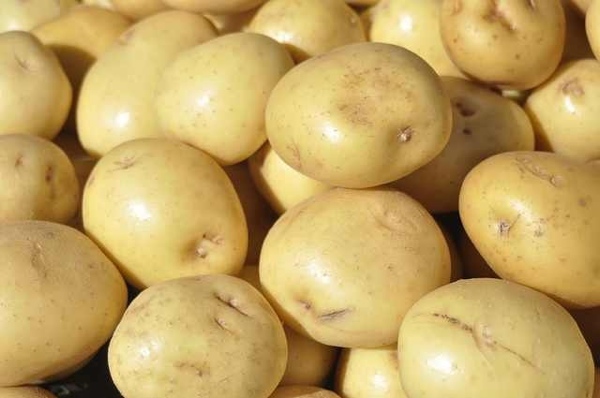
In our take on this recipe, we use Sel de mer for a truly French salt flavor note, and grains of paradise for pepper influence at its most elegant level. The cast iron adds a certain je ne sais quoi to the flavor as well.
Trust us, do it just like this, and then you can try your own variants. Don’t add anything else to Anna, just vary the kinds of salt and pepper used; you’ll be pleasantly surprised at the notable differences in each.
Build this recipe in the exact order I’ve shown here; you really need to minimize the time the potatoes go from sliced, to ice water, to oven in order to allow them to maintain their flavors without oxidizing.
6-8 Yukon Gold Potatoes
4 Ounces fresh, unsalted Butter
1 teaspoon Sel de Mer
Fresh ground Grains of Paradise
Rinse and peel the potatoes. Using a food processor fitted with the slicing blade or a mandoline, slice them very thin, (About 1/8″is perfect), transferring them as they are sliced to a large bowl of ice cold water.
Melt butter in a small sauce pan and remove from heat.
Preheat oven to 425° F.
Drain the slices and pat them dry between paper towels.
Generously brush the bottom and side of a 9″ or 10″ cast iron skillet with half a tablespoon of the butter, using a basting brush.
Arrange the slices in layers, overlapping each slice slightly; brush each layer with butter, a sprinkle of sea salt and a few twists of grains of paradise.
Cover the layered potato slices with parchment and gently but firmly press down on the assembled potato cake.
Bake on the middle rack for 30 minutes.
Remove the parchment and continue baking for another 25 to 30 minutes, until the slices are tender and golden brown.
Remove from oven and turn the Anna onto a cutting board and cut it into 4 to 8 wedges.

Serve with crème fraîche and freshly made scrambled eggs for a real treat.

If you’ve never experienced a genuine French Fry, or their cousin, le frite Belge, then you’re missing out on one of life’s great pleasures. This is the pinnacle of frydom. What makes them so special? They’re cooked twice. That’s it; nothing fancy, but that’s the secret, the trick that makes all the difference. An initial blanching cooks them through, creating that creamy inside fry lovers love. The subsequent fry brings the other half of the golden equation into play, super crisp outsides. While it may sound fussy and time consuming, it’s really not. You can do the prep well ahead of meal time and wait until right before service to cook them if you like.
Besides, if you’re going to go to the trouble of making fries at home, you need to do it right. As one of my favorite Chefs, Anthony Bourdain so eloquently puts it, “There’s no half-assed way to make a French fry.”
Ideally, to do this right you’ll want a deep fryer. If you don’t have one, no biggy; you’ll just need a heavy soup or stock pot, a mesh basket or slotted spoon made of steel, and a decent candy or frying thermometer.
Now, there’s obvious consideration for the type of spuds used. Big old Russets are best, but you can sure do this with Yukon Golds if you like the flavor better; waxy spuds like reds just aren’t that great for fries. Take note that the age of your spuds matters as well. You want older rather than younger spuds, because the older ones have fully developed starch content and better moisture balance for deep frying.
Next question; does size matter in a fry? The answer is yes, it does. You can vary from steak fry to fast food skinny as you see fit, and anything in between falls into acceptable range. Where you want to be kind of depends on the ratio you like in your fries. If you’re a crispy fan, skinny is better; if you relish the creamy insides more, make ’em bigger. The real key is to make your fries pretty darn uniform, so that they’ll fry evenly. You don’t have to get silly about this, just pay attention some when you’re cutting. If you like things really uniform, keep your eyes out at garage sales and second hand stores for one of those nice, heavy fry cutters. They’re out there, and if they’re mechanically sound, they’re a joy to use.
Next, what oil? Peanut gets the nod quite a bit and makes a tasty fry indeed, but it’s not the healthiest option out there. For my mind, if you make fries infrequently, you can splurge, have peanut oil, (or lard, or duck fat, both of which make amazing fries), and feel no guilt. If it worries you, choose a lighter vegetable oil.
And finally before we get to the recipe, a serious note on safety. Grease fires are no joke; they happen, they’re incredibly dangerous and you don’t need to go there. Keep a constant eye on the temp while frying and never go out of the safe temp zone, (There’s no need to ever fry anything over 400° F, frankly. Keep a tight fitting lid for the pot or pan your using close at hand, and if you don’t already, (which you bloody well aughta), have a fire extinguisher in your kitchen. NEVER EVER THROW WATER ON A GREASE FIRE, EVER, PERIOD! If you get a fire, cover the pot, turn off the heat, step away from the stove, grab a phone and get ready to call 911 if things don’t calm down right away.
Alright, let’s boogie.
Go with a spud per person when planning your shopping.
4 Potatoes, Russet or Yukon Gold
Sea Salt
3 to 4 cups Oil for frying
You can leave skins on if you like, but generally, you’ll get better, more evenly cooked results without them, and the nutritional benefits derived from the skins are pretty much moot when fried, so go ahead and peel your spuds.
Cut your spuds into roughly 1/2″ square by 3″ fries; again, go skinnier if you like crispy, bigger if you like creamier.

Fill a large bowl with ice water. Toss the spuds into the bowl as soon as they’re cut; this will keep them from oxidizing and turning nasty colors, as well as helping remove excess starch. Leave your spuds in the ice water for at least 30 minutes, or in fridge cold water for as long as overnight.
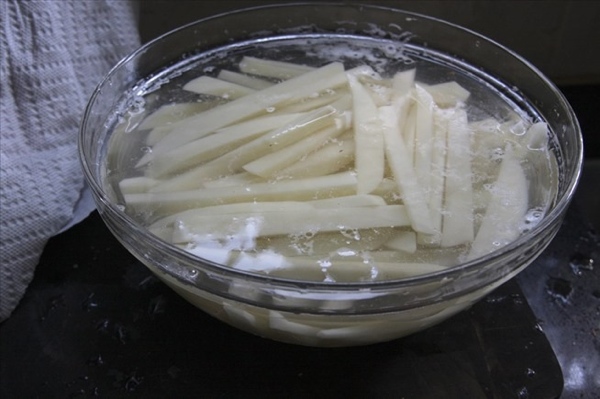
When your soak time has elapsed, rinse the spuds well in cold, running water to remove that starch.
Now it’s time for the blanching. If you’re not familiar with the term, it means to plunge food into, (most often), water, and in this case, oil, for a brief time, in order to do anything from softening it, to partially or fully cooking it. Sometimes blanching is done to tame strong flavor notes, as with game or onions. Nuts and fruit can be blanched to make the skins softer and easier to remove, (hazelnuts, almonds, peaches and plums, for example). Blanching is often used in restaurants to pre-cook veggies, thereby making them faster to prepare at service, and to help keep their colors nice and bright. It’s a great technique to learn and use at home. When used for these other purposes, the food is just plunged into boiling water for 30 seconds to a minute, then immediately plunged into an ice bath, (50% each ice and water), to quickly stop the cooking process.
Use enough oil in your deep fryer or pot to reach roughly halfway up the sides of the pan; never fill higher than about two-thirds, for safety’s sake.
Preheat your oil to 280˚F.
Once the oil is up to temp, cook the potatoes in one potato batches until they are soft and their color has turned to semi-translucent white. Don’t get antsy and yank ’em before you see the color change occur; this is gonna take about 7 minutes, give or take. The smaller batches make things more manageable and keep your oil from cooling too much, which leads to soggy frites. Use a slotted spoon or skimmer to carefully pull the fries out of the oil and then set them out in a single layer on a baking sheet.
Let the fries rest for 15 to 30 minutes.
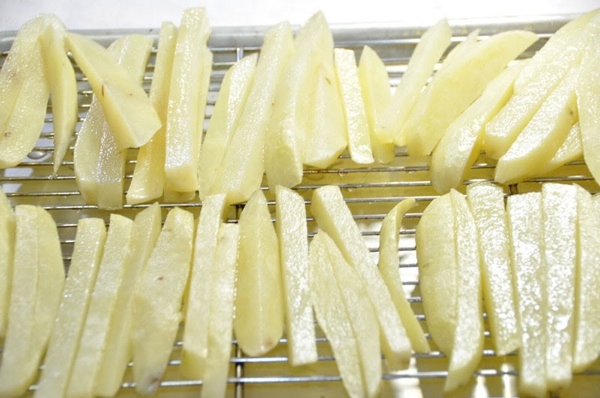
Raise the oil temp to 375˚F. That is right where you want it, and you want it to stay right there through cooking; this is critical for perfect Frittes. Fry the blanched potatoes in one potato batches for about 3 minutes, until they are crisp and golden brown.
Pull the fries out and shake off any excess oil.
Immediately drop your fries into a large steel or glass mixing bowl, lined with a clean, dry kitchen towel or paper towels.
Season with sea salt to taste.
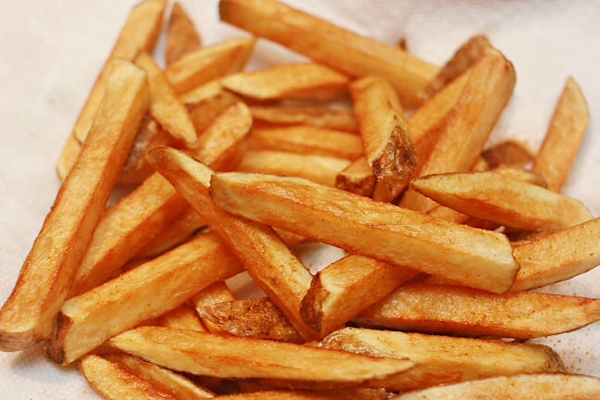
Pull the towels and give the fries a good toss around the bowl to evenly disperse the salt.
Serve while they are nice and hot, never make ’em wait, never rest them; doing so leads to soft, soggy fries.


 UrbanMonique