Ladies and Gentlemen; dinner is now being served in the Library


Were you aware of the startling fact that annual cookbook sales in the U.S. is measured in billions of dollars? That’s billions with a B, gang…

As I type, kicked back in the ol’ recliner, there’s a pile of books on the side table; two on Mexican regional cooking by Diana Kennedy, Michael Ruhlman’s Ratios and Charcuterie, (With Brian Polcyn), Frederic Sonnenschmidt’s Art of Garde Manger, and Harold McGee’s On Food and Cooking. The Kennedy books are just acquired, having read of Frances Mayes’ appreciation for her work; the others are almost constant references that I use pretty much every time I write on this blog.

M and I own what we think are a lot of books; I’m looking over at four shelves, each three feet wide, two six feet high and two at four feet, pretty much full and there’re more in our bedroom, respective caves, guitar shop and night stands.. Of those, we have roughly four linear feet of cookbooks. A lot of the stuff we actually read, we buy used in paperback, read, share and then donate to the YWCA Resale Store. Cookbooks, on the other hand, are predominantly hard backs with shiny dust covers; some are even signed by the authors.

Here’s the rub; in our collection, we’re talking around 30 to 40 titles. If you’re a twenty first Century foodie, there a good few authors you’d recognize; Rick Bayless, Lynne Rosetto Kasper, Mark Miller, Grady Spears, Mike Simon, Maggie Glezer and Mario Batalli, to name a few. Despite all those bright lights, the books that get used consistently and frequently would be limited to Irma Rombauer’s Joy of Cooking and James Beard’s American Cookery. Those that I have actually read, cover to cover, would also tally exactly two; Harold McGee’s seminal volume and Claudia Roden’s The Book of Jewish Food. That’s what, .5% or thereabouts?

How does that stack up to your experience? An informal survey found most folks said things like, “Got it as a gift, never cracked it,” “Use it very rarely,” and things along that line: Truth be told, that’s probably the way things are supposed to be; cookbooks are, after all, reference volumes and not much more than that.

I’ve been cooking my whole life, for pleasure and occasionally for a living: That said, it’s time to share another secret. Putting up recipes here for y’all was actually quite a bit of work for me, because I do not typically use recipes; I cook from the heart and off the cuff, always have, always will.

To cook professionally, you must be able to put out consistent, repeatable, high quality food, and you have to be able to do that quickly and efficiently. I am a pretty good at best, but more to the point, I am quite good at the quick and efficient part. To do what I do pretty much unconsciously as a recipe, measured out and tested, is work! I’ve always been a great skier; in my teens, I became a ski instructor. I was doing great until they said “Those are really nice turns, how do you do that?” I stared back blankly at them and said something pithy like “Ummmmm, I uh, just turn…” In teaching me to teach, they first had to alert me to the fact that I was a great skier, not a skier who knew how to teach others what to do in a logical and repeatable fashion. Cooking is much the same.

That said, over the winter months, I’m gonna try and relate to you some tricks and tips and methods whereby you can cook the same way; the desired end result being that you, as I do, maybe steal concepts and themes from all those cookbooks far more often than you do simply repeat a recipe. Iron Chef Mike Simon, one of my culinary heroes, says he uses Beard’s American Cookery for ideas when he is in need of a new dish; sounds like a darn good idea to me!

Starting with the recipes IS important. Like learning anything else, repetition breeds familiarity, practice makes perfect, and routine is great so long as it is accurate and thorough. Somewhere along the experience timeline, you look up and realize that you didn’t really think about the fact that pasta dough is a consistent ratio of three parts flour to two parts egg, you just pulled out what you needed, measured, mixed, rolled, cut, boiled, served and it was fantastic; that’s the magic we’re after.

So, in a rambling way, what I’m proposing is that, if you want to cook and cook well, a few well chosen reference guides are a good thing, maybe even a necessity. What follows is just my recommendation; if you have them, pull them out, give them a go over, and we’ll go from there. If you don’t own them, go to your local bookstore, or hit up a good used seller on Amazon and pick up a copy; you can thank me later…

1. James Beard’s American Cookery

2. Irma Rombauer’s Joy of Cooking

3. Michael Ruhlman’s Ratios

That’s it. That’s more than enough, in fact. So, let’s get crackin’, ‘K?

House and Semi-House Made


Comfort food is a wonderful thing, if for nothing else, than from the breadth and depth of the cornucopia. One of my favorite things to do is to twist a traditional recipe into something similar in feel but different in content; maybe that’s what folks mean when they call something “fusion” cooking, maybe not, but it works for me! Hence comes Enchilada Lasagna…

With noodles, (Mas o menos), made from Masa, homemade queso, and homegrown veggies, this is a real treat all around.

Queso Blanco and Queso Fresco are names that are often used interchangeably, but they are not the same beast: Both are white cheeses commonly made from fresh cow’s milk, are usually salted, and appear often in Mexican and South American cuisine, but that’s where the broad similarities end. Queso Fresco is made with rennet, used to form the curds. Queso Blanco uses an acid, such as vinegar, lemon or lime juice, to form curds. Queso Fresco will melt readily and is great for making its namesake dipping and topping salsa, know ubiquitously throughout the southwest as simply Queso. Queso Blanco does not really melt, but will become softer or creamer when heated. It’s sometimes known as queso para freir, literally cheese for frying; it retains its shape very nicely when fried, and takes well to breading or coating with herbs and chiles. The variations of these cheeses are as broad as the regions they are made in; they are not dissimilar in consistency to Feta or Peneer.

Queso Blanco

One gal whole milk, (Pasteurized or raw is cool, but ultrapasteurized is NOT!)
1/2 cup of white vinegar, lemon or lime juice
Salt to taste

Pour milk into a non-reactive pan on medium heat. Stir regularly to avoid scalding on the bottom of the pan. Using a cooking thermometer, track your temp throughout; you’re looking for 180º F.

If you’re using citrus for your acidifier, juice, seed, and measure. Lemon or lime juice adds a certain note to the flavor of your cheese that is very pleasant; I’m not sure how to specify what it tastes like, you’ll just have to try all three and decide which you like best. I have used cider vinegar as well and been very pleased with the results. My current favorite is lemon juice, FYI…

Add your acidifier: Curds will begin to separate from the whey right away; they are quite small in this cheese, (Noticably smaller than the Ricotta recipe I shared a while back, so if you see that and wonder, fear not!). The curds are about small pea size at best in this recipe.
Let the mixture simmer for a couple minutes and then carefully pour it off into a cheesecloth lined colander; be sure to use several layers of cheesecloth if you have the standard wide-weave kind you’ll find in the grocery or hardware store.

You can toss the whey, or you can save that to make ricotta with, or you can dump it into your compost heap.

Now is the time to salt the curds and add any herbs, chiles, etc; in this recipe, I’ve diced up some nice sweet peppers that will flavor this batch. Gently mix everything together. Note that you can add a bit more salt than you might like when tasting at this point – You’re going to hang and drain this cheese for a couple hours, and salt will be some of what goes away.

As we did with the Ricotta, bundle up your cheese, tie it off in a nice little ball and hang it from your faucet.

Draining your cheese is something that shouldn’t be rushed; I like to go at least 2 hours, and you can go well more than that if you want – The more you drain, the firmer your cheese!

Recipe yields about 16 ounces of lovely Queso. It will keep, well sealed, in the fridge for roughly as long as the expiration date on the milk you used, but really, it shouldn’t last that long, OK? Here’s what ours looks like with that fantastic sweet, red pepper in it. ¿Muy bonita, si?

Corn Tortillas, (in this case, AKA noodles)

2 cups corn Masa Harina, white or yellow
1 ¼ cups hot water
1 teaspoon salt

A starting note; make sure you get Masa, AKA corn flour, NOT corn meal – The latter will not do the trick!

Mix masa and salt in a bowl. Add the hot water and stir until you can handle the mix without it sticking too much to your paws; at first, the mix will seem a bit dry and that’s OK. Add more hot water a teaspoon at a time until you form a nice, semi-elastic dough that stays together and doesn’t stick to the bowl. Knead the dough for a couple minutes, adding tiny amounts of water or masa as needed to keep the dough workable and not too wet or dry; you want it to feel moist and workable, but not wet or sticky; it almost feels like a nice, loamy soil when it’s right, (If that makes sense…)

Pinch off a piece of dough and roll it between your hands into a golf ball sized chunk. Let these sit, separated and covered with a moist paper towel, on a plate for a few minutes. If you have a tortilla press, (Or your rolling pin, if not and that’s just fine too!), now’s the time to get it out, along with a gallon freezer bag cut into two equal pieces that you’ll use to hold your dough while you roll or press it out.

FYI, this ain’t like pie dough, so it is not gonna get tougher if you handle it:
Grab a golf ball and flatten it between your palms until it’s about a 3” circle. Place that between your plastic sheets and roll or press until you get a nice 6” to 7” tortilla; they can be a bit thicker than the store bought ones – Believe me, they’ll be WAY better tasting!

If we were making straight tortillas, we’d be heating up a dry cast iron pan or comal over medium high heat; cook the tortillas for about 45 second to a minute a side, then place them in aluminum foil in a warm place to rest for a bit until you’re ready to use them.

In this instance, I’m using the dough to make analog lasagna noodles, so I pressed out the dough until it’s just thick enough for my pasta roller to receive and worked it through once on the widest setting, then let the results sit and ry for a few minutes, (No additional cooking needed for this variation.)

Tomato Sauce

We’re gonna make a basic Mexican influenced sauce for this dish, from fresh tomatoes. We’re going quick and dirty here, ‘cause this is dinner on a working day, no guests, no time, no energy, so… Gonna forgo blanching, etc in the name of speed!

6 ripe tomatoes of your choice
1 clove garlic
5 or 6 sprigs of cilantro
Couple slices of large onion
1 medium hot chile of your choice
½ teaspoon cumin seed
¼ teaspoon annatto seed
¼ teaspoon celery seed
½ teaspoon Mexican Oregano
¼ teaspoon chipotle flake
Shot of vegetable oil
Dash salt

Cut tomatoes in half, rough chop garlic, cilantro, onion and chile; throw all that plus the oil into a blender or processor.

Combine cumin, annatto, celery seed, oregano, chipotle and salt in a spice grinder or mortar and pestle and grind to a fine, even powder.

Add spice mix to veggies and blend/process until everything is nice and uniform. Open top of blender. Stick your nose in there. Breathe deep and marvel at your skillful handiwork. Go find other folk in the house, make them smell it and tell you how amazing you are…

Variation: You could substitute tomatillos for tomatoes in any percentage you like; doing the whole thing yields a gorgeous green sauce!

Now we’re ready to assemble the main dish. Lightly oil a glass baking dish, then begin by ladling some sauce in; smooth that out, add an even layer of protein, (Again, I used some killer fajita beef and chicken made by my pal Kevin, which I cubed. You could also use pork, or homemade Chorizo, for which there is a recipe lurking somewhere on this blog!). Add a sprinkling of cheese, then a layer of tortilla/noodle and repeat; I like to end with tortilla, as I think that lets the flavors get locked in and blend better as everything bakes. I topped this with some nice, sharp shredded Asiago, to further confuse the nationality of the dish and add a nice little counterpoint to the mild queso.

Bake at 350 for 35 to 45 minutes, until top tortilla is browned and everything is nice and bubbly. Allow to cool for 10 minutes on stove top prior to plating.

For topping, you simply gotta have some pico and guac, don’t ya think?

Citrus Pico

2 or 3 ripe, medium tomatoes
¼ to ½ medium sweet onion
5 – 8 sprigs cilantro
1 medium to hot chile of your choice
1 small lime
Shot of grapefruit juice
Salt and Pepper to taste

Dice tomatoes and onion, chiffenade cilantro and fine dice the chile. Add all to a nonreactive bowl. Juice lime over veggies, keeping seeds out of course. Add shot of grapefruit juice, and salt and pepper to taste. Toss to coat and blend, allow to rest chilled for 30 minutes.

Guacamole Authentico

2 or 3 ripe, medium avocados
1 firm medium tomato
1 or 2 ¼ slices from a medium, sweet onion
½ small Shallot
5 or 6 sprigs fresh Cilantro
1 small sweet chile
1 small lime
salt to taste.

Skin avocados and remove flesh with spoon into a molcajete or nonreactive mixing bowl. Core, seed, and dice tomato to ¼”. Fine mince cilantro and shallot. Stem, seed, core and fine mince chile. Quarter the lime.

Mash avocado gently with a fork, leaving it with substantial chunks roughly ½”in size. Add tomato, onion, garlic, cilantro, and chile. Squeeze juice from ½ of lime, salt lighly and taste; add more lime as needed. Cover and refrigerate for 30 minutes to allow flavors to blend.

To plate, shred a 50% – 50% mix of iceberg lettuce and red cabbage. Place shreds in a bowl and lightly salt and pepper. Place a mound of the shreds on a plate, serve a generous slice of the casserole on top, then add small spoonfuls of pico, guac, and sour cream. Serve with a nice, cold lager or pilsner.

Desert, anyone?

M loves sweets, especially good ones: I’m pretty sure I’ve shown the crème caramel variation of this incredible desert, but this time we’ll go for a very cool variation of that, which I dub Crème Añejo. Contrary to popular opinion, it’s fast and easy. Crème brûlée/Crème Añejo is a baked custard, as opposed to a stirred custard, (Done on a stove top in a double boiler); both are easy, but for my mind, letting the oven do the work while I read beats the crud out of constant stirring, so… Seriously, making these guys takes maybe 10 minutes, tops, so what are y’all waiting for?

Crème Añejo

1 quart heavy cream
1 vanilla bean, split and scraped, (You can sub ½ teaspoon of extract too)
1 cup vanilla sugar, (Split and scrape a vanilla bean into 1 cup sugar, let sit for 1 hr+, then remove bean)
6 large egg yolks
Double shot of Añejo Tequila, (Could use Rum, Bourbon, Scotch, or…)

Preheat your oven to 325º F.

Arrange 6 ramekins in a glass baking dish at least 3” deep.

Put cream, vanilla bean and seeds into a nonreactive pan over medium heat. Bring mixture to a rolling boil and then immediately pull it off the heat. Let the mixture cool, covered, for 15 minutes. Remove the vanilla bean, which you can dry out and then use to make yet more vanilla sugar.

In a mixing bowl, combine ½ cup of the vanilla sugar and the egg yolks; whisk them together well. Now take the cream mixture and slowly pour that into the egg/sugar, whisking constantly.

For the Añejo caramel, pour the tequila into a sauce pan on medium high heat; Allow the booze to heat until the alcohol is boiled off; remove it from the heat.

Place the rest of the vanilla sugar into a pan on medium heat and allow it to melt thoroughly. Once it is liquefied, begin to add the tequila VERY SLOWLY – Liquid into caramelized sugar is volatile – The sugar superheats the liquid and will vaporize it explosively if you’re not REALLY careful about this process – Add the liquid a tiny bit at a time, stirring constantly and allowing the mixture to come to equilibrium before you add more. Once the booze and sugar are combined happily, add a tablespoon of butter and whisk everything together; immediately pour equal portions of the Añejo caramel into each ramekin.

Pour the custard into the ramekins to within roughly ¾” of the tops. Place the dish into your oven on a rack set in the middle position. Pour hot water into the dish until the water level is roughly ½ way up the sides of the ramekins.

Bake for 40 to 45 minutes. Check for done by jiggling each ramekin. If the custard is done, the edges will look firm but the middles will still jiggle a bit; this is just where ya wanna be, as the latent heat in the custard will complete the cooking while they rest.

Refrigerate the custards for at least 2 hours, then pull ‘em out and let ‘’em sit in room temp for at least 15 minutes: Run a knife around the rim of the ramekin, and then quickly flip ’em over onto a desert plate and viola, instant bliss!

Serve with a sprig of mint as a garnish; stand back and keep your hands and feet clear as your guests dig into this stuff!

More cheese, please!


This just in:
“Hey, Eben; loved the eggplant thing, but really would like a more in depth treatment of the homemade cheese, specifically, pictures like you did with the pasta thing. Can you do that, please?”

I can! Here’s a reprint of the ricotta recipe with pics.

Homemade Ricotta:

½ gallon whole milk
½ gallon buttermilk

Pour all your milk into a non reactive pan over medium high heat; use the best pan you got, preferably one with a nice thick bottom to store heat well.


Milks starting their heat run on medium high; notice the nice, thick base on the stainless pan.

Stir the milk just about non-stop, taking care to check the bottom of the pan often, making sure that things aren’t burning.


Checking the temp often; on this run, separation began at about 110 degrees F.

As the milk gets hot, you’re gonna see curds starting to rise to the surface. As you see this happening, use a flat whisk or spatula to scrape the bottom and free up more curds, (Yes, they will get their whey… Sorry, couldn’t resist…)


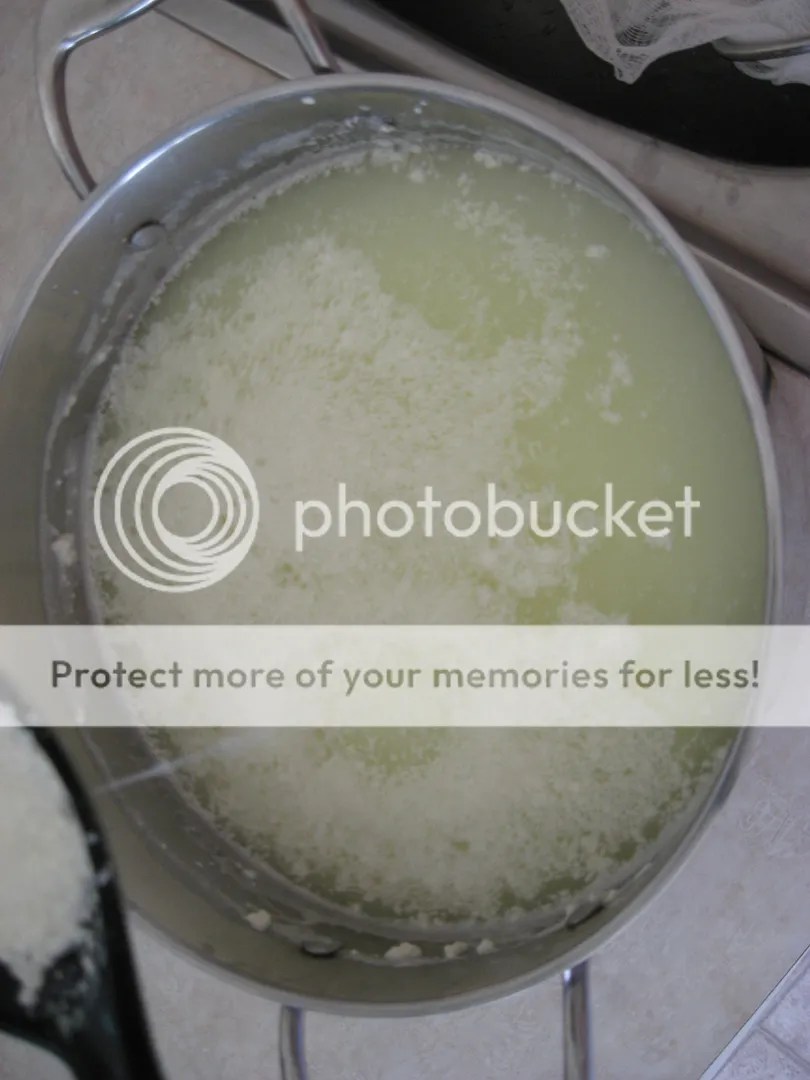
Curds and whey starting to visibly separate

Snag a large colander or chinoise, the wider the better. Line the colander with cheese cloth; if you use real cheese cloth, you need a good 6+ layers to avoid stuff running through too much. On a tip from Michael Ruhlman in his book, Ratios, I bought some cheap, plain white handkerchiefs and use them for straining and after a good washing; they do a much better job, are reusable and are generally more satisfying to work with.


Stainless colander lined with 6 layers of cheesecloth.

When your milk mixture gets to roughly 175º F, you’ll see the curds and whey begin to separate; (The curds are the white globs and the whey is the watery leftovers, FYI).


At 165 degrees F, very distinct separation!

Pull your pan off the heat and with a ladle, carefully transfer your curds to the lined colander; do NOT press on the curds; let the moisture leave of its own accord!


Spooning off the fresh curds


Really nothing left at this point but whey

Gently grab the corners of your cloth, draw them together and tie ‘em with kitchen twine, (You DO have kitchen twine, right?) Let the cheese drain and cool for about 20 minutes.


There ya go, (Makes you want to say Braaaaaiiiiiiins, doesn’t it?)


My favorite draining trick; string tied to faucet over collander

Makes about 2 cups of finished cheese. Place it in an airtight, glass container to store; it’s good for a few days refrigerated, but it really shouldn’t even last that long, should it?


Cheese, please! This batch went onto a homemade pizza with sausage, tomato, sweet peppers and lime basil.

An Egg by Any Other Name


This just in from Jenn Digby;
“Any ideas on what to do with eggplant (other than deep fry and serve under melted cheese)? it seemed a lot less intimidating when I was a vegetarian, but now they cheer and bump fists when I close the fridge door in defeat.”

Oh let’s whip those saucy little buggers into shape, shall we, girlfriend! The eggplant is much maligned because, like tofu, it, in and of itself, is not a stellar performer, but use it for the qualities in which it shines and you’ll be a happy camper, (And the little buggers will sit in stony silence when you shut the fridge door…). Eggplant, (Aubergine in French), is another member of the same family as tomatoes, sweet peppers and spuds; they are a great source of dietary fiber and have a bunch of nutrients, so let’s give them the shot they deserve, huh?

So, you ask, what IS that stuff good for? Well, again, just like tofu, it can take on a variety of textures and sucks up and holds good flavors like nobody’s business; eggplant needs just a little work to truly shine, so watch them prep steps, eh?

Jenn noted she wants something other than deep fried under melted cheese, and the first thing that comes to mind is a variation on Eggplant Parmigiano made with a lighter hand; it’s a wonderful dish, basically a veggie lasagna, if you will!

Eggplant Veggiano with Homemade Ricotta Cheese

2-3 good sized eggplants
5 – 6 fresh tomatoes of your choice, (Canned/preserved is fine too!)
1-2 carrots, shaved with a peeler
1-2 small shallots, minced
1-2 sticks celery, minced
½ cup fresh basil, chiffenade
Dash of balsamic vinegar
1 clove garlic, fine diced
Olive oil
Thyme
Rosemary
Salt, Pepper to taste

Blanch your tomatoes, cool and remove the skins. Puree/blend/motor boat until a nice smooth consistency. In a couple tablespoons of olive oil, sweat your shallots, celery and garlic on low heat. Raise heat to medium low and add tomato puree, dash of balsamic vinegar, then add basil, thyme, rosemary, salt and pepper to taste, allow to simmer for about 20 minutes or so. Pour your sauce into a bowl to cool and leave the pan just as it is, ‘cause you’re gonna use it again in a sec or two…

Choose eggplants that are nice and shiny purple and firm; avoid really big ones or anything where the skins are white; remember the adage; baby tender, old guy tough! They may look gnarly, but they’re actually a pretty sensitive veg; store them whole, unwashed, at about 45 to 55 degrees, ideally, and no longer than any other fresh veggie.

OK, so to prep the eggplants, check ‘em for dirt and critters; wash gently, cut off the ends and then you’re ready to go. Use a stainless steel bladed knife when cutting the eggplants; they have some nutrients in ‘em that will turn them a nasty black color if you introduce them to carbon steel!

For this recipe, we want the eggplant to emulate pasta; cut them into roughly ¼” slices. If you have a mandolin, (The kind for hand slicing, not the kind Sam Bush plays), you can slice quite thin and that’s just fine. Lightly salt the slices and stick ‘em in a colander, or on a tight weave wire rack, with a cookie sheet underneath as a drip pan; let ‘em sit for about 30 minutes: This is kind a room temperature sweat, if you will, just designed to pull some moisture out of the eggplant and tenderize them a bit. While that’s working, it’s cheese making time…

“Cheese making time,” you say, “In 30 minutes?! Yeah, gang, yeah; it’s that easy; OK, so maybe you could do this first if you’re worried about time, but… Everybody needs to try their hand at homemade cheese; that’s my story and I am stickin’ to it – The quality is like nothing you’ve ever bought, short of very good artisanal offerings. It is super simple, incredibly satisfying, and your guests will gaze on you with wonder and admiration as they chow down… Ricotta is a great first effort; it’s so simple it’s silly. The buttermilk does all the work for you, so let’s get after it!

Homemade Ricotta:

½ gallon whole milk
½ gallon buttermilk

Pour all your milk into a non reactive pan over medium high heat; use the best pan you got, preferably one with a nice thick bottom to store heat well.

Stir the milk just about non-stop, taking care to check the bottom of the pan often, making sure that things aren’t burning.

As the milk gets hot, you’re gonna see curds starting to rise to the surface. As you see this happening, use a flat whisk or spatula to scrape the bottom and free up more curds, (Yes, they will get their whey… Sorry, couldn’t resist…)

Snag a large colander or chinoise, the wider the better. Line the colander with cheese cloth; if you use real cheese cloth, you need a good 6+ layers to avoid stuff running through too much.

On a tip from Michael Ruhlman in his book, Ratios, I bought some cheap, plain white handkerchiefs and use them for straining and after a good washing; they do a much better job, are reusable and are generally more satisfying to work with.

When your milk mixture gets to roughly 175º F, you’ll see the curds and whey begin to separate; (The curds are the white globs and the whey is the watery leftovers, FYI).

Pull your pan off the heat and with a ladle, carefully transfer your curds to the lined colander; do NOT press on the curds; let the moisture leave of its own accord! Gently grab the corners of your cloth, draw them together and tie ‘em with kitchen twine, (You DO have kitchen twine, right?) Let the cheese drain and cool for about 20 minutes. Makes about 2 cups of finished cheese; placed it in an airtight, glass container to store; it’s good for a few days refrigerated, but it really shouldn’t even last that long, should it?

Rinse your eggplant thoroughly under cold running water until you get all the salt off. Reheat the pan you did up your sauce in to medium high heat and add another tablespoon of olive oil. Place your eggplant and carrot slices and lightly sauté them.

Preheat your oven to 375º F. Lightly grease an appropriately sized glass baking dish with a little olive oil. Place a layer of eggplant down, followed by carrots and then layers of sauce and your fresh ricotta. End with sauce and if you’re feeling frisky, sprinkle on a little hard cheese like Parmigiano or Pecorino.

Bake for +/- 35 minutes, until sauce and cheese and browned and bubbling.

Enjoy!

Variation: If you don’t want as much olive oil in your dish, (Although I can’t imagine why not…), as an alternative to browning your eggplant and carrot slices, you can steam them; it’ll give a very nice, lighter taste note.