Blog

Mocha Hazelnut Tart with Caramel Drizzle


Mocha hazelnut tart with sea salt


We roast our own coffee at home, as recently described herein. This morning, when M was handling brewing duties, the smell of that freshly roasted and ground coffee was intoxicating. I noted hints of sweet things, like cocoa and roasted nuts, and right then and there a tart made with coffee, chocolate, and hazelnuts popped into mind.

As I started to compose the recipe, a couple of things came to mind. The first was the best way to assure that those amazing coffee attributes made it into the finished product. That’s when I figured that steeping the ground coffee in cream would work to maintain the subtler notes that you might lose, were you to just use brewed coffee. I was right; the coffee aroma and taste that resulted was absolutely heavenly.

For the chocolate, a ganache seemed to make sense; it’s been around since the 18th century, though it’s arguable whether it was the French or the Swiss who first came up with the idea. Ganache is an incredibly versatile thing, made by heating cream, pouring it over chopped chocolate, and allowing it some time to steep and warm through. The blend is gently whisked until smooth; extracts, liqueur, or spices can be added as well. The addition of butter imparts a shine and silky smooth texture to the finished ganache. The ratio of chocolate to cream is infinitely variable, imparting a wide range of finished densities. Here, I used what generally comes out to about 2:1 chocolate to cream by weight, which yields a proper density to fill a tart, make truffles, or use as a layer in a cake. A 1:1 ratio yields a much lighter product suitable for glazing. Cool a ganache and whisk it fairly briskly, and you add enough air to lighten it notably, resulting in an excellent frosting. Work slowly and steadily when incorporating the chocolate and cream, and you’ll find this to be a fairly anxiety free method. You’ll note that I don’t call for refrigerating this tart; you can certainly do so, but know that a chilled ganache becomes rather hard. You won’t lose too much flavor, but it will be quite the brick in consistency.

I also wanted this to be a treat that celebrated the more savory aspects of chocolate and coffee, as opposed to being cloyingly sweet; the entire tart recipe has slightly over a half cup of sugar in it. The rest of the sweet notes come through the coffee and dark chocolate, and the overall impression is a very well tempered treat. The caramel sauce contributes a highly controllable degree of sweetness; you can use none, a little, or a lot as your tastes desire.

The tart crust is the only baking you need to do, so it’s really pretty simple to make. I’d go so far as to say that if you’ve never explored making ganache before this will be a fun intro for you. I made this with fresh, local cream and butter; I’d recommend you do the same.

This is truly amazing stuff, incredibly smooth, complex, and powerful. It’s also wickedly decadent, not the kind of thing you just have laying around the shanty all the time. Or maybe you do. Slice it thin and savor every bite.


Mocha Hazelnut Tart with Caramel Drizzle


For the Crust –

1 Cup All Purpose Flour

1/2 Cup Powdered Sugar

4 Tablespoons Unsalted Butter

1 Large Egg

1/4 Cup Dark Cocoa Powder


Have all ingredients at or close to room temperature.

In a mixing bowl, add sugar and butter; whisk until well combined and creamy.

Add the egg, and whisk until thoroughly blended.

Add dry ingredients and fully incorporate.

Form dough into a ball, then flatten to a roughly 5″ disk.

Wrap in plastic and refrigerate for at least 1 hour.


Preheat oven to 350° F.

Sandwich the dough disk between layers of parchment or waxed paper, and roll it out to about 1/8″ thick, sized for a tart pan with a 3/4″ to 1″ lip.

Transfer crust to tart pan and press gently to fit. Trim any excess dough flush with the edge of the pan.

With a fork, evenly pierce the dough all the way through to the bottom of the pan, across the entire bottom of the tart.

Bake until tart looks somewhat dry and pulls away slightly from the edge of the pan, about 15 minutes.

Remove and allow to cool completely.


For the Ganache –

1 1/2 Cups Heavy Cream

10 Ounces Dark Chocolate, (64% to 72% Cacao is best)

4 Tablespoons unsalted Butter

1/2 Cup freshly ground Coffee Beans

1/2 Cup Hazelnuts

2 Tablespoons Bakers Sugar

Sea Salt


If you have a burr bean grinder, grind coffee beans on the coarsest setting. If you use a whirly blade grinder, pulse the beans to a rough grind and that’ll work. If, gods forbid, you have neither, carefully rough chop beans with a santoku or chefs knife.


Preheat oven to 350° F.

If you’ve bought shelled and skinned hazelnuts, place them on a dry baking sheet and roast them until lightly browned, about 12-15 minutes.

Remove from oven and set aside to cool. Once cooled enough to handle, carefully rough chop them and set aside.


If you have hazelnuts with the skins still on, (Which, by the way, are far cheaper than the former option), here’s the best way to completely remove those.

For every cup of hazelnuts, bring 2 cups of water to a boil in a medium sauce pan.

Add 3 tablespoons of baking soda and stir; note that the mixture will foam quite a bit.

Add hazelnuts and boil for about 3 minutes; don’t be concerned when the water turns quite black, it’s par for the course with this method.

Fill a mixing bowl 3/4 full of ice water.

Use a slotted spoon to remove a test nut and plunge it into the ice water. Gently rub the nut to see if the skin comes off easily; if not, let the nuts boil for another couple of minutes, then try again. Once you’re getting an easy peel, transfer all nuts to the ice water and peel away.

Wrap nuts in paper towels and dry thoroughly.

Roast and rough chop nuts as per above.


Have butter at room temperature.

In a sauce pan over medium heat, bring cream to a simmer.

Add ground coffee beans, stir well to incorporate, then remove from heat.

Cover the pan tightly and allow the cream and coffee blend to steep for 30 minutes.

Run cream blend through a double mesh strainer, then return the steeped cream to the sauce pan and discard the ground coffee, (layered cheese cloth will work if you don’t have a strainer).

Place sauce pan back over medium heat.

In a measuring cup, add 2 teaspoons of hot water to the sugar, stir well to dissolve, then add to the coffee cream, and bring the mixture to a simmer.

Rough chop chocolate, then add to a mixing bowl.

Carefully pour hot cream mixture over the chocolate, then allow to steep for 5 minutes.

With a whisk, gently combine cream and chocolate, (going too fast and hard will cause the chocolate to seize – take your time and feel out the proper pace).

When the mixture is about halfway incorporated, start adding the butter a tablespoon at a time; allow each batch of butter to fully incorporate before adding more. Continue whisking until ganache is smooth and glossy.

Pour ganache into tart crust; smooth the top with spatula or pastry knife.

Top with chopped hazelnuts and dust very lightly with sea salt.

Let sit at room temperature for at least 2 hours before serving.


For the Caramel Drizzle –

1 Cup Bakers Sugar

6 Tablespoons unsalted Butter

1/2 Cup heavy Cream

1/2 teaspoon Vanilla Extract

1/2 teaspoon Sea Salt


In a sauce pan over medium-low heat, combine sugar with 1/4 cup water. Stir steadily until sugar dissolves.

Increase heat to medium and boil without stirring, occasionally swirling the pan to aid even cooking. Continue until syrup is a deep golden amber, about 7–8 minutes.

Reduce heat to low; add the butter a tablespoon at a time and whisk to incorporate – Note that mixture will bubble vigorously, so be careful.

Slowly stir in cream, whisking steadily.

Add vanilla and salt.

Whisk until the caramel is smooth and creamy.

Remove from heat and let cool for 10 minutes.

Pour into a glass jar or small bowl.

Sauce will store for a week, refrigerated in an airtight glass container. Warm slightly before drizzling if stored.

Cut a nice slice of tart, drizzle a few lines of caramel over the top, and enjoy. You can make this a day ahead; the flavors will be fully developed, maybe even better than day one. One of my staff at the cafe commented after her first bite, “I’ve just seen God.” Now that’s a testament…


Perfect Popovers


It’s currently 48° F, with the wind south by southwest off the sea, blowing steadily at 20 knots with gusts strong enough to shake the cabin. In other words, it’s a great time for soup or stew. As an accompaniment to that, you’d be hard pressed to beat a nice, hot popover.

There are plausible claims that popovers are a U.S. dish. The oldest recipe reference to popovers I’m aware of is American, within M. N. Henderson’s Practical Cooking, which dates to the Centennial year of 1876.

It’s thought that the popover is naught but younger kin to Yorkshire Pudding, which certainly makes sense. Perhaps it’s good old yankee ingenuity that is evident in their making; much smaller, they don’t require the lengthy beat/chill/beat sequence that a Yorkshire does to rise successfully. They can be enjoyed in less than 45 minutes, as opposed to several hours.

While the batter for popovers is simplicity itself, the successful baking thereof is not. The tricks to great popovers are as follows;

1. Have all ingredients at room temperature before you incorporate them; this allows faster heating, which is critical to a good rise.

2. Scalding the milk; heating the milk helps integrate it with the other batter constituents, and promote a faster rise and lighter final product.

3. Very through blending of the batter; as with a quiche or frittata, well blended ingredients, with a wealth of minute air bubbles worked into the batter, make for a lighter popover. An immersion blender does the best job, especially one that has a beater head.

4. Heat the tin and the fat, (butter); again, having everything as hot as possible when introduced to baking heat allows that energy to be used for generating steam, the engine behind a well-risen popover, rather than it being needed to simply heat the pan and the batter.

5. Don’t open the oven door while they’re cooking, period.

Here’s our go to version. They’ll take you about 10 minutes to make.

1 Cup All Purpose Flour

1 Cup Whole Milk

2 Large Eggs

3 Tablespoons unsalted Butter

1 teaspoon fine Kosher Salt

Have all ingredients at room temperature, (Butter doesn’t matter, since you’ll melt it shortly).

Preheat the oven to 400° F.

Pour milk into a small saucepan over medium heat. Remove the milk when it scalds, (small bubbles formed along the edge of the pan), and set aside to cool.

Melt butter, and lightly brush 6 to 8 cups of a muffin tin with same.

Slide the muffin tin into the hot oven for about 5-7 minutes.

Crack eggs into a large mixing bowl; whisk until well blended, about 1-2 minutes.

Add milk, flour, remaining melted butter, and salt.

With an immersion blender, whisk briskly until the batter is smooth and even, about 2-3 minutes.

Remove tin from oven and fill each roughly half way with batter.

Bake until fully inflated and golden brown, about 30 to 35 minutes.

Serve immediately, piping hot.

Waffles 101


Along with stand mixers and fondue sets, waffle irons are more than likely collecting dust in a corner of many of our pantries. Waffles get a bad rap as ‘food that’s not good for you,’ and ‘a pain to make’; nothing could be further from the truth. Sure, a store bought, frozen waffle is an abomination, along with generic table syrup, and both are to be avoided like the plague. A homemade waffle, on the other hand, topped with delicious things is a delight in every way.


Batter or dough has been cooked between two hot plates for hundreds of years. The earliest recipe written in English that I’m aware of appeared in the 1600s, and paid proper homage to the Dutch ‘wafel’, that from the Frankish ‘wafla’, which harken back as far as the 1100s and meant honeycomb or cake. Waffles started out life as derivations of the communion wafer, thin, crisp cakes not unlike the modern pizzelle, still quite popular in Italy. These earliest versions were almost always round and made of grain flour and water, just as communion wafers were and are. As such, they weren’t particularly big on taste, so flavorings like honey or florally infused water were introduced, such as rose and orange blossom. It wasn’t until the 1300s that a recipe included eggs, wine, flour, and salt, but did not contain leavening of any note. Another hundred years would pass before irons notably different in pattern from the communion wafer, or oublie, would appear. These new versions, the French fer à oublie and the Belgian wafelijzer, were square or rectangular, and set with an even grid pattern; the space between these early irons was still rather thin, leading to a finished product likely akin to the modern Brussels waffle. Another couple of centuries would pass before recipes routinely included yeast, sweeteners, and spices added directly to the batter. Leavening was the innovation that allowed waffles to become the thicker, more appealing treat we enjoy to this day.

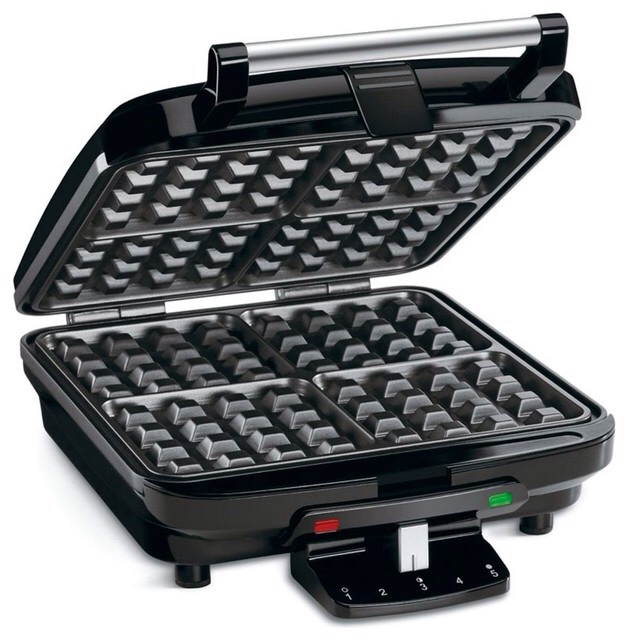
Waffle makers have advanced leaps and bounds from the versions we had as kids. There are makers that’ll do anywhere from 2 to 8 at a pop; some are deeper and rotate, to specialize in the thicker Belgian version. There are timers and dark-to-light controls as well. I opted for a simple maker with a light to indicate ready status, and no other bells and whistles. If you keep an eye on your maker while it’s working, it’s a safe bet that somewhere around 6 to 8 minutes in, when the steam output has diminished and you’re smelling nice, toasty cereal notes, your waffle will be done. After you’re used to yours for a while, it’ll be second nature that requires little conscious thought. Non stick is nice, and can now be found in non-toxic, environmentally friendly versions; it’s great to have, but does not mean you don’t still need a little something sprayed or wiped on before you cook.

Waffle recipes are pretty straightforward; once you’ve got your ratios down, they lend themselves well to experimentation. A few points, illustrated with the recipes below.

Thicker, lighter styles, like Belgian, want the eggs separated and the whites beaten and folded in to achieve that end.

The same process will help heavier, gluten poor flours generate a lighter, less leaden final product.

Vital wheat gluten is a fantastic tool to help those heavier flours end up as fluffy waffles.

Leavening can usually be achieved adequately with just baking powder, but judicious use of both powder and soda works just fine as well, especially with heavier batters. Yeast raised waffles take longer, but reward with a complex, tangy note that faster leaveners just can’t duplicate.

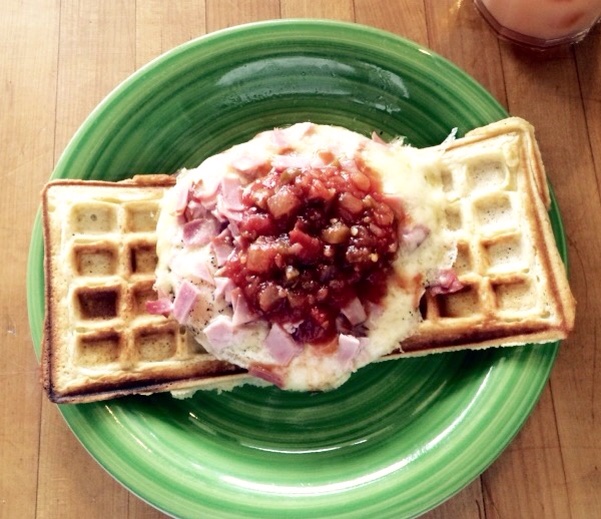
Here are a few variants to spark your creative juices. Any of these recipes can be made savory if you wish. Thinly sliced green onions, chive, or other herbs can be added to the batter, or incorporated into toppings made with sour cream, cremé fraîche, crema, or Greek yoghurt. Chutney, salsa, mostarda, or sauteéd vegetables are equally delicious, as is a waffle topped with an over easy egg, crumbled bacon, and melted cheese. If you add veggies or fruit directly to a batter, consider sweating them in a sauté pan first, to reduce the amount of moisture and keep your waffles from getting soggy or falling apart.


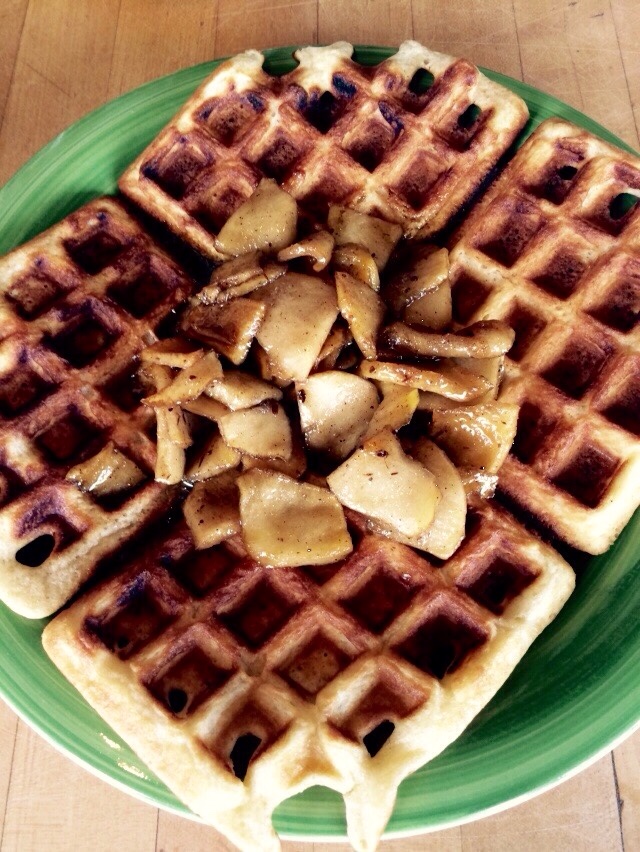
For topping sweet waffles, it’s awfully hard to beat real maple syrup and butter.

You can substitute whole wheat pastry, or whole grain white flour, one to one for any recipe calling for all purpose. Subbing 2% milk for whole works, and almond or soy milks make fine alternatives as well. Coconut oil makes a great sub for butter, as will olive, avocado, or grapeseed oils for savory waffle recipes. Honey, agave nectar, or less refined sugars are also fine alternatives. Fresh fruit is always a delightful topping for any variant.


With modern waffle makers, it’s best to pour a ladle or two of batter into the middle of the iron, enough spread to within a couple inches so of the edge; gently closing the lid will finish the job.

Each recipe will make 6-8 waffles. They will store well short term, and are delicious toasted the next day.

Yeast Raised Waffles
2 Cups all purpose Flour
3/4 Cup Whole Wheat Pastry Flour
2 Cups whole Milk
2 large Eggs
1/2 Cup Unsalted Butter
1 Tablespoon Sugar
1 package active dry Yeast, (2 1/4 teaspoons)
1 teaspoon Sea Salt
1/4 teaspoon Baking Soda
 
In a small pot over medium heat, combine milk and butter; stir until melted and bubbles start to form on the edge of the pan. Add sugar and salt and stir steadily until melted and hot but not simmering. Remove from heat and let stand until lukewarm.
In a warmed mixing bowl, combine 1/2 cup warm water and yeast. Let stand until it foams, about 5 minutes.
Add warm milk mixture to yeast and stir.
Whisk in flours, then cover tightly with plastic wrap and let stand until doubled in volume, at least two to three hours at room temp, or overnight in the fridge.
Preheat waffle iron.
Whisk eggs and baking soda into the batter.
Cook according to manufacturer’s directions until golden brown.


Belgian Waffles

2 Cups all purpose Flour

2 large Eggs

2 Cups Whole Milk

1/2 Cup unsalted Butter

1/2 Cup Sugar

3-1/2 teaspoons Baking Powder

1 teaspoon Vanilla Extract

1 Cup fresh Strawberries


Preheat waffle iron.

Rinse and slice strawberries.

Separate eggs into two small dishes.

Melt butter.

In a large mixing bowl, combine flour, sugar and baking powder.

In a second mixing bowl, lightly beat egg yolks until frothy. Add milk, melted butter, and vanilla, and whisk thoroughly to incorporate.

Add wet to dry mix and whisk gently until just combined.

Whisk egg whites until stiff peaks form; fold gently into the batter.

Cook in a preheated waffle iron according to manufacturer’s directions until golden brown.

Serve topped with strawberries.


Buttermilk Waffles

2 cups all purpose Flour

2 Cups Buttermilk

2 large Eggs

1/3 Cup unsalted Butter

2 Tablespoons Sugar

2 teaspoons Baking Powder

1 teaspoon Baking Soda

1 teaspoon Vanilla Extract

Pinch Sea Salt


Preheat waffle iron.

Melt butter.

In a large mixing bowl, combine flour, sugar, baking powder, baking soda, and salt, and whisk to incorporate. In a separate bowl, whisk and combine thoroughly buttermilk and butter; add the eggs and vanilla, and whisk again.

Add wet mix to dry and whisk gently until just combined; batter will be slightly lumpy.

Cook until golden brown, according to manufacturer’s instructions.


Buckwheat Waffles

2 Cups Buckwheat Flour

2 Large Eggs

1 1/2 Cups whole Milk

1/2 Cup Greek Yoghurt

1/2 Cup unsalted Butter

2 Tablespoons Bob’s Vital Wheat Gluten

2 Tablespoons Honey

2 teaspoons Baking Powder

1 teaspoon Baking Soda

Pinch of Cinnamon

Pinch of Sea Salt


Preheat waffle iron.

Melt butter.

In a large bowl, add buckwheat flour, vital wheat gluten, baking powder, baking soda, salt, and cinnamon, and combine.

Separate eggs into two small dishes.

Add yolks to a second mixing bowl, and whisk until frothy. Add the sugar, butter, milk, and yogurt and combine thoroughly.

Whisk egg whites until they raise to soft peaks.

Add wet mix to dry and whisk gently until just combined.

Add one half of the egg white and fold them gently into the batter; do the same with the second half.

Cook until golden brown, according to manufacturer’s instructions.


Whole Grain Waffles

2 Cups Whole Wheat Pastry Flour

2 large Eggs

1 1/2 Cups whole Milk

1/2 Cup Sour Cream

1/4 Cup Butter

2 tablespoons Honey or Agave Nectar

2 teaspoons BakingPowder

1 teaspoon Baking Soda

1 teaspoon Vanilla extract

Pinch Sea Salt


Preheat waffle iron.

Melt butter.

In a large mixing bowl, combine flour, sugar, baking powder, baking soda, and salt, and whisk to incorporate.

In a separate bowl, whisk and combine thoroughly buttermilk and butter; add the eggs and vanilla, and whisk again.

Add wet mix to dry and whisk gently until just combined; batter will be slightly lumpy.

Cook until golden brown, according to manufacturer’s instructions.


Waffles 101


Along with stand mixers and fondue sets, waffle irons are more than likely collecting dust in a corner of many of our pantries. Waffles get a bad rap as 'food that's not good for you,' and 'a pain to make'; nothing could be further from the truth. Sure, a store bought, frozen waffle is an abomination, along with generic table syrup, and both are to be avoided like the plague. A homemade waffle, on the other hand, topped with delicious things is a delight in every way.


Batter or dough has been cooked between two hot plates for hundreds of years. The earliest recipe written in English that I'm aware of appeared in the 1600s, and paid proper homage to the Dutch 'wafel', that from the Frankish 'wafla', which harken back as far as the 1100s and meant honeycomb or cake. Waffles started out life as derivations of the communion wafer, thin, crisp cakes not unlike the modern pizzelle, still quite popular in Italy. These earliest versions were almost always round and made of grain flour and water, just as communion wafers were and are. As such, they weren't particularly big on taste, so flavorings like honey or florally infused water were introduced, such as rose and orange blossom. It wasn't until the 1300s that a recipe included eggs, wine, flour, and salt, but did not contain leavening of any note. Another hundred years would pass before irons notably different in pattern from the communion wafer, or oublie, would appear. These new versions, the French fer à oublie and the Belgian wafelijzer, were square or rectangular, and set with an even grid pattern; the space between these early irons was still rather thin, leading to a finished product likely akin to the modern Brussels waffle. Another couple of centuries would pass before recipes routinely included yeast, sweeteners, and spices added directly to the batter. Leavening was the innovation that allowed waffles to become the thicker, more appealing treat we enjoy to this day.

Waffle makers have advanced leaps and bounds from the versions we had as kids. There are makers that'll do anywhere from 2 to 8 at a pop; some are deeper and rotate, to specialize in the thicker Belgian version. There are timers and dark-to-light controls as well. I opted for a simple maker with a light to indicate ready status, and no other bells and whistles. If you keep an eye on your maker while it's working, it's a safe bet that somewhere around 6 to 8 minutes in, when the steam output has diminished and you're smelling nice, toasty cereal notes, your waffle will be done. After you're used to yours for a while, it'll be second nature that requires little conscious thought. Non stick is nice, and can now be found in non-toxic, environmentally friendly versions; it's great to have, but does not mean you don't still need a little something sprayed or wiped on before you cook.

Waffle recipes are pretty straightforward; once you've got your ratios down, they lend themselves well to experimentation. A few points, illustrated with the recipes below.

Thicker, lighter styles, like Belgian, want the eggs separated and the whites beaten and folded in to achieve that end.

The same process will help heavier, gluten poor flours generate a lighter, less leaden final product.

Vital wheat gluten is a fantastic tool to help those heavier flours end up as fluffy waffles.

Leavening can usually be achieved adequately with just baking powder, but judicious use of both powder and soda works just fine as well, especially with heavier batters. Yeast raised waffles take longer, but reward with a complex, tangy note that faster leaveners just can't duplicate.

Here are a few variants to spark your creative juices. Any of these recipes can be made savory if you wish. Thinly sliced green onions, chive, or other herbs can be added to the batter, or incorporated into toppings made with sour cream, cremé fraîche, crema, or Greek yoghurt. Chutney, salsa, mostarda, or sauteéd vegetables are equally delicious, as is a waffle topped with an over easy egg, crumbled bacon, and melted cheese. If you add veggies or fruit directly to a batter, consider sweating them in a sauté pan first, to reduce the amount of moisture and keep your waffles from getting soggy or falling apart.


For topping sweet waffles, it's awfully hard to beat real maple syrup and butter.

You can substitute whole wheat pastry, or whole grain white flour, one to one for any recipe calling for all purpose. Subbing 2% milk for whole works, and almond or soy milks make fine alternatives as well. Coconut oil makes a great sub for butter, as will olive, avocado, or grapeseed oils for savory waffle recipes. Honey, agave nectar, or less refined sugars are also fine alternatives. Fresh fruit is always a delightful topping for any variant.


With modern waffle makers, it's best to pour a ladle or two of batter into the middle of the iron, enough spread to within a couple inches so of the edge; gently closing the lid will finish the job.

Each recipe will make 6-8 waffles. They will store well short term, and are delicious toasted the next day.

Yeast Raised Waffles
2 Cups all purpose Flour
3/4 Cup Whole Wheat Pastry Flour
2 Cups whole Milk
2 large Eggs
1/2 Cup Unsalted Butter
1 Tablespoon Sugar
1 package active dry Yeast, (2 1/4 teaspoons)
1 teaspoon Sea Salt
1/4 teaspoon Baking Soda
 
In a small pot over medium heat, combine milk and butter; stir until melted and bubbles start to form on the edge of the pan. Add sugar and salt and stir steadily until melted and hot but not simmering. Remove from heat and let stand until lukewarm.
In a warmed mixing bowl, combine 1/2 cup warm water and yeast. Let stand until it foams, about 5 minutes.
Add warm milk mixture to yeast and stir.
Whisk in flours, then cover tightly with plastic wrap and let stand until doubled in volume, at least two to three hours at room temp, or overnight in the fridge.
Preheat waffle iron.
Whisk eggs and baking soda into the batter.
Cook according to manufacturer's directions until golden brown.


Belgian Waffles

2 Cups all purpose Flour

2 large Eggs

2 Cups Whole Milk

1/2 Cup unsalted Butter

1/2 Cup Sugar

3-1/2 teaspoons Baking Powder

1 teaspoon Vanilla Extract

1 Cup fresh Strawberries


Preheat waffle iron.

Rinse and slice strawberries.

Separate eggs into two small dishes.

Melt butter.

In a large mixing bowl, combine flour, sugar and baking powder.

In a second mixing bowl, lightly beat egg yolks until frothy. Add milk, melted butter, and vanilla, and whisk thoroughly to incorporate.

Add wet to dry mix and whisk gently until just combined.

Whisk egg whites until stiff peaks form; fold gently into the batter.

Cook in a preheated waffle iron according to manufacturer's directions until golden brown.

Serve topped with strawberries.


Buttermilk Waffles

2 cups all purpose Flour

2 Cups Buttermilk

2 large Eggs

1/3 Cup unsalted Butter

2 Tablespoons Sugar

2 teaspoons Baking Powder

1 teaspoon Baking Soda

1 teaspoon Vanilla Extract

Pinch Sea Salt


Preheat waffle iron.

Melt butter.

In a large mixing bowl, combine flour, sugar, baking powder, baking soda, and salt, and whisk to incorporate. In a separate bowl, whisk and combine thoroughly buttermilk and butter; add the eggs and vanilla, and whisk again.

Add wet mix to dry and whisk gently until just combined; batter will be slightly lumpy.

Cook until golden brown, according to manufacturer's instructions.


Buckwheat Waffles

2 Cups Buckwheat Flour

2 Large Eggs

1 1/2 Cups whole Milk

1/2 Cup Greek Yoghurt

1/2 Cup unsalted Butter

2 Tablespoons Bob's Vital Wheat Gluten

2 Tablespoons Honey

2 teaspoons Baking Powder

1 teaspoon Baking Soda

Pinch of Cinnamon

Pinch of Sea Salt


Preheat waffle iron.

Melt butter.

In a large bowl, add buckwheat flour, vital wheat gluten, baking powder, baking soda, salt, and cinnamon, and combine.

Separate eggs into two small dishes.

Add yolks to a second mixing bowl, and whisk until frothy. Add the sugar, butter, milk, and yogurt and combine thoroughly.

Whisk egg whites until they raise to soft peaks.

Add wet mix to dry and whisk gently until just combined.

Add one half of the egg white and fold them gently into the batter; do the same with the second half.

Cook until golden brown, according to manufacturer's instructions.


Whole Grain Waffles

2 Cups Whole Wheat Pastry Flour

2 large Eggs

1 1/2 Cups whole Milk

1/2 Cup Sour Cream

1/4 Cup Butter

2 tablespoons Honey or Agave Nectar

2 teaspoons BakingPowder

1 teaspoon Baking Soda

1 teaspoon Vanilla extract

Pinch Sea Salt


Preheat waffle iron.

Melt butter.

In a large mixing bowl, combine flour, sugar, baking powder, baking soda, and salt, and whisk to incorporate.

In a separate bowl, whisk and combine thoroughly buttermilk and butter; add the eggs and vanilla, and whisk again.

Add wet mix to dry and whisk gently until just combined; batter will be slightly lumpy.

Cook until golden brown, according to manufacturer's instructions.