Semi-Greek


Ok, so we suddenly have, shall we say, a whole pantload of cucumbers! What to do, what to do… Can’t preserve much of them, can’t give them all away, so gotta get cookin’. first thing that comes to mind for me is Tzatziki, just ’cause I do love it so. Secondly, we wanted something cool, ’cause it’s bloody 100+ outside and we neither need a bunch of cooking heat nor hot food on days like this, eh?

So off to the market, with a vague idea of a Greek themed dindin. I saw no lamb, so I settled on pork and beef, both USDA Choice, which they had as a Buy-1-Get-3-Free deal, so I bought three of each, of course. Snagged some very nice Greek yoghurt and some flatbread. No Retsina in sight, so a dry white wine, and back to the kitchen I went. I decided to make the protein as Greek-Like as a could and work from there. Here’s what I came up with.

Kinda-Greek Sausage
50%-50% cuts of beef and pork
Basil
Rosemary
Oregano
Thyme
Granulated Garlic
Salt & Pepper
Olive Oil

Note: I did this as sausage ’cause I have an attachment for our Kitchenaid – If you don’t, fret not – Just cut stuff to about 1/2″ and go with that, it’ll be fine – You won’t need to freeze/chill the flesh if you go this route, but limit its time outside the fridge strictly for food safety considerations.

Remove meat from packages, cube to about 1.5″ and throw them into the freezer for about 15 minutes. Throw another stainless bowl in there too, to catch the finished product. When making sausage, or really, any forcemeat, keeping your ingredients really cold all throughout the process is critical: This is necessary first and foremost to keep the proteins under 40°F and thus out of the Food Temperature Danger Zone. Secondly, it helps make a more homogenous end product with better taste and texture.

I grabbed the herbs from the garden, of course, (Which you should do too, by the way…) Field strip herbs and chiffenade/mince. Remove protein from freezer, coat liberally with oil, add herbs, garlic, salt and pepper, mix well.

Process through grinder with the wider of the two plates provided. Use chilled bowl for catching the finished sausage and return finished product to the fridge ASAP.

I cooked off the sausage in a saute pan, and M came home as I was doing so – I knew I’d done OK when the first words out her mouth were “Oh that smells soooo good!”

Now for the magic ingredient…

Tzatziki

1 8 oz container of Greek Yogurt, (You can use regular too)
1 med cucumber
2 tbspn olive oil
Juice from 1/2 to 1 lemon, (As you like it)
1 tspn dill, chopped fine, (You can sub spearmint)
2 cloves of garlic, minced
salt to taste

If you don’t have Greek Yoghurt, plain will do, but find Greek if you can; it is richer, tangier and thicker, all of which are good things when it comes to Tzatziki.
Line a colander or strainer with paper towel and drain the yogurt for 15 to 30 minutes; this is critical in avoiding a runny final product.

Peel, seed and grate cucumber. We used Armenian from our garden, which have wonderful taste and nice, firm flesh. Any decent cuke will do, but make sure it is nice and firm!

Combine everything and mix well by hand, as blending or processing will make your yogurt break down.

Place in a non-reactive bowl, cover, and refrigerate for 1 to 2 hours.

Let the sausage cool along with the Tzatziki.

Cut up veggies of your choice for garnish – We went with yellow bell pepper, tomato, cilantro, lettuce, onion, and pimento stuffed green olives – Talk about yummy!

Grill or toast flatbread. I wanted flatbread we could open and stuff like a Gyro, but the stuff I found wouldn’t do that, so we just cut grilled wedges and called it good. If you like cheese, then Feta or Mizithra would rock with this – We didn’t want to cloud the wonderful Tzatziki, so we left it off of ours.

Pile everything on and απολαύστε – εύγευστος!
(Enjoy – Delicious!)

Pickling Two – The Sequel…


Had a bunch of gorgeous jalapenos hanging around the fridge, (Summer vacation, you know – They were bored because “there’s nothing for them to do” – Sheesh…). So I did a variation of the quick pickle brine recipe I posted the other day for these beauties – It’s been three days tonight, so they’re coming out with some green chile & chicken enchiladas for dindin!

Pickled Jalapenos

4 Cups Jalapenos, whole, cleaned and topped.
2 Cups white vinegar.
2 teaspoons sea salt.
1 teaspoon granulated sugar.
1 Tablespoon whole peppercorns, (I used our favorite black/red/green/white blend).
1 teaspoon of Dill.
3 Cloves Garlic, peeled and quartered.

Bring vinegar and seasonings to a low boil.

Place Jalapenos in a clean, glass container.

Pour hot solution over veggies to cover. Refrigerate at least 24 hours, and 3 days are even better. Kept refrigerated, they’ll last a good couple of weeks, if you don’t devour them first, of course!

We’ll let ya know the verdict after dinner!

When Critters Attack


M opened the pantry the other day and was greeted by bugs. This did not please her, obviously, but after all, this is Tejas and damn near every kind of critter you can name lives here and wants to share your digs…

So, out came everything that had lived there, (And all over the kitchen it went), and everything not hermetically sealed was trashed.

Bucky watched all this from a sensible distance as the pantry was flame sterilized, followed by several coats of fresh paint laid down thereafter…

The bottom line was that the space got a much needed cleaning and organizing, plus a spiffy new look, and I got my kitchen back…

That’s Wild Rice with a Capital W, Boyo…


>There’s a lot of stuff out there that gets called wild rice, but a facts a fact, and here’s the fact about that, jack: For the real skinny on wild rice, I turned to my friend and supplier, Christy Hohman-Caine from the great northern wilds of Minnesota, eh? She explains thusly:

“Wild rice (Zizania palustris) is an annual grass that ripens about the end of August and into Sept. Processing requires drying the rice, then parching it, then removing the hull. It can be done strictly by hand, using a kettle (big ceramic pots pre-euro trade) and a paddle to parch and taking the hull off by “jigging” or “dancing” the rice in a pit. More industrial processors around here are not exactly high tech, but they may use propane to heat big metal barrels that have paddles (instead of people) to keep the rice tossing. Even then, the rice man checks each batch as it parches, because each strain is different and the amount of moisture may be different too. You gotta know what you’re doing.

Here’s a good article on the process showing the range from family processing to larger processors. Even the largest around here is not like the processing that commercial processors do (for paddy rice, like ol’ Uncle Ben’s). Check the slideshow with this after you read it. In spite of the names, these are all Indian people.”

By the way, she just tossed that off as a quick email response, gang – See why I love that girl?

So there ya have it! Chances are, if you’re looking to get the genuine article at your local Safersons, it ain’t happenin’. A little poking around online should net what you’re after though.

Suffice it to say that this stuff, real wild rice, is like nothing you’ve ever had before; it’s like good ale versus Super Lite beer; and it’s addictive, once you’ve had it, you’ll never wander yonder again.

We’re gonna do up a nice dish with this as an opener, and then segue into some follow up meals; why, ‘cause if you’re like us, you’ll make too much rice for the first meal and then have a container sitting around that can either get thrown out after a week, or be put to further good use as it should be!

So here goes: Today we cover the Big Kahuna knock out first meal, then on to the leftovers down the line.

Urb’s Chicken Breasts with wild rice, dried cranberries and crushed hazelnuts.

We took some nice natural chicken breasts, skinned and boned ‘em, butterflied ‘em out, and then pounded them a bit so they’re a nice, even thickness. Two points to consider here: One, this may look like fancy pants cookin’, but it ain’t; you could do this in the field if you wanted, (Seriously – Platt and I ate REAL well during our deer hunt – Being out and about does not mean you have to sacrifice good cooking, that’s what chuck boxes were made for…) Secondly, this recipe works even better with wild game; Quail, Pheasant, Partridge, or Dove would all rock with this – The wild rice, dried fruit and nuts with animal is simply the best, (Ever heard of Pemican?). OK, onward!

After the flesh is pounded out, (And yes, you should have a meat hammer if you don’t already), we put it in a nice little marinade of white wine, orange and grapefruit juice, with a little salt, pepper, onion powder, and celery seed. Let it sit for about ½ hour, then pull the breasts out and reserve the marinade.

NOTE: As with ALL poultry, always follow safe handling practices with the flesh and everything you use to contain and handle it!

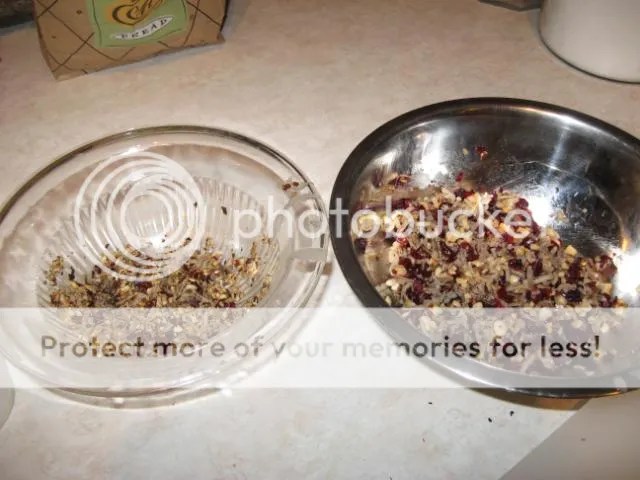
We cooked the wild rice to the slightly dry side, then mixed equal portions of rice, dried cranberries, and chopped hazelnuts, (The hazelnuts were out of season, so we toasted them to get ’em back to a nice, perky condition). I put a spoon or so of bacon fat in the mix, (Everybody’s favorite cheat!), since chicken is lean and a little fat helps everything get together cozy-like; I also rehydrated a couple of our home grown smoked cherry peppers and chopped them into the mix for a nice, smoky taste with a touch of heat. Spread an even layer of the mixture over the meat, and then grab your kitchen twine. Roll the breasts into nice logs and tie them off.

The meat goes into an oiled pan on high heat and is evenly browned; once that’s done, pop ‘em into a baking dish, cover it with foil and toss that into a 350º F oven to finish. We use our schmancy thermometer to make sure we achieve 170º F internal temp, rather than using a timer. We took the remaining rice/cranberry/nut mix and tossed it on top of the breasts.

Once it’s done, pull it out and let it rest at least 10 minutes, as it will continue to cook and get to the magic done temp – Remember, NEVER cut flesh that’s just come out of the oven, you’ll guarantee dry and nasty if you do!

While the chicken is cooking, grab your marinade and use it to deglaze the pan you browned the breasts in. Mix all that up nicely and get the naughty bits off the pan bottom, and then set it on a low simmer to reduce; we took our down to roughly 25% and then added a couple tablespoons of butter, making it syrup-thick so it coats a spoon nicely when tested.

Our accompaniment for this wonderful stuff was nice, fresh green beans with lemon butter, and some Texas toast. Cut nice thick rounds of the rolled breast, (Remembering to take the twine off…), arrange and drizzle with the reduced sauce, and go wild! We had ours with a nice, dry white wine and a cooking show on the tube – fact is, ours looked a LOT better than theirs, and so will YOURS!

Enjoy!

Keep Chile


Ivar Haglund, the legendary Washington State musician, unofficial waterfront mayor, and restaurateur, coined the phrase ‘Keep Clam.’ While this was certainly a play on Keep Calm, (Ivar liked puns a lot), it also makes a fine invocation for preservation.

As we’ve discussed a few times already, growing veggies and fruit and such is wonderful, but if you don’t preserve ‘em, the joys of your bounty are necessarily short lived. Teach folks to grow chiles and they’ll eat well for a week or two; teach ‘em to dry, can and freeze and they’ll eat well all winter long…

Monica grew me nine varieties of chiles this year, from pretty sweet to nuclear, with several stops in between. My favorite thing to do with them is dry them, because I can then make spice blends with ‘em, or reconstitute ‘em for moles and such, and they’ll keep for a long, long time.

Some I roast and freeze, ‘cause they’re that much easier and faster to pull out and use for enchilada sauce and stuff like that. I roast whole, skin on, etc and leave ’em that way; when I pull ’em out to thaw and use is the time to skin and seed as needed. Store ’em in glass or plastic as you have available; they’ll last all winter if you suck as much air out of the container as possible.

Like Tabasco? I love the stuff, but nothing from the factory matches what you can do yourself – Dried and ground Tabascos are incredible in everything from eggs and soup to macaroni and cheese or chili. To me, they’re the perfect blend of reasonable heat and sweet, complex chile overtones; perfection!

If you like the hot sauce version better, mash up your favorite chiles, add vinegar and water, (I like 50% – 50%) until everybody’s floating, simmer lightly for about 10 minutes, then throw everything into an airtight glass jar and let it sit in the fridge for a couple weeks. Pull it out, strain it, put it in a glass jar and bingo, you got your own hot sauce, with heat and flavor exactly as you want it – Chiles are kinda like wine grapes; they do great solo or in a blend, so experiment and make your own.

Love chili powder, but never found one that really floats yer boat? make your own then. I use a combination of Jalapeno, New Mexican, and Tabasco; that gives me the taste and heat I’m after to a T. For hot powder, I zap the chiles whole in my spice blender, seeds and all; for mild, I pop off the tops and remove the seeds and dried membranes – Yeah, it’s that easy and yeah, the former is that much hotter than the latter!

Classic chile powder has claims on it from Mexico to Texas to everywhere else in the southwest. The classic blend is not, as many seem to believe, simply ground chiles and nothing else – It is in fact a blend and the other stuff is every bit as important! Try this with your favorite variety(ies); alter the ratios as your palate sees fit – Have some fun!

Classic Chili Powder

3 Tablespoons ground chiles of your choice
1 teaspoon ground cumin
1 teaspoon ground Mexican Oregano
½ teaspoon smoked paprika
½ teaspoon ground garlic

Put everybody into a spice grinder or molcajete and grind fine. Pour through a fine mesh sieve into a glass bowl; don’t push stuff through – If it doesn’t fit, let it be. Place into a shaker top spice jar and enjoy; try this blend on soup, eggs, grilled cheese, roast chicken, gravy, etc, etc…

Ladies and Gentlemen; dinner is now being served in the Library


Were you aware of the startling fact that annual cookbook sales in the U.S. is measured in billions of dollars? That’s billions with a B, gang…

As I type, kicked back in the ol’ recliner, there’s a pile of books on the side table; two on Mexican regional cooking by Diana Kennedy, Michael Ruhlman’s Ratios and Charcuterie, (With Brian Polcyn), Frederic Sonnenschmidt’s Art of Garde Manger, and Harold McGee’s On Food and Cooking. The Kennedy books are just acquired, having read of Frances Mayes’ appreciation for her work; the others are almost constant references that I use pretty much every time I write on this blog.

M and I own what we think are a lot of books; I’m looking over at four shelves, each three feet wide, two six feet high and two at four feet, pretty much full and there’re more in our bedroom, respective caves, guitar shop and night stands.. Of those, we have roughly four linear feet of cookbooks. A lot of the stuff we actually read, we buy used in paperback, read, share and then donate to the YWCA Resale Store. Cookbooks, on the other hand, are predominantly hard backs with shiny dust covers; some are even signed by the authors.

Here’s the rub; in our collection, we’re talking around 30 to 40 titles. If you’re a twenty first Century foodie, there a good few authors you’d recognize; Rick Bayless, Lynne Rosetto Kasper, Mark Miller, Grady Spears, Mike Simon, Maggie Glezer and Mario Batalli, to name a few. Despite all those bright lights, the books that get used consistently and frequently would be limited to Irma Rombauer’s Joy of Cooking and James Beard’s American Cookery. Those that I have actually read, cover to cover, would also tally exactly two; Harold McGee’s seminal volume and Claudia Roden’s The Book of Jewish Food. That’s what, .5% or thereabouts?

How does that stack up to your experience? An informal survey found most folks said things like, “Got it as a gift, never cracked it,” “Use it very rarely,” and things along that line: Truth be told, that’s probably the way things are supposed to be; cookbooks are, after all, reference volumes and not much more than that.

I’ve been cooking my whole life, for pleasure and occasionally for a living: That said, it’s time to share another secret. Putting up recipes here for y’all was actually quite a bit of work for me, because I do not typically use recipes; I cook from the heart and off the cuff, always have, always will.

To cook professionally, you must be able to put out consistent, repeatable, high quality food, and you have to be able to do that quickly and efficiently. I am a pretty good at best, but more to the point, I am quite good at the quick and efficient part. To do what I do pretty much unconsciously as a recipe, measured out and tested, is work! I’ve always been a great skier; in my teens, I became a ski instructor. I was doing great until they said “Those are really nice turns, how do you do that?” I stared back blankly at them and said something pithy like “Ummmmm, I uh, just turn…” In teaching me to teach, they first had to alert me to the fact that I was a great skier, not a skier who knew how to teach others what to do in a logical and repeatable fashion. Cooking is much the same.

That said, over the winter months, I’m gonna try and relate to you some tricks and tips and methods whereby you can cook the same way; the desired end result being that you, as I do, maybe steal concepts and themes from all those cookbooks far more often than you do simply repeat a recipe. Iron Chef Mike Simon, one of my culinary heroes, says he uses Beard’s American Cookery for ideas when he is in need of a new dish; sounds like a darn good idea to me!

Starting with the recipes IS important. Like learning anything else, repetition breeds familiarity, practice makes perfect, and routine is great so long as it is accurate and thorough. Somewhere along the experience timeline, you look up and realize that you didn’t really think about the fact that pasta dough is a consistent ratio of three parts flour to two parts egg, you just pulled out what you needed, measured, mixed, rolled, cut, boiled, served and it was fantastic; that’s the magic we’re after.

So, in a rambling way, what I’m proposing is that, if you want to cook and cook well, a few well chosen reference guides are a good thing, maybe even a necessity. What follows is just my recommendation; if you have them, pull them out, give them a go over, and we’ll go from there. If you don’t own them, go to your local bookstore, or hit up a good used seller on Amazon and pick up a copy; you can thank me later…

1. James Beard’s American Cookery

2. Irma Rombauer’s Joy of Cooking

3. Michael Ruhlman’s Ratios

That’s it. That’s more than enough, in fact. So, let’s get crackin’, ‘K?