House and Semi-House Made


Comfort food is a wonderful thing, if for nothing else, than from the breadth and depth of the cornucopia. One of my favorite things to do is to twist a traditional recipe into something similar in feel but different in content; maybe that’s what folks mean when they call something “fusion” cooking, maybe not, but it works for me! Hence comes Enchilada Lasagna…

With noodles, (Mas o menos), made from Masa, homemade queso, and homegrown veggies, this is a real treat all around.

Queso Blanco and Queso Fresco are names that are often used interchangeably, but they are not the same beast: Both are white cheeses commonly made from fresh cow’s milk, are usually salted, and appear often in Mexican and South American cuisine, but that’s where the broad similarities end. Queso Fresco is made with rennet, used to form the curds. Queso Blanco uses an acid, such as vinegar, lemon or lime juice, to form curds. Queso Fresco will melt readily and is great for making its namesake dipping and topping salsa, know ubiquitously throughout the southwest as simply Queso. Queso Blanco does not really melt, but will become softer or creamer when heated. It’s sometimes known as queso para freir, literally cheese for frying; it retains its shape very nicely when fried, and takes well to breading or coating with herbs and chiles. The variations of these cheeses are as broad as the regions they are made in; they are not dissimilar in consistency to Feta or Peneer.

Queso Blanco

One gal whole milk, (Pasteurized or raw is cool, but ultrapasteurized is NOT!)
1/2 cup of white vinegar, lemon or lime juice
Salt to taste

Pour milk into a non-reactive pan on medium heat. Stir regularly to avoid scalding on the bottom of the pan. Using a cooking thermometer, track your temp throughout; you’re looking for 180º F.

If you’re using citrus for your acidifier, juice, seed, and measure. Lemon or lime juice adds a certain note to the flavor of your cheese that is very pleasant; I’m not sure how to specify what it tastes like, you’ll just have to try all three and decide which you like best. I have used cider vinegar as well and been very pleased with the results. My current favorite is lemon juice, FYI…

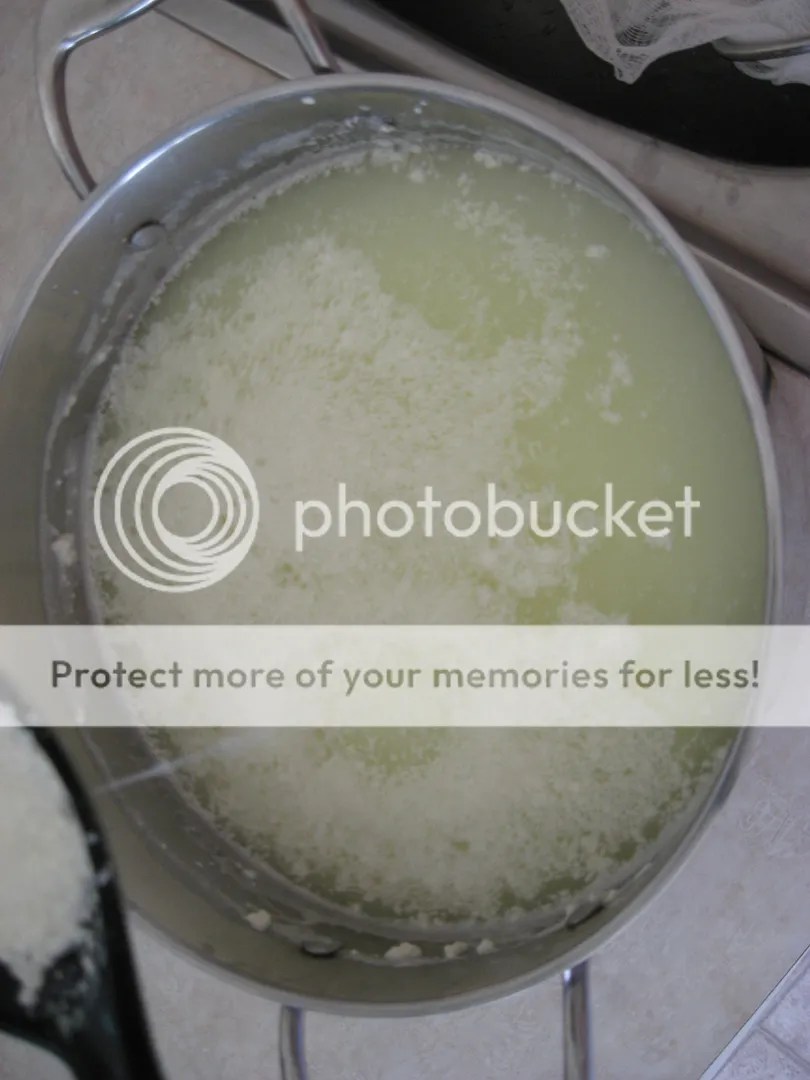
Add your acidifier: Curds will begin to separate from the whey right away; they are quite small in this cheese, (Noticably smaller than the Ricotta recipe I shared a while back, so if you see that and wonder, fear not!). The curds are about small pea size at best in this recipe.
Let the mixture simmer for a couple minutes and then carefully pour it off into a cheesecloth lined colander; be sure to use several layers of cheesecloth if you have the standard wide-weave kind you’ll find in the grocery or hardware store.

You can toss the whey, or you can save that to make ricotta with, or you can dump it into your compost heap.

Now is the time to salt the curds and add any herbs, chiles, etc; in this recipe, I’ve diced up some nice sweet peppers that will flavor this batch. Gently mix everything together. Note that you can add a bit more salt than you might like when tasting at this point – You’re going to hang and drain this cheese for a couple hours, and salt will be some of what goes away.

As we did with the Ricotta, bundle up your cheese, tie it off in a nice little ball and hang it from your faucet.

Draining your cheese is something that shouldn’t be rushed; I like to go at least 2 hours, and you can go well more than that if you want – The more you drain, the firmer your cheese!

Recipe yields about 16 ounces of lovely Queso. It will keep, well sealed, in the fridge for roughly as long as the expiration date on the milk you used, but really, it shouldn’t last that long, OK? Here’s what ours looks like with that fantastic sweet, red pepper in it. ¿Muy bonita, si?

Corn Tortillas, (in this case, AKA noodles)

2 cups corn Masa Harina, white or yellow
1 ¼ cups hot water
1 teaspoon salt

A starting note; make sure you get Masa, AKA corn flour, NOT corn meal – The latter will not do the trick!

Mix masa and salt in a bowl. Add the hot water and stir until you can handle the mix without it sticking too much to your paws; at first, the mix will seem a bit dry and that’s OK. Add more hot water a teaspoon at a time until you form a nice, semi-elastic dough that stays together and doesn’t stick to the bowl. Knead the dough for a couple minutes, adding tiny amounts of water or masa as needed to keep the dough workable and not too wet or dry; you want it to feel moist and workable, but not wet or sticky; it almost feels like a nice, loamy soil when it’s right, (If that makes sense…)

Pinch off a piece of dough and roll it between your hands into a golf ball sized chunk. Let these sit, separated and covered with a moist paper towel, on a plate for a few minutes. If you have a tortilla press, (Or your rolling pin, if not and that’s just fine too!), now’s the time to get it out, along with a gallon freezer bag cut into two equal pieces that you’ll use to hold your dough while you roll or press it out.

FYI, this ain’t like pie dough, so it is not gonna get tougher if you handle it:
Grab a golf ball and flatten it between your palms until it’s about a 3” circle. Place that between your plastic sheets and roll or press until you get a nice 6” to 7” tortilla; they can be a bit thicker than the store bought ones – Believe me, they’ll be WAY better tasting!

If we were making straight tortillas, we’d be heating up a dry cast iron pan or comal over medium high heat; cook the tortillas for about 45 second to a minute a side, then place them in aluminum foil in a warm place to rest for a bit until you’re ready to use them.

In this instance, I’m using the dough to make analog lasagna noodles, so I pressed out the dough until it’s just thick enough for my pasta roller to receive and worked it through once on the widest setting, then let the results sit and ry for a few minutes, (No additional cooking needed for this variation.)

Tomato Sauce

We’re gonna make a basic Mexican influenced sauce for this dish, from fresh tomatoes. We’re going quick and dirty here, ‘cause this is dinner on a working day, no guests, no time, no energy, so… Gonna forgo blanching, etc in the name of speed!

6 ripe tomatoes of your choice
1 clove garlic
5 or 6 sprigs of cilantro
Couple slices of large onion
1 medium hot chile of your choice
½ teaspoon cumin seed
¼ teaspoon annatto seed
¼ teaspoon celery seed
½ teaspoon Mexican Oregano
¼ teaspoon chipotle flake
Shot of vegetable oil
Dash salt

Cut tomatoes in half, rough chop garlic, cilantro, onion and chile; throw all that plus the oil into a blender or processor.

Combine cumin, annatto, celery seed, oregano, chipotle and salt in a spice grinder or mortar and pestle and grind to a fine, even powder.

Add spice mix to veggies and blend/process until everything is nice and uniform. Open top of blender. Stick your nose in there. Breathe deep and marvel at your skillful handiwork. Go find other folk in the house, make them smell it and tell you how amazing you are…

Variation: You could substitute tomatillos for tomatoes in any percentage you like; doing the whole thing yields a gorgeous green sauce!

Now we’re ready to assemble the main dish. Lightly oil a glass baking dish, then begin by ladling some sauce in; smooth that out, add an even layer of protein, (Again, I used some killer fajita beef and chicken made by my pal Kevin, which I cubed. You could also use pork, or homemade Chorizo, for which there is a recipe lurking somewhere on this blog!). Add a sprinkling of cheese, then a layer of tortilla/noodle and repeat; I like to end with tortilla, as I think that lets the flavors get locked in and blend better as everything bakes. I topped this with some nice, sharp shredded Asiago, to further confuse the nationality of the dish and add a nice little counterpoint to the mild queso.

Bake at 350 for 35 to 45 minutes, until top tortilla is browned and everything is nice and bubbly. Allow to cool for 10 minutes on stove top prior to plating.

For topping, you simply gotta have some pico and guac, don’t ya think?

Citrus Pico

2 or 3 ripe, medium tomatoes
¼ to ½ medium sweet onion
5 – 8 sprigs cilantro
1 medium to hot chile of your choice
1 small lime
Shot of grapefruit juice
Salt and Pepper to taste

Dice tomatoes and onion, chiffenade cilantro and fine dice the chile. Add all to a nonreactive bowl. Juice lime over veggies, keeping seeds out of course. Add shot of grapefruit juice, and salt and pepper to taste. Toss to coat and blend, allow to rest chilled for 30 minutes.

Guacamole Authentico

2 or 3 ripe, medium avocados
1 firm medium tomato
1 or 2 ¼ slices from a medium, sweet onion
½ small Shallot
5 or 6 sprigs fresh Cilantro
1 small sweet chile
1 small lime
salt to taste.

Skin avocados and remove flesh with spoon into a molcajete or nonreactive mixing bowl. Core, seed, and dice tomato to ¼”. Fine mince cilantro and shallot. Stem, seed, core and fine mince chile. Quarter the lime.

Mash avocado gently with a fork, leaving it with substantial chunks roughly ½”in size. Add tomato, onion, garlic, cilantro, and chile. Squeeze juice from ½ of lime, salt lighly and taste; add more lime as needed. Cover and refrigerate for 30 minutes to allow flavors to blend.

To plate, shred a 50% – 50% mix of iceberg lettuce and red cabbage. Place shreds in a bowl and lightly salt and pepper. Place a mound of the shreds on a plate, serve a generous slice of the casserole on top, then add small spoonfuls of pico, guac, and sour cream. Serve with a nice, cold lager or pilsner.

Desert, anyone?

M loves sweets, especially good ones: I’m pretty sure I’ve shown the crème caramel variation of this incredible desert, but this time we’ll go for a very cool variation of that, which I dub Crème Añejo. Contrary to popular opinion, it’s fast and easy. Crème brûlée/Crème Añejo is a baked custard, as opposed to a stirred custard, (Done on a stove top in a double boiler); both are easy, but for my mind, letting the oven do the work while I read beats the crud out of constant stirring, so… Seriously, making these guys takes maybe 10 minutes, tops, so what are y’all waiting for?

Crème Añejo

1 quart heavy cream
1 vanilla bean, split and scraped, (You can sub ½ teaspoon of extract too)
1 cup vanilla sugar, (Split and scrape a vanilla bean into 1 cup sugar, let sit for 1 hr+, then remove bean)
6 large egg yolks
Double shot of Añejo Tequila, (Could use Rum, Bourbon, Scotch, or…)

Preheat your oven to 325º F.

Arrange 6 ramekins in a glass baking dish at least 3” deep.

Put cream, vanilla bean and seeds into a nonreactive pan over medium heat. Bring mixture to a rolling boil and then immediately pull it off the heat. Let the mixture cool, covered, for 15 minutes. Remove the vanilla bean, which you can dry out and then use to make yet more vanilla sugar.

In a mixing bowl, combine ½ cup of the vanilla sugar and the egg yolks; whisk them together well. Now take the cream mixture and slowly pour that into the egg/sugar, whisking constantly.

For the Añejo caramel, pour the tequila into a sauce pan on medium high heat; Allow the booze to heat until the alcohol is boiled off; remove it from the heat.

Place the rest of the vanilla sugar into a pan on medium heat and allow it to melt thoroughly. Once it is liquefied, begin to add the tequila VERY SLOWLY – Liquid into caramelized sugar is volatile – The sugar superheats the liquid and will vaporize it explosively if you’re not REALLY careful about this process – Add the liquid a tiny bit at a time, stirring constantly and allowing the mixture to come to equilibrium before you add more. Once the booze and sugar are combined happily, add a tablespoon of butter and whisk everything together; immediately pour equal portions of the Añejo caramel into each ramekin.

Pour the custard into the ramekins to within roughly ¾” of the tops. Place the dish into your oven on a rack set in the middle position. Pour hot water into the dish until the water level is roughly ½ way up the sides of the ramekins.

Bake for 40 to 45 minutes. Check for done by jiggling each ramekin. If the custard is done, the edges will look firm but the middles will still jiggle a bit; this is just where ya wanna be, as the latent heat in the custard will complete the cooking while they rest.

Refrigerate the custards for at least 2 hours, then pull ‘em out and let ‘’em sit in room temp for at least 15 minutes: Run a knife around the rim of the ramekin, and then quickly flip ’em over onto a desert plate and viola, instant bliss!

Serve with a sprig of mint as a garnish; stand back and keep your hands and feet clear as your guests dig into this stuff!

More cheese, please!


This just in:
“Hey, Eben; loved the eggplant thing, but really would like a more in depth treatment of the homemade cheese, specifically, pictures like you did with the pasta thing. Can you do that, please?”

I can! Here’s a reprint of the ricotta recipe with pics.

Homemade Ricotta:

½ gallon whole milk
½ gallon buttermilk

Pour all your milk into a non reactive pan over medium high heat; use the best pan you got, preferably one with a nice thick bottom to store heat well.


Milks starting their heat run on medium high; notice the nice, thick base on the stainless pan.

Stir the milk just about non-stop, taking care to check the bottom of the pan often, making sure that things aren’t burning.


Checking the temp often; on this run, separation began at about 110 degrees F.

As the milk gets hot, you’re gonna see curds starting to rise to the surface. As you see this happening, use a flat whisk or spatula to scrape the bottom and free up more curds, (Yes, they will get their whey… Sorry, couldn’t resist…)


Curds and whey starting to visibly separate

Snag a large colander or chinoise, the wider the better. Line the colander with cheese cloth; if you use real cheese cloth, you need a good 6+ layers to avoid stuff running through too much. On a tip from Michael Ruhlman in his book, Ratios, I bought some cheap, plain white handkerchiefs and use them for straining and after a good washing; they do a much better job, are reusable and are generally more satisfying to work with.


Stainless colander lined with 6 layers of cheesecloth.

When your milk mixture gets to roughly 175º F, you’ll see the curds and whey begin to separate; (The curds are the white globs and the whey is the watery leftovers, FYI).


At 165 degrees F, very distinct separation!

Pull your pan off the heat and with a ladle, carefully transfer your curds to the lined colander; do NOT press on the curds; let the moisture leave of its own accord!


Spooning off the fresh curds


Really nothing left at this point but whey

Gently grab the corners of your cloth, draw them together and tie ‘em with kitchen twine, (You DO have kitchen twine, right?) Let the cheese drain and cool for about 20 minutes.


There ya go, (Makes you want to say Braaaaaiiiiiiins, doesn’t it?)


My favorite draining trick; string tied to faucet over collander

Makes about 2 cups of finished cheese. Place it in an airtight, glass container to store; it’s good for a few days refrigerated, but it really shouldn’t even last that long, should it?


Cheese, please! This batch went onto a homemade pizza with sausage, tomato, sweet peppers and lime basil.

Smoke ’em if ya got ’em


Just a quick rejoinder to the salsa thread regarding smoking chiles. I should point out that, according to true smoking gourmands, I probably already blasphemed with my take on process; so be it. Cooking is as rife with The Right Way and the Only Way as guitar making, and that’s saying something. While some things do need to be done a certain way to get the right result, there is plenty of wiggle room left for the most part; smoking is, for my mind, one of those gray areas.


Freshly roasted Hatch chiles cooling

When I wrote up directions for smoking chiles, I made a broad assumption that everyone has or wants to have access to a smoker, and it ain’t necessarily so. As such, I thought I might offer some viable alternatives to the rest of y’all who want the flavor but not the additional stuff!

If you watch food TV, you probably have seen some variation on the stovetop smoker; all I can say is this; I wouldn’t go there unless you are cool with a house full of smoke. Pro kitchens can move air at a volume we can’t even touch and that’s that…

If you own a grill, you’re in business however. That said, it’s already time for a digression: Down here in the south, barbecue is almost religion, and how one gets there is near and dear to a cook’s heart. Hence, a little terminology is in order, and yeah, this is one of those things where it needs to be done a certain way!

A lot of folks say, “We’re gonna barbeque,” when what they mean and do is, in fact, grilling. In essence, true barbeque requires, first and foremost, indirect heat, and secondly, the ability to cook low and slow. With what you’ve read thus far about smoking, you might note that these two methods sounds a lot alike, and in fact, they are; true smoking also requires indirect heat and low and slow, and as such, the two are indeed intrinsically linked. Grilling, on the other hand, is cooking relatively quickly over direct heat, as we know and love with burgers, dawgs, corn on the cob, veggies, and the like. This is why you’ll see a barbeque/smoker and a grill in many a backyard.

Ok, so back on track. No smoker, but want the taste; no problem. There are a lot of wood products made for adding smoke to a grill these days; I’d bet your grocery has ‘em, and if they don’t, or don’t have what you want, head on over to Butcher and Packer online; they have everything in very high quality and very decent prices. The products made for the grill are cheap, ready to use and allow you to get some flavors you might not have readily available, like Mesquite, Apple, or Hickory.

If you do, on the other hand, have a decent smoking wood at hand, then small pieces and chips, soaked in water for a half hour or so prior to cooking, will do the trick just fine.

Take whatever wood source you’ve chosen, make a bag roughly 6” to 8” square with a double layer of aluminum foil, put your chips, etc in that, seal it up, and poke a good few holes in the top. Place your smoker bag on your flame deflector/above your burner with the heat on low, and put your chiles right above that, (Or use one for each burner if you’re doing a big batch process), close the lid and let ‘er rip. You should get a decent +/- 10 to 15 minutes of smoke from such a rig and that’ll do the trick just fine.


Homegrown chipotles on the grill…

And last but not least, how about if you don’t own a grill, don’t want one, don’t have room, etc? Still, no problem: Get online with Butcher and Packer again and look up their powdered hickory smoke. It is great stuff, all natural, packs a wallop and I defy dang near anyone to tell the difference on the finished product as to where the smoke flavor came from. This stuff is great in the dead of winter or spur of the moment. Mix the powder with a little olive oil, rub it on your chiles and roast ‘em in your oven; great flavor, great smell while cooking and no smoke filled home!

Smoking is not limited to chiles either, of course; you can use these methods for tomatoes, onions, garlic, potatoes, and on and on! Try smoking something you’ve not done before, like fresh cherries, apples, or limes – You’ll be surprised what great things you can and will do!

¡Salsa Fresca!


This just in!

Hey Eben and Monica,

OK, the tomatoes are now coming in faster than anyone wants to eat sliced, fresh tomatoes, and the time of salsa and stewed tomatoes is upon us.

I have made salsa a few times, but never really settled on a recipe. It has been good, but not great, and I’d like to take it up a notch. I also would like to make at least one big batch of real “chipotle” salsa with roasted __________ (peppers? jalapenos? tomatoes? what do I roast?) And how do I roast? On a gas grill, or in a gas oven (my only two available options, unless I start a fire in the guitar shop.) I have 4 kinds of tomatoes: Sungold Cherry (good for a sweet salsa?), Italian Plum, Oregon Spring medium big, red, slicing tomato, and an heirloom called Pruden’s Purple. I have mucho Jalapenos, plus several varieties of sweet peppers (Ace, Lipstick, Carmen, Banana.) Our Cilantro is at the coriander stage, so that will need to be purchased. I’ll also buy onions, as ours are small and probably too mild for good salsa zing.

When talking salsa recipes, one has to put their cards on the table about just how hot is hot enough. For me personally, I have had some changes to my innards, where my tongue can handle a lot hotter than my stomach and intestines, so if you would be so kind, please offer a variation on salsa recipe(s) that are closer to commercial “medium” than “hot.” I know I lose macho points for that, but physiological reality is reality.

Thanks!

Dennis

Oh it will absolutely be our pleasure, D-Man!! Salsa runs like water at our house; we always have several varieties working, as any self-respecting Tejano should! We’ll divide the subject broadly into fresh and cooked salsas and go from there.

Basic considerations for salsas are very loose; use whatever variety of tomato floats your boat; sweet, savory, peppery, any and every note can and will do nicely. Sweet onions are better than hot or too peppery; there are plenty of other flavor notes to pick up other than hot onions. Fresh cilantro is a must; if you don’t have it, don’t add it.

Now, let us address heat right up front. When it comes to using chiles, do use your imagination, but as Dennis alluded to in his request, in general it’s best to make things cooler than you might like if you’re a real ChileHead: If you’re making something to feed others, you really should make the heat level lowest common denominator. I don’t mean don’t have any heat in a salsa,, because to me, that’s just tomato sauce; I do mean build something reasonable that most folks can handle, and then add a side dish of fresh chopped chiles for your fellow ChileHeads to add as they see fit. As some of you know, I dig heat big time; that said, when we do salsa for others, we use one cored and seeded mild jalapeño for the chile and that’s it…

OK, let’s do the fresh stuff first; literally translated, Pico de Gallo means ‘Roosters Beak’ and maybe for that reason is also sometimes called Salsa Fresca. Pico is our personal favorite manifestation of the art. The essence of it is simply tomato and onion, though for our minds, you must have cilantro and chile as well. Pico lends itself to many, many things, from simple munching with chips, to a scoop on soup or stew or damn near anything else from eggs to enchiladas. Here’s the basic recipe we work from:

Classic Pico de Gallo

4 tomatoes of your choice, cored, seeded and diced
1 sweet onion, diced
¼ cup fresh cilantro, minced
1-3 chiles of your choice, cored, seeded and fine diced.
Salt, pepper and sugar to taste.

Note: You might look at the recipe above and ask, “Sugar? huh?!” Well, in pico especially, salt and/or sugar can and will bring out flavor balances, so experiment and use them as you see fit.

Options:
MANY, is the bottom line. Add FRESH lime, lemon, orange, or grapefruit juice to add a great citrus note to the flavor. Juice a tomato and add that. Garlic, dill, shallot, annatto, chipotle, smoked paprika, smoked cherries, smoked salt, smoked pepper seed – Get the picture? Experiment and see what floats your boat!

Picante:
A lot of folks have asked about the difference between a pico style salsa and a picante style salsa; it’s a great question, not a dumb one! To us down here, pico is the raw, mixed veggie salsa with a minimal juice or sauce component, while picante is a salsa that is predominantly sauce-based. If you think of restaurant salsa, it is much more often picante style than pico. That said, there’s a broad assumption that picante style salsas are always cooked, and I’m here to say that it ain’t necessarily so; to me, the freshest and best picantes are NOT cooked, but that’s just me – You do what floats your boat, right? Right! One general note, the components of picante should be a finer dice/mince than pico; it’s just a bit more blended/refined…

Fresh Salsa Picante

4 tomatoes of your choice
1 onion, skinned and minced
¼ cup minced cilantro
2-3 chiles of your choice, seeded, cored and minced
1 clove garlic, minced
Salt, pepper, and cumin to taste.

Blanche your tomatoes; peel them all after blanching.
Take 3 of your ‘maters and put ‘em in a blender, processor, or have at ‘em with a boat motor until they are thoroughly liquefied. Add salt, pepper, garlic and cumin to taste to this liquid and set aside.

Dice your remaining tomatoes, and combine with onion, cilantro, and chiles. Add your liquid component and blend thoroughly. Taste and adjust spicing as needed. Refrigerate and allow to chill and blend for at least an hour prior to serving.

Cooked Salsas:
The primary delights of cooked salsa are twofold; one, you get a blending and sophistication of flavor that is not always found in a fresh salsa, and two, you get longevity, which is very good when winter days grow shorter, eh? That said, cooking a salsa also allows you to add subtlety of flavor that may not always fly in a fresh product, so feel free to think outside the box in this regard!

For recipe considerations, I offer the following:

Classic Red Salsa

10 -12 tomatoes of your choice
1-2 med onion, diced.
½ cup fresh cilantro, chopped
2-4 chiles, your choice, blanched, stemmed, veined and seeded.
1-2 cloves of garlic, minced
2 tablespoons olive oil
2 teaspoons cider vinegar
Salt and pepper to taste

Blanch half your tomatoes, then peel and blend, puree or motorboat to a nice, even consistency. Put that mix into a sauce pan over medium heat.
Add oil to a sauté pan over medium-high heat. Once oil is hot, add onion and chiles and sauté for a couple minutes. Remove from heat and garlic and allow to sauté for another minute or two.
Combine sauted veggies, the rest of your tomatoes, Cored, seeded and diced), the cilantro, vinegar, salt and pepper to taste, and simmer on low heat for about an hour. Remove from heat and place into a non-reactive container to cool. Will last several days refrigerated, also can be canned, of course!

Salsa Verde

10-12 tomatillos, husks removed, of course…
1-2 small sweet onion, diced
¼ cup fresh cilantro, chopped
2-4 green chiles of your choice, (Anaheim or Hatch are nice), diced
1-2 cloves of garlic, minced
Salt and pepper to taste.

Employ the exact same process as for the red salsa above and you’re good to go!

Smokin!
First and foremost is Dennis’ question above; how about chipotle? Yeah, buddy! Like I said above, we love jalapeños and eat ‘em like candy; we love chipotle just as much, you see, ‘cause they ain’t nothin’ more than a
dried and/or smoked jalapeño, and that’s a fact! Smoking or roasting your own chiles will get just the right note you want.

I take my chiles and roast them on the grill as my go-to method; just layer chiles on the grates and let ‘em have it until the skins are black and blistered. Remove them and allow to cool. You can skin, stem and seed then and further process for freezing or canning, or simply bag ‘em up, suck the air out and freeze ‘em right like that; all those options will work great and give a very nice flavor.

If you have a smoker, put a nice even layer of whole chiles under moderately low heat smoke, (Under 200 degrees for me) for 20 to 60 minutes depending on the level of smoky you want. I’ve smoked already roasted chiles and fresh ones; they all come out nicely. If I’m going to use the dehydrator and completely dry the peppers after smoking, I use fresh; if I’m gonna can or freeze, I usually roast lightly first, then smoke.

Fully dried, smoked jalapeños processed in your spice blender, (AKA a second, cheap coffee bean grinder), makes chipotle flake and powder, with which you can do SO much! For salsa, add your smoked peppers in lieu or in combination with fresh chiles to get the level of smokiness and flavor you like; that usually means making several batches to find just the right blend – Darn…

As for canning, while many have hot water processed salsa and done OK, I have to say that I prefer and advise pressure canning for all salsas; because of that, cooked salsas lend themselves much better to the process than fresh do, so keep that in mind as you haul out the canning gear this fall.

So there ya go, D-Man, did I cover everything?

Good, Better, Best


OK so, let’s generalize about eating veggies. We’ve covered some specific eats and styles of cooking, but big picture, what to do? Here’s a few thoughts.

Crudité:
AKA, fancy French word for raw! Raw veggies are wonderful, and there’re few better methods to get great flavor from them: Crudité veggies are usually prepped and cut to bite size, which is nice for your diners, given the robust textures involved. While crudité veggies are usually done as an appetizer, they needn’t be held to just that: If you’re doing a multi-course meal, consider a crudité course between others as a nice palette cleanser. You can certainly add raw veggies to a main course or salad as well. A crudité course typically involves something to dip the veggies in, like a nice olive oil, balsamic vinegar, or a vinaigrette; even super simple things like butter and good salt with fresh radishes is a real treat.

Steaming:
A lot of veggies will turn out grandly if steamed, but not that many folks do it – I’m not sure why, maybe we feel we need special equipment, etc… Truth be told, a steaming basket does do a better job and if you’re truly gonna steam, ya kinda need one: See, to do this correctly, you need a little boiling water turning to steam beneath your veggies, with the rising, moist heat doing the cooking. If your veggies are sitting in boiling water, well, you’re not steaming, OK? Obvious choices to best benefit from this method include sugar snap peas, carrots, artichokes, asparagus, quartered onion or cabbage, and…

Boiling:
Well, let’s face it, boiling is kinda crude in the big picture of things: If you’re preparing nice, delicate, flavorful veggies, why boil ‘em to death if you have options? Answer, don’t, just do the ones that need or want this method. Truth be told, I can’t think of many things other than spuds that really want to be boiled… Yams, maybe turnips… I just can’t think of much more, and truth be told again, most of these will taste, look, and feel better with other methods, such as…

Roasting:
Roasting is cooking with dry heat, which might sound an awful lot like baking because… It is. Either method speaks of cooking with dry heat, with maybe a small amount of fat or liquid; baking usually refers to breads and baked goods, while roasting speaks to eat, fish, poultry, etc. For veggies, roasting is best done in an open pan, (We like glass and stone a lot, but metal’s fine if that’s what you’ve got). Dang near any veggie you want to cook will love being roasted and will reward you with depth and intensity of flavors that’ll knock your socks off. From potatoes to tomatoes and everything in between, try it, you’ll like it. Love asparagus or artichoke steamed? Try ‘em roasted with a drizzle of good olive oil and salt. Roast disparate veggies, (i.e. those that cook at different times), together by varying the cut you use to prepare each veg; for example, cut potatoes and carrots relatively small, while leaving celery, onion and tomato bigger – Balance things right and they all get done at the same time and are juuuuuust right! Roasting absolutely begs for flavor, so indulge, but conservatively – Apply my Golden Rule of Three, (No more than 3 spices, major flavor notes, etc), and have some fun: Olive oil, salt and Oregano; Garlic, lime, dill; thyme, chive, and balsamic vinegar; Salt, Pepper, and Rosemary – get the picture?

Braising:
Brai… huh?! Oh, trust me, if you don’t know braising, you wanna, for real! Braising means browning food in a fat, and then slow cooking it in a covered, liquid filled container. Do veggies dig this? Is the Pope Austrian? YES!! What are we talking about here? OK, demo time – how about killer root veggies for a nice treat? take potatoes, carrots and beets, cut ‘em into roughly bite sized pieces, and then heat a sauté pan to high with good olive oil in it. Brown the root veggies evenly, then put them in a casserole pan and cover with a bottle of good dark beer, like a Porter or Stout of your choice. Add garlic, salt, pepper, and a shot of Tabasco, and let that mix simmer until the veggies are fork tender, then serve with… Get the picture?

Anyway, there ain’t much right and wrong, just what you like, what you don’t, and what you ain’t tried yet – So try something here you’ve not, and let me know whatcha think!

Molcajete Madness


This just in:

Well, I’m not actually asking about pesto, I’m asking about the molcajete. I found that many people were disappointed with trying to season theirs; maybe an inferior product that just gave up grit forever, maybe just for decoration? I’d have to buy one online (not too many molcajete stores around here)–so what do I look for and how do I season it?

Thanks for the great posts.
Chris

Always a pleasure, Chris!

Well, first and foremost, unless you’re in a big cosmopolitan city, you DO need to buy online. I did, mostly because that’s a ton easier and more efficient than traipsing all over Fo’t Wuth!

Secondly, know that molcajetes are made from dang near every kind of stone you can name, and they are not all created equally: If it’s real cheap and/or too good to be true, then it probably is: Safe to say that the cheaper rocks are more prone to never ending grit sloughing off, which we most certainly do not want. The best stuff, (So say my Mexican friends), is granite or basalt with a relatively low sand content. I bought a Granite model, made by Vasconia and sold through Amazon; I couldn’t be happier with this guy; it has a great texture, is very sturdy, and cost about $30, which is right in the wheelhouse for decent stuff.

Now, as for the seasoning issue; a good molcajete will shed a bit of grit, because it is what it is, stone being ground with stone. A lousy one will shed lots and never stop, regardless of what you do; bottom line, avoid cheap, no-name stuff, ‘cause that is, as you noted, just for looks at best… That said, just like a good cast iron pan, seasoning a molcajete takes a loooooong time; this is why both tools are passed down through generations.

In any case, ya gotta start somewhere, so here’s what you do.

1. Immerse your new cool tool in water for 3 or 4 hours.
2. Pull ‘er out and let ‘er dry thoroughly.
3. Put ¼ cup of rice in the beast and grind until the rice is a molcajete-colored powder; stop when you get there and clear the rice dust out.
4. Combine a tablespoon each of garlic, rock salt, cumin and cilantro; grind all that into the molcajete and coat it thoroughly with the paste. Let that stuff sit in the molcajete for 6 to 8 hours in the fridge, then clean it out under cool running water.
5. Now go to town on your favorite recipe; if you got a good tool, you will not be eating grit and things are good to go. The rest of the seasoning happens over the weeks, months and years…

So, get out there and get you one, y’all!