Biscuits To Die For


Greg Atkinson is a great guy, and he makes fantastic biscuits – He also happens to be a real deal big time Chef. From the Friday Harbor House on San Juan island, to Canlis in Seattle, and now Restaurant Marché on Bainbridge, (his current masterpiece), Greg has been seminal to the development of Pacific Northwest cuisine as a genuine force to be reckoned with. He’s won a James Beard M. F. K. Fisher Distinguished Writing award, and authored a handful of excellent northwest cookbooks. And, he posts pictures of those lovely little things pretty much every week, which instantly makes you crave biscuits – Biscuits to die for.

The incomparable Greg Atkinson

When we say ‘Biscuit,’ we really do have to define what we’re talking about, because it’s a broad definition indeed – Pilot bread is a biscuit, as is a saltine cracker, actually – And those are a far cry from the golden, flaky little gems that just got pulled outta my oven. The version I make owe their origin story to tthe American south, (as do rolled or beaten biscuits). These days, you can find them everywhere, as it should be.

This form of biscuit is essentially a quick bread, a combination of flour, leavening, milk, fat, and a little salt. Of course, every cook has their preferences for most of those constituents – Milk or buttermilk, butter or lard, soft southern flour, or harder northern varieties – Fact is, they’ll all make great biscuits if you handle things right.

So, what is it we’re after then, if we’re looking to make a great southern style biscuit? The terms that get bandied about most are tender and flaky, but the fact is, those two words really mean quite different things. Down South, folks prefer their biscuits tender, and that means they’re made from a fairly wet dough, what’s often called a drop biscuit – That produces a fairly dense crumb, quite like a muffin. Flaky, on the other hand, implies defined layers in the finished product, and while they’re still quite light when done right, they’re definitely a bit chewier than their southern cousins – And generally, that’s how northern folks, (where I’m from), like ’em – This is the dough Greg uses, and gave me the insight into, and is what I make now – One day last spring, he posted a bare bones recipe, which is just what I like. I’ve been working on this for about 6 months, getting the process and ingredients just right – I can reproduce this pretty much anywhere, which means you can too.

Now, I’ve no illusions that what I’m about to share is totally unique, ’cause it’s not. For one thing, it’s Greg’s recipe, tweaked a little, which is pretty much how all recipes are passed along. It’s the process steps he shared and I’ve adopted that are the real trick to the game. Greg’s offering was, in fact, slightly cryptic. He mentions shortening and butter in the very brief narrative, but then doesn’t list shortening in the ingredients. He said that the dough is ‘never really mixed or kneaded in the conventional sense,’ and nothing else about working it. He baked in a ‘very hot oven,’ – Now, I don’t think he was being purposefully difficult – It was literally a couple of pictures and a paragraph he’d posted in response to somebody who’d pestered him for a recipe. While it took a few months to figure things out, it was enough for me to work with.

This version of biscuit dough isn’t a short dough, though many folks think that it is – Short, in the baking context, refers to a high ratio of fat to flour, as well as the presence of sugar. While biscuits are rich, they’re not particularly fatty, and there’s no sugar at all in the mix, (at least not in my recipe) – The recipe I’ll share has 12 ounces of fat to 5 cups of flour, or slightly under a 1:4 ratio – Compare that to shortbread, where the fat to flour ratio is 1:2, and you get the picture.

So, what is the magic then? The best way I can describe the overarching principle is this – It’s like pie crust, which means that, the more you fuck with the dough, the less you succeed. Now, that’s a simple enough statement, but it doesn’t really do much towards explaining the details of what you should and shouldn’t do. There is a series of seemingly minor but vital steps to take, and as with all doughs, batters, etc, how you handle them is absolutely as critical to success as the stuff they’re made of.

What we’ve got is fat, (butter and oil), suspended in flour and liquid, (milk). The first challenge a biscuit maker faces is how to get the butter well distributed through the flour-milk paste. The primary enemy here is heat, and what do most cooks do to distribute butter? Cut it into cubes and then work it by hand into the infamous ‘Pea sized’ thing we read in all the cook books – Trouble is, our hands melt the butter and warm the flour, and that’s pretty much counter-productive. The way to counteract this is to have everything except the oil as cold as possible, and to keep your paws, for the most part, out of the mix. More on that shortly.

Another old saw about the formation of doughs worth visiting is the supposition that what we’re forming is tiny pockets of flour, coated with fat, but the fact is that has it absolutely ass backwards – What really happens is that is that the flour/liquid slurry coats tiny little pockets of fat – Now, think about that for a sec, and when you do, a light comes on, ’cause that makes a hell of a lot more sense. While the degree of mixing will always vary, the fact that the flour/liquid mix encapsulates the fat helps us understand why that whole business with the butter is a great idea – That and the fact that it just plain works.

Now, for the final bit of science, with an apology to all of you who aren’t food science geeks, (but it’s actually important). Harken back to where we discussed the two primary types of American biscuits, the tender and the flaky – Turns out that the key to these is predominantly determined by… (Wait for it…), how we handle the dough. The former, the southern biscuit, requires enough manipulation to construct layers of the flour/liquid slurry and fat, AKA, working that dough enough for gluten to develop to a significant degree, while the latter, the flaky northern version, absolutely demands minimal handling in order to keep gluten from developing at all – And that’s saying a mouthful. In other words, to build these biscuits we’re talking about here, you really cannot do anything more than reasonably combine the ingredients, period – And fact is, that is exactly what Greg was talking about when he wrote that these biscuits are, ‘never really mixed or kneaded in the conventional sense,’ AKA, full circle, eh?

So on to the finale – marching orders. As always, you reap what you sew, so use ingredients as fresh and local as you can – In something this simple, ingredient quality is everything, and subpar or old stuff truly won’t taste very good – One more word to the wise, as we’ve covered here before, leaving agents like yeast, baking soda or powder do have expiration dates, and old stuff will not work well, if at all, so check yours and get fresh before you get started.

Biscuits to die for - Its all in the proper prep
Biscuits to die for – Its all in the proper prep

Genuinely Flaky Biscuits

5 Cups All Purpose Flour
2 Cups Whole Milk
6 Ounces Butter
6 Ounces Avocado Oil
2 Tablespoons Baking Powder
1 teaspoon Sea Salt

At least a day before you build, pop a pound of butter into the freezer and leave it there – It can be your go-to stash for baking.

Add flour, baking powder, and salt to a mixing bowl and whisk to incorporate thoroughly.

Put the bowl and contents into the freezer for at least an hour prior to mixing, and longer if you like – Overnight is fine.

When you’re ready to mix, pull a stick of frozen butter and use the medium shred on a box grater to process 6 ounces. Toss the butter into the mixing bowl with your dry ingredients and return it to the freezer for 15 minutes after grating.

Preheat your oven to 450° F.

Grab something nice and thick and heavy to bake in or on – I use a pizza stone, but a cast iron pan works just fine too.

Pre-measure 6 ounces of avocado oil and set aside at your prep area.

Pull your chilled bowl, and add the milk and oil to the other ingredients.

Now, when it’s mixing time, that means, in this instance, absolutely minimal – Think of something like Belgian waffles, where you need to fold beaten egg whites into the rest of the batter – You work carefully, delicately, so that you don’t smoosh all the air out of those whites you’ve just worked so hard to beat – That’s the concept here – Carefully and slowly fold everything with a wooden spoon or the side of a spatula, just enough to reasonably incorporate all the ingredients, and no more.

Turn the dough out of the bowl onto a cutting board, and gently pat it into a round, about 1″ thick.

Use a glass, can, whatever works for you that will let you cut biscuit rounds out of the block.

Place biscuits on your stone/pan – Ideally, you’d like about a half inch or so between each.

When you get to the scraps of your dough, just gently hand form the last biscuit or two.

Bake until golden brown, about 15 minutes.

Devour with abandon.

Salt Cured Egg Yolks


There’s no telling how long people have been preserving eggs. As one of natures most amazing sources of energy and great taste, there’s always been great interest in having them available whenever desired. Whether by brine, smoke, or chemistry, there are a bunch of ways to do it. And it’s a natural progression to go from preserving the whole egg to just focusing on the yolk, since that’s where all the really good stuff is – and if you’re going to do that, there’s nothing easier or more effective that a simple salt cure.

Egg yolks are a nutritional powerhouse. All the fat and roughly half the protein an egg possesses is in there, along with a very long list of other things – carbohydrates, amino acids, vital trace nutrients, minerals, vitamins, and yeah, a healthy shot of cholesterol, but that’s had a bad rap for far too long. Donald K. Layman, Professor Emeritus of Food Science and Nutrition at the University of Illinois has gone so far as to say that, “cutting dietary cholesterol is almost irrelevant when it comes to promoting healthy blood cholesterol levels and heart health.” While that’s not an endorsement to go off and start an all Twinkie diet, it does get eggs and a bunch of other formerly vilified foods off the hook.

Century Egg - Seriously acquired taste
Century Egg – Seriously acquired taste

There are a raft of preserved egg and yolk examples out there. The Chinese alone have been doing this for hundreds of years, exemplified by the so called Century Egg, which appeared in Hunan province during the Ming Dynasty. This, like rotten shark, is an acquired taste to say the least – They make durian seem tame – and yes, I’ve tried one, and I won’t do it again. To be fair, it’s the smell more than the taste that’s severely off-putting – think of a multi-feline cat box unchanged for weeks, and you get close.

Smoked eggs are sublime

Smoked eggs are as they sound, done either with cold or hot smoke. They too are sublime – The smoke, and as such choice of wood used, adds a lovely depth and complexity to the egg – It exemplifies egg versatility to a surprising degree.

Salt cured whole eggs

Then there’s the brined or salt cured whole egg, which is an entirely different experience – good ones are lovely, like a really good egg with over the top concentrated richness and umami. The star of course, is the yolk.

This whole exercise begs the question – why would I want to do it? Well, you either love egg yolk or you don’t – If you don’t, go out and play – if you do, read on. Egg yolk has a savory, smooth taste absolutely brimming with umami, and they’re pretty, to boot. If we can create a version of that which intensifies the umami, and makes them instantly usable whenever the whim hits, it’s worth doing.

There’s also the transformational consideration – Great food is all about taking something common and doing uncommon things with them – When the whole process is stunningly simple, it’s that much sexier in the end run – And salt cured egg yolks are very sexy indeed. What you end up with is something that you can and will grate, with a gloriously bright yellow color. Preserved yolk tastes like buttery cheese – rich but not cloying – with a high level of umami added to whatever floats your boat – And it will, believe me – On pasta, pizza, salads, veggies, you name it, a little grating of this is stunningly good.

On to the process. It is a very simple thing, albeit there are a couple of versions, and we’ll cover both herein. As with all things simple in cooking, the first and most critical consideration is ingredient quality. If ever there’s a time to buy the freshest, most local eggs you can, this would be it. Since we’re merely concentrating that which already exists, mediocre will certainly breed mediocre. What you want is a stellar egg, one with a lovely orangish-yellow yolk, as fresh as you can get. Ditto for salt – you don’t need fancy, but you do want pure – high quality, coarse kosher or sea salt, with absolutely nothing else in it, is the key. Once you’ve got these together, do the deed the same day – It doesn’t take long, and that way you’re assured of taking full advantage of fresh stuff.

Set yolks in the salt cure

As for specific methodology, as mentioned, there are two primary schools – One uses just salt for the cure with passive secondary drying, while the other employs a salt and sugar cure coupled with mechanical drying in an oven or dehydrator. Both work fine, so it comes down to your predilection, and how fast you want to get done. Again, it’s so simple, it’s highly worth trying a batch of each and making your own comparison. From there, you can tweak whatever you like best to make it yours. Here’s the drill.

In both methods, the first step is the cure. You need a bunch of salt for this, depending on how many yolks you plan to do. Again, it’s super easy to do, so start with maybe four yolks, try out the results, then try the other method, pick your fave. To process a dozen yolks, you’ll need a pound of coarse kosher or sea salt. If you use the sugar/salt cure, it’s a 50%-50% blend of each – Use regular old cane sugar for that – Nothing fine or fancy needed. That’s the only difference in the cures.

Once you’ve chosen your cure, get an appropriately sized container big enough to hold how ever many yolks you want to process, as well as a bunch of cure. I like food storage containers with a snap fit lid for this – It’s gonna go in the fridge for a week, so it’s nice to have something that’ll stand up to daily use and exploration. Word to the wise, if you’ve got a bunch of folks in your house, tell them what you’re doing and point out the container – that can go a long way toward not having your stuff tossed or played with.

Pour an even layer of cure about 1/2″ thick into the container, then form a series of evenly spaced divots to receive how ever many yolks you’re gonna cure.

Have a second airtight container ready for your egg whites. Carefully separate yolks from whites, (You can and should freeze the whites for a future endeavor.) Slide a yolk into each little depression in the cure.

Now carefully cover the yolks with a nice, even layer of cure – Here again, you want about 1/2″ or so of cure over the tops of the yolks.

Seal up the container and slide it into the fridge, and leave it alone for a week.

Once your week is up, pull the yolks. Fill a small bowl with warm water, and have a clean piece of cheese cloth handy.

Cured
Cured

Take each yolk out of the cure, and brush excess cure off. Dip the cheese cloth into the water and use that to gently clean as much cure off of the yolks as you can – At this stage, they’re still a little tacky, which is just fine – Don’t freak out if the cleaning process is taking a bit of yolk with it, but again, be gentle.

Now comes the division between finishing steps.

If you’re going the passive route, then all you need is some more clean cheese cloth. Wrap each yolk in a hunk of that and tie it off with kitchen twine.

After that, hang it from a shelf in your fridge so that each yolk has good air flow all around it. Leave them there for at least a week, and two is better. When that’s done, you’re done, and you can go to town with them.

If you prefer the faster mechanical method, then you’ll set your oven or an adjustable dehydrator to 200° F. Put the yolks on a silicone pad or parchment if you’re using the oven, onto a rack if you’re going dehydrator. Let the yolks dry for 45 minutes. Remove from heat, allow to cool to room temp before refrigerating.

Grated salt cured egg yolk

Either way you choose, the yolks, refrigerated in a non-reactive, airtight container will last at least a month, (but they won’t, ’cause you’ll scarf ’em down.)

Salt cured egg yolk on house made pizza - Si!
Salt cured egg yolk on house made pizza – Si!

Now, back there a ways I mentioned that you can tweak things, and you can – herbs and spices in the cure are par for the course, so have some fun, use your imagination, and let me know what you come up with, yeah?

Champagne Mangoes Three Ways


You might have been perusing the produce aisle recently and seen a fruit called a Champagne Mango. They’re somewhat new to many parts of the US, but they ain’t new in the Big Picture view. The Champagne, also known as an Ataúlfo, (and young, baby, yellow, honey, or adolpho), is a well established Mexican cultivar. Champagnes are gorgeous; big, heavy, golden-yellow beauties that are somewhat pear shaped. They’re thin skinned, with deep yellow, rich flesh and a very skinny pit. They’re quite high in sugar, with a tangy-sweet flavor, rich in vitamin C and dietary fiber.

Down in the Mexican state of Chiapas, when Ataúlfo Morales bought Some land back in 1950, there were already bearing mango trees on the property. Around eight years later, a researcher from the Mexican Commission of Pomology heard of Señor Morales’ mangoes and came to have a look. He went off with samples and stock which he named Ataúlfo, in honor of the property owner, and the rest is history.

If you like mangoes, (and even if you don’t), you owe it yourself to try these beauties. While they’re a real treat to peel and eat straight away, here are three of our favorite things to do with them.

Fruit Curds go back quite a ways in history. Technically, since they include eggs, butter, and require preparation like an emulsion, they’re probably more of a custard than a preserve, I guess. The 1844 edition of The Lady’s Own Cookery Book included a primitive version of a lemon curd;, using lemons to acidify cream, then separating the lemony curds from the whey. Further back yet you’ll find recipes for ‘lemon cheese’, used to make what was called a lemon cheese cake, but reads like what we’d call a lemon tart these days. Our version of Mango Curd is stunningly good, if we do say so ourselves…

2 ripe Mangoes
3 large Eggs
6 Tablespoons unsalted Butter
1/2 Cup Agave Nectar or Honey
1 fresh small Lemon
1 fresh small Lime
Pinch of Sea Salt

Rinse, Peel and roughly chop the mangoes; you’ll want to kind of shave the meat away from the skinny pit.

Purée the mango chunks with a stick blender or food processor. You want to end up with about 1 cup of purée.
Set that aside.

Rinse, zest and juice the lemon and lime, then set juice and zest aside.

Cut very cold butter into about 1/2″ cubes.

Crack eggs into a mixing bowl and whisk lightly.

For cooking the blend, a double boiler is best. If you don’t have one, work with a bowl or pan that will fit comfortably inside a larger one. Fill your double boiler bottom or pan about 2/3 full of water and heat over medium flame. You want the water steaming, but not simmering when you’re ready to cook.

Combine the eggs, lemon and lime zest, citrus juice, the agave nectar or honey, and a pinch of salt. Whisk the mixture until fully incorporated and evenly colored, about 2 to 3 minutes.

Add the mango purée to the blend and whisk for about a minute to fully incorporate.

Put your bowl with the blended ingredients over your pan filled with hot water, (Or double boiler). Allow the mixture to heat, stirring gently but continuously, for about 3 minutes. Start adding the butter in small batches of 6 to 8 cubes, whisking steadily and allowing each batch to melt and incorporate before adding the next.

Again, a curd is an emulsion, so the butter, (fat), needs time and gentle whisking to properly marry with the egg and fruit blend.

When all the butter is melted, continue whisking gently and steadily until the curd begins to thicken noticeably, about another 2 to 3 minutes.

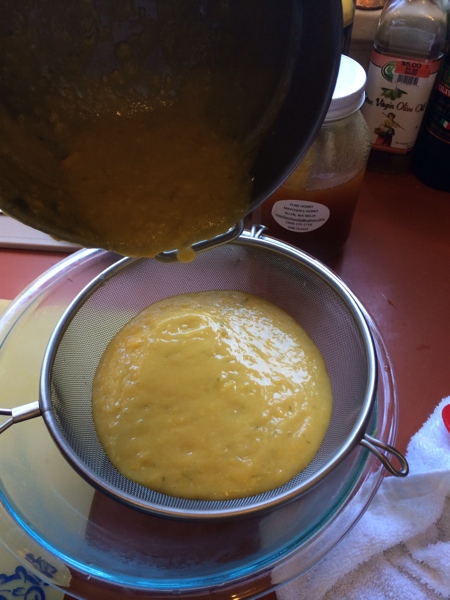
Remove the curd from the heat. Transfer the curd to a fine mesh strainer over a glass or steel bowl and use a spatula to gently strain the curd through the strainer. You’ll end up with some zest and fiber that doesn’t make it through.

Refrigerate in a glass jar or airtight container for at least four hours. The curd will keep for about a week refrigerated, but I’ll bet it won’t last anything close to that long…

A small dish of this lovely stuff is a remarkably delicious desert, or an excellent palate cleanser after a heavy course in a fancy meal. Try it on freshly made shortbread with strawberries for a real treat.

NOTE: You may substitute coconut oil for butter for a dairy free variation.


Granitas are the pure essence of fruit and natural sweeteners. With no diary on board, they’re actually not at all bad for you either. This version was the best we’ve made, of any fruit.

2 ripe Champagne Mangoes
2 Cups Water
1 fresh small Lemon
1 fresh small Lime
3/4 cup Agave Nectar or Honey

Rinse, peel and rough chop the mango flesh.

Rinse, zest, and juice the lemon and lime.

In a food processor or blender, purée the mango until smooth and uniform, about 1 to 2 minutes, stopping to scrape down the sides with a rubber spatula as needed.

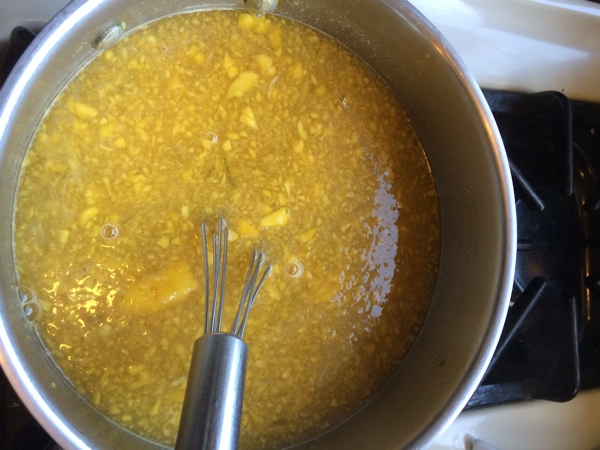
Add the water and honey or agave to a sauce pan over medium heat. Thoroughly melt the sweetener, then add the purée, zest, lemon and lime juice, and stir to incorporate.

Add the puréed mango and stir steadily and gently until the blend starts to simmer. When the whole blend is evenly mango colored and starts to thicken slightly, remove it from the heat; the whole heating process will take around 3 to 5 minutes.


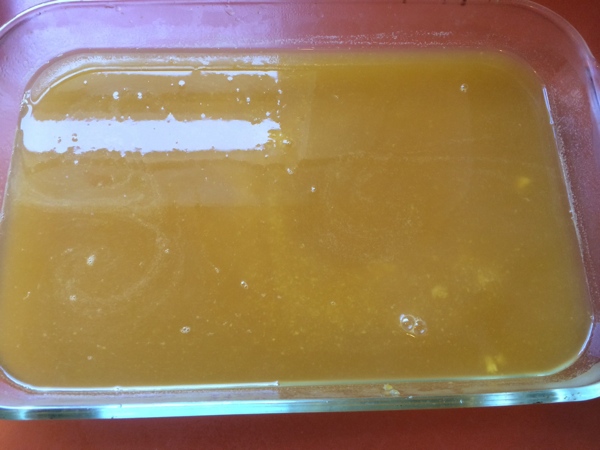
Remove the mixture from heat and pour the blend through a single layer strainer into a 9-inch-square shallow baking pan. This pan size works best ­because it provides a large surface area, a key point in speeding up the freezing process. To further hasten freezing, use a heavy steel or glass pan.

Put the pan in the freezer and stir about every hour with a large fork, times down like you’re raking the granita. Depending on your freezer temp, it will take around 3 to 5 hours for the granita to freeze completely.

You can eat the granita as soon as it’s frozen through, but the flavor will genuinely develop appreciably if you transfer it to an airtight container and freeze it over­night.

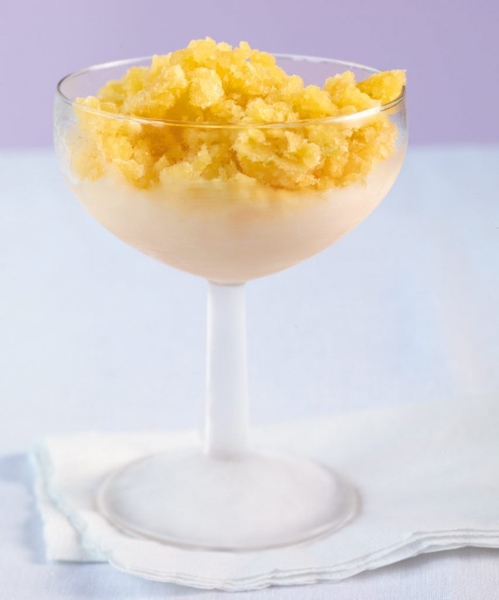
When you’re ready to serve the granita, just scape up the shaved ice and fill a chilled margarita glass, band top with a mint sprig.


Mango salsa is a real treat; the counterpoint of sweet and heat is great with fish, poultry, and pork. Try it on freshly scrambled eggs too.

1 Champagne Mango
2 ripe Roma Tomatoes
1/2 Red Onion
1-3 Jalapeño Chiles
2-4 sprigs fresh Cilantro
1 small Lemon
1 small Lime
Pinch of Sea Salt

Rinse all fruits and veggies. Peel and dice mango. Core, seed and dice the tomatoes. Dice the onion. Chiffonade the cilantro. Juice the citrus.

Combined all ingredients in a non-reactive bowl. Cover and chill for at least 30 minutes, (and as long as overnight – The flavors just get better.)

Ribs R Us


Noticed the other day that ribs are big in the stores, now that summer has officially begun. Seems like a good time to offer a fave take on those bad boys. Now first off, I admit here and now that M does ribs better than I do in terms of process, so I’ll just synthesize her method and my seasoning.

So why are ribs so dang tasty; there’s not much there, so what’s the secret? In a word, bones; bones and some marrow influence, too. Little cuts of meat attached to the stuff that we use to make amazing stocks, soups, stews, and reductions from, that’s the ticket. When cooked low and slow, the influence of the bones and marrow make their presence known in a way nothing else can really emulate.

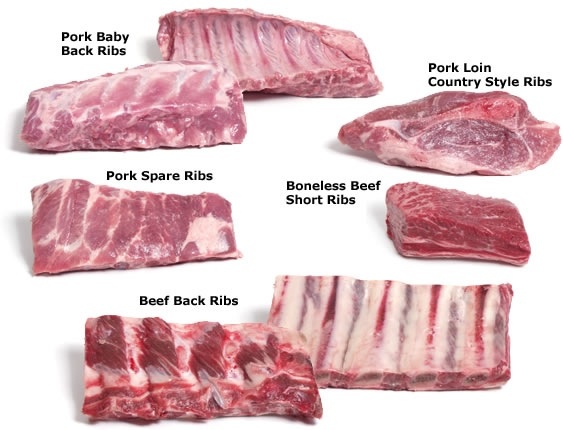
Do you know your ribs? All of ’em? Here’s a quick run down on the variations you’ll find out there.

Spareribs
Or spare ribs, either spelling works, and either way, it always means pork, period. Spareribs are cut from the side or belly. Nowadays, they’re usually sold trimmed and ready to go, but you still may find them offered with the brisket bone attached; if you get them that way, just cut the bone out and save it along with the rest for making stock. Spareribs may or may not have the skirt attached, (a thin flap of meat that runs along the meaty side). If the skirt is there, you’ve got St. Louis style ribs, and if it’s trimmed off, you’ve got Kansas City style. If you ever wondered what those two terms were all about but were afraid to ask, you may now consider yourself enlightened. If you’re serving spareribs as an appetizer, two ribs per person will do the trick; a half rack, (six ribs), is a decent entrée portion.

Baby Back Ribs
Arguably the most popular pork rib variety, baby backs are less meaty than many other styles, but tend to be leaner than their bigger cousins as well. Baby backs are, in fact, cut from the back of the rib cage. They tend to include a high proportion of loin meat, which explains their lean and tender nature. Reasonable portions for baby backs are 3 ribs per as an appetizer, or a half slab entrée.

Country Style Ribs
This cut is a bit of a misnomer. Cut from the sirloin or rib end of the pork loin, this meatiest variant of the rib family doesn’t really include ribs at all. You can often find this cut in single portion packages, as well the equivalent of a half or full slab; they’re perfect for those who want to use a knife and fork instead of getting all handsy with their meal. Country ribs can be pretty fatty and may need some trimming prior to cooking. Portion sizes are one apiece for appetizer, two as an entrée.

Beef Back Ribs
These big ribs come from the back of the loin; they’re the beef version of baby backs. Meatier than pork ribs, they contain five or six bones per slab. That said, while the bones are big, they’re not super meaty. They will, however, be plenty tasty if given a good rub and lightly smoked. Portions are two per as an appetizer and five or six as an entrée.

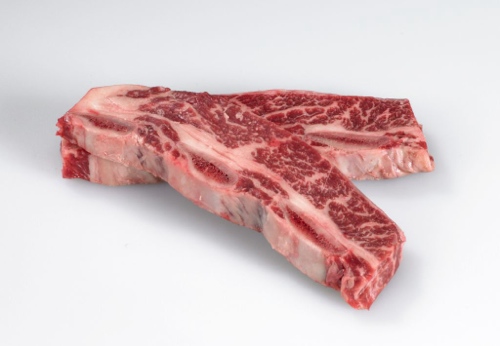
Beef Short Ribs
This cut used to be a tremendous bargain, until every chef in the world decided to make them popular. Now, they can often be pricier than they’re worth – If you see other cuts for much less, buy those. Short ribs come from the bottom end of the rib cage, or plate cut. Short ribs are not a tender cut and really shouldn’t be grilled or barbecued; they need low and slow braising or smoking to really shine. The cut can be fatty, so trim as needed before you cook. A quarter pound appetizer and half pound entrée will do the trick.

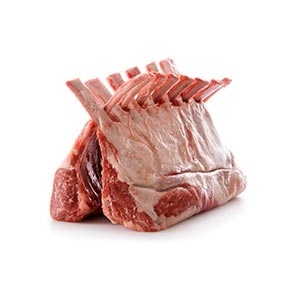
Lamb Ribs
A full rack of lamb contains eight ribs. The ribs themselves are really quite skimpy, so the chop is typically left attached;you’ll find them offered as rib chops or as a whole rack. The racks are a fairly famous cut and make a great roast. Fancy stuff has been done with these for many moons, like cutting the rack into 3-3-2 and tying them tips up as a crown roast, or trimming the meat at the tips of the chops back to the bone, which is the famous French chop or rack. A double French rack is two racks tied tips up back to back. If you’re not familiar working with the lamb rack cut, make sure to ask if the chine, (backbone), between the ribs has been cut, so that the roast is easy to carve. If you’ve not cooked a lot of lamb before, be aware that it’s usually quite a bit gamier than beef and pork. The heart of the gamy flavor is fat, so trim appropriately if you’re not comfortable with that. Soaking lamb in buttermilk for at least 2 hours and as much as overnight will help a lot to tame the game and keep them moist and juicy. While you can certainly cook and serve single rib chops, you’ll get a much juicier result if you leave them as doubles; you can then cut them into singles for an appetizer and leave them doubled as an entrée.

Game Ribs
Then there’s game; I’ve personally had and cooked venison, elk, boar, buffalo, bear and ostrich. The first thing to remember with game ribs is to use them; I don’t know how many hunters and cooks I’ve known who don’t even consider this, but we all should. First off, if you harvest, you’ve got the responsibility not to waste, and that’s a biggy. Seconly, if you love game, ribs can and should be a signature taste of the beastie. As with lamb, game ribs can be gamy, so trim the fat, if any, and marinate. Buttermilk works great here, but wine and herb, or a nice flavorful brine will shine as well. Keeping in mind that fleet-footed game like deer and elk are quite lean to begin with, so marinating will do a lot to keep things tender and juicy.


Here’s a wet rub and BBQ sauce that will go great with any of the above.
This recipe will serve for a couple of racks of ribs.
We’ll do a low and slow cook with a grilled finish for knockout flavor.

2 Tablespoons extra virgin Olive Oil
1/4 Cup Honey or Agave Nectar
2 Tablespoons Smoked Sweet Paprika
1 Tablespoon cracked black Pepper
1 teaspoon Onion powder
1 teaspoon granulated Garlic
1 teaspoon Sea Salt
3-4 Shots Tabasco or dried Chile Powder
Optional: 1 teaspoon Smoke Powder

Preheat oven to 225° F.

Rub ribs generously with the olive oil.

In a mixing bowl, combine the honey, paprika, pepper, onion powder, garlic and Tabasco or chile powder, and the smoke powder if you’re using that. Rub evenly over the ribs, taking time to work it on to all surfaces.

Wrap racks, meaty side down, in a large piece of metal foil (The wide, heavy duty stuff does best; if you’ve got light weight stuff, double it). Seal the edges of foil with a double fold.


Cooking Stage 1, oven low and slow.
Cook smaller, more delicate ribs like baby backs for three and a half hours; the bigger ones can go four hours.

Preheat grill on high, then reduce heat to low with lid open. If you’re just using your oven, leave it at 225° F.

Remove ribs from oven and drain off any excess drippings. Carefully flip ribs over to bone side down, using a big grilling spatula or two smaller ones. Your ribs should be at the pint where they’re starting to fall off the bone, so be gentle.

Trim the foil back to so you’ve got a baking sheet kind of affair, with a 3/4″ inch lip of rolled foil all the way around the ribs, to catch juices and keep the sauce in place for the remainder of the cooking.

Apply an even, thick layer of sauce to the meat side with a basting brush.

Cooking Stage 2, sauced and grilled, (or not)
Transfer ribs to the grill if you’re going that route.
Cook on low heat, with the lid down, for 20 to 30 minutes more.

If you’re using the oven for the whole job, cook uncovered for 20 to 30 minutes more.

Remove from oven and serve promptly with more sauce, house made potato salad, and baked beans.

A nice local Pilsner, Lager or dry white wine is the perfect accompaniment, refreshing your pallet and cutting through the fat for that next juicy rib.


Try this amazing cranberry powered sauce; folks are gonna make yummy noises and ask “what IS that?” in a good way…

Eben’s Cranberry BBQ Sauce

1 bag Cranberries
1 Cup Sweet Onion
1 bottle Porter or Stout
1 large Navel Orange
1/2 Cup dry Red Wine
1/2 Cup Balsamic Vinegar
1/2 Cup Honey or Agave Nectar
1/3 Cup Worcestershire Sauce
1/3 Cup Soy Sauce
2 cloves Garlic

Peel and dice onion, peel and mince garlic. Zest and juice the orange.

Use a nice, fresh local Porter or Stout.

Throw everybody into a large stainless steel sauce pan over medium high heat and blend well.

As soon as the cranberries start to pop, reduce heat to achieve a nice, steady simmer. Allow to simmer for 1 hour, stirring occasionally.

Process sauce with an immersion blender, or carefully transfer to a blender, if that’s what you’ve got. Be very careful if you use a blender; process in batches and watch out for the hot sauce. Process until the sauce is uniform and smooth. If you don’t have an immersion blender, AKA. A motor boat, go buy yourself one for Christmas, they’re indispensable.

If you like your sauce a bit chunkier, as we do, you’re done; if you like it smoother, run the sauce through a strainer once.

Transfer to a glass bowl or jar and refrigerate for at least 4 hours prior to use, to allow the flavors to marry and the sauce to finish thickening.

And remember, save those piles of bones for making pork or beef stock; they’re way too good to toss!

Brines, Marinades, Rubs, and Glazes


Here in the Great Pacific Northwet, it’s beginning to look like maybe, just maybe, it’ll stop raining one day. As such, it’s time to think about grilling again. When we do that, there’s a veritable cornucopia of cool things to do with the stuff we grill, like brines, marinades, rubs, and glazes.

First things first, though – Time to clean and inspect your grill, before you light the fires – Here’s a pretty good primer for that.

Next question, how are you grilling? In a big way, the answer to that question will determine what to do before your food hits the fire. Grilling is, for most of us, far less controlled than cooking in an oven or on a stove top. As such, knowing how to properly set up a charcoal grill, or use a gas one, makes a big difference to your end results. The back end of this Char Siu post has clear directions for setting up a two zone charcoal grill.

Brines, marinades, rubs and glazes will all contribute to the food we grill, especially proteins and veggies. Some of those contributions will alter proteins by tenderizing, or add moisture to help foods that tend to dry out in high heat stay juicy, and all these potions can add big flavor punch when you want or need it. What’s best depends on what’s cooking.

Brining is, in simplest term, utilizing a salt solution to add internal moisture to foods that have a tendency to dry out when grilled – It’s also a great way to add some subtle flavor notes from herbs and spices. Poultry, pork, and firm fish like cod, salmon, and swordfish do especially well with a brine. This little primer will give you some great base knowledge and ideas.

Marinades combine an acid and a base, just as we do for vinaigrettes. Marinating can take anything from a few minutes to days, depending on what you’re working with. Marinades generally carry bolder flavor profiles than a brine does, although those flavors may or may not get as deep into a protein, veggie, etc, depending on how long they work. Beef works great marinated, as do some of the gamier meats like lamb, game, and field poultry. A general search on the site here will provide a bunch of options from which you can springboard to your own thing.

A rub can be either dry or wet, and is what it sounds like – Where marinades are meant to get deeper into the meat somewhat as a brine does, rubs sit on top and do their work right there. Salt and pepper are most common, and fact is, if you’ve got a really lovely fresh protein or veggie, may be all you need or want. More stuff can certainly be added, and doing so can help a bunch in forming a nice crust on your food, and sealing in moisture on that relatively hot grill. Here’s a bunch of ideas to get you started.

Finally, we’ve got glazes. Generally speaking, glazes employ some sugar or an analog, and maybe some fat, like butter, which are integral to making things stick to your food. They also are quite prone to burning, however, so glazes are generally done last, and watched closely to make sure they do their thing properly. M came home with some incredibly pretty local pork chops, which prompted this whole post. I decided to wing a sweet and sour glaze for those bad boys – Here’s what I came up with.

Sweet and Sour Pork Glaze

1/4 Cup Balsamic Vinegar
1/4 Cup Ketchup
1 Tablespoon Honey
1 teaspoon Yellow Mustard
1 teaspoon Dark Molasses
1 teaspoon Worcestershire Sauce
1 teaspoon granulated Onion
1 teaspoon granulated Garlic
Pinch Lemon Thyme
Pinch Sea Salt

Combine all ingredients in a non-reactive mixing bowl and whisk to incorporate thoroughly. Allow to sit for 15-20 minutes at room temp for flavors to marry.

Bast pork with glaze liberally in the last 3-5 minutes that it’s grilling, and keep a close eye on things so the sugars don’t burn.

Feel free to leave some at table as well.