Parmigiano-Reggiano Stock


You might call it Parmesan, but it really is Parmigiano-Reggiano, ya know. It is arguably the most popular of Italian cheeses worldwide, and rightfully so. When you tase the real deal, aged between 24 and maybe 48 months, the depth and breadth of flavor notes is stunningly good. Maybe, subconsciously, that’s why so many of us save the rinds, even if we don’t do anything with them – the stuff is so damn tasty, we just can’t bear to throw out the ‘inedible’ part. Fear not, I say, because thankfully that inedible thing is hogwash. Last spring, I wrote about stuff you can do with the rinds, but somehow, I missed making stock – time to fix that.

Real deal Parmigiano-Reggiano comes from the five provinces that are allowed to call the stuff by its proper name – Parma, Reggio Emilia, Modena, Bologna, and Mantua. Sorry, but anything else from somewhere else is just cheese. The outer most layer of a wheel of Parmesan Reggiano is the place where all the interaction with the outside world has occurred, while inside, that miraculous cheese matures. The rind hardens, forming a barrier to keep bad things out while allowing moisture to leave the cheese over time. When we buy it, we obviously want a reasonable ratio of rind to cheese. Don’t go too far on that, though, and definitely save rinds, because parmigiano rind stock is liquid heaven.

Parmigiano stock, made with aromatics, herbs, plenty of rinds, and simmered low and slow is the ticket. What you get will be redolent with the scent, taste, and umami powered mouth feel only Parmigiano-Regiano can provide. It is the stuff for staples like Italian wedding, white bean, or minestrone soups. Use it to cook beans low and slow and the results are truly ethereal. Freeze it in resealable ice cube trays and add it to pan sauces or veggies. Cook rice with it and prepare to swoon – no, I’m not bullshitting – it really is that good.

Best of all, it’s incredibly simple to make. There’s a lot of versions out there – This is my take on it, powered by soffritto, the legendary Italian aromatic base, with fresh herbs. Try it the way I’ve written it, then tweak your next batches to your liking, and make it truly yours.

Note: if you’re not a rind saver, you’ll find that quite a few retailers now sell them by the pound – so long as the initial quality is good, and they’ve been properly kept, you shouldn’t hesitate to buy them that way. If you do save them, refrigerated in an airtight container is fine – they’ll last for months.

Urban’s Parmigiano-Reggiano Stock

1 Gallon (16 Cups) fresh Water

1 Pound Parmigiano Rinds

1 large Sweet Onion

2 fresh Carrot

2-3 stalks Celery

6-8 fat cloves fresh Garlic

1/4 Cup Extra Virgin Olive Oil

8 sprigs fresh Oregano (2 Tablespoons dry)

6 sprigs fresh Thyme (1 Tablespoon dry)

1 Tablespoon Tasmanian Pepperberries (regular old pepper is fine, but not nearly as complex)

2 Turkish Bay Leaves (not California!)

Peel and quarter the onion, smash and peel garlic, rough chop carrots and celery.

Add the olive oil to a heavy stock pot over medium high heat, and heat through.

Add onion and carrots and fry for 2-3 minutes.

Add the garlic and celery and continue cooking, stirring occasionally, until the onion is lightly browned, about 3-4 minutes.

Add the water to the veggies and allow to heat through until the stock starts to simmer, about 6-8 minutes.

Add the all remaining ingredients and stir to incorporate.

Once the stock comes to a boil, reduce to a bare simmer, uncovered.

Simmer for at least 2 hours, and up to 4, stirring occasionally to make the sure the rinds don’t stick, and to test the strength of the stock.

When the stock smells strongly of parmigiano, is slightly cloudy, and everything other than the absolute outer hardest layer of rind has gone into solution, you’re done.

Pour the stock through a colander and send all the non-liquid stuff to compost.

If you’re finicky, you can further clarify the stock through cheesecloth, but frankly, who bother? This is good, rustic stuff in your kitchen, not something done for presentation at a white linen restaurant – live a little and let it be.

Cool stock to room temperature. Store in clean glass jars with enough headroom to not break the container when freezing, about 2”. Also do some up in ice cube trays for smaller batch fun.

Stock is fine refrigerated for 3-4 days. If you want to hold it longer than that, freeze it – it’s good there for a couple of months.

Spaghetti alla Carbonara


In 1972, my family spent a month touring Italy. We stopped, of course, in Perugia, where my older sister was studying abroad, at the Università per Stranieri di Perugia. We stayed at a hilltop hotel with a rather large dining room. One night, Ma and Pa went out by themselves, and my older Bro and I had dinner there – That was the first time I experienced Spaghetti alla Carbonara.

The plates were, for a 12 year old, huge. A lady at the table next to ours showed us the right way to do things – grab some pasta with a fork, spin that into the bowl of your spoon, then pop that lovely stuff into your mouth. The stuff was stunningly good, and it became an instant favorite for me, but try as I might, I couldn’t finish. First the waiter looked appalled, and asked if I didn’t like it. I denied this, just said it was too much, but the process was already underway. Next came the head waiter, then the maitre d’, and finally, the Chef. With all these guys gesturing and beaming, I finished that damn plate. Ever since, I’ve been more judicious about my intake, and well that I should be – This is seriously rich stuff.

Carbonara is another of those fascinating dishes that are hard to pigeonhole. It’s a Roman thing, in all likelihood – and the locals have heartily embraced it as such. It’s delightfully simple, stemming from the pasta/cheese/pepper family of dishes, like cacio e pepe – maybe more like pasta alla gricia, since carbonara must have cured pork to be authentico. While the roots go way back, this is not an old dish. Carbonaro means ‘charcoal burner,’ and lead to the sobriquet, ‘coal miners pasta,’ but that is probably poetic license.

Carbonara appeared in Italy post World War II, because quite frankly, there was little or no eggs or bacon in that war torn collection of city states prior to the war. There was plenty of both afterwards thanks to the presence of American GIs and their vast supply stores. I think the Carbonara moniker came about because pepper and diced bacon kinda look like coal, if one is being imaginative. This line of reasoning is substantiated by the notable absence of the dish in Ada Bono’s seminal 1930 work, La Cucina Romana – If carbonara had been part of the scene, I guarantee it would have been in her book – and it did appear in Elizabeth David’s 1954 edition of Italian Food. In any event, Italians loved it, and so did the GI’s.

Like any seminal dish, there are a lot of potential rights and wrongs around making Carbonara, I mean come on – it’s Italian cooking, OK? In Italy, 90% of the time you encounter it the meat will be guanciale, the pasta will be spaghetti, the cheese will be Pecorino Romano, and the only other ingredients will be eggs, black pepper, and salt – anything else will be received akin to putting pineapple on their pizza.

Guanciale

Guanciale is worth checking out, but it can still be a bit hard to find here in the states. It is cured pork from the jowl or cheek, notably porkier and fattier than bacon or pancetta. The magic lies in the fat, which melts beautifully when it’s cooked, adding marvelous depth of flavor and mouth feel to a dish. Americans tend to use bacon for Carbonara, which is fine, really, especially if it’s really good bacon – sure they frown on this in Italy, but even pancetta can get you looked at funny over there. I think you should use what you like, but trying a cured pork product you’ve not had before should be on your dance card.

While the pasta you deploy doesn’t have to be spaghetti, it should be something with a hefty surface to volume ratio – that’ll allow the simple and relatively small amount of sauce involved to fully deploy. Folks have been known to double the sauce and use something like penne, and while that would technically be wrong, I’d snarf it down.

Pecorino RomanoParmigiano Regiano

The cheese should be Pecorino Romano, but if you like parmigiano regiano, use that – Just know that they’re very different things – Pecorino is a salty, sharp, almost smoky sheep’s milk cheese, while Parmesan comes from cows – it’s nuttier and funkier stuff.

If ever there was a dish that wanted the best, freshest eggs you can find, this would be it. The taste and the appearance of the dish depend on great eggs, because they constitute most of the sauce – a watery, pale supermarket egg is not going to make great carbonara. Most cooks use whole eggs, while some employ only yolks, and either is fine, really.

As far as other stuff in carbonara goes, everything I’m about to mention does not go into the dish according to purists, and I feel strongly that you try the traditional dish at least once – After that, do what you like – it’s your kitchen. Some folks deploy a little cream in their sauce. Veggies from peas to broccoli and leaks to mushrooms have made their way into the mix. One thing you must never, ever do, however, is buy and eat anything from the store called ‘carbonara sauce’ – knowing what is likely in that stuff to make it shelf stable, it should be obvious that it’s not something you want in your pasta.

Mise en place for Spaghetti alla Carbonara

Spaghetti alla Carbonara

1 Pound Dry Pasta

4 Large Eggs

8 Ounces Guanciale, (Pancetta or bacon are fine too)

1/2 Packed Cup Pecorino Romano Cheese

1/2 Packed Cup Parmigiano Regiano Cheese

Fresh Black Pepper

Cut your pork into roughly 1/2” cubes.

Grate cheese.

Fill a large pot with 5-6 quarts of water, then add 4 tablespoons of kosher salt and bring to a boil over high heat.

Add the spaghetti, allow the water to return to a boil, then reduce heat to maintain a rolling boil.

Cooking Spaghetti alla Carbonara

Boil pasta until it’s al dente, about 6-9 minutes.

In the largest skillet you’ve got, sauté the pork over medium heat until the fat is rendered out and the meat is crisp, about 3-4 minutes. Turn off the heat and slide the pan off of the burner.

Crispy pork for carbonara

Reserve 1 cup of past water, then drain the pasta into a colander.

Egg and cheese mix for carbonara

Crack the eggs into a small mixing bowl, then whisk – add the cheese and whisk to fully incorporate.

Slide the skillet back onto a burner on medium and let it heat back through for a minute.

Add the pasta and half the reserved pasta water and use a couple of forks to incorporate that with the meat and fat – a lot of the water will evaporate and that’s OK.

Spaghetti alla Carbonara

Pull the skillet off the heat again, then add the egg and cheese blend and the rest of the pasta water, and use the forks to quickly incorporate everything – work quickly to get the pasta coated with the egg and cheese mix, and take care that the eggs don’t sit on the bottom of the skillet and scramble – if you get a little of that effect, don’t worry – we’re all human, it happens, and it’ll still be delicious. It’s your kitchen.

Spaghetti alla Carbonara

Season the pasta liberally with fresh ground black pepper, take a picture, then portion onto plates or bowls and serve pronto. Every time I spin a fork full of this lovely stuff, I’m right back in that dining room in Perugia.

Spaghetti alla Carbonara

Boston Brown Bread


If you’re from New England, and specifically Boston, you know all about Boston Brown Bread – Pared with Boston baked beans and fresh cole slaw, it’s graced many a Saturday night supper throughout New England.

The B&M company, not to be confused with the huge British food conglomerate, has been making baked beans and brown bread for over 150 years, and there’s a reason they’re still around doing just that .

A lot of folks, even locals, think that B&M is a Massachusetts based enterprise, but it ain’t so. Way back in 1867, George Burnham started a canning business and was joined by Charles Morrill – and Burnham & Morrill was born. B&M has been a fixture in Portland, Maine at One Bean Pot Circle, ever since.

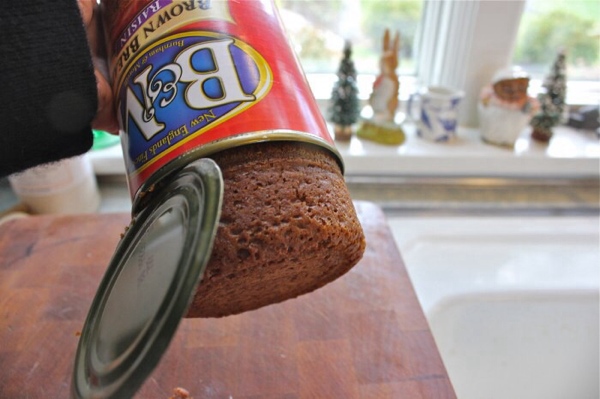
Their rightfully famous beans are still slow cooked in brick ovens, and their brown bread is The One, as far as I’m concerned. Brown bread cans are filled with batter and the product is baked therein – and that’s just how you can do it at home.

In the 19th Century, Brown Bread was poverty food throughout the British Empire, although it eventually gained cache for the health benefits of the mixed flour used to make it. It eventually crossed the big pond and became a staple for the colonists, then a sentimental favorite. Keeping in mind that lobster was also once considered ‘poverty food,’ I don’t think there’s a stigma attached to liking brown bread.

Boston Brown Bread is a great recipe for folks who are nervous about bread baking – It’s easy, fast, and almost foolproof – Brown Bread is steamed, rather than baked, and requires very little prep time.

If you’ve never tried it, do. Served hot with fresh butter, ham, baked beans, and cole slaw, you got that legendary Saturday Night Suppah – And it’s great the next morning, too.


Boston Brown Bread

1 Cup Whole Milk

1/2 Cup Whole Wheat Flour

1/2 Cup Rye Flour

1/2 Cup Corn Meal

1/3 Cup Dark Molasses

1/2 teaspoon Baking Soda

1/2 teaspoon Baking Powder

1 teaspoon Vanilla extract

1/2 teaspoon Allspice

1/2 teaspoon Orange Zest

1/2 teaspoon Sea Salt

1 Tablespoon Butter for greasing cans

NOTE: there are folks, (even B&M), who make this with raisins or currants within – I’m not one of them, but if you are, you can add a quarter cup to this recipe.

there are also purists who pull eschew the addition of flavorings such as vanilla, allspice, and orange zest – I’m not one of those, either.


Rinse and dry two 28 Ounce metal cans with one end of each cut off.

Move a rack to the bottom third of the oven and heat the oven to 325° F.

Choose an oven safe pot or dish deep enough so that you can fill it with water to about halfway up the sides of the cans. Boil enough water on the stove top to fill that pot or dish.

Lightly coat the insides of the cans with vegetable oil.

In a mixing bowl, combine wheat flour, rye flour, cornmeal, baking soda, baking powder, allspice, and salt.

Add the molasses, milk, vanilla and zest to the dry ingredients and thoroughly combine.

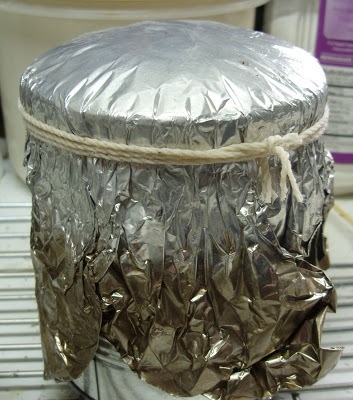
Divide the batter evenly between the prepared cans. Cover the top of each can with a double thickness of aluminum foil and tie securely with kitchen string. Place the cans in your deep pan and slide that into the preheated oven.

Carefully fill the pan with boiling water to about halfway up the sides of the cans.

Bake for 70 to 75 minutes. At seventy minutes, remove the foil tops. When the edges of the bread begin to pull away from the sides of the cans, you’re there.

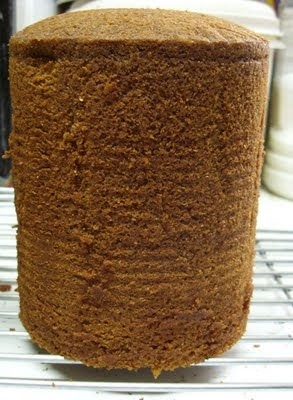
Remove the cans from the oven, place on a wire rack to cool for 1 hour before sliding the bread out of the cans. If the bread is a bit sticky, a thin bladed knife run around the can will free it up.

Don’t forget to have plenty of fresh, local butter on hand…

Split Pea Soup


Great ingredients make great soup

If you’ve ever lived in the southern part of the U.S.A., then you’ve likely experienced the tradition of eating black-eyed peas, (AKA, Hoppin’ John), on New Year’s Day – Doing so is believed to be not only a harbinger of prosperity in the new year, but a pretty decent hangover cure as well. Other anointed foods for New Years include pork, corned beef and cabbage, whole fish, and even ring shaped eats.

Here at UrbanMonique, we went to bed quite early on New Year’s Eve, but we still like to hedge our bets. As such, we decided it was a perfect night for M’s stunningly delicious split pea soup. That decision was made all the easier by the fact that we had leftover ham from Christmas, (including a gorgeous bone), and some amazing pea stock we froze back in the summer after harvesting snap peas from the garden. Split pea soup kinda gets a bad rap for the same reason Brussels sprouts do – Lackluster cooking, or overcooking, leads to less than stellar results – We’re here to shatter that reputation.

Ham glam shot
Ham glam shot

I hail from New England, where split pea soup has always been quite popular. Legend has it this dish was introduced to the region by southward migrating Québécois, but the ubiquity of split peas throughout many cultures may dispel that. Cultivars of Pisum sativum have been favored by humans for millennia – Romans and Greeks were growing them as far back as 500 B.C.E. – Given their propensity for far flung travel and conquest, it’s a safe bet they got them from somebody else. And in any age before modern food preservation, it’s a sure thing that drying peas was standard practice, as it still is today.

Harkening back to my comment about lackluster versions of split pea soup, it’s no surprise, frankly, when we recall the old rhyme, ‘peas porridge hot, peas porridge cold, peas porridge in the pot nine days old.’ Lets face it, if that was good eating, we’d all still be doing it. Starting out with high quality, fresh ingredients will quickly dispel that nightmarish vision. Your journey toward that end must start with the peas themselves. Many of us have a bag of the little green guys in our pantry, straight from the store – It’s just as likely that said bag of peas has been in your pantry since the Pleistocene era too, right? If so, that’s a problem right off the bat. Dried peas, beans, etc will last a very long time, if stored properly, but left in the original plastic bag and tossed onto a shelf in the pantry doesn’t qualify as ‘proper’. The main adversary for split peas is oxygen, and that’s the case for pretty much all legumes, pulses, etc. The solution is a decent quality, air tight container – With those in use, you can easily get 3 to 5 years of storage, and if you add an oxygen absorber, like Oxy-Sorb, which is specifically made for the purpose, you ou’ll easily extend your shelf life to 10 years or more. Oxy-Sorb is great stuff, cheap, and readily available, by the way – A 100 pack costs about ten bucks, delivered from numerous online sources, and big chain grocery stores sell it as well – Same goes for decent quality food storage vessels, (and frankly, you’d be hard pressed to do better than quart, half gallon, or gallon mason jars for that job.)

As with all great soups and stews, great split pea soup depends on carefully chosen components and a specific process of assembly. It is a simple dish, but nonetheless, there are definitive steps that need to be followed. As always, this begins with the essentials, (other than peas, of course) – That’s good ham with a nice, big bone, fresh aromatics, stock, and seasoning. As for the latter, all too often what’s used for split pea soup is what’s suggested on the plastic bag they come in, AKA, water. While water sure works, stock is so much better, and is key to great soup.

Homemade, great leftovers - All you need to get started.
Homemade, great leftovers – All you need to get started.

Vegetable or chicken stock will work great, and if you’ve been keeping up with class, then you’ve taken opportunities to make and freeze stock along the way. As mentioned previously, back in July we had a bumper crop of snap peas, and took steps to harvest and preserve those – In so doing, the inspiration for pea stock hit me and we made some – It was and is incredible stuff – a lovely translucent green, with a scent redolent of fresh peas, even when defrosted some six months later – There’s a testimonial to why we freeze, dry, can, or otherwise preserve great home grown food, if ever there was one, (That doesn’t mean you need to have matched us overachievers – Use what you’ve got – Homemade preferred, but store bought is just fine.)

And while we’re talking homemade, if and when you get a nice bone, never, ever throw it out. Sure, your critters will love ’em, but your house made stocks and broths will love ’em even more. As for aromatics – It’s a safe bet that in too many home kitchens, the carrots, onion, garlic, celery and the like might be a bit long in the tooth by the time you get around to using them – In a word, don’t do that. The French have it right when they go to the market almost daily – If it’s worth making and eating, it’s worth fresh ingredients – Don’t buy the big bags of bulk carrots, onions, etc – Go to the market frequently, and poke, prod, smell, and look when you shop – Reject the rubbery, the off colored, or too soft, and carefully pick fresh stuff – That is one of the real joys of shopping, so take advantage.

And finally, there’s seasoning. I’ve said this before and will again – If you’re buying herbs and spices from the grocery store, you’re missing out. If you’re using spices from a cute little revolving wheel thingy, and the spices came with that, and you got it when you got married, you’re fired. Herbs and spices have very bit as much a shelf life as other foods, and less so than some – they’re good for 6 months or so, if they’ve been prepared and stored properly. If your wheel o’ spices is out where sunlight hits it on a regular basis, your stuff is toast and needs to be replaced. If it’s not from a high quality source, like World Spice, Penzeys, Pendereys, to name just a few, you’ve no guarantee that what your buying is up to snuff – And finally, never use my sainted Father’s wine buying plan when it comes to spice – The more you get for less dough is not a successful strategy.

So, with all that, here’s the scoop.

M’s Heavenly Split Pea Soup

4 Cups Vegetable or Chicken Stock
2 Cups Water
2 Cups (about 1/2 pound), Ham
1 nice big Ham Bone
1 Pound dried Split Peas
2 large Carrots
3 stalks Celery
2 Tablespoons chopped Shallot
3 cloves Garlic
1 Lemon
1-2 Tablespoons Parsely
1 teaspoon Lemon Thyme
1/2 teaspoon ground Pepper
1/2 teaspoon crushed red Chile
1/4 teaspoon Sea Salt
2 Tablespoons Avocado Oil.

In a stock pot over medium high heat, combine water, stock and the ham bone. When the stock begins to boil, reduce heat until its barely maintaining a simmer. Allow the stock and bone to simmer for 60 minutes.

An hour or so of simmering will properly marry the flavors of pork Bone and stock

Rough chop ham, cut carrots into half-rounds about 1/4″ thick, chop celery, dice shallot and mince garlic.

Aromatics, the heartbeat of great soup

Zest lemon, cut in half.

Place peas in a single mesh strainer and rinse under cold running water, checking for non-food detritus.

Rinse and inspect pease before deployment!

In a soup pot over medium heat, add oil and heat through. Add carrot, celery, and shallot. Sauté until the shallot begins to turn translucent.

Always sauté your aromatics first!

Remove Bone from stock and allow to cool, then give it to your dawg.

Add stock, water, ham, and split peas to soup pot with aromatics over medium heat. Stir to incorporate. When the soup starts to boil, reduce heat to barely maintain a slow simmer. Simmer soup for 1-2 hours, until the split peas are where you like them – just slightly al dente is the sweet spot.

Great split pea soup should look like what it's made from, not mush!
Great split pea soup should look like what it’s made from, not mush!

Add parsley, lemon thyme, a tablespoon of lemon zest, pepper, Chile, and salt. Stir to incorporate and taste, adjust seasoning as desired. Allow the soup to simmer for another 10 minutes.

Add the herbs and spices last so they don't lose their floral qualities
Add the herbs and spices last so they don’t lose their floral qualities

Serve nice and hot, garnished with a little more fresh lemon zest and shot or two of hot sauce if you like such things. A dollop of fresh sour cream doesn’t suck, either.

M's Heavenly Split Pea Soup
M’s Heavenly Split Pea Soup

Serve with crusty bread and a glass of decent Zinfandel, and you’re in hog heaven.

Cornbread, Old & New


I’ve said it before and I’ll say it again – Recipes aren’t really meant to be repeated exactly, time and time again – Even when you’re the one who wrote them. They’re a springboard to further exploration, and nothing more. After thanksgiving, there must be turkey soup with home made stock, and that begs for accompaniment by something delightful – like cornbread, for instance.

Let us pause to consider from whence this stuff came. Cornbread is largely seen as a southern culinary thing, but its roots go far beyond those boundaries. Our modern versions harken back in the 1600’s, when European interlopers adapted some bread making techniques to the new cereal the natives had introduced them to, (and had been cultivating, starting down in Mexico, for something around 10,000 years).

Nowadays there are regional variances in style, and it’s interesting that those are almost diametrically opposed to what we see with biscuits – The farther south you go, the cornbread gets more rustic and less cakey, often with little or no added sugar and very little flour, (in fact, sometimes none at all). Meanwhile, while up north and out west, while not exactly flaky, you find a sweeter, more floury version. White cornmeal, closely akin to masa, is more popular in the south, yellow up north. Those southern differences may have to do with the prevalence of Mexican regional cooking, and the proximity to the origin point of the cereal itself, while up north, European influences speak loudest. That jibes with my personal experience as well – Growing up in Massachusetts, I remember cornbread as overly sweet and therefore, not much to my liking. When M and I moved to Texas, I found what I was looking for – Something that’s a bit more savory, and highlights the natural sweetness of corn without adding sugar or other sweeteners to the mix.

In any event, cornbread isn’t something we make super often, so when we do, it can fairly be considered a treat. In that light, one should consider what it is you most want out of the stuff. For me, that means as moist as I can get it, while still being firm and grainy with genuine cornmeal flavor.

For a good few years now, I’d landed on a cheddar version that we like a lot. I’ve taken to soaking the corn meal in milk or cream as a critical step, and in fact, doing that does make notably moister bread. Grinding my own cornmeal fresh, from local, organic corn was even better.

Then, as fate would have it, a measuring malfunction lead to a new twist, or at least, new to me – I’d put too much cornmeal in the mix. Once I realized it, I balanced everything back out, but found I was out of the heavy cream I’d used for the dairy, so I thought – what the hell, why not throw in some sour cream?

The second part of this tiny epiphany had to do with the chosen fat for the batch. I’ve used, and advocated here, leaf lard and/or butter, but all of a sudden, I thought about biscuits, and realized that what has really made my current version sing is avocado oil. If you haven’t tried that yet, it’s not really avocado-y in taste at all, just very subtle and buttery – Perfect for cornbread. Since I’d putzed around so long, I didn’t bother with the dairy rest for the cornmeal, (and it turns out that, with this version, I didn’t need it.) And as fate would have it, what resulted was what M happily anointed as ‘far and away, the best cornbread you’ve every made’ – High praise, that, believe you me.

So I made a second batch, to make sure the recipe worked, then made one the old way, for comparison. What that does is give y’all a couple of options. In the picture below, the old recipe is the batch to the left, the new one to the right. First off, I assure you, both are fully cooked, and neither has had anything done to it other than being sliced. You can see how dense, moist, and almost muffinish the new recipe is, while the old one is lighter and airier. I like them both a lot, but M was right – The new stuff is heavenly.

Old style to the left, New to the right

Urban’s Old Standby Cheddar Cornbread
1 1/2 Cups Corn Meal, (yellow or white)
1/2 Cup All Purpose Flour
1/2 Cup grated Sharp Cheddar Cheese
1 Cup Whole Milk
4 Tablespoons Leaf Lard (or Unsalted Butter)
1 Egg
2 teaspoons Baking Powder
1/2 teaspoon Sea Salt

Optional: 1-2 seeded and cored Jalapeño chiles

Preheat oven to 400° F

Pour cornmeal into a bowl and add the milk; mix well and allow to sit for 15 minutes.

Mix remaining dry ingredients, (Including the cheese), in a large bowl.

Melt shortening, then combine all ingredients and mix by hand to a nice, even batter consistency.

Place the pan(s) you’ll do the bread in into a 400 F oven, with a small dot of shortening in each pan, (Or a tablespoon full if using a single pan).

When the shortening is melted and sizzling, remove the pan, pour in the batter and return to the oven.

Bake at 400° F for 20 to 25 minutes, or until golden brown.

What Monica calls the best cornbread I’ve ever made

Urban’s New Deal Cornbread
1 1/2 Cups Cornmeal
1/2 Cup All Purpose Flour
1/2 Cup Heavy Cream
1/2 Cup Sour Cream
1/2 Cup shredded Extra Sharp Cheddar Cheese
4 Tablespoons Avocado Oil
1 large Egg
2 teaspoons Baking Powder
1/2 teaspoon Sea Salt

Preheat oven to 400° F and set a rack in the middle position, with the pan your going to bake in thereupon.

Combine all dry ingredients and mix thoroughly.

Add the cheese, egg, dairy, and oil, and whisk into a uniform batter.

Carefully remove the hot baking pan and rub a little avocado oil around the inside, without burning yourself.

Pour the batter into the baking pan and return it to the hot oven.

Bake for 30-35 minutes, until golden brown.

Cranberry Citrus Granita


Granitas are a lovely, light alternative to ice cream or sherbet that contain no dairy at all and are super simple to make; if you’ve never tried one, it’s time. This version highlights the tart sweetness of cranberries and citrus and is, quite frankly, stunningly pretty.

We’re highlighting cranberries ’cause we typically just haul them out for the holidays, but that’s not right, (but go ahead and do so now, OK?) Cranberries are incredibly tasty, make gorgeous food, and are darn good for you as well. They’re not only rich in Vitamin C, but have excellent infection fighting properties as well, as anyone who’s had a urinary tract infection knows. Cranberries contain compounds known as condensed tannins, which are potent antioxidants with known anti-inflammatory properties. Cooking does not degrade tannins, so here’s a delicious little fruit that’s remarkably healthy even when we do stuff to ’em. Here’s how you granita.

1 Cup Water
3-4 fresh Navel Oranges
1 each fresh Lemon and Lime
1 1/2 Cups Cranberries, fresh or frozen, washed and sorted
1/2 Cup Agave Nectar or Honey

Thoroughly rinse cranberries and citrus. If your citrus has been waxed or treated, put them whole in a bowl containing ¼ cup white vinegar mixed with 4 cups cold water. Allow them to soak for about 15 minutes, then rinse in fresh water and dry with a clean towel.

Zest all citrus, then juice each into separate small bowls or cups.

In a heavy bottomed sauce pan over medium-high heat, add;
The water,
Cranberries,
1 cup of orange juice,
1 teaspoon lime juice,
1 teaspoon lemon juice,
The agave nectar or honey,
1/2 teaspoon of orange, lemon and lime zest.

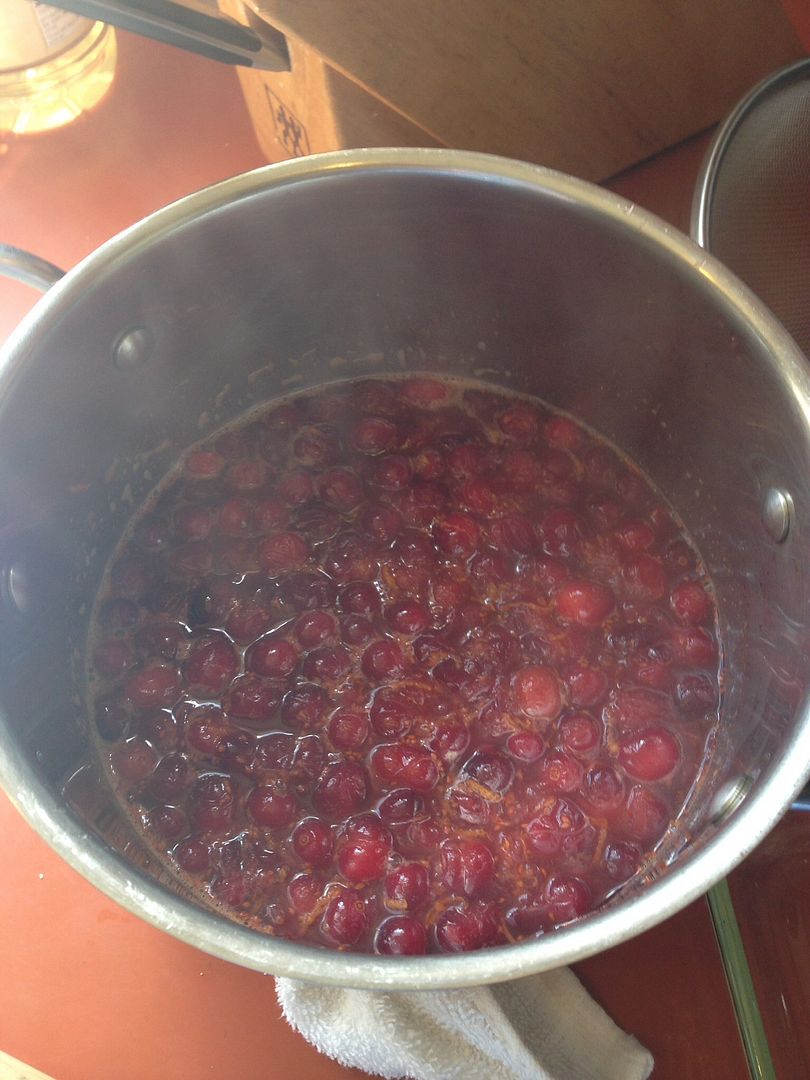
Heat to a fast simmer, stirring occasionally, until the berries start to pop, (about 5 minutes).

Remove pan from heat and purée the ingredients with a stick blender; be careful, the blend holds heat well and is sticky.

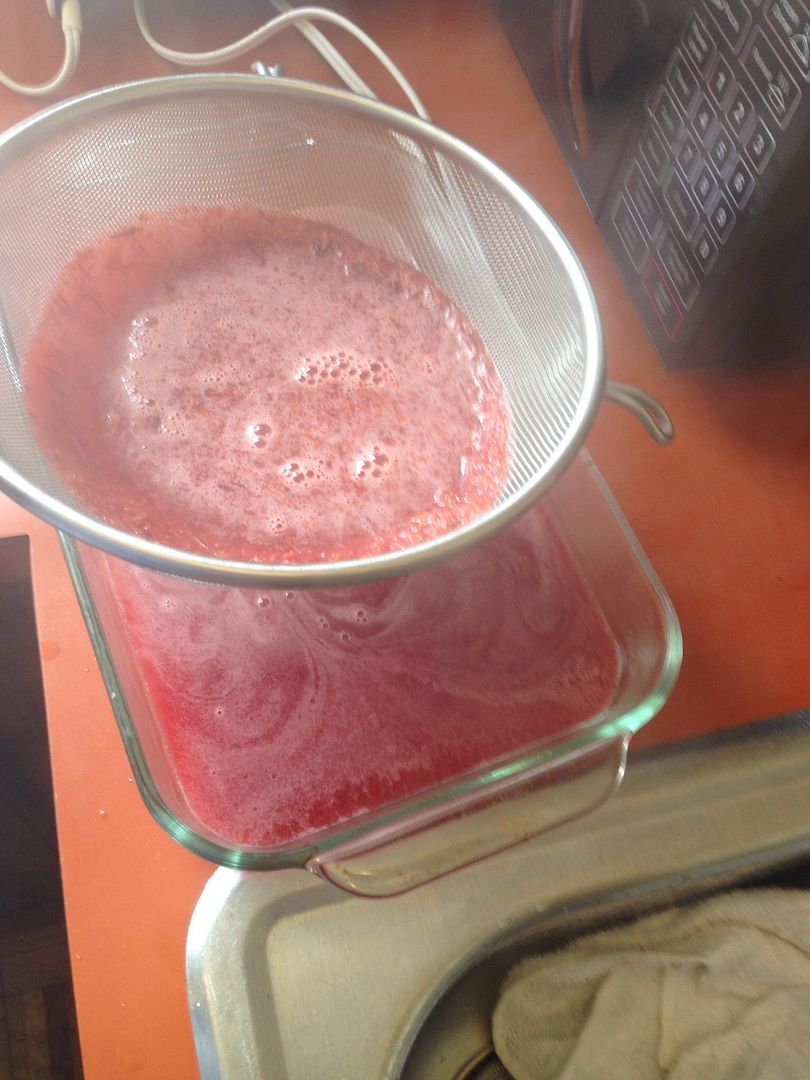
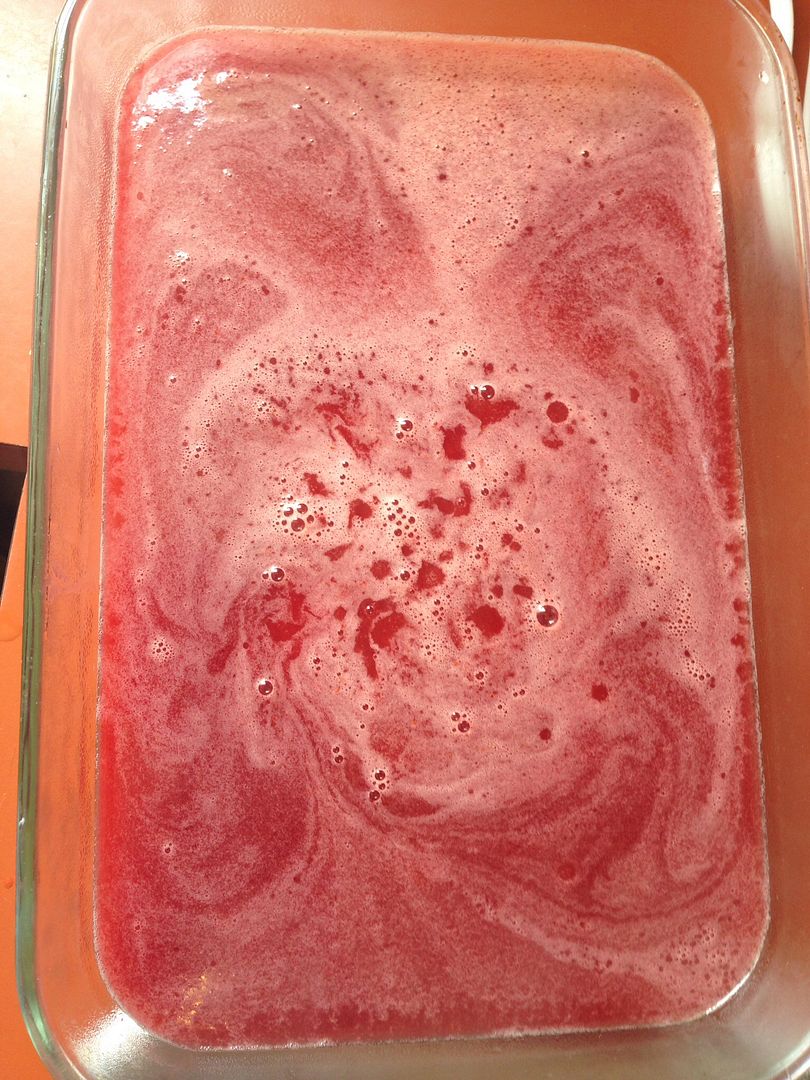
Carefully pour the mixture through a steel mesh strainer, into a glass baking pan, (around 9″ x 12″ is right, and a half cookie sheet with sides will work if you don’t have the pan).

Press gently on the mix with a spatula; you’ll end up with some skins and zest that won’t make it through the strainer.

Slide the pan into your freezer for at least 4 hours, (and overnight is fine), along with 4 margarita or Marie Antoinette champagne glasses. Freeze until the granita is completely set.

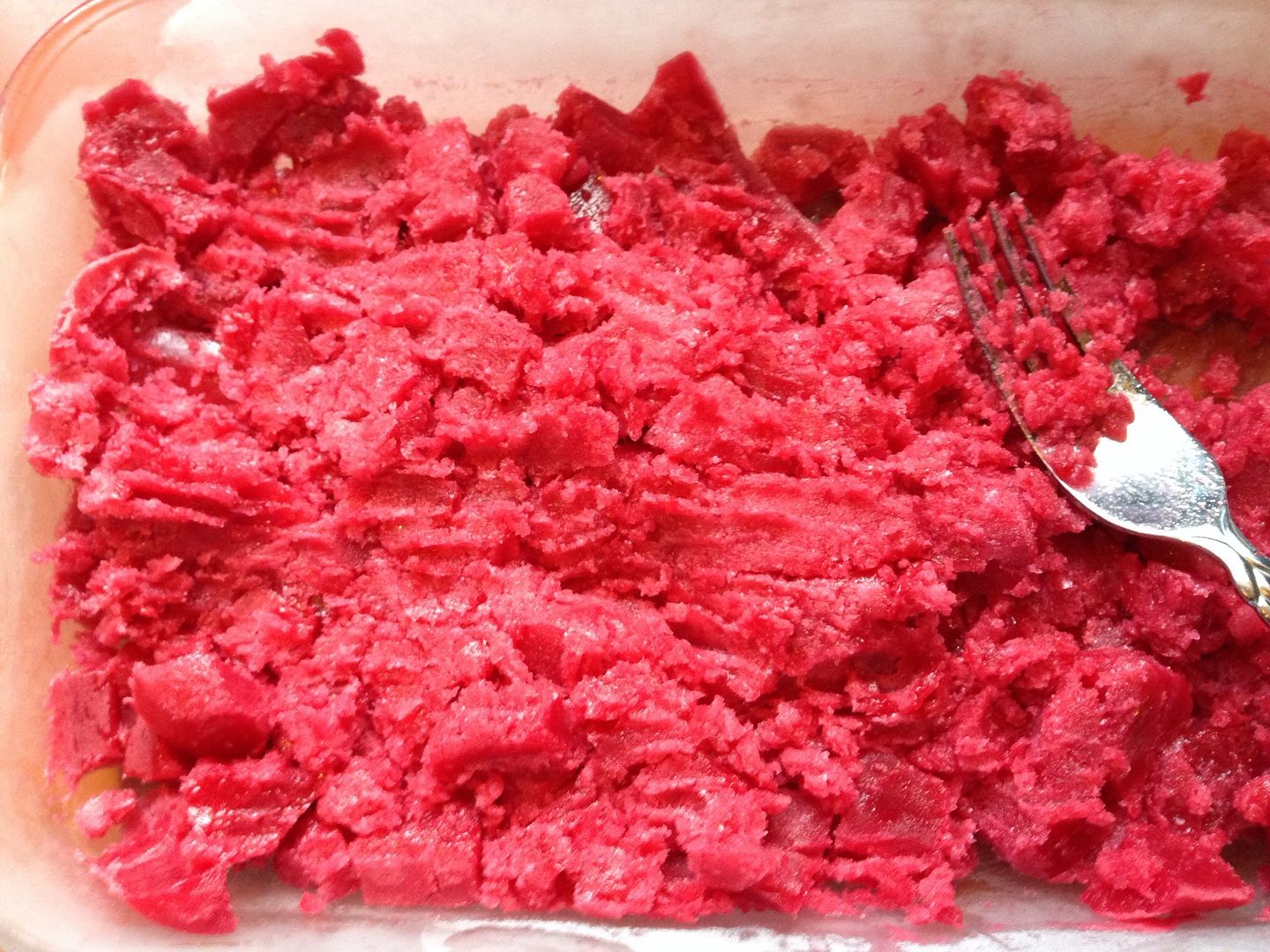
Scrape the granita carefully towards with a fork while holding the pan steady, until you’ve got a nice shaved ice consistency.


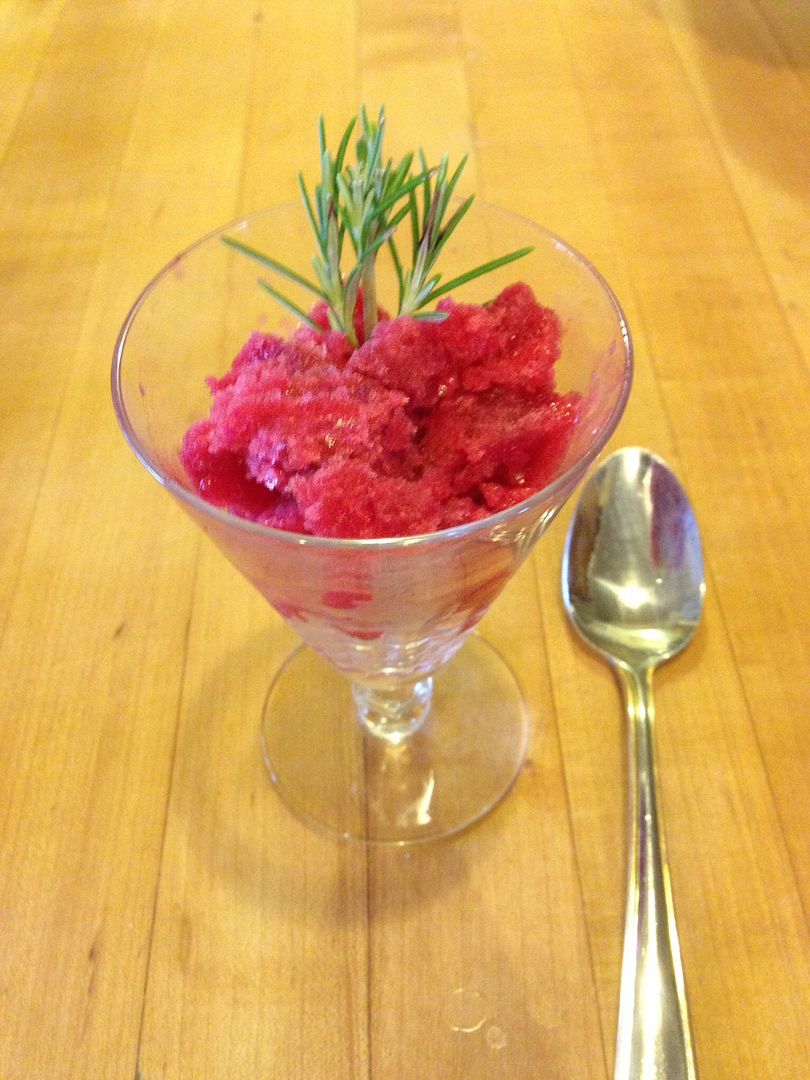
Scoop granita into the chilled glasses, garnish with a Rosemary sprig, and serve immediately.

Et voilà!