Oops


“Cooking is creating a big fucking problem and learning how to solve it”

Craig Thornton


“Learning to cook like a great chef is within the realm of possibility. However, it is something that is rarely taught; it must be caught.”

Karen Page & Andrew Dornenburg


“Great chefs rarely bother to consult cookbooks”

Charles Simic


Forewarning; this piece is a muse, albeit one that does contain a recipe. Bear with me, I promise you it'll be worth it. It's really about Craig Thornton's quote above; one of the most succinct and honest evaluations of what cooking is all about. I put the other two up because they have bearing on what I'm going to talk about as well; I'll tell you why shortly. Onward.

So, I made shortbread last night. I dig shortbread. I'm part Scots. I've easily made shortbread a thousand times in my life. I screwed this one up. I was building my own recipe, which is something I often do, but this one, I blew. It was chocolate almond shortbread. I did a couple things extra in creating it, and changed a process step as well. It didn't come out very well. Shortbread is so simple, trained weasels could make it; hence one of my favorite quotes – 'Great cooking is almost always simple, but not always easy'. If you're wondering about the quote source, it's me. I said that a few years back.

I've always been an intuitive chef. I cook from heart and hip. That said, any good and curious cook is going to want to read what others know. I started, long ago, with Irma Rombauer, Julia Child, and James Beard. Over the decades, I've read hundreds of books about food and cooking, and gleaned great ideas and inspiration from many, but the list of what I consider truly go-to cooking books hasn't expanded all that much. Since my deepest cooking roots are French, I added Auguste Escofier, Larousse Gastronomique, and Saulnier & Brunette. Harold McGee, Claudia Roden, Marcella Hazan, Diana Kennedy, and Michael Ruhlman have also joined that initial group of three. These are the sources that I return to, time and again, when I'm stuck for ideas.

Charles Simic, while a wonderful poet, isn't a great chef to my knowledge, so my guess is that he was snowed by the ego of someone else when he said great chefs don't consult cookbooks. When it comes to our basic repertoires as a chef, we generally can do it in our sleep; we need no consultation for that, or for most variations on familiar themes. That said, we're all human, and pressure, fatigue, boredom, or a myriad other things can cause any chef to blow the easiest of recipes, just like I did.

What Page and Dornenburg refer to is nothing more than passion, in essence. On top of that, you need chops and practice. From knife skills to standard practices, classic combinations to the ability to turn out food at a high level of quality and at speed, all takes a lot of work. What I do now professionally isn't haute cuisine by any sense of the word. Yet I tell youngsters who are obviously interested in food and possibly in a career, that there is much they can learn in our little cafe. Repetition, focus, mis en place, attention to details, producing consistent quality under significant time pressure – All these things will stand you well in any professional kitchen, and all of them can sink you if you don't have them down pat. Fast casual isn't fine dining, but a busy lunch, one that runs around $3,000 to $4,000 over 2 hours time, turning out plates that retail for roughly $12 each is a lot of work. Get used to that, and the pressure won't seem such a daunting thing, regardless of what genre you work in down the line.

Those constraints really aren't any different for a home chef. Whether you're turning out food for your family or for guests, there's certainly pressure to perform; no cook wants to make bad food, and no cook wants to see or hear other people disappointed in what they've made. For an inexperienced chef trying new or complicated things, that pressure can achieve critical mass. My Sis is a spectacular cook; she's written cookbooks, and she's always a wizard in the kitchen – She blew exactly one meal I'm aware of, back in the '60s, and fact is, she still gets razzed about it from time to time…

A few of you know that I make and play guitars. I build instruments the same way I cook, grounded in basics and science, but definitely from the artistic side. As a musician, I've played professionally for several years. There are definite parables in cooking and musicianship, in a couple of critical regards;

Many people think they can cook as well as a Pro, and many people think they could play on stage; in most cases, they're wrong – If it was easy, everybody would do it. It's not. It takes passion, dedication, practice and persistence; that's what makes it so rewarding when we succeed, and such a joy to pursue.

Many beginners in either pursuit quit before they have a chance to be good; in either case, it's often reaching too far too fast that causes that. You're not going to be able to cut a perfect dice the first time you pick up a knife, and you're not going to be able to play the lead riff from Reeling in the Years after your first guitar lesson.

Those things said, I think it's important to keep in mind that not everyone has to be great, nor wants to be. Good is often good enough. Sound in the basics that really interest you may be all you have time and energy for, and that's just fine. I tell new guitarmakers the same thing I tell new cheesemakers; anybody can make good cheese, (guitars), with a little knowledge and effort – To consistently make really great cheese or guitars takes a significantly greater investment. Wherever you lie on that spectrum is an OK place to be.

Certainly at some point, chefs discover or invent. Ferrari Adrià is widely hailed as the Founder of molecular gastronomy, but Harold McGee wrote his book long before Adrià was big on the scene. Granted, McGee isn't a chef, and Adrià was clearly the first Chef to turn it into an art form and create one of the most successful restaurants in the world. Thomas Keller didn't invent haute cuisine, he's just way better at it than all the rest of us.

Before I started this blog, writing about food and cooking for magazines, and talking about it on live radio, I was a great cook, but I didn't write down my recipes. If you'd asked me back then how I did something, I'd look blankly at you for a moment and then answer, “I dunno, I just did it.” When I was 15, I became a ski instructor. I remember Danny, one of the guys who taught me to teach, saying, “Man, you really tore up those bumps, I mean you ski really well!” I mumbled a thanks, and then he said, “How'd you do it? 'Cause if you can't explain that, you can't teach.” Bingo, the light bulb came on…

I've had to learn how to make recipes that are accurate, repeatable, clearly explained, and that make great food – If I couldn't do that, we wouldn't be here now.

So back to Craig Thornton's blisteringly honest synopsis, and what happened with the shortbread – What did I do to understand and fix my mistake? It turned out that my ratio calculations weren't correct, and I didn't handle the butter correctly, so I tossed the bad batch and made another that came out just right.

When I was composing the recipe, I didn't subtract some flour in lieu of the added almonds, so my wet to dry ratio was off. I also didn't handle the butter correctly. Shortbread wants relatively warm butter creamed into the sugar with a spatula. Doing that allows the sugar crystals to form tiny air bubbles in the butter, and those allow the shortbread to rise when it's baked; skip this step, and you get the denser finished product I made first. It was good, but not good enough to post here and pass on to y'all. I needed that ethereal, melt in your mouth shortbread. I adjusted my ratio, and altered my method to get what I wanted.

For the record, the word 'Short', has very specific connotations in baking. Short bread/cake/etc, implies a specifically high ratio of fat to flour. These doughs and batters are always non-yeast raised, and characteristically produce a rich and crumbly finished product. Thorough and properly executed incorporation is critical to achieving great results.

The moral of this ramble is that you can become a good, or even great chef if you want to, but don't ever doubt that even great chefs make mistakes, some times on simple things. They also certainly do study their errors in an effort to understand their mistakes and avoid them in the future. Anybody who says otherwise is pulling your leg. Here's that recipe – It's a subtle, complex shortbread that's not too sweet.


Chocolate Almond Shortbread

1 Cup Whole Wheat Pastry Flour

1/2 Cup raw Almonds

1/2 Cup sweet cream Butter

5 Tablespoons Bakers Sugar

2 Tablespoons Dark Cocoa Powder

1/4 teaspoon Sea Salt


Have butter at or near room temperature.

Preheat oven to 350° F.

In a skillet over medium, toast almonds until lightly browned.

Remove from heat and place in a food processor; process until reduced to a rough meal consistency.

In a mixing bowl, combine butter and sugar; cream with the side of a spatula until evenly mixed.

In a second bowl, combine flour, cocoa, salt, and almonds and blend throughly.

Add sugar/butter Belen to dry and mix by hand until thoroughly incorporated.

Press dough into a 9″ x 9″ baking pan, (or thereabouts – you want the dough about 3/4″ high). Prick the dough evenly across the entire surface, all the way through its thickness; this allows excess steam to escape and promotes flat, even baking.


Bake at 350° F for 12-15 minutes, until shortbread looks dry and has pulled away from the pan edges slightly.

Remove and cut into 3″ squares. Allow to cool before serving – Really hot shortbread is delightful, but it's also molten, so beware!


Coffee & Dark Chocolate Crème Brûlée


If it seems that I'm dessert obsessed lately, I sorta am. Fact is, my recipe files were sadly lacking in desserts, and an honest assessment lead to the realization that my chops were too – So I'm out to fix that; suffer through it if you can.

Crème Brûlée, Crema Catalana, Flan, Créme Caramel, and Burnt Cream, is essentially a custard. While many variants add the hard caramel or burnt sugar top, there's nothing at all wrong with putting that caramel on the bottom, and/or making it liquid rather than hard. Some might argue that this would not technically be a brûlée, based on the contention that theFrench verb form brûlée literally means 'to burn'. I'd counter that making a caramel is more or less burning sugar, hence such arguments are quibbling at best.

Crème brûlée in its more or less modern iteration first appeared in a 17th Century cookbook by François Massialot, though he is not the originator of the dish; regardless of claims, custards go back farther than Chef Massialot did. Interestingly enough, a later edition of his cookbook changed the name to Crème Anglaise, a pouring custard not usually associated with this dish. Later iterations fully anglicized the name to Burnt Cream. The derivations mentioned above come from England, Spain, Portugal, and Mexico. There are certainly other names for what is a quite universal treat, and whatever you call it, it's delicious.

The classic version is flavored only with vanilla; remove the chocolate and coffee, and reduce the sugar by one tablespoon from our version below, and there you are. That said, it'd be a shame not to try the full Monty as we did.

For the Crème

2 Cups Heavy Cream

6 Egg Yolks

2 Tablespoons fresh ground Coffee

5 Ounces 60% Cacao Chocolate

3 Tablespoons Bakers Sugar

1 teaspoon Vanilla Extract


For the Caramel

2/3 Cup Bakers Sugar

1/4 Cup brewed Coffee

1/4 teaspoon Vanilla Extract

Pinch Sea Salt


Have ramekins right at hand.

In a sauce pan over medium high heat, add brewed coffee and reduce by 50%. Add sugar to reduced coffee and combine thoroughly. As blend starts to melt, reduce heat to medium, add vanilla and salt, whisking steadily. When the blend is smooth and consistent, pour equal measures into the bottom of each ramekin and tilt to coat the entire surface. Set ramekins aside. Note: blend will foam quite a bit when vanilla and salt are added, so be careful with heat, removing pan from burner when necessary to keep things under control.

Preheat oven to 300° F.

In a heavy sauce pan over medium heat, bring cream to a simmer.

Remove from heat, stir in ground coffee, cover, and allow to steep for 15 minutes.


Run cream mixture through a double mesh strainer, or doubled cheesecloth, returning steeped cream to sauce pan, and discard the coffee grounds.

Over medium heat, scald cream, (heat until small bubbles form around the edge of the pan); remove from heat.

Place chocolate in a steel or glass mixing bowl; pour cream over chocolate and allow to steep for 5 minutes.

Gently whisk cream mixture into the chocolate. Go slowly and feel the process out so that the chocolate doesn't seize. Set aside.

In a large mixing bowl, combine egg yolks, sugar, and vanilla; whisk to incorporate.

Add the cream and coffee blend to the egg mixture and combine thoroughly; go slowly – you want to combine without adding air bubbles to the blend.

Divide mixture among 6 ramekins or custard cups; you want to fill each to within about 3/4″ of the tops.

Place ramekins in a baking dish as or nearly as tall as they are; leave about an inch of space around each ramekin.

In a kettle or pan, boil enough water to fill the baking dish to at last 3/4 the height of the ramekins.

Note: I violated my no bubbles rule, as you can see – They're purely a cosmetic issue, so…
Bake until custards set around the edges, but still jiggle a bit in the center when gently shaken, about 40 to 50 minutes.

Remove from oven and leave in the water bath to cool; when cooled to room temp, transfer to fridge and cool at least 2 hours before adding caramelized sugar top.

When ready to serve, run a thin knife around the edge of a custard, then quickly invert onto a desert plate.


Mocha Hazelnut Tart with Caramel Drizzle


Mocha hazelnut tart with sea salt


We roast our own coffee at home, as recently described herein. This morning, when M was handling brewing duties, the smell of that freshly roasted and ground coffee was intoxicating. I noted hints of sweet things, like cocoa and roasted nuts, and right then and there a tart made with coffee, chocolate, and hazelnuts popped into mind.

As I started to compose the recipe, a couple of things came to mind. The first was the best way to assure that those amazing coffee attributes made it into the finished product. That’s when I figured that steeping the ground coffee in cream would work to maintain the subtler notes that you might lose, were you to just use brewed coffee. I was right; the coffee aroma and taste that resulted was absolutely heavenly.

For the chocolate, a ganache seemed to make sense; it’s been around since the 18th century, though it’s arguable whether it was the French or the Swiss who first came up with the idea. Ganache is an incredibly versatile thing, made by heating cream, pouring it over chopped chocolate, and allowing it some time to steep and warm through. The blend is gently whisked until smooth; extracts, liqueur, or spices can be added as well. The addition of butter imparts a shine and silky smooth texture to the finished ganache. The ratio of chocolate to cream is infinitely variable, imparting a wide range of finished densities. Here, I used what generally comes out to about 2:1 chocolate to cream by weight, which yields a proper density to fill a tart, make truffles, or use as a layer in a cake. A 1:1 ratio yields a much lighter product suitable for glazing. Cool a ganache and whisk it fairly briskly, and you add enough air to lighten it notably, resulting in an excellent frosting. Work slowly and steadily when incorporating the chocolate and cream, and you’ll find this to be a fairly anxiety free method. You’ll note that I don’t call for refrigerating this tart; you can certainly do so, but know that a chilled ganache becomes rather hard. You won’t lose too much flavor, but it will be quite the brick in consistency.

I also wanted this to be a treat that celebrated the more savory aspects of chocolate and coffee, as opposed to being cloyingly sweet; the entire tart recipe has slightly over a half cup of sugar in it. The rest of the sweet notes come through the coffee and dark chocolate, and the overall impression is a very well tempered treat. The caramel sauce contributes a highly controllable degree of sweetness; you can use none, a little, or a lot as your tastes desire.

The tart crust is the only baking you need to do, so it’s really pretty simple to make. I’d go so far as to say that if you’ve never explored making ganache before this will be a fun intro for you. I made this with fresh, local cream and butter; I’d recommend you do the same.

This is truly amazing stuff, incredibly smooth, complex, and powerful. It’s also wickedly decadent, not the kind of thing you just have laying around the shanty all the time. Or maybe you do. Slice it thin and savor every bite.


Mocha Hazelnut Tart with Caramel Drizzle


For the Crust –

1 Cup All Purpose Flour

1/2 Cup Powdered Sugar

4 Tablespoons Unsalted Butter

1 Large Egg

1/4 Cup Dark Cocoa Powder


Have all ingredients at or close to room temperature.

In a mixing bowl, add sugar and butter; whisk until well combined and creamy.

Add the egg, and whisk until thoroughly blended.

Add dry ingredients and fully incorporate.

Form dough into a ball, then flatten to a roughly 5″ disk.

Wrap in plastic and refrigerate for at least 1 hour.


Preheat oven to 350° F.

Sandwich the dough disk between layers of parchment or waxed paper, and roll it out to about 1/8″ thick, sized for a tart pan with a 3/4″ to 1″ lip.

Transfer crust to tart pan and press gently to fit. Trim any excess dough flush with the edge of the pan.

With a fork, evenly pierce the dough all the way through to the bottom of the pan, across the entire bottom of the tart.

Bake until tart looks somewhat dry and pulls away slightly from the edge of the pan, about 15 minutes.

Remove and allow to cool completely.


For the Ganache –

1 1/2 Cups Heavy Cream

10 Ounces Dark Chocolate, (64% to 72% Cacao is best)

4 Tablespoons unsalted Butter

1/2 Cup freshly ground Coffee Beans

1/2 Cup Hazelnuts

2 Tablespoons Bakers Sugar

Sea Salt


If you have a burr bean grinder, grind coffee beans on the coarsest setting. If you use a whirly blade grinder, pulse the beans to a rough grind and that’ll work. If, gods forbid, you have neither, carefully rough chop beans with a santoku or chefs knife.


Preheat oven to 350° F.

If you’ve bought shelled and skinned hazelnuts, place them on a dry baking sheet and roast them until lightly browned, about 12-15 minutes.

Remove from oven and set aside to cool. Once cooled enough to handle, carefully rough chop them and set aside.


If you have hazelnuts with the skins still on, (Which, by the way, are far cheaper than the former option), here’s the best way to completely remove those.

For every cup of hazelnuts, bring 2 cups of water to a boil in a medium sauce pan.

Add 3 tablespoons of baking soda and stir; note that the mixture will foam quite a bit.

Add hazelnuts and boil for about 3 minutes; don’t be concerned when the water turns quite black, it’s par for the course with this method.

Fill a mixing bowl 3/4 full of ice water.

Use a slotted spoon to remove a test nut and plunge it into the ice water. Gently rub the nut to see if the skin comes off easily; if not, let the nuts boil for another couple of minutes, then try again. Once you’re getting an easy peel, transfer all nuts to the ice water and peel away.

Wrap nuts in paper towels and dry thoroughly.

Roast and rough chop nuts as per above.


Have butter at room temperature.

In a sauce pan over medium heat, bring cream to a simmer.

Add ground coffee beans, stir well to incorporate, then remove from heat.

Cover the pan tightly and allow the cream and coffee blend to steep for 30 minutes.

Run cream blend through a double mesh strainer, then return the steeped cream to the sauce pan and discard the ground coffee, (layered cheese cloth will work if you don’t have a strainer).

Place sauce pan back over medium heat.

In a measuring cup, add 2 teaspoons of hot water to the sugar, stir well to dissolve, then add to the coffee cream, and bring the mixture to a simmer.

Rough chop chocolate, then add to a mixing bowl.

Carefully pour hot cream mixture over the chocolate, then allow to steep for 5 minutes.

With a whisk, gently combine cream and chocolate, (going too fast and hard will cause the chocolate to seize – take your time and feel out the proper pace).

When the mixture is about halfway incorporated, start adding the butter a tablespoon at a time; allow each batch of butter to fully incorporate before adding more. Continue whisking until ganache is smooth and glossy.

Pour ganache into tart crust; smooth the top with spatula or pastry knife.

Top with chopped hazelnuts and dust very lightly with sea salt.

Let sit at room temperature for at least 2 hours before serving.


For the Caramel Drizzle –

1 Cup Bakers Sugar

6 Tablespoons unsalted Butter

1/2 Cup heavy Cream

1/2 teaspoon Vanilla Extract

1/2 teaspoon Sea Salt


In a sauce pan over medium-low heat, combine sugar with 1/4 cup water. Stir steadily until sugar dissolves.

Increase heat to medium and boil without stirring, occasionally swirling the pan to aid even cooking. Continue until syrup is a deep golden amber, about 7–8 minutes.

Reduce heat to low; add the butter a tablespoon at a time and whisk to incorporate – Note that mixture will bubble vigorously, so be careful.

Slowly stir in cream, whisking steadily.

Add vanilla and salt.

Whisk until the caramel is smooth and creamy.

Remove from heat and let cool for 10 minutes.

Pour into a glass jar or small bowl.

Sauce will store for a week, refrigerated in an airtight glass container. Warm slightly before drizzling if stored.

Cut a nice slice of tart, drizzle a few lines of caramel over the top, and enjoy. You can make this a day ahead; the flavors will be fully developed, maybe even better than day one. One of my staff at the cafe commented after her first bite, “I’ve just seen God.” Now that’s a testament…


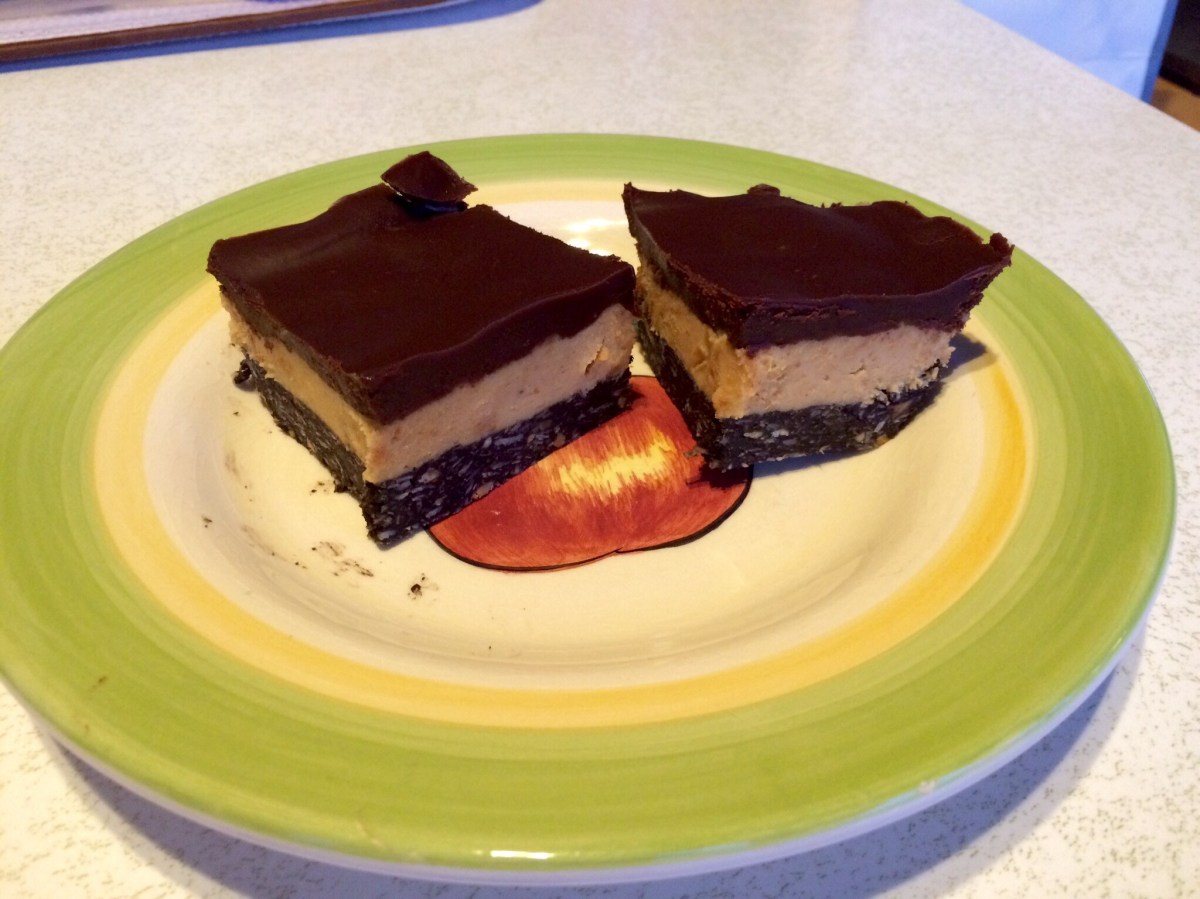
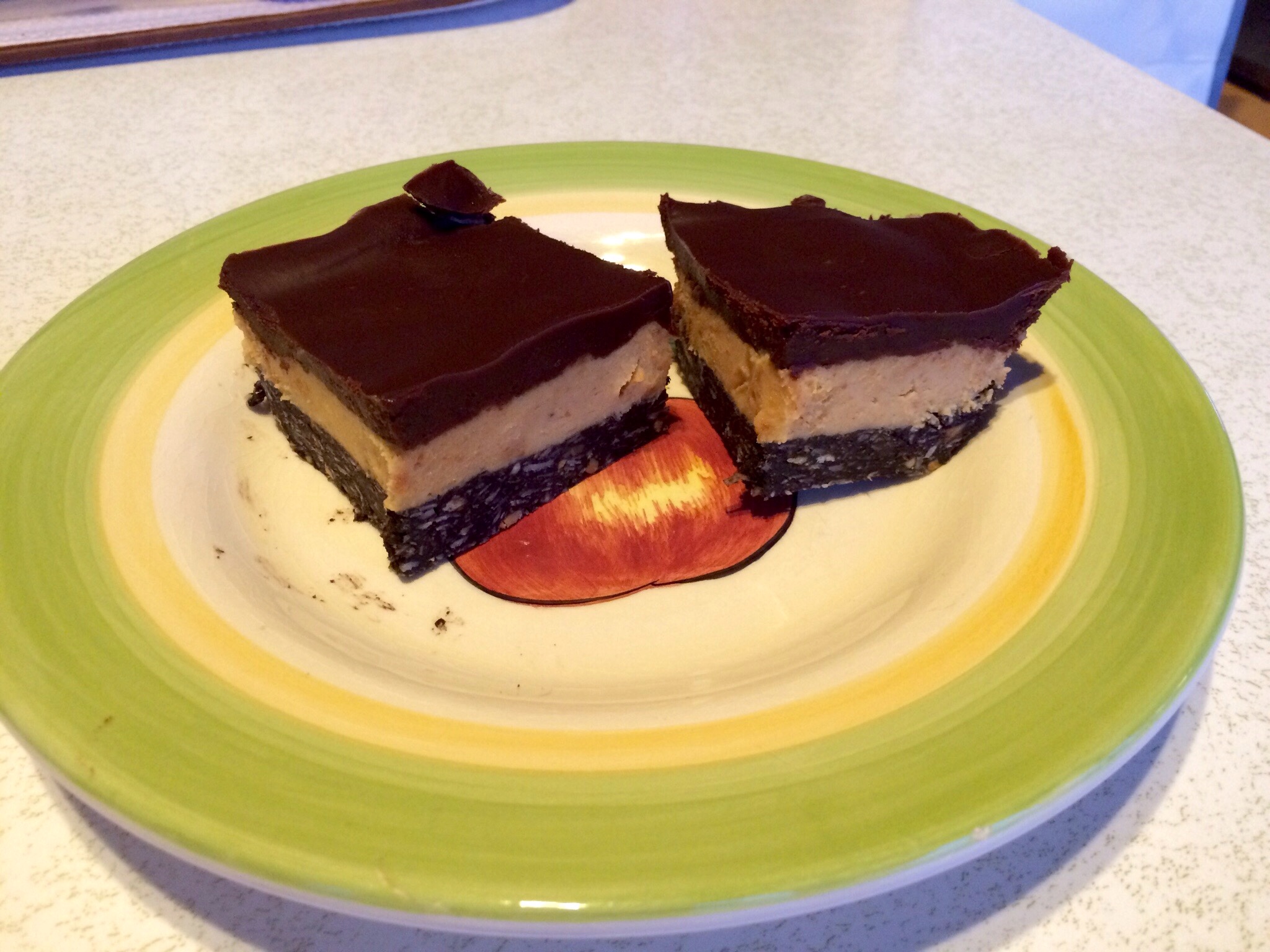
Peanut Butter Nanaimo Bars


By multiple requests, here’s my peanut butter Nanaimo Bar. Something this good demands local, fresh ingredients, so please, don’t skimp. As decadent as this is, the final product has an amazing balance of salty to sweet, accented by the almonds and the peanut butter. We enjoy ours with freshly brewed, French roast coffee.


Bottom Layer

½ Cup Unsalted Butter

¼ Cup Dark Brown Sugar

5 Tablespoons Cocoa Powder

1 large Egg

1 ¼ Cups Graham Cracker Crumbs

½ Cup Almonds

1 Cup flaked Coconut


In a sauté pan over medium heat, melt 1 ounce of butter, then add the almonds, and sauté until golden brown. Remove from heat and allow to cool.

In a food processor, add graham crackers and process to a rough crumb. Add the almonds and coconut and pulse to a fine, even consistency.

In a double boiler over hot, but not simmering water, melt and combine the butter, sugar, and cocoa powder.

Add the egg and stir gently but continuously, until the blend is thoroughly heated through and the begins to thicken.

Remove from heat, add the wet to the dry mix, and incorporate thoroughly.

Press the mixture into an ungreased 8″ x 11″ pan; your base layer should be roughly 1/2″ thick.

Slide the pan into the freezer while you work on the next layer.


Second Layer

½ cup Unsalted Butter

3/4 Cup fresh Peanut Butter

3 Tablespoons Sour Cream

1 1/2 Cups Powdered Sugar


In a large mixing bowl, combine all ingredients and whisk briskly to a creamy consistency. You want to incorporate enough air to notably lighten the feel. Taste and adjust proportions so that you taste peanut butter over sweet for this layer. Spread evenly over the bottom layer, then return to the freezer.


Third Layer

4 Ounces 72% Cacao Dark Chocolate

2 Tablespoons unsalted Butter

2 Tablespoons Sour Cream

Pinch of Sea Salt


In a double boiler over medium low heat, melt the chocolate. Cut the butter into roughly 1/2″ squares, add a couple at a time and let them melt and incorporate before adding more. Finally, add the sour cream and salt and whisk to an even consistency.

Remove from heat and allow to cool until the blend starts to thicken.

Pour and spread evenly over the second layer.


Chill the bars in the fridge for at least 2 – 4 hours before cutting into roughly 2″ x 4″ bars.


Bars will be good for at least a week refrigerated, but there’s no way on God’s green earth they’ll last that long.


Almond Biscotti


Almond Biscotti are a delight, but as with all things baked, best when they're fresh. That said, they're meant to be crunchy; if you ever thought that their consistency was somewhat akin to hardtack, you'd be right on the mark. Biscotti have their origins in the same vein as that staple of old time sailors. Initially, biscotti was a twice baked, fatless ration carried by the Roman Legions, meant to last for months if not years. The almond flavoring we use here harkens back to that original version. Nowadays, we often add a little fat to make them more toothsome, at the expense of longevity.

Make this recipe fresh at home and you'll never go back to store bought.


2 Cups Whole Wheat Pastry Flour

3/4 Cup local Honey or Agave Nectar

1/2 Cup slivered Almonds

2 whole Eggs

1 Egg White

1 Tablespoon Unsalted Butter

3/4 teaspoon Baking Soda

1 Vanilla Bean, (or 1/2 teaspoon pure extract)

1/4 teaspoon Almond Extract

1/4 teaspoon Sea Salt


Preheat oven to 350° F and set a rack in the middle spot.

Line a heavy gauge baking sheet with parchment paper and set aside.

Cut or process almonds to a rough chop.

In a saucepan over medium heat, melt the butter and sauté the almonds until slightly browned, about 2 minutes. Remove from heat and set aside.

Carefully slice the vanilla bean lengthwise. Scrape the seeds into a smaller mixing bowl. Put the pod into your sugar bowl to add a lovely vanilla note; you can also save the pod for a recipe that calls for a liquid and soak it therein.

In a large mixing bowl, thoroughly combine the flour, almonds, baking soda, and salt.

In a separate bowl, blend the vanilla, almond extract, eggs, egg white, and honey or agave.

Add the wet mix to the dry and combine thoroughly. This will be a rather dry dough. Turn it out onto a lightly floured surface and knead for about 15 seconds. Like a good pie dough, you just want to incorporate the ingredients and activate the gluten a bit; take care to not overwork the dough – 15 seconds kneading, max.

Divide the dough in two and roll each half out by hand to roughly 12″ length.

Place loaves on your prepped baking sheet and gently flatten them down to about 3/4″ thickness.

Bake for about 30 minutes, or until the loaves are firm and slightly springy to the touch.

Remove loaves from the oven, reduce oven heat to 325° F.

Place loaves onto a wire rack and allow to cool for 10 minutes.

Slide loaves onto a cutting board and slice each at a 45° angle and 1/2″ thick.

Place slices on an unlined baking sheet, then bake for 10 minutes.

Flip each biscotti over and bake another 10 minutes.

Remove from oven, place biscotti on the wire rack, allow them to cool completely.

Store biscotti in an airtight glass container. They'll last quite a while, but they're best if eaten within a few days of baking.


VARIATIONS:

Dip biscotti about half their length in the chocolate of your choice. Set them on a wire rack until the chocolate has hardened completely.

Add 1/2 Cup of dried cranberries, raisins, dates, apricots, or other dried fruit to the wet mix.