Tacos Birria


Birria, real birria, is a sublime beauty. Like so many fantastic regional Mexican sauces, there is a perceived, daunting complexity to the making, but birria is far easier than it looks or tastes, and it rewards with stunning depth and complexity. If you’ve ever enjoyed a really good red or black molé, the effect is similar. Birria hails from the state of Jalisco, which is more or less in the middle of the country on the Pacific side; it runs inland for nearly half the country’s width, some 30,000 square miles of beach, mountain, forest and plain, with altitudes from sea level to over 14,000 feet. Many things considered ‘Mexican’ by us gringos come from here, from mariachi and ranchero music to birria and tequila.

The popular nickname for people from Jalisco is Tapatio, a name hot sauce fans everywhere will instantly recognize. That, the competing hot sauce Cholula, and la Rojeña distillery, home of Jose Cuervo, are easily the most widely known constituents of Jalsciense food and drink, but there’s much more. Fish from ocean and lake, wild game birds, corn, beans, and a dizzying array of chiles are just the start. The Spanish introduced stock animals, dairy, and additional fruit and vegetables. All that bounty has lead to a rich and varied cuisine that blends the old and new in an ever-evolving melange. For classics, posole, menudo, and guacamole all have their roots here, as does birria.

Birria is arguably the state dish, served for special occasions and holidays. It, like posole and menudo, are also celebrated as hangover cures, (and you could do far worse for a morning after repast). Basically a stew, birria is most often found served in tacos, with pickled onions and lime from street carts, birrierias, throughout Mexico. Like any other long standing, legendary dish, the ‘correct’ preparation of birria varies widely. Traditionally, the meat is goat or mutton, marinaded in adobo spices, then married with chiles, tomatoes, onion, and spices. Here in the states, neither of those proteins is widely available, so the dish is made with beef or pork ribs, or even chicken.

Below you’ll find our take on birria; it’s pretty true to the original. If you go with beef ribs as we did, find a big package of the rough looking, inexpensive stuff – The long, slow boil will tenderize any cut, so don’t spend big bucks on short ribs, which are popular these days, and as such, stupid expensive.

I offer preparations for both homemade adobo and achiote paste as well. My understanding is that the latter is actually a Yucateco specialty, (From the Yucatan Penninsula), but it would not be much of a stretch for there to have been a cross-country trade in such things. Both of these are amazing when homemade – night and day from anything store bought.

When you’re ready to shop, locate a Mexican grocery or carniceria near you and make a visit. You will likely find all the spices and chiles you need there, (most of which are really inexpensive and already ground), and bitter orange juice, too. A carniceria will likely have great ribs as well. Don’t forget fresh tortillas either – 4″ or 5″ corn are best.

Again, this may look daunting, but I assure you it’s not. Assemble all the pieces on your kitchen table, stage ingredients, and enjoy the journey – It will be absolutely worth the effort. Make the adobo, achiote, and pickled onions ahead of the birria, so you’ll have plenty of time to build that at a leisurely pace. Several of the prep steps can be done the night before as well, so break things up if it seems like it’s too much in one swell foop. I strongly suggest you print this whole thing out and read it through it a time or two before you cut loose; it’s not hard, but there are quite a few moving parts…
Classic Adobo:

1/4 cup sweet paprika.

3 tablespoons ground black pepper.

2 tablespoons onion powder.

2 tablespoons dried oregano (preferably Mexican)

2 tablespoons ground cumin.

1 tablespoon chipotle chile powder.

1 tablespoon garlic powder.

Blend all ingredients throughly and place in an airtight spice jar. Adobo can be used as a dry rub, or moistened to a paste with bitter orange or grapefruit juices; each of the wet variants brings a whole new angle to the marinade. Apply to your chosen protein and allow to rest, refrigerated and uncovered, for at least 2 hours and up to overnight.


Achiote Paste
2 tablespoons annatto seeds

1 teaspoon cumin seeds or 1 teaspoon cumin powder

1 teaspoon black pepper or 1 teaspoon chipotle pepper

5 allspice berries

1 teaspoon salt

1 pinch nutmeg
NOTE: Annato is a colorant used to make cheese yellow, among other things; it will stain anything and everything porous it touches, (including your hands), so handle with care.

Put all ingredients into a spice grinder, and pulse until you’ve achieved a uniform, fine powder.

Transfer to a small mixing bowl, and add a tablespoon of cold water; mix into a thick paste that holds together well – For this recipe, 1 to 2 tablespoons of water is plenty.

You can place the paste into an ice cube tray, cover, and freeze it, and it’ll last a good 6 months; just pop out a cube when you need some. Refrigerating in an airtight container will last a good 90 days.

To use the paste as a marinade, blend a tablespoon of paste with 6 to 8 cloves of roasted garlic and 1/2 Cup of bitter orange juice, (also called Seville orange juice by some purveyors), or grapefruit juice.

Smear onto chicken or pork and allow to marinate for at least 2 hours and up to overnight.

Tacos Birria

3 Pounds Beef Ribs

5 mild Hatch or Anaheim Chiles

2 dried Pasilla Chiles

2 dried Ancho Chiles

1 12 oz. can Tomatoes

1 small Sweet Onion

4 cloves Garlic

12 black Peppercorns

1 tablespoon Achiote Paste

1/2 teaspoon Cumin Seed

Sea Salt

Freshly ground pepper
12 to 16 small corn tortillas.

Pickled sweet onions

Fresh Lime wedges


Pickled Onions

1 small sweet Onion (Red or yellows are fine if you prefer more bite)

3/4 Cup White Vinegar

2 Tablespoons Bakers Sugar

1/2 teaspoon Mexican Oregano

1/2 teaspoon Sea Salt
Refried Black Beans

1 12 ounce can Black Beans

1 Cup Chicken Stock

1-2 cloves Garlic

2 Tablespoons Butter

1/4 Cup Cream

Sea Salt and freshly ground Black Pepper to taste

Combine beans, stock, and smashed or pressed garlic in a pan over medium heat and bring to a boil. Reduce heat and allow to simmer while building the birria.

Drain beans and transfer to a skillet over medium heat. Smash beans with a fork or potato masher to a nice, rough consistency.

Add butter and whisk with a fork to incorporate.

Add cream and whisk to incorporate.

Season to taste with salt and pepper, reduce heat to low.
M’s Mexi Rice

1 Cup long grain white Rice

1 1/2 Cups Chicken Stock

1 Tablespoon Butter

1/2 teaspoon Chipotle powder

1/2 teaspoon Mexican Oregano

1/2 teaspoon Salt

1/2 teaspoon ground pepper

Combine rice, butter, and seasonings in a pot over medium high heat. Sauté the rice for 2 to 3 minutes.

Add stock bring to a boil.

Cover and reduce heat to low.

Simmer covered for 15 to 20 minutes until liquid is absorbed and rice is fluffy.

Remove from heat, leave covered and set aside until service.
The Birria

At least 4 hours prior to cooking, and up to overnight, prepare a wet adobo rub per instructions above. Evenly coat your meat, and allow to marinate, refrigerated and uncovered.

In a large stock pot over medium heat, add the ribs in tight layers. Season with a tablespoon of sea salt and cover with fresh water until you’ve got a couple inches over the highest ribs.

Bring the pot to a boil, then cover and reduce heat to low.


Skim the fat and foam that comes to the surface.

Boil ribs for 2 1/2 to 3 hours, skimming as needed; if the water gets down to rib level, add a bit more to keep them covered.

Rinse, peal, and thinly slice one of the sweet onions. In a mixing bowl, combine vinegar, sugar, salt and oregano, whisk to incorporate. Toss onions into the bowl and make sure they’re fully covered by the brine. Refrigerate for at least 2 hours and up to overnight.

If using whole dried chiles, put them in a small bowl and cover completely with water. Allow to soak for 30 to 60 minutes, until the chiles are soft and pliable.


Rinse, stem and seed Hatch or Anaheim chiles. Rinse, peel and quarter the remaining onion. Peel the garlic cloves and leave whole. Roast all those ingredients on a baking sheet under a broiler, turning once or twice, until chile skins are blistered. Remove from oven and hot baking sheet, and set aside to cool.

Prep Adobo and Achiote paste, per above.

When rib meat is tender and starting to separate from the bones, use tongs and transfer ribs to a colander for a 15 minute rest.

Reserve 1 1/2 cups of the rib broth, pour the rest off and return the pot to the stove, with the burner off.

Add peppercorns and cumin seed to a spice grinder and pulse to a smooth powder.

Remove reconstituted chiles from soaking water, then stem and seed them.

In a blender or food processor, combine all chiles, the roasted onion and garlic, tomatoes, pepper and cumin, and achiote paste. Pulse to a smooth consistency. Add a cup of the reserved broth and pulse to incorporate; you can add more broth if you prefer the sauce a bit thinner.


Place a single mesh strainer over the stock pot and run the sauce through, gently pressing by hand. Turn heat to medium. When the sauce starts to bubble, reduce heat to medium low and cook for 20 minutes, until the sauce thickens slightly.

Heat tortillas, wrapped in foil, in a warm oven.

Separate the rib meat from bones and fat, and hand shred.

Add the meat to the sauce, reduce heat to low, and cook for 15 minutes longer.


Season with sea salt and freshly ground black pepper to taste.


Serve three or four tacos, garnished with pickled onions and a couple lime wedges, refrieds, and rice.

Salut.

Purées


My Nephew Ian comes up with so many good questions that turn into posts, I should have him on the payroll… This time around, he asks “Was thinking about making a cauliflower purée – how do I do that so that it actually tastes good?” The question sparked the realization that I get a lot of questions about purèes, so it’s time to expand on the topic.

Most humans start out eating purées as their first ‘solid’ food; that may explain both the attraction as well as the reticence many adults have with the concept. A purée is basically a sauce, somewhere between a paste and a very thick liquid in consistency. Point of fact, several variants are things we eat quite often, like apple sauce and mashed potatoes. Others are a bit rarer, like the cauliflower Ian asked about. The term is, of course, French – it means to purify or refine, and it’s quite old – My research found references to it all the way back to the 1200s.

Achieving a purée isn’t difficult; foods can be blended, processed, ground or sieved to achieve the desired result. That means that those of you who don’t have blenders or processors won’t be left out – something as simple as a sturdy single mesh strainer, a masher, or an old fashioned potato ricer will work just fine for many foods; a large fork will work in a pinch, too.

When it comes to constructing a tasty purée, a little forethought goes a long way. Potatoes lend themselves selflessly to the process, while that cauliflower requires a bit more effort. In both cases, (as with most foods you purée), cooking is necessary; this achieves several things, from making a food purée-able, to arriving at the desired consistency, and improving overall flavor. Steaming is always a great first cooking choice as it preserves nutrient content better than boiling does. A slow, gentle simmer is another good choice. At a minimum, blanching prior to puréeing takes the raw edge off, and maintains nice, bright colors as well.

Next consideration is water content. You might think that the average spud has more water onboard than cauliflower does, but it ain’t necessarily so – cauliflower is around 92% water, while the potatoes are more like 79%, (root veggies are among the lowest water content of any of the common veggies, one reason they store well.) What that tells us is that the cauliflower is going to require some reduction in water content to achieve a good purée, while the spuds will need some moisture added. Here’s a handy reference for future use.

Next consideration is the overall taste profile – what you’re after with a purée. Foods that have big flavor right out of the chute, like apples and berries, or sweet peppers and fresh peas, don’t need a whole lot of reinforcement to make a great purée – A little spice in the former (cinnamon, vanilla bean, ginger for instance), a little seasoning in the latter (sea salt, fresh ground pepper, a touch of citrus), and you’re good to go. Working with a light touch in either example allows the food being puréed to shine without being overpowered. Now that cauliflower, well… There are certainly folks who like this veggie plain, but it’s a safe bet more of us like some serious augmentation – my version treats it pretty much like mashed potatoes, adding stock, dairy, and fresh herbs, as you’ll see below. Personally, I treat almost all root veggies that way – They’re big on starch and sugar, but can all use some help in the taste arena.

A few final thoughts. A purée is a nice change of pace, and a great way to insert a touch of flavor into every bite of a main course dish. Whatever you purée, a nice, smooth consistency is what you’re after – gritty or lumpy isn’t likely to float anybody’s boat – This is where stock and dairy, (cream, sour cream, butter, and yoghurt are all nice), really shine as an adjunct ingredient. Keep that textural change in mind; make sure there are plenty of other touches, like a little crunch, so that you’re presenting a nice, balanced plate. Consider something a bit outside the box when you’re ready to try one – The herbed blueberry version below goes great with pork or chicken, as a for instance.

Here’s a couple to get you started.

Cauliflower Purée

1 Head Cauliflower

1/4 Cup Vegetable Stock

2 Tablespoons Butter

1 Tablespoon Avocado Oil

1 teaspoon Lemon Thyme

1 teaspoon Sea Salt


Rinse cauliflower, pat dry, and cut into roughly 1/2″ chunks.

Place cauliflower in a steamer basket, within a large pot with about an inch of water therein.

Turn heat to medium high until water starts to boil.

Cover pot, reduce heat to low, and steam cauliflower until it mashes easily when tested with a fork, about 15 to 20 minutes.

Transfer cauliflower to a blender or processor. Add stock, oil, butter, lemon juice, and salt. Pulse until a nice, smooth consistency is achieved, about a minute.

Crush lemon thyme by hand and add; add a few twists of pepper. Pulse to incorporate, taste and adjust salt and pepper as needed.

Serve promptly.

Herbed Blueberry Purée

2 Cups fresh Blueberries, (frozen will do fine)

2 Tablespoons Agave Nectar

1 Navel Orange

4-5 leaves Fresh Basil (Cinnamon, or Christmas Basil is spectacular)

Pinch Sea Salt

Rinse blueberries, then toss them into a blender or processor and pulse to a smooth consistency, about 30 seconds.

Cut orange in half; zest and juice half, return the rest to fridge.

Chiffonade basil.

In a saucepan over medium heat, combine berries, honey, zest, juice of half orange, and salt.

Bring mixture to a boil, then reduce heat so blend is at a low simmer; cook for 10 to 15 minutes until blend has reduced and thickened notably.

Remove from heat, add basil and stir to incorporate. Allow basil to steep for 15 minutes as the mixture cools.

Pour the blend into a glass bowl through a single mesh strainer to remove solids and basil leaf.

You can serve just as it is, or allow to cool to room temperature.

Will store refrigerated for 3-4 days.

To serve, heat in a sauté pan, add 1 tablespoon of butter and whisk to incorporate.

Serve hot.


Meatloaf 101


John Bowman, a musician friend and lover of good food, recently posted on FB asking for best meatloaf recipes. I confidently pulled up the blog and found… Nada. Hard to believe, but true. Then my friend Tracy, who writes for her blog, The Culinary Jumble, recently posted a great recipe, noting that meatloaf just isn’t made much in the U.K. We traded some tips, but I didn’t have a posted recipe to share, so I’m going to send this one to her without a doubt, (And do check out her blog!) in any case, it’s time to correct that omission. We love meatloaf, even though 5 year old Monica locked herself in the bathroom and had to be extricated by the landlord because mom was making meatloaf again, (True story; it was the cook’s fault, not the meal’s).

Meatloaf is a perfect example of the adage, ‘great cooking is almost always simple, but not always easy.’ There’s a bad meatloaf story in every kitchen. While simple it may be, it’s also a dish rife with opportunities to screw up. So today we’ll explore a little history, a little science, some technique, and finally, a great recipe.

In plainest terms, meatloaf is just that – seasoned ground meat, most commonly beef in this country, though pork, lamb, game, poultry, and even seafood are also used – what is a crab cake, other than meatloaf? Combinations of meats are quite common as well. The loaf is formed in various shapes and cooked; usually baked, but sometimes smoked. There are schools of thought for cooking in a loaf pan, and also on a baking sheet.

While notably popular in North America, meatloaf isn’t a native per se. The earliest published variant I’m aware of came from a 4th or 5th Century AD Roman cookbook. There are modern versions from Ireland to Russia, Norway to Portugal, Greece to the Middle East, as well as Northern Africa, the Philippines, and South America. Immigrants to the U.S. brought all these here, and we’ve heartily adopted it. The first American recipes showed up in the late 1800s.

Now, before we talk ingredients, a bit of the science behind the dish. Because we’re dealing with ground meat, quite a bit of the natural connectivity present in whole cuts is lost; as such, cooks rely on binders to keep a meatloaf together, but that’s really only half the equation. What happens to meat when it’s cooked is equally important to the success or failure of a meatloaf. Let’s assume we’re baking at 350° F. When the internal temperature of our meatloaf hits 120° F, proteins in the meat begin to coagulate, making it firm up. When that temperature rises to around 140° F, coagulation becomes more pronounced, and notable separation of solids and liquids commences. At around 150° F, a fairly catastrophic breakdown of collagen occurs, and our meatloaf releases a whole lot of moisture while becoming distinctly chewier. Some of that is good, too much is bad; so this is where a stabilizer comes in handy, helping retain some of that cast off moisture. At 160° F, collagen begins to convert into gelatin. The fairly firm mass of solid meat relaxes a bit, and even though things are technically drier than they were twenty degrees ago, those changes make our meatloaf tender and juicy – The sweet spot, if you will, but also, the root of a couple of potential problems.

First problem – Most recipes don’t list a suggested final internal temperature, so most cooks don’t cook to one – They use time alone, and as an old boss of mine was fond of saying, “Hope is a poor formula for success.” Secondd problem – A whole lot of meatloaf recipes I found that bothered to mention a final internal temperature for meatloaf cited 165° F as the cook-to temp to reach before you pull it out of the oven to rest.

Overcooking is easily the number one cause of meatloaf failure, and almost all cooked meats need a post-cooking rest. Meatloaf is no exception, and many a fine effort has been ruined by the lack thereof. Resting achieves several things, one of which is the completion of cooking. Think of your meatloaf as a heat sink, and you get the picture; if you’ve baked a meatloaf made with 2 pounds of flesh at 350° F, it will take a good 50 to 60 minutes for the internal temperature to reach 155° F. Pull it out of the oven, set it on top, and the heat built up does not dissipate quickly. Ten minutes later, the internal temperature will read right around 165° F; leave it for 15 minutes and it’ll be higher yet. A big roast of beef or pork wants a good 30 minute rest before carving – With that in mind, ask yourself this: How often do you wait that long, and how often has a big roast like that not turned out as you wished, if your answer was, “Not often?” The other important aspect of a rest is that it allows the meat to cool down. While that may seem counterintuitive, it’s absolutely necessary. We don’t eat meatloaf at 160° F, unless we want second degree burns. An internal temperature of around 120° F is ideal; this cooling time allows your meatloaf to firm up and recover some of its moisture retaining capability. The moral of this story is that, regardless of what you put in your recipe, improper cooking and resting will certainly ruin it, while proper technique will make the best of any reasonable effort.

Onward to content; what should go into the perfect meatloaf? At your local supermarket, they probably offer a pre-made meatloaf grind. My advice is to avoid that; we’re making this at home, from scratch; we don’t want somebody else’s idea of ideal. That ubiquitous grind, by the way, is often comprised of beef, pork, and veal. That mix, while great for meatballs, just doesn’t hold up that well in a notably larger meatloaf. I’ll state without reservation that the best mix is beef with a bit of pork, in the form of bacon. We grind our own here, using our trusty Kitchenaid mixer attachment. If you have one of these mixers, I strongly urge you to snag the grinder attachment; this allows you to custom mix absolutely fresh grinds for anything you like – The difference between that and store ground is night and day; (Just like coffee, meat starts to degrade notably as soon as it is ground). For home grinders, consider that meatloaf is supposed to be a fairly economical meal, so avoid expensive cuts; they’re unnecessary for this application, and the fact that you threw Wagyu in is likely to be lost in the melange anyway. Our formula is 50% – 50% Chuck to Round, (I like Top Round best). Chuck is inexpensive, has the fat content you’re after, and great flavor when used right. Round has great density, decent flavor, relatively low fat content, and is usually cheap. This combination, twice ground, (course plate, then fine plate), yields a beautiful meatloaf base. We’ve often ground the bacon in as well, which is very nice; if you do, use a tablespoon of Avocado oil for sautéing your veggies. I’m also a fan of adding your dry spices to the mix just prior to second grind; it yields great dispersion of those additional flavor notes.

If you don’t own that grinder toy, ask your store’s on duty meat person to grind a couple of cuts that you select; any decent outfit with a sense of customer service will do this for you. Unless you really know and trust your meat folks, don’t believe a package that says ‘Fresh Ground,’ especially in a large chain supermarket – I’ll guarantee you that stuff is bulk grind from God-knows-where that they’ve re-ground in the store. It’s not fresh, and it’s likely not all that good.

Now we come to the mix – what else should or should not be in there. The most common additives, eggs and bread crumbs, are really a stabilizer and an extender, respectively. I agree wholeheartedly with the use of both, and here’s why. As mentioned above, the meat for this dish has lost significant connectivity due to being ground; eggs help to stabilize some of that lost structure. Bread crumbs help by absorbing some of the moisture shed by the meat during cooking, as well as providing a subtle, smoother mouth feel without compromising flavor.

There is one more critical additive, and that’s a moisturizer. Eggs are often thought of as performing this function in meatloaf, but in fact they don’t. Many recipes use some form of dairy, but I’m not a fan of that, because it adds too strong a flavor note. While tasty, that dairy note bring stroganoff to mind, and that’s just not what we’re after. What you want is stock, which will add ample moisture and compliment the flavor of the meat. What kind is up to you, though I strongly encourage it to be homemade. Store bought will work in a pinch, but it lacks the fat and gelatin content of homemade, with its wonderful richness and enhanced mouth feel. Beef, chicken, or vegetable will do; all add certain notes to the final product, so use what you wish to emphasize. Beef stock will deepen the meatiness of your loaf, and some folks find that overkill. Veggie stock adds moisture with the least flavor. Chicken stock will add subtle richness without too many major notes. In any case, stock, eggs, and bread crumbs provide the perfect matrix to keep your meatloaf juicy and flavorful – try it, you’ll like it.

Next, we have seasoning. This should be comprised of flavor notes you really like, that are complimentary to beef. Some of these need to go into the mix, naturally, and some need to go on top, (Some form of glaze is a must). We’re of the opinion that certain veggies absolutely belong in great meatloaf, because without them, you’re simply making seasoned burger. The recipe that follows is our go-to combination, but I encourage you to alter, add, or delete as you see fit. As Bob Ross would say, “That’s your meatloaf…”

Finally, le coupe de grâce – The glaze. In keeping with the simple is best principle, this is where certain prepared sauces get used a lot. We’ve tried straight ketchup, Heinz 57, A-1, Pickapeppa, Tiger sauce, Thai sweet pepper sauce, seasoned tomato sauce, seasoned tomato purée, and even fruit purées. All of these were good, but if I had to pick a top three, I’d vote Pickapeppa, Tiger sauce, and Thai sweet chili sauce, (Thai Kitchen makes a decent bought sauce, but you can make your own – Hit me up if you’d like a recipe.) As for what goes into this version, we’ll stick with a classic doctored ketchup; while you can make your own ketchup, it’s incredibly tomato intensive, far more than you’d imagine, so buying something decent is much more practical for the majority of us. Muir Glen and Annie’s make decent organic versions, and even Heinz and Hunts make no HFCS or preservative versions now. While lots of folks add more sugar to their ketchup based glaze, we don’t – that noble condiment has more than enough already, and it’s the tangy end we’re looking to bolster with our sauce.

So, here you go, our guaranteed spectacular recipe.

Build Notes: We don’t put cheese in ours; it’s meatloaf we’re making here, not cheeseburgers, (But if you like it, do it – sometimes I just like being snarky.) We bake on a rimmed baking sheet, not in a loaf pan; you get a nice caramelized crust this way, which helps seal in moisture a bit, and contributes a textural element to the dish.


Urb&Monique’s Meatloaf

2 Pounds 85%-15% Ground Beef

1/4 Pound thick cut Bacon

2 large Eggs

1 small sweet Onion

1/2 small Carrot

1/2 stalk fresh Celery

3/4 Cup Stock, (Beef, chicken, or veggie)

1/2 Cup plain Bread Crumbs

1 teaspoon Sea Salt

1 teaspoon Smoked Sweet Paprika

4-5 sprigs fresh Cilantro

1/2 teaspoon fresh ground Pepper

4-5 shakes Hot Sauce, (Tabasco, Franks, Cholula, etc)


For the Glaze

¾ Cup Ketchup

¼ Cup Malt Vinegar

2-3 dashes Worcestershire Sauce

2-3 dashes of Hot Sauce


Prepare glaze; in a small bowl, combine ketchup, vinegar, Worcestershire, and hot sauce and whisk to incorporate. Set aside, uncovered, at room temperature.

If you’re grinding your own, grind beef and set aside in the fridge.

Preheat oven to 350° F

Heat a sauté pan over medium heat.

Cut bacon into lardons, roughly 1/4″ square pieces.

Add the minced bacon and sauté, stirring steadily, until most of the fat has rendered out and the bacon is nice and crisp, about 3-4 minutes.

With a slotted spoon, transfer the bacon onto several layers of clean paper towel. Leave the bacon fat in the pan and return it to the burner.

Rinse, peel and trim onion, garlic, cilantro, carrot and celery. Fine dice onion, carrot, and celery, mince the garlic, and chiffonade the cilantro.

Add onion and carrot to the hot fat and sauté until onions begin to turn translucent, about 2 minutes. Add celery and sauté for another minute or so, then add garlic, incorporate, and sauté for another minute. Lightly season this blend with sea salt and a few twists of pepper. Remove from heat and set aside.

In a large mixing bowl, crack eggs and whisk lightly to a uniform blend. Add broth and bread crumbs, and whisk to incorporate. Add the sautéed veggies and combine.

Add measured quantities of sea salt, pepper, paprika, pepper sauce, and cilantro. Whisk all to thoroughly incorporate.

Now add the ground beef and bacon, and combine by hand until well incorporated.

Line a heavy baking sheet with parchment.

Carefully empty the mix from your bowl onto the sheet pan.

Form a uniform loaf shape, roughly 10″ x 6″. Slightly flatten the top of the loaf, and make all exposed surfaces as smooth and even as possible.


Bake loaf at 350° F for 40 minutes.

With a basting brush, apply a nice thick layer of baste to the entire loaf, and return to heated oven – Because the baste is rather sugar intensive, adding it now helps to keep it from burning, and allows the added flavor notes to be more pronounced in the final product. Set any remaining baste aside to use as a table condiment for service.

Bake for 10 minutes more and check internal temperature with a quick read thermometer, (You can also use a probe thermometer, as we do, which allows you to leave it in while baking.)

When temp reads 155° F, remove meatloaf from oven, turn off heat and slide plates into oven to warm.

Allow loaf to rest for 15 minutes.

Slice roughly 1″ thick, and serve with roasted potatoes and a crisp, green salad.


Oops


“Cooking is creating a big fucking problem and learning how to solve it”

Craig Thornton


“Learning to cook like a great chef is within the realm of possibility. However, it is something that is rarely taught; it must be caught.”

Karen Page & Andrew Dornenburg


“Great chefs rarely bother to consult cookbooks”

Charles Simic


Forewarning; this piece is a muse, albeit one that does contain a recipe. Bear with me, I promise you it'll be worth it. It's really about Craig Thornton's quote above; one of the most succinct and honest evaluations of what cooking is all about. I put the other two up because they have bearing on what I'm going to talk about as well; I'll tell you why shortly. Onward.

So, I made shortbread last night. I dig shortbread. I'm part Scots. I've easily made shortbread a thousand times in my life. I screwed this one up. I was building my own recipe, which is something I often do, but this one, I blew. It was chocolate almond shortbread. I did a couple things extra in creating it, and changed a process step as well. It didn't come out very well. Shortbread is so simple, trained weasels could make it; hence one of my favorite quotes – 'Great cooking is almost always simple, but not always easy'. If you're wondering about the quote source, it's me. I said that a few years back.

I've always been an intuitive chef. I cook from heart and hip. That said, any good and curious cook is going to want to read what others know. I started, long ago, with Irma Rombauer, Julia Child, and James Beard. Over the decades, I've read hundreds of books about food and cooking, and gleaned great ideas and inspiration from many, but the list of what I consider truly go-to cooking books hasn't expanded all that much. Since my deepest cooking roots are French, I added Auguste Escofier, Larousse Gastronomique, and Saulnier & Brunette. Harold McGee, Claudia Roden, Marcella Hazan, Diana Kennedy, and Michael Ruhlman have also joined that initial group of three. These are the sources that I return to, time and again, when I'm stuck for ideas.

Charles Simic, while a wonderful poet, isn't a great chef to my knowledge, so my guess is that he was snowed by the ego of someone else when he said great chefs don't consult cookbooks. When it comes to our basic repertoires as a chef, we generally can do it in our sleep; we need no consultation for that, or for most variations on familiar themes. That said, we're all human, and pressure, fatigue, boredom, or a myriad other things can cause any chef to blow the easiest of recipes, just like I did.

What Page and Dornenburg refer to is nothing more than passion, in essence. On top of that, you need chops and practice. From knife skills to standard practices, classic combinations to the ability to turn out food at a high level of quality and at speed, all takes a lot of work. What I do now professionally isn't haute cuisine by any sense of the word. Yet I tell youngsters who are obviously interested in food and possibly in a career, that there is much they can learn in our little cafe. Repetition, focus, mis en place, attention to details, producing consistent quality under significant time pressure – All these things will stand you well in any professional kitchen, and all of them can sink you if you don't have them down pat. Fast casual isn't fine dining, but a busy lunch, one that runs around $3,000 to $4,000 over 2 hours time, turning out plates that retail for roughly $12 each is a lot of work. Get used to that, and the pressure won't seem such a daunting thing, regardless of what genre you work in down the line.

Those constraints really aren't any different for a home chef. Whether you're turning out food for your family or for guests, there's certainly pressure to perform; no cook wants to make bad food, and no cook wants to see or hear other people disappointed in what they've made. For an inexperienced chef trying new or complicated things, that pressure can achieve critical mass. My Sis is a spectacular cook; she's written cookbooks, and she's always a wizard in the kitchen – She blew exactly one meal I'm aware of, back in the '60s, and fact is, she still gets razzed about it from time to time…

A few of you know that I make and play guitars. I build instruments the same way I cook, grounded in basics and science, but definitely from the artistic side. As a musician, I've played professionally for several years. There are definite parables in cooking and musicianship, in a couple of critical regards;

Many people think they can cook as well as a Pro, and many people think they could play on stage; in most cases, they're wrong – If it was easy, everybody would do it. It's not. It takes passion, dedication, practice and persistence; that's what makes it so rewarding when we succeed, and such a joy to pursue.

Many beginners in either pursuit quit before they have a chance to be good; in either case, it's often reaching too far too fast that causes that. You're not going to be able to cut a perfect dice the first time you pick up a knife, and you're not going to be able to play the lead riff from Reeling in the Years after your first guitar lesson.

Those things said, I think it's important to keep in mind that not everyone has to be great, nor wants to be. Good is often good enough. Sound in the basics that really interest you may be all you have time and energy for, and that's just fine. I tell new guitarmakers the same thing I tell new cheesemakers; anybody can make good cheese, (guitars), with a little knowledge and effort – To consistently make really great cheese or guitars takes a significantly greater investment. Wherever you lie on that spectrum is an OK place to be.

Certainly at some point, chefs discover or invent. Ferrari Adrià is widely hailed as the Founder of molecular gastronomy, but Harold McGee wrote his book long before Adrià was big on the scene. Granted, McGee isn't a chef, and Adrià was clearly the first Chef to turn it into an art form and create one of the most successful restaurants in the world. Thomas Keller didn't invent haute cuisine, he's just way better at it than all the rest of us.

Before I started this blog, writing about food and cooking for magazines, and talking about it on live radio, I was a great cook, but I didn't write down my recipes. If you'd asked me back then how I did something, I'd look blankly at you for a moment and then answer, “I dunno, I just did it.” When I was 15, I became a ski instructor. I remember Danny, one of the guys who taught me to teach, saying, “Man, you really tore up those bumps, I mean you ski really well!” I mumbled a thanks, and then he said, “How'd you do it? 'Cause if you can't explain that, you can't teach.” Bingo, the light bulb came on…

I've had to learn how to make recipes that are accurate, repeatable, clearly explained, and that make great food – If I couldn't do that, we wouldn't be here now.

So back to Craig Thornton's blisteringly honest synopsis, and what happened with the shortbread – What did I do to understand and fix my mistake? It turned out that my ratio calculations weren't correct, and I didn't handle the butter correctly, so I tossed the bad batch and made another that came out just right.

When I was composing the recipe, I didn't subtract some flour in lieu of the added almonds, so my wet to dry ratio was off. I also didn't handle the butter correctly. Shortbread wants relatively warm butter creamed into the sugar with a spatula. Doing that allows the sugar crystals to form tiny air bubbles in the butter, and those allow the shortbread to rise when it's baked; skip this step, and you get the denser finished product I made first. It was good, but not good enough to post here and pass on to y'all. I needed that ethereal, melt in your mouth shortbread. I adjusted my ratio, and altered my method to get what I wanted.

For the record, the word 'Short', has very specific connotations in baking. Short bread/cake/etc, implies a specifically high ratio of fat to flour. These doughs and batters are always non-yeast raised, and characteristically produce a rich and crumbly finished product. Thorough and properly executed incorporation is critical to achieving great results.

The moral of this ramble is that you can become a good, or even great chef if you want to, but don't ever doubt that even great chefs make mistakes, some times on simple things. They also certainly do study their errors in an effort to understand their mistakes and avoid them in the future. Anybody who says otherwise is pulling your leg. Here's that recipe – It's a subtle, complex shortbread that's not too sweet.


Chocolate Almond Shortbread

1 Cup Whole Wheat Pastry Flour

1/2 Cup raw Almonds

1/2 Cup sweet cream Butter

5 Tablespoons Bakers Sugar

2 Tablespoons Dark Cocoa Powder

1/4 teaspoon Sea Salt


Have butter at or near room temperature.

Preheat oven to 350° F.

In a skillet over medium, toast almonds until lightly browned.

Remove from heat and place in a food processor; process until reduced to a rough meal consistency.

In a mixing bowl, combine butter and sugar; cream with the side of a spatula until evenly mixed.

In a second bowl, combine flour, cocoa, salt, and almonds and blend throughly.

Add sugar/butter Belen to dry and mix by hand until thoroughly incorporated.

Press dough into a 9″ x 9″ baking pan, (or thereabouts – you want the dough about 3/4″ high). Prick the dough evenly across the entire surface, all the way through its thickness; this allows excess steam to escape and promotes flat, even baking.


Bake at 350° F for 12-15 minutes, until shortbread looks dry and has pulled away from the pan edges slightly.

Remove and cut into 3″ squares. Allow to cool before serving – Really hot shortbread is delightful, but it's also molten, so beware!


Waffles 101


Along with stand mixers and fondue sets, waffle irons are more than likely collecting dust in a corner of many of our pantries. Waffles get a bad rap as ‘food that’s not good for you,’ and ‘a pain to make’; nothing could be further from the truth. Sure, a store bought, frozen waffle is an abomination, along with generic table syrup, and both are to be avoided like the plague. A homemade waffle, on the other hand, topped with delicious things is a delight in every way.


Batter or dough has been cooked between two hot plates for hundreds of years. The earliest recipe written in English that I’m aware of appeared in the 1600s, and paid proper homage to the Dutch ‘wafel’, that from the Frankish ‘wafla’, which harken back as far as the 1100s and meant honeycomb or cake. Waffles started out life as derivations of the communion wafer, thin, crisp cakes not unlike the modern pizzelle, still quite popular in Italy. These earliest versions were almost always round and made of grain flour and water, just as communion wafers were and are. As such, they weren’t particularly big on taste, so flavorings like honey or florally infused water were introduced, such as rose and orange blossom. It wasn’t until the 1300s that a recipe included eggs, wine, flour, and salt, but did not contain leavening of any note. Another hundred years would pass before irons notably different in pattern from the communion wafer, or oublie, would appear. These new versions, the French fer à oublie and the Belgian wafelijzer, were square or rectangular, and set with an even grid pattern; the space between these early irons was still rather thin, leading to a finished product likely akin to the modern Brussels waffle. Another couple of centuries would pass before recipes routinely included yeast, sweeteners, and spices added directly to the batter. Leavening was the innovation that allowed waffles to become the thicker, more appealing treat we enjoy to this day.

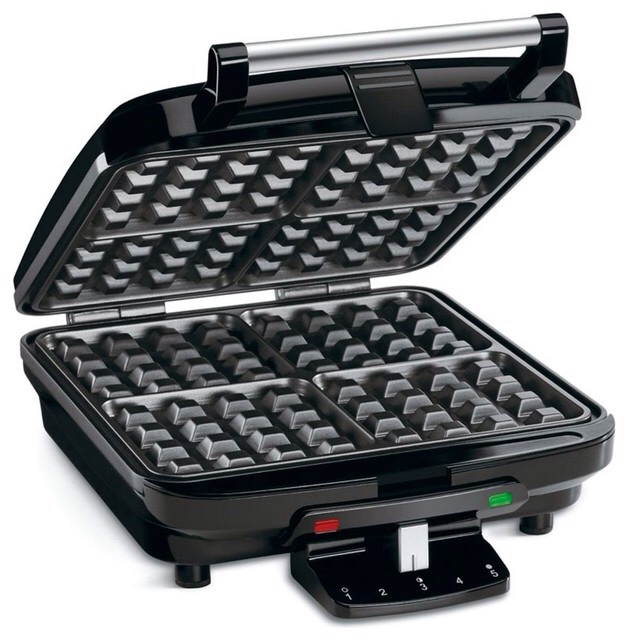
Waffle makers have advanced leaps and bounds from the versions we had as kids. There are makers that’ll do anywhere from 2 to 8 at a pop; some are deeper and rotate, to specialize in the thicker Belgian version. There are timers and dark-to-light controls as well. I opted for a simple maker with a light to indicate ready status, and no other bells and whistles. If you keep an eye on your maker while it’s working, it’s a safe bet that somewhere around 6 to 8 minutes in, when the steam output has diminished and you’re smelling nice, toasty cereal notes, your waffle will be done. After you’re used to yours for a while, it’ll be second nature that requires little conscious thought. Non stick is nice, and can now be found in non-toxic, environmentally friendly versions; it’s great to have, but does not mean you don’t still need a little something sprayed or wiped on before you cook.

Waffle recipes are pretty straightforward; once you’ve got your ratios down, they lend themselves well to experimentation. A few points, illustrated with the recipes below.

Thicker, lighter styles, like Belgian, want the eggs separated and the whites beaten and folded in to achieve that end.

The same process will help heavier, gluten poor flours generate a lighter, less leaden final product.

Vital wheat gluten is a fantastic tool to help those heavier flours end up as fluffy waffles.

Leavening can usually be achieved adequately with just baking powder, but judicious use of both powder and soda works just fine as well, especially with heavier batters. Yeast raised waffles take longer, but reward with a complex, tangy note that faster leaveners just can’t duplicate.

Here are a few variants to spark your creative juices. Any of these recipes can be made savory if you wish. Thinly sliced green onions, chive, or other herbs can be added to the batter, or incorporated into toppings made with sour cream, cremé fraîche, crema, or Greek yoghurt. Chutney, salsa, mostarda, or sauteéd vegetables are equally delicious, as is a waffle topped with an over easy egg, crumbled bacon, and melted cheese. If you add veggies or fruit directly to a batter, consider sweating them in a sauté pan first, to reduce the amount of moisture and keep your waffles from getting soggy or falling apart.


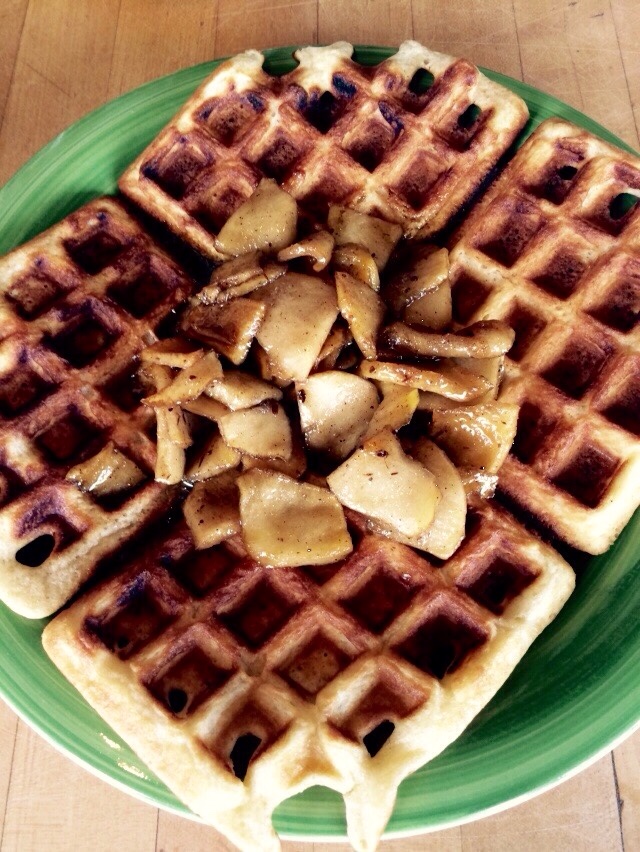
For topping sweet waffles, it’s awfully hard to beat real maple syrup and butter.

You can substitute whole wheat pastry, or whole grain white flour, one to one for any recipe calling for all purpose. Subbing 2% milk for whole works, and almond or soy milks make fine alternatives as well. Coconut oil makes a great sub for butter, as will olive, avocado, or grapeseed oils for savory waffle recipes. Honey, agave nectar, or less refined sugars are also fine alternatives. Fresh fruit is always a delightful topping for any variant.


With modern waffle makers, it’s best to pour a ladle or two of batter into the middle of the iron, enough spread to within a couple inches so of the edge; gently closing the lid will finish the job.

Each recipe will make 6-8 waffles. They will store well short term, and are delicious toasted the next day.

Yeast Raised Waffles
2 Cups all purpose Flour
3/4 Cup Whole Wheat Pastry Flour
2 Cups whole Milk
2 large Eggs
1/2 Cup Unsalted Butter
1 Tablespoon Sugar
1 package active dry Yeast, (2 1/4 teaspoons)
1 teaspoon Sea Salt
1/4 teaspoon Baking Soda
 
In a small pot over medium heat, combine milk and butter; stir until melted and bubbles start to form on the edge of the pan. Add sugar and salt and stir steadily until melted and hot but not simmering. Remove from heat and let stand until lukewarm.
In a warmed mixing bowl, combine 1/2 cup warm water and yeast. Let stand until it foams, about 5 minutes.
Add warm milk mixture to yeast and stir.
Whisk in flours, then cover tightly with plastic wrap and let stand until doubled in volume, at least two to three hours at room temp, or overnight in the fridge.
Preheat waffle iron.
Whisk eggs and baking soda into the batter.
Cook according to manufacturer’s directions until golden brown.


Belgian Waffles

2 Cups all purpose Flour

2 large Eggs

2 Cups Whole Milk

1/2 Cup unsalted Butter

1/2 Cup Sugar

3-1/2 teaspoons Baking Powder

1 teaspoon Vanilla Extract

1 Cup fresh Strawberries


Preheat waffle iron.

Rinse and slice strawberries.

Separate eggs into two small dishes.

Melt butter.

In a large mixing bowl, combine flour, sugar and baking powder.

In a second mixing bowl, lightly beat egg yolks until frothy. Add milk, melted butter, and vanilla, and whisk thoroughly to incorporate.

Add wet to dry mix and whisk gently until just combined.

Whisk egg whites until stiff peaks form; fold gently into the batter.

Cook in a preheated waffle iron according to manufacturer’s directions until golden brown.

Serve topped with strawberries.


Buttermilk Waffles

2 cups all purpose Flour

2 Cups Buttermilk

2 large Eggs

1/3 Cup unsalted Butter

2 Tablespoons Sugar

2 teaspoons Baking Powder

1 teaspoon Baking Soda

1 teaspoon Vanilla Extract

Pinch Sea Salt


Preheat waffle iron.

Melt butter.

In a large mixing bowl, combine flour, sugar, baking powder, baking soda, and salt, and whisk to incorporate. In a separate bowl, whisk and combine thoroughly buttermilk and butter; add the eggs and vanilla, and whisk again.

Add wet mix to dry and whisk gently until just combined; batter will be slightly lumpy.

Cook until golden brown, according to manufacturer’s instructions.


Buckwheat Waffles

2 Cups Buckwheat Flour

2 Large Eggs

1 1/2 Cups whole Milk

1/2 Cup Greek Yoghurt

1/2 Cup unsalted Butter

2 Tablespoons Bob’s Vital Wheat Gluten

2 Tablespoons Honey

2 teaspoons Baking Powder

1 teaspoon Baking Soda

Pinch of Cinnamon

Pinch of Sea Salt


Preheat waffle iron.

Melt butter.

In a large bowl, add buckwheat flour, vital wheat gluten, baking powder, baking soda, salt, and cinnamon, and combine.

Separate eggs into two small dishes.

Add yolks to a second mixing bowl, and whisk until frothy. Add the sugar, butter, milk, and yogurt and combine thoroughly.

Whisk egg whites until they raise to soft peaks.

Add wet mix to dry and whisk gently until just combined.

Add one half of the egg white and fold them gently into the batter; do the same with the second half.

Cook until golden brown, according to manufacturer’s instructions.


Whole Grain Waffles

2 Cups Whole Wheat Pastry Flour

2 large Eggs

1 1/2 Cups whole Milk

1/2 Cup Sour Cream

1/4 Cup Butter

2 tablespoons Honey or Agave Nectar

2 teaspoons BakingPowder

1 teaspoon Baking Soda

1 teaspoon Vanilla extract

Pinch Sea Salt


Preheat waffle iron.

Melt butter.

In a large mixing bowl, combine flour, sugar, baking powder, baking soda, and salt, and whisk to incorporate.

In a separate bowl, whisk and combine thoroughly buttermilk and butter; add the eggs and vanilla, and whisk again.

Add wet mix to dry and whisk gently until just combined; batter will be slightly lumpy.

Cook until golden brown, according to manufacturer’s instructions.


Waffles 101


Along with stand mixers and fondue sets, waffle irons are more than likely collecting dust in a corner of many of our pantries. Waffles get a bad rap as 'food that's not good for you,' and 'a pain to make'; nothing could be further from the truth. Sure, a store bought, frozen waffle is an abomination, along with generic table syrup, and both are to be avoided like the plague. A homemade waffle, on the other hand, topped with delicious things is a delight in every way.


Batter or dough has been cooked between two hot plates for hundreds of years. The earliest recipe written in English that I'm aware of appeared in the 1600s, and paid proper homage to the Dutch 'wafel', that from the Frankish 'wafla', which harken back as far as the 1100s and meant honeycomb or cake. Waffles started out life as derivations of the communion wafer, thin, crisp cakes not unlike the modern pizzelle, still quite popular in Italy. These earliest versions were almost always round and made of grain flour and water, just as communion wafers were and are. As such, they weren't particularly big on taste, so flavorings like honey or florally infused water were introduced, such as rose and orange blossom. It wasn't until the 1300s that a recipe included eggs, wine, flour, and salt, but did not contain leavening of any note. Another hundred years would pass before irons notably different in pattern from the communion wafer, or oublie, would appear. These new versions, the French fer à oublie and the Belgian wafelijzer, were square or rectangular, and set with an even grid pattern; the space between these early irons was still rather thin, leading to a finished product likely akin to the modern Brussels waffle. Another couple of centuries would pass before recipes routinely included yeast, sweeteners, and spices added directly to the batter. Leavening was the innovation that allowed waffles to become the thicker, more appealing treat we enjoy to this day.

Waffle makers have advanced leaps and bounds from the versions we had as kids. There are makers that'll do anywhere from 2 to 8 at a pop; some are deeper and rotate, to specialize in the thicker Belgian version. There are timers and dark-to-light controls as well. I opted for a simple maker with a light to indicate ready status, and no other bells and whistles. If you keep an eye on your maker while it's working, it's a safe bet that somewhere around 6 to 8 minutes in, when the steam output has diminished and you're smelling nice, toasty cereal notes, your waffle will be done. After you're used to yours for a while, it'll be second nature that requires little conscious thought. Non stick is nice, and can now be found in non-toxic, environmentally friendly versions; it's great to have, but does not mean you don't still need a little something sprayed or wiped on before you cook.

Here are a few variants to spark your creative juices. Any of these recipes can be made savory if you wish. Thinly sliced green onions, chive, or other herbs can be added to the batter, or incorporated into toppings made with sour cream, cremé fraîche, crema, or Greek yoghurt. Chutney, salsa, mostarda, or sauteéd vegetables are equally delicious, as is a waffle topped with an over easy egg, crumbled bacon, and melted cheese. If you add veggies or fruit directly to a batter, consider sweating them in a sauté pan first, to reduce the amount of moisture and keep your waffles from getting soggy or falling apart.

For topping sweet waffles, it's awfully hard to beat real maple syrup and butter.

You can substitute whole wheat pastry, or whole grain white flour, one to one for any recipe calling for all purpose. Subbing 2% milk for whole works, and almond or soy milks make fine alternatives as well. Coconut oil makes a great sub for butter, as will olive, avocado, or grapeseed oils for savory waffle recipes. Honey, agave nectar, or less refined sugars are also fine alternatives. Fresh fruit is always a delightful topping for any variant.

With modern waffle makers, it's best to pour a ladle or two of batter into the middle of the iron, enough spread to within a couple inches so of the edge; gently closing the lid will finish the job.

Each recipe will make 6-8 waffles. They will store well short term, and are delicious toasted the next day.


Belgian Waffles

2 Cups all purpose Flour

2 large Eggs

2 Cups Whole Milk

1/2 Cup unsalted Butter

1/2 Cup Sugar

3-1/2 teaspoons Baking Powder

1 teaspoon Vanilla Extract

1 Cup fresh Strawberries


Preheat waffle iron.

Rinse and slice strawberries.

Separate eggs into two small dishes.

Melt butter.

In a large mixing bowl, combine flour, sugar and baking powder.

In a second mixing bowl, lightly beat egg yolks until frothy. Add milk, melted butter, and vanilla, and whisk thoroughly to incorporate.

Add wet to dry mix and whisk gently until just combined.

Whisk egg whites until stiff peaks form; fold gently into the batter.

Cook in a preheated waffle iron according to manufacturer's directions until golden brown.

Serve topped with strawberries.


Buttermilk Waffles

2 cups all purpose Flour

2 Cups Buttermilk

2 large Eggs

1/3 Cup unsalted Butter

2 Tablespoons Sugar

2 teaspoons Baking Powder

1 teaspoon Baking Soda

1 teaspoon Vanilla Extract

Pinch Sea Salt


Preheat waffle iron.

Melt butter.

In a large mixing bowl, combine flour, sugar, baking powder, baking soda, and salt, and whisk to incorporate. In a separate bowl, whisk and combine thoroughly buttermilk and butter; add the eggs and vanilla, and whisk again.

Add wet mix to dry and whisk gently until just combined; batter will be slightly lumpy.

Cook until golden brown, according to manufacturer's instructions.


Buckwheat Waffles

2 Cups Buckwheat Flour

2 Large Eggs

1 1/2 Cups whole Milk

1/2 Cup Greek Yoghurt

1/2 Cup unsalted Butter

2 Tablespoons Bob's Vital Wheat Gluten

2 Tablespoons Honey

2 teaspoons Baking Powder

1 teaspoon Baking Soda

Pinch of Cinnamon

Pinch of Sea Salt


Preheat waffle iron.

Melt butter.

In a large bowl, add buckwheat flour, vital wheat gluten, baking powder, baking soda, salt, and cinnamon, and combine.

Separate eggs into two small dishes.

Add yolks to a second mixing bowl, and whisk until frothy. Add the sugar, butter, milk, and yogurt and combine thoroughly.

Whisk egg whites until they raise to soft peaks.

Add wet mix to dry and whisk gently until just combined.

Add one half of the egg white and fold them gently into the batter; do the same with the second half.

Cook until golden brown, according to manufacturer's instructions.


Whole Grain Waffles

2 Cups Whole Wheat Pastry Flour

2 large Eggs

1 1/2 Cups whole Milk

1/2 Cup Sour Cream

1/4 Cup Butter

2 tablespoons Honey or Agave Nectar

2 teaspoons BakingPowder

1 teaspoon Baking Soda

1 teaspoon Vanilla extract

Pinch Sea Salt


Preheat waffle iron.

Melt butter.

In a large mixing bowl, combine flour, sugar, baking powder, baking soda, and salt, and whisk to incorporate.

In a separate bowl, whisk and combine thoroughly buttermilk and butter; add the eggs and vanilla, and whisk again.

Add wet mix to dry and whisk gently until just combined; batter will be slightly lumpy.

Cook until golden brown, according to manufacturer's instructions.