Cheese Rice Soufflé


Cheese rice soufflé


Had quite a few requests for the recipe behind this Instagram pic, so here it is. It's a simple cheese rice souffle, (and they really are simple.) Here's my spin on this classic.

The soufflé is generally attributed to Marie-Antoine Carême, a founding father of French grande cuisine. Carême's first iterations were made in the early 19th century, in stiff, straight sided pastry casings that are the inspiration for the modern soufflé dish.

Technically, a soufflé is a cake consisting of a cream sauce or pastry cream combined with beaten egg whites. Soufflé is actually a tense of the French verb 'souffler', to blow or puff,; an apt description of the cooking process involved. The base cream may be sweet or savory. The beaten egg whites, incorporating a lot of tiny air bubbles, provides the classic rise that defines this delicious dish.

Soufflés can be made in containers of all shapes and sizes, but the traditional vessel is a straight sided, white glazed porcelain soufflé pan, round with a glazed or unglazed bottom and fluted sides. The porcelain transmits heat quickly and well, the unglazed bottom anchors the dish, and the straight, glazed sides allow an unfettered rise in the oven.

The keys to a grey soufflé are;

a pre-heated oven,

Eggs at room temperature,

Very gentle folding of the beaten egg whites.

You want as much energy as possible to go toward the rise of the soufflé, as opposed to heating ingredients, so the preheated oven is a big help, as are eggs at room temp. Very gentle folding of the egg whites ensures that all that air trapped in the egg white matrix is available to the soufflé – again, that's the fuel behind the rise, and rough handling kills it quickly.

I've made this with all kinds of rice; I get the best results with long grain or wild. It's easily the most elegant use of leftover rice I can think of.


Cheese Rice Soufflé

2 Cups cooked Rice

1 1/2 Cups Extra Sharp Cheddar

3 large Eggs

1 1/2 Cups whole Milk

2 Tablespoons All Purpose Flour

2 Tablespoons unsalted Butter

1 Tablespoon minced Shallot

1 teaspoon Lemon Thyme

1/2 teaspoon ground Grains of Paradise

1/2 teaspoon Sea Salt

Dash of Tabasco Sauce


Have eggs at room temperature before starting.

Preheat oven to 350° F.

Crack and carefully separate eggs whites and yolks into two mixing bowls.

In a heavy sauce pan over medium heat, melt butter. Add flour and whisk to combine.

Allow roux to cook for 2-3 minutes until lightly browned.

Slowly add milk in small amounts, whisking each into the roux.

Incorporate all the milk without breaking the roux; in other words, it should start out as thick as mashed potatoes and end up as a fairly thick cream sauce, never being allowed to separate into liquids and solids. Slow and steady incorporation is the key.

Add rice, shallot, lemon thyme, salt, grains of paradise, (pepper is Ok), and Tabasco. Whisk to combine.

Remove from heat and transfer to a large mixing bowl.

Whisk egg yolks with a teaspoon of water, until they've thickened slightly and are nice and uniform.

Add yolks to cream and rice mixture and blend thoroughly.

By hand or with a whisk attachment for an immersion blender, beat egg whites until stiff peaks form; you want to be able to flip a bit of the whites it's your whisk and see them stand pretty much straight up and stay there.

Check the temperature of your cream and rice mix. You want it warm, but not hot enough to start cooking the eggs prior to baking.

Working in thirds, gently fold the beaten egg whites into the cream and rice blend. Use the side of a spatula and take your time. The batter should look and feel quite light when fully blended.

Chose a pan sized such that the batter will fill it about 2/3 way up the sides.

Carefully pour the batter into an ungreased soufflé pan.

Bake uncovered for 45 to 55 minutes. Don't open the oven – Let it work!

Soufflé top should be nicely risen and golden brown.

Serve immediately with a nice, crisp salad. Sparkling dry cider is a great accompaniment.


Smoked Chicken Stew


So, from last nights butterflied, grilled chicken, I saved the carcass and made stock and stew therefrom. If you’re not doing this kind of thing on a regular basis, you really need to be reading this blog more often.
Here’s how.

For the stock,
1/2 sweet Onion
1 Carrot
1 stalk Celery
2 Bay leaves

Rinse, trim and then chop veggies to uniform rough dice. Note: Can’t tell you how often I see home cooks throw out celery tops with leaves on them, or how wrong that is. Especially when using celery for mirepoix, making stock, etc, you want those leaves; they pack beautiful, delicate celery flavor, and impart it to other foods better than the stalks do.

Glean any appreciable meat from the chicken and reserve for lunch, (we didn’t have any left, frankly, and we’ll be using breast meat for the making of this stew anyway…)

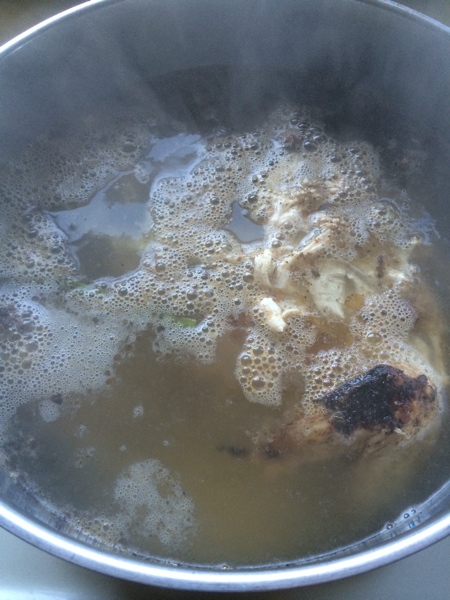
Everything goes into a stock pot over high heat with enough water to cover well, about 3/4 gallon. As soon as things start to simmer, reduce heat to just maintain that, and let it go for at least 2 hours and up to 4. As you lose water to cooking, gradually add more. Ideally, you want to end up with about 8-10 cups of lightly colored and flavored stock. That is rather light as stock goes, but we’re making a robust stew that will pack its own flavors; this is just the canvas…

Remove from heat, discard all the big chunks by straining through a colander. Chill the rough stock in a large bowl in the freezer until most of the fat has risen to the top. Skim that off, then clarify the stock once or twice by running it through a chinoise or strainer.

Return stock to a stock pot over medium heat.

For the stew,
2 Carrots
2 stalks Celery
3 Red Potatoes
1 Tomato
1 Lemon
2 cloves Garlic
1/4 sweet Onion
2 sprigs Cilantro
Extra virgin Olive Oil
White Wine
Black Pepper
Smoked Salt

Rinse and trim all veggies. Cut carrots, celery, potatoes, tomato, onion and cilantro to a fairly uniform rough dice, about 1/2″ pieces. Mince the garlic and cilantro and toss everybody but those into the stew pot.

Heat a tablespoon of extra virgin olive oil in a sauté pan over medium high heat. Toss in onion and sauté until it starts to go translucent. Add garlic and sauté about another minute. Add a splash of white wine and continue sautéing until the raw alcohol is burned off. Toss all that into the stew pot. This step, done with strong aromatic veggies like onion and garlic, adds a nice richness to a soup or stew, and helps tame the raw heat they can pack.

For the chicken, you can smoke it over your grill, barbecue or smoker with a bit of smoking wood, pellets, what have you, or you can cheat like I did. If you’re a regular here, you know how much I love Butcher & Packers hickory smoke powder. As advertised, it gives a pure taste of hickory smoke and nothing else. I’ve fooled Texas BBQ snobs with this stuff. Saves a bunch of time and sacrifices nada in the process; try it. They also make chipotle powder, and powdered mesquite, which are equally fabulous. 

Dirty Rotten Cheater’s Smoked Chicken,

2 Cups Chicken Breast
1/2 Cup Whole Grain White Flour
1-2 teaspoons Smoke Powder
1/2 teaspoon Smoked Salt
1/2 Teaspoon ground black Pepper
2 Tablespoons vegetable oil

Cut chicken into roughly 3/4″ dice.

Add 2 tablespoons of oil to a large sauté pan over medium high heat.

Combine flour, smoke powder, salt and pepper in a paper bag, (amount of smoke is up to you). Add the chicken and shake until all the chicken is thoroughly coated. Remove the chicken and tap/shake off excess dredge.

Add chicken to pan and allow it to cook long enough to sear well on all sides. You want to develop a genuine, caramelized crust, so don’t play with it too much or turn it too often. Keep a close eye on it so it doesn’t burn.

Once the chicken is well seared, transfer it to the stew pot and stir it in well. Turn heat down until you’re at a nice low and slow temperature, with no signs of simmering.

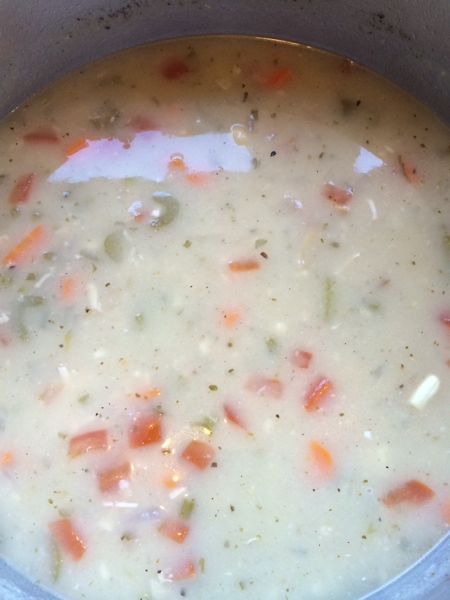
Let the stew cook for at least two hours. Slice the lemon into quarters. Add the juice from half to the stew, reserve the others for service. Adjust seasoning with smoked salt and pepper. Stir regularly, taking care to make sure stuff isn’t sticking to the bottom. The regular stir helps release the dredge from the chicken and combine it with fats, which is what is going to thicken your stew. If you like things thicker yet, microwave an extra Yukon potato, mash it with a tablespoon of butter, and stir that into the stew as well.

Serve with crema, sliced lemon, our jalapeño-cheddar cornbread, and a nice, cold Negro Modelo.

One Hour Minestrone


OK, so a good few of y’all have asked for the zero-to-minestrone in an hour recipe, so here goes.

There is much leeway in this wonderful soup. You can make it with meat or vegetarian. You can add whatever veggies are in house with confidence. In other words, there are few rules. That said, what I’ll propose as the single non-negotiable point is this: the base stock should be veggie and include white beans, (AKA Great Northerns). As I’ve said numerous times here, try it this way first and then go forth as you see fit thereafter…

So, let’s say that like me the other night, you got a hankering for soup, it’s 5 pm, you have no stock on hand and nothing prepped. Ready?

Open and lightly rinse a can of white beans. Pour them into a sauce pan and add,
2 Cups hot water
1 small Shallot, minced
1 Bay Leaf
Sprig of Parsley, minced
1/2 teaspoon Italian Oregano
Shake Sea Salt
Twist of ground Pepper

Get that up to a simmer and reduce heat so it barely perks along.

Preheat oven to 400 F.

Choose 1 medium sweet onion, then choose carrot and celery for size so that you get roughly 50% onion and 25% each celery and carrot, then rough chop. Toss those on a sheet pan, drizzle with olive oil and shove them in the oven for 15 minutes.

Set a stock pot over high heat with 10 cups of hot water and bring to a boil.

When the veggie timer goes off, pull them out of the oven and throw them into the boiling water. Allow them to boil freely for 15 minutes, then strain or scoop all the veggies out and toss ’em in your compost. Toss the bean pan contents into the stock pot and there’s your speed stock.

Dice 2 or 3 potatoes and a carrot, then throw them in the microwave for a minute or two until just fork tender; add them to the pot. If there are any other root veggies you have or like, do the same with those.

In a sauté pan over medium high heat, toss 1/2 diced sweet onion and a stalk or two of celery until they start to soften and sweat; throw those into the pot. If you have the leaves and tiny shoots on your celery,so much the better, just use that.

Begin scavenging the fridge and shelves. I found fresh frozen corn, peas and green beans as well as canned tomatoes we’d preserved earlier in the year and threw a handful of each into the mix. If you’ve got leftover pasta or rice in the fridge, in it goes; this is how and why minestrone has been made for many moons, capiche?

Now you can make this a broth soup or you can make it stewier if you like. If thickening appeals to you, the simplest way is to just purée some of the soup and add it back; that’ll give you slight thickening and will honor the flavor you’ve chosen exactly, of course. If you want thicker still, use a slice or two of day old bread, or a scoop of some of that rice or pasta you found in the fridge, or even leftover mashed potatoes. Take that chosen thickener, toss it in your blender or processor, add two or three ladles of soup and let ‘er rip, then return that to your stock pot and viola.

Adjust seasoning with salt and pepper to taste, then allow your minestrone to simmer for 15 minutes or so. Take that time to use your preheated oven and make some quick corn bread, or rub slices of baguette with a split clove of garlic and a brush of butter.

Serve hot and bask in your ingenuity.

Enjoy!

New Years Fondue


Few dishes are more festive than a great fondue. The method invites the creative use of leftovers, so dive into the freezer or fridge. Fondue is also a great ‘Hobo Stew’ dish, so invite your guests to bring their favorite dippers, or an alternate fondue to expand the fun.

Cheeses for fondue need to be varieties that melt well and yield a smooth, creamy consistency. The noble Swiss variants used here are famous for their good behavior in a fondue, and their light, nutty flavor. Cheddar and Jack also do very well, so experiment and find your favorite.

Bread is the traditional primary dunk, but by no means the end of the road! Venison, pheasant, meat balls, and sausage tortellini are great treats, as are crisp apples, grapes, broccoli, roasted potatoes, and snap peas. The sky and your taste buds are the limit!

Classic Cheese Fondue
3/4 pound each Gruyère and Emmentaler cheese, grated
3/4 cup dry white wine
1 teaspoon freshly squeezed lemon juice
1 tablespoon flour
1 tablespoon butter
3 Tablespoons tart Cherry Juice or Kirsch
1 small clove fresh garlic
Sea salt, Black Pepper and Smoked Paprika to taste

Pour wine and lemon juice into a non-reactive sauce pan over medium heat and bring to a simmer. Add the cheeses slowly and stir constantly until each batch melts and incorporates thoroughly. Reduce heat to medium-low and stir occasionally.

Melt butter in a small pan, then add flour and incorporate, then add cherry juice and thoroughly blend to a smooth paste.

Add the paste to the cheese mixture and blend thoroughly. Press garlic, and add salt, pepper and paprika to taste. Reduce heat to warm and stir now and then until ready to serve.

A fondue pot is best for service, but not necessary, ’cause its gonna go quick!

Cube bread, slice fruit and veggies and arrange on a tray. Thoroughly cook meat, poultry or pasta through and keep warm until served.

20121231-112236.jpg

M and I wish y’all a wonderful, prosperous 2013 filled with great food, family and friends!

“Drop the last year into the silent limbo of the past.
Let it go, for it was imperfect,
and thank God that it can go.”
Brooks Atkinson

Quick and Easy


So, you’re on our way home and your mate calls, says, “What are we doing for dinner?”

You blink a couple times, “Uhhhhhhhhh…”

Sure, you could slurp soup from a can, slap together a sandwich, sling a salad, but…
Why not take a minute and build something good, semi-homemade, fast and easy?

A quick stop at Trader Joe’s for pizza dough, pineapple, Italian sausage, and fresh mozzarella, you’re good to go – The rest should be at home in a decent pantry, meaning you should have canned tomatoes, (Any style will work; always cruise that aisle and pick up a can or two when they’re on sale – Same with beans, etc), fresh garlic, dried or fresh herbs, good oil and vinegar.

This super simple recipe takes maybe 15 to 20 minutes of prep time.

Casa Calzone

Fast Pizza/Calzone/Pasta sauce:

1 22 ounce tomatoes
1 6 oz can Tomato Paste
2 cloves fresh Garlic
1 teaspoon Oregano
1 teaspoon Basil
1 Tablespoon extra virgin Olive Oil
Dash Balsamic Vinegar
Salt & Pepper to Taste

In a glass or stainless bowl, blend or motorboat tomatoes to an even consistency. Crush or mince garlic, add tot tomatoes along with all other ingredients, blend thoroughly. Allow to sit at room temperature for 15 minutes. You may simmer your sauce for 15 to 20 minutes for a more focused flavor note, but it’s not necessary for great results.

Fillings:
Whatever you like! Go simple for the sake of speed and ease of prep; two or three major notes is plenty and delicious. Leftover chicken, pork, beef. If you do something fresh like our sausage, then saute until cooked roughly 3/4 through and set aside.

Just fresh veggies are wonderful too; you can do them straight away, sauteed lightly, or roasted prior to filling; each little change will yield a unique and lovely taste.

We went with classics:
Ham & Pineapple
Italian Sausage & Roasted Red Pepper

Preheat oven to 475 F. and place a rack in the upper-middle position.

Roll pizza dough out to a circle or square; dough should be roughly 1/8″ thick. Transfer carefully to a baking sheet or pizza stone.

Spread an even layer of sauce roughly 1/2″ thick over half the dough, then add generous amounts cheese and toppings. Lightly wet the edge of the uncovered dough with a little water.
Gently fold the dough over to completely cover, and seal the edge by rolling it back on itself a couple of turns while pressing together.

Uploaded from the Photobucket iPhone App

Uploaded from the Photobucket iPhone App

Cook for 10 to 12 minutes, remove from oven and let rest for 5 minutes prior to cutting and serving.

Garnish with grated hard cheese, fresh herbs, or good olive oil and balsamic vinegar.

Uploaded from the Photobucket iPhone App

Toast a job well done!

Scaling, Converting, and More Leftover Tech


Well, if you’re a regular here, you know we have a real passion for leftovers. It is damn near criminal to waste good food and it happens way too often. To some degree, this is our fault, ‘our’ being foodies and bloggers who exhort others to cook. I say that because a lot of what I find in out there are recipes offered in quantities that demand leftovers. And it goes without saying that restaurants in the US routinely offer ridiculously huge portions, the lions share which is thrown out as well.

So something needs to be done about it, right?

Right.

You can do your part by learning to scale recipes when they’re designed for more folks than you’re going to reasonably feed. Scaling is especially useful if a recipe is complex or involves expensive ingredients; in any case, most of the time, you just don’t need or want to cook at larger volumes. While it sounds easy, it isn’t always such, (I found this out taking a homebrew recipe to barrel volume…) Scaling definitely involves a bit of art in addition to straight math.

Take, for instance, a recipe that catches your eye, but is shown for 10 when you need it for 4.

Knocking it down mathematically is straightforward: You take the quoted measure of each ingredient and divide it down to where you want to be. So in this case, we’d divide 4 by 10, yielding 0.4; each of the stated measurements would then be multiplied by 0.4 to reach your goal.

Lets say the recipe calls for 4 cups of all purpose flour. Take the 4 cups, multiply by 0.4.

4 cups × 0.4 = 1.6 cups of flour for your 4 person conversion, and so on down the line of ingredients.

As a guitar maker, I can tell you that I spend a fair amount of time converting fractions to decimals, so don’t feel even a little bit bad for squinting at 1.6 cups for a second or two. Truth be told, for the vast majority of home cooking, eyeballing 1.6 cups is going to work out just fine. Yes, things like a teaspoon are gonna end up 0.4 but again, almost a half, more than a third; you’ll get the idea.

For any and all of this that seems to funky to do, drop over here to this handy Cooking Conversion Tool at About.com. For those of you who actually use your smart phone or tablet for cooking as I do, there’s a very decent app called Kitchen Calculator Pro that works great.

One of the things we do here is to test conversions for you. As I mentioned, scaling recipes isn’t always as simple as the math. Sometimes things have to be tweaked to come out just right. That said, this is often a case of personal taste; it’s nothing to worry about on the big picture view, but if you’re wanting to impress your new date with a great home cooked meal, you might wanna test that conversion first, right?

A lot of the secret of cooking well has to do with ratios; it could be reasonably argued that, next to good ingredients, nothing is more important. Author and Chef Michael Ruhlman has put out a few tools and books about this stuff. I own both his Bread Baking and ratio apps for iPhone and iPad, and I use them both. They’re good common sense stuff and a handy reference when you’re experimenting.

Now, all that said, there are times when you’re going to build food at larger volumes. You’ll notice that a lot of what we do here starts out fairly basic; consideration of multiple meals is a primary reason for that. We, like most of y’all, are not exactly wading in spare time, so prepping one primary meal that can become two or three saves work and is much more efficient.

When you’re doing that, you may well build dishes that are sized for much more than your one-meal needs. Of course quite a few things like soup, stew, chili, roasted or broiled meats, potato dishes and many veggies, really do taste better the next day. It makes sense if you think about it; good ingredients, well married, seasoned and cooked – It should taste better, right?

To close this post, we’ll give you a lightning round example of what we’re talking about.

Day 1; we’re both off, so we bought a big ol’ pork roast and paired it with gnocchi, seedless red grapes and a nice salad.

Day 2: Sky’s the limit; we could do cold sandwiches, Mex, what’ll it be? It was a bit nippy, so digging into the fridge, we found some great veggies, soaked and added some beans and made a wonderful soup. The prep for this took maybe 15 minutes, then we just stuck it in the pot to get happy. Paired with sourdough garlic bread and some more grapes, life is good.

Day 3: We sure could have soup again, but why not throw 30 minutes prep time into the mix and make a pot pie, right? Kitchenaid pie crust recipe, 15 minute rest, blind baked in a baking dish, thicken the soup with a little roux, and off you go…

There’s three distinct, easy meals from one pork roast. Efficient, fun, and delicious.

What are you gonna make tonight?

E & M