Real Deal Fried Rice


The difference between authentic, regional Chinese cooking and the Americanized versions most of us were exposed to in the Twentieth century is vast indeed. That said, we were raised on the latter before discovering the former, so there are times when we jones for the cheap seats. Nonetheless, there are genuine roots to all that Americanized stuff as well – Even sweet and sour whatever, or chop suey. Dishes made famous, (infamous?), here were generally a far cry from their authentic roots, due predominantly to a lack of proper ingredients. While Chinese immigrants often brought, grew, or made the tools and supplies needed for authentic cooking with them, those were neither truly desired by nor fed to American diners for many decades.

Happily, here in the 21st century, most, if not all of what you need to cook authentic regional Chinese dishes is readily available. Even in relatively small towns, there is often a thriving Asian market, and if not, it’s all there in online stores. Naturally, the recipe resources available to home chefs has blossomed as well; there are myriad cookbooks for virtually every Chinese cooking style and region, let alone classes, online videos, and groups dedicated to the exploration thereof.

UrbanMonique House Fried Rice

Without a doubt one of, if not the most beloved Americanized dishes, is fried rice, and for good reason. The combination of proteins, veggies, fruit, and sauces is almost limitless, and few dishes are more satisfying when made well. Add the fact that it’s a perfect use for leftover rice, and you’ve got a perennial winner. Naturally, this begs the question – Where did fried rice actually originate?

Frying rice in some form or another has been done for as long as man has been eating cereals, and recipes harken as far back as the sixth century AD. The most well known variety is often called Yangzhou, after the city in the east central coast of China; it includes roast pork, prawns, scallions, and green peas. This is still considered one of, if not the signature version of fried rice, served at Chinese restaurants throughout the world, and called either House, or Special fried rice. That popularity doesn’t necessarily apply to China herself – There, myriad variants of the dish are found, especially in the south where rice is a major staple – Everything from heavily sauced Fujian and Cantonese versions, to Chāhan flavored with Katsuobushi, (Bonito flakes), and the red and white, yin-yang Yuan style. And that’s just China – There are signature versions from Burma, Thailand, Vietnam, Laos, Korea, Japan, Indonesia, Singapore, and Europe. There’s a Hawaiian version with Spam, and an ‘American’ version in Thailand served with hot dogs and catsup, and more varieties from South America and Cuba as well.

While you certainly can and should check out those recipes, the ubiquity of the dish certainly encourages exploration in the kitchen. Like spaghetti sauce, or mac and cheese, every household has a signature version that’s the best, so there’s no reason you shouldn’t add one of your own.

The real trick to great fried rice lies no so much in the add-ons, but in what rice you use – for the best results, you want cold, day old rice – or even frozen, (and that should be all the reason you need to save leftover rice every chance you get). The reason is moisture, or lack thereof. If you’ve ever tried making fried rice from fresh stuff, chances are you ended up with something soggier than you wanted. Using refrigerated, day old allows the rice grains to dry out somewhat, yielding nicely separated grains, and the slightly chewy texture we’re after. For longer storage, freeze rice in a ziplock bag with the air sucked out. Either way, once you’ve got your base material squared away, building whatever you like becomes a quick and easy task.

Long grain white rice is best for frying

Next question – what kind of rice is best? Long grained white will dependably cook up plump, distinct grains. This is due to a couple of important starch molecules, namely amylose, and amylopectin. Long grain white rice contains the highest concentration of amylose. This starch does not gelatinize when rice cooks, so varieties rich in it yield that fluffy stuff we’re after. Amylose also crystallizes and hardens when rice is cooled after cooking, but melts readily upon reheating, again lending itself perfect to frying over high heat. Amylopectin, on the other hand, makes rice that is sticky and softer, and while that’s perfect for risotto or paella, it’s not so much for fried. Medium and short grain varieties are richer in this starch, while long grain white has significantly less. Thai jasmine rice is also long grained, but has less amylose, so can get a bit sticky. If you like the slightly sweeter taste of jasmine, Basmati might be a better choice for frying.

Restaurant woks at work

And finally before we cook, what about the best vessel for the job – to wok or not to wok, that is the question. The answer is, not absolutely necessary, but if you want the real McCoy, then only a wok over a really hot flame will give you that certain je ne sais quoi – the slightly grilled, smoky, almost burnt flavor notes great fried rice flaunts. When the weather allows here, we cook ours in a wok over the same propane powered burner we use for roasting coffee, outside – There’s no way I know of to get a hot enough flame inside, unless you’ve got a pretty serious commercial quality gas range.

A carbon steel wok on a propane burner

Cooking in a high carbon steel wok also imparts a certain flavor note of its own, just as cast iron does. It’s a subtle thing, but certainly notable and for my mind, highly desirable. If you don’t own a wok and decide to buy one, go with a 14″ like ours, with a flat bottom and double handles, one long, one short. Take great care to read up on the proper initial cleaning and seasoning of a new wok – failure to do so can literally sink your investment before you even get started. Now, all that said, you can do a perfectly fine job in a heavy skillet, but in any event, use the biggest thing you’ve got in your kitchen – a big cast iron skillet or Dutch oven is a fine alternative.

Alright, now that we have our pan chosen, here are a few basic guidelines for the overall process.

Get your pan as hot as you can safely get it, and use an oil with a high smoke point, like peanut or avocado. Those elusive grilled/smoky notes depend on it.

Use the biggest pan you’ve got – this is why even good home woks are 14″ – an overloaded pan won’t get hot enough to do the job right. If you’re cooking for more than two, do so in batches, as you would when deep frying.

Don’t overdo the sauce – Too much of a good thing will overpower the flavor of delicate ingredients, and will make your rice mushy as well. Note: most soy sauce you find in stores is considered dark, even if it doesn’t say so – Light soy is notably saltier and more assertive in taste, so should be used sparingly.

Alright – Here’s our version to get you started.

UrbanMonique House Fried Rice

UrbanMonique House Fried Rice
4-5 Cups cooked Rice, (1 Cup of dry long grain white should yield just right)
1/2 Pound Chinese Pork, fine diced
2 large Eggs
4-6 Scallions, trimmed and diced
1/2 Cup Chinese Long Beans, trimmed and diced
1/4 Cup Carrot, fine diced
1/4 Cup sweet Pepper, diced
1/4 Cup Green Peas
1-2 Tablespoons Avocado or Peanut Oil

For the Sauce
1 Tablespoon steaming hot Water
1 Tablespoon Dark Soy Sauce
1 teaspoon Light Soy Sauce
1 teaspoon Sesame Oil
1 teaspoon Honey or Agave Nectar
1/2 teaspoon Szechuan Pepper
1/4 teaspoon Smoked Sweet Paprika

In a non-reactive mixing bowl, combine all sauce ingredients and whisk with a fork to incorporate. Allow flavors to marry for about 10 minutes before use.

Scramble eggs until fluffy, remove from heat and set aside.

Preheat your wok/pan over medium-high until it’s fully heated through.

Gently massage the cold rice by hand, to break up any and all clumps.

Turn the heat up to high, add a tablespoon of oil to the wok and let it heat through.

Add the carrots and peppers to the hot oil and fry for about 2 minutes, stirring constantly.

Add the scallions, peas, and long beans and fry for another couple of minutes, until heated through.

Add the rice and pork, then fry for 2 to 3 minutes, stirring constantly.

Add the sauce and the eggs, stir to incorporate and heat through.

Serve piping hot.

Chiles Rellenos de Oaxaca


On a chilly, rainy Saturday morning, M and I set out for the local farmer’s market in Bellingham. On arrival, we found a thriving and well attended scene – it’s a thing I love about towns like this – Rainy weather does nothing to dissuade Bellinghamsters from their appointed rounds, any more than snow and cold did the Concordians of my youth.

Rain doesn't stop Bellinghamsters
What struck us as particularly vibrant was the surprising number of small farms represented, most of which were organic. The fall bounty of chiles, tomatoes, sausage, and cheese set my dinner plan in mind – Chiles rellenos de Oaxaca. We made our leisurely rounds, then headed home to cook.

Great produce at the farmer's market
You’ll find some variant of the Chile Relleno, ‘stuffed peppers’, all over Mexico. Most often, the chile used will be Poblanos, and rest assured that the people who share the same name, (folks from the State of Pueblo), lay claim to the origins of that famous dish. That said, the amazing number and breadth of relleno variants indicates that pretty much anywhere chiles grow, they are and have been stuffed for a long, long time.

Oaxacan Chiles
The typical chile relleno is stuffed with cheese, coated in an egg batter, and fried. You’ll see that throughout Mexico, and of course, up here in the states as well. The Oaxacan version, however, is a bit more robust – It is, technically, a chile relleno de picadillo, meaning stuffed with cheese and shredded or minced meat; everything from goat and lamb, to pork, beef, or chicken is used, as is chorizo, that singularly delightful Mexican fresh sausage. The other hallmark of Oaxacan rellenos is the range of chiles used; they grow a dizzying variety down there, and whatever looks good and is in season is as likely as not to end up stuffed. That’s a good thing for us all to embrace, frankly – Each chile brings a different level of taste, heat, and color to a dish, and variety is indeed a wonderful thing.

Fresh chorizo
Chorizo, or chouriço, is not indigenous to Mexico; it is an import from the Iberian Peninsula, where both Spain and Portugal lay claim to its origins. While the Spanish version uses smoked pork, the Mexican is made with fresh. There are as many varieties of chorizo as there are chiles, frankly, so defining The Real Recipe is a bit of a crap shoot. I’ve got a favorite recipe that I use, and I’ll share that here. I make Chorizo as a loose sausage, and you can too; it’s much simpler that way. If you’d rather buy and you’re from this neck of the woods, I’ll tell you that the Haggen’s version has been declared muy authentico by trusted Mexican friends, and after testing that claim, I agree wholeheartedly – It’s surprisingly good stuff. As promised, here’s my version.
Fresh Chorizo

2 pounds fresh ground local Pork
1/4 Cup Apple Cider Vinegar
3 cloves Garlic, minced
2 Tablespoon Smoked Paprika
1-2 teaspoons flaked or ground Chipotle Chile
1 teaspoon Mexican Oregano
1 teaspoon flaked Salt
1/2 teaspoon ground black Pepper
3-5 Tablespoons Ice Water

Chill a large stainless steel mixing bowl in the freezer for about 20 minutes prior to building the chorizo. Pork should be refrigerated right up to the point of assembly.
Combine all ingredients in the cold bowl and mix by hand until you have a homogenous blend. You should end up with a nice moist, deeply red sausage.
Transfer sausage to a airtight, non-reactive container and place it in the freezer for about fifteen to twenty minutes.
Remove from freezer and refrigerate until ready to use.
If you’re not using the chorizo right away, wrap tightly in plastic, then aluminum foil and freeze.

Fresh Queso Blanco
The cheese used for this dish simply must be fresh queso blanco. This soft, non-aged white cheese also has its roots on the Iberian Peninsula, but has been wholeheartedly adopted throughout the Americas. Queso blanco is remarkably easy to make; if you’ve never given it a try, you really must. The caveat here is that ultra-pasteurized milk simply will not produce good cheese. You need something fresh and as local as possible – Since there’s no aging involved, and no culture added, this cheese will directly reflect the milk you make it from, (although you certainly can add herbs, veggies, etc if you like). While the ability to press this cheese will make a more consistent product, you really don’t need a dedicated press. Here’s how it’s done. Here again, you can find fresh queso blanco at many grocery stores these days, too.

You’ll need;
Non-reactive stock pot,
Steel mixing spoon,
Instant read thermometer,
Metal colander
Decent cheesecloth

Queso Blanco
1/2 gallon fresh whole milk, (no ultra-pasteurized)
6 teaspoons Live Apple Cider Vinegar
1/4 to 1/2 teaspoon Sea Salt
Salt to taste

In a stock pot over medium low heat, add the milk.
Stir occasionally and monitor temperature until milk reaches 185° F, about 10 minutes or so.
Reduce heat to low and add 2 teaspoons of vinegar, and stir gently. You will see curds begin to separate from the whey; going forward, stir very gently – The curds retain moisture, which you want, so stir them, don’t batter them.
After a minute or so add 2 more teaspoons of vinegar and stir.
Repeat with the last 2 teaspoons of vinegar after another minute or two.
Let the curds and whey rest for five minutes.
Once you’ve got well formed curds, continue to stir gently to keep the curds from clumping, (called matting in the cheese making parlance)
Spread cheesecloth over your colander. If you’d like to make ricotta with the whey, put the colander inside a mixing bowl; if not you can discard it.
Gently pour the curds into the lined colander. Add salt,(and any herbs or veggies), and mix gently by hand.
You can now hang the cheese in the cloth for 10 to 20 minutes if you prefer a dryer cheese. If not, (and thereafter if you do), it’s time to press the cheese. I’ve got a press, so that’s what I use; I realize 99% of y’all don’t have one, so here’s what you do:

Pressing the queso
Return the cloth wrapped cheese to the colander. Place a flat plate small enough to fit well within the colander on top of the cheese. Place a stock pot on top of the plate. Water weights 8 pounds a gallon. Start with one gallon of water and let the cheese sit for 20 minutes. Add 2 more gallons of water and continue pressing for 2 hours.
Remove cheese from cloth, wrap it in waxed paper and refrigerate until ready to use. Fresh queso will last for 3 to 4 days refrigerated.

And finally, the rellenos.

Chiles Rellenos de Oaxaca for 4, (or a hungry two, or leftovers…)
4 Poblano Chiles
1/2 Pound Chorizo
1/2 Pound Queso Blanco
1 14.5 ounce can Tomatoes
1/4 Cup diced Sweet Onion
2 tablespoons minced, toasted almonds
2 cloves minced Garlic
1/2 teaspoon fresh ground Cinnamon
Sea Salt and fresh ground Pepper to season
Olive Oil
Canola Oil or Lard for frying

For the Batter
4 Egg Whites
1 Tablespoon Wondra Flour
Pinch Sea Salt
1/2 Cup All Purpose Flour for dredging

To a sauté pan over medium heat, add chorizo and cook until lightly browned and no pink shows.
Add minced almonds and continue cooking until they’re lightly toasted.
Remove chorizo blend from pan into a small bowl.
Add diced queso to chorizo/almond mix, and incorporate. Set aside.

queso-chorizo blend
Add a tablespoon of olive oil to the sauté pan and scrape all the little chorizo remnants loose.
Add onions and sauté until they start to turn translucent.
Add garlic and sauté until raw garlic smell dissipates.
Add tomatoes to sauté pan and heat through, stirring to incorporate, until sauce starts to simmer.
Add cinnamon, and season with salt and pepper to taste. Reduce heat to low and stir occasionally.
Heat oven to Broil and place a rack on a high setting.
Place chiles on a baking sheet and broil until the skins begin to blister, turning steadily to get all sides evenly seared.
Remove chiles from oven and set onto a plate to cool.
Set oven to bake at 300° F and set a rack to a middle position.
When chiles are cooled enough to handle, carefully cut the stem and seed cluster free from each chile and discard.
Carefully stuff each chile with equal volumes of the chorizo/queso mixture. Set stuffed chiles on a plate.

Rellenos ready to stuff
Add 1/2 cup oil or lard to a frying pan over medium high heat to 350° F.
Set 1/2 cup of flour onto a plate or shallow dish for dredging.
Beat egg whites, with a pinch of salt added, to a stiff peak, then add a tablespoon of flour and beat to incorporate.
Carefully roll chiles in flour, one at a time, then roll them through the egg whites to coat.
Carefully place chiles in hot oil and fry until golden brown, turning carefully onto each side, about 3 to 4 minutes total.
Carefully place chiles on a baking sheet and slide that into the oven. Bake chiles for 15 minutes at 300° F.
To serve, ladle a generous dose of tomato sauce into a bowl, and add a relleno to each.

Chiles rellenos de Oaxaca
Top with sour cream and fresh chopped cilantro.
I’m certainly not going to tell you how to eat your dinner, but I will say this – The real joy of this dish is to break up the relleno in the tomato sauce until you’ve got an even, kind of chili-like consistency – Doing that lets all the ingredients blend together in each bite – And it is amazing, indeed.

Cooking at the Gathering


So, a couple weeks ago, I didn’t post, because, as luck and joy would have it, I was 1600 miles from home, at my other home for a few precious days. Formally known as The Luthier Community Gathering, this is an annual event held in the north woods of Minnesota. Hosted by Grant Goltz and Christy Hohman at their incredibly eclectic and homey spread, this is several days of companionship, renewed and new friendships, music, incredible house made beer and ale, and of course, food.   

Over the years, I’ve become the official Chef de Gathering, and it is a joy of joys to do. Over the three days of the main event, we feed somewhere around 30 to 40 folks for dinner, and maybe 12 to 20 for breakfasts and lunches. While some folks bring a little of this and a little of that, Chris and I provide the mainstays, (and usually Monica, who couldn’t make the trip this year due to a new job). And rank has its privilege – I get my own incredibly cozy Chef apartment, and an incredible kitchen to work from.


 For such a big crowd, the process is incredibly easy. At some point, we’ll touch base and decide on theme, main ingredients, etc – it rarely takes more than a couple minutes. I say, “Hey Chris, what are we gonna build?” She fires off some options, inspiration takes hold, and off we go. 

 The real joy comes not only from feeding good friends in a great kitchen, but in the gathering of ingredients. Grant and Christy run a Community Supported Agriculture, (CSA), operation on their spread, so the variety and scope of produce is truly stunning, as you can see.  So, picking ingredients means just that; heading out on the trail with basket in hand, and coming back with the bounty. 


 This year marked the first truly amazing mushroom harvest, from logs inoculated and set up last season – Shiitakes, an almost embarrassing wealth of gorgeous, just picked beauties – I put them in everything I could think of, (and I did say ‘almost’).


Our mutual friends, John and Lissa Sumption, have a working CSA close by, (King’s Gardens), so literally anything we don’t have right on hand can be had with a phone call. During my visit, Mark, the very talented local butcher, stopped by and dropped off some goodies, for which he took produce in barter. The results speak for themselves.  

  
 Our recent piece on apples contains several of the recipes we did this year. Here’s the recipe for smoked Guacamole – It’s become a must-do for the event ever since we debuted it seven or eight years ago.


The Annual Gathering is open to any and all who love music, good friends, and good food. Here’s a video and a song that pretty well sums up the vibe. It’s held in August every year. This year, a dear friend from my wildfire fighting days, Nancy Swenson, made the trip out – First time we’d seen each other in thirty four years!

¡Ceviche!


Ours pals Chris and Grant hail from northern Minnesota, land of 10,000 lakes, most of which have great fishing. Among the various options to go after, panfish are a personal favorite. They’re fun, feisty, and you can harvest a very decent catch relatively guilt free, ’cause those suckers breed like there’s no tomorrow.

But wait a minute, you ask, what are panfish anyway? Great question! The term has some wiggle room is the broadest answer; panfish mean different things to different regions and fishers. Some folks will tell you it means any species that, fully grown, fit well in the ol’ cast iron frying pan, while others claim it’s because the fish themselves are frying pan shaped. I’ve heard Crappie, Blue Gills, Sunfish, Perch, Pumpkin Seeds, and Small Mouth Bass all referred to as pan fish. To me, any of these small, plentiful species qualify for the term.

Anyway, I digress; back to why Chris got in touch. She wrote, “We caught lots of Crappies. The fillets are thin and the flesh is quite soft, but they’re nice and sweet. Any tips?”

Sure do; while a simple butter poach is lovely, or a sauté in olive oil, lemon, and dill, sometimes it’s fun to go a bit farther afield and try something new. Ceviche is the ticket. This favorite of the coastal Americas derives from an Incan dish of fish cured with salt and chiles, and marinated in passion fruit juice. The modern incarnation in its simplest form is fresh, raw fish cured in citrus juices and seasoned with chiles. Ceviche is fabulous with any white fleshed fish, and that certainly includes the pan varieties. 

If you’ve never tried making or eating ceviche and are maybe a bit squeamish about it, don’t feel bad, so was Chris; she wrote, “Have never had anything like that before, so I was wary. Not anymore! I knew you wouldn’t steer me wrong!” (That’s my kinda endorsement). 

Nonetheless, what makes folks nervous is the lack of cooking involved in making ceviche. Technically speaking, cooking requires heat, so ceviche isn’t cooked, but it’s not raw either; it’s fish cured in a citric acid bath. Fact is, both processes initiate a chemical reaction called denaturation, which alters the proteins in the fish chemically and physically. The end result of either method is fish that becomes firm to the touch, opaque to the eye, and a ‘cooked’ taste.

So, how long should fish be marinated in citrus juices in order for denaturation to take place? That depends on the variety of fish you use, and how well you like your fish cured. Just a few minutes in citrus juices and your fish will start to go opaque, though the interior will still look raw and the flesh won’t have firmed up yet. Just as with cooking, you can marinate too long, leading to a tough texture and an overpowering citrus note. The key to even, dependable results is to always butcher your fish down to roughly bite sized pieces. Doing so increases the fish’s surface area and makes it easier for the citric acid to do its thing. Generally, the flakier and softer the fish, the faster it will cure in citrus. Watching for the complete opaque appearance and firm feel you expect when you cook fish will give you good results.

The freshness of the fish you choose to marinate is a critical consideration, because citric acid curing doesn’t kill bacteria the way cooking does. If you’ve got any concern about this, it’s best to freeze your fillets at or below -4° F for a good week prior to making ceviche. That will kill potential parasites like tapeworms and roundworms. Alternatively, you can do a quick blanch with your fish, dropping the fillets into boiling water for a full minute, then immediately plunging them into ice water to stop the cooking process, before you marinate it. This quick shock also helps softer fleshed fish maintain a firmer texture when cured.

There’s a world of variety waiting for you to explore once you wade in. Just varying the citrus creates truly unique dishes, so try lemon, lime, blood orange, grapefruit, or yuzu. Same goes with the chiles; from light heat and fruity to truly fiery, each one creates a different finish. A touch of a varietal vinegar does the same thing. A bit of mango in your finished mix beautifully compliments the sweetness of the fish, and on and on.

Here’s the one I did up for Chris; It’s a pretty classic swing at the dish, and super easy to make

1 Pound Fish
6-8 Limes
2 medium varietal Tomatoes
3-4 Green Onions (Sweet Onion is fine as a sub)
1 stalk Celery
1-2 Jalapeño Chiles (Again, you can vary the variety as you like)
1/2 Cup fresh Cilantro

Cut fillets into bite size pieces. 

Place fish in a non-reactive bowl and cover completely with lime juice.

Refrigerate covered for 6-8 hours, until the fish has turned completely opaque.

When the fish is ready, fine dice all the remaining veggies and mix well, including the olive oil.

Discard the marinating juice from the fish.

Add the juice from 2 fresh limes and the cured fish to the mix and toss gently.

Serve with fresh tortillas, crema, guac, and ice cold beer!


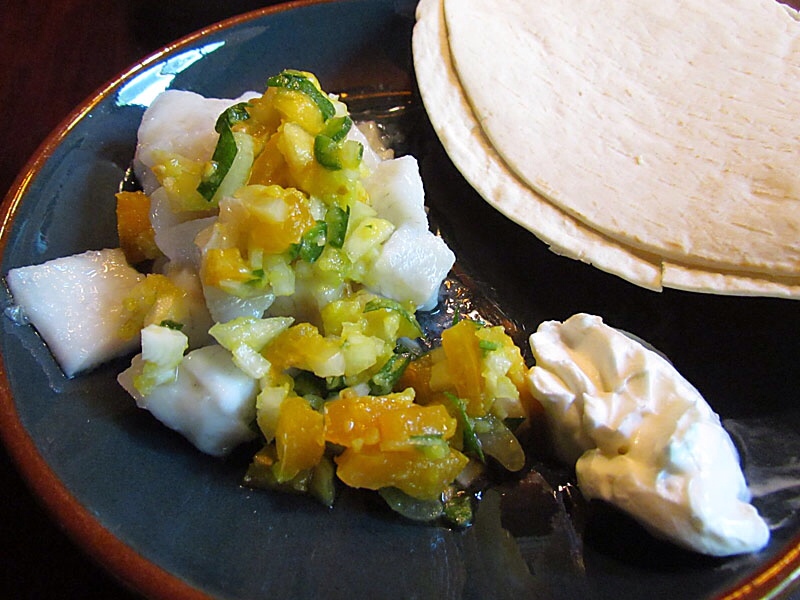
Here’s Chris’ gorgeous plate, made with Golden Jubilee heirloom tomatoes.