We’ve got pals coming over tonight for dinner and some guitar playing.
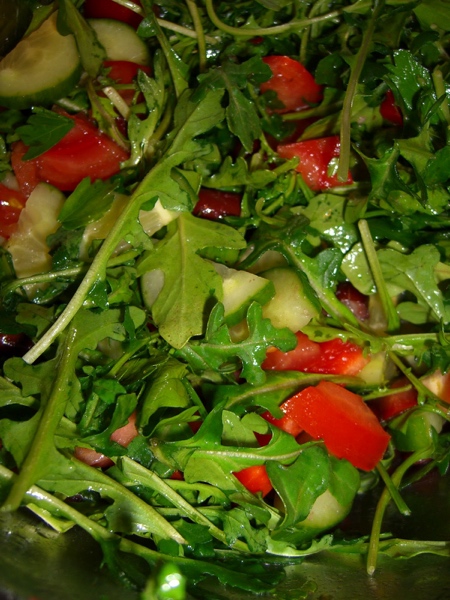
We’ll be doing a nice surf and turf with grilled Angus beef and butter poached true cod; for stuff that rich, you really need a refreshing salad that’ll cut through the fairly hefty proteins. This simple version is a long time fave of ours. The shallot, arugula, and garlic chives are a bit outside the box, and a real delight as well. If you can’t find fresh garlic chives, grow some; they’re easy to raise in a window box herb garden and go wonderfully with lots of stuff.
For the Salad,
2 Cups fresh Arugula
2 medium English Cucumbers
2 medium Tomatoes
1 small bulb Shallot
10-12 Garlic Chives
For the Dressing:
3-4 Tablespoons Extra Virgin Olive Oil
2 Tablespoons Apple Cider Vinegar
1 fresh Lemon
Sea Salt and fresh ground Pepper to taste
Peel, seed and thinly slice the cucumbers.
Core, seed and dice the tomatoes.
Mince the shallot, and chiffenade the garlic chives.
Zest and juice the lemon.
Combine all the dressing ingredients, and allow to rest for 15 minutes.
Combine all salad ingredients in a non-reactive bowl and toss to thoroughly coat veggies; allow the salad to rest, refrigerated, for 30 minutes.
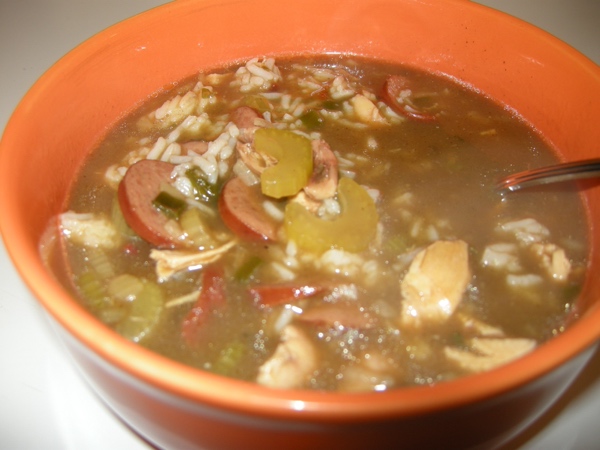
Jambalaya, crawfish pie, filé gumbo… Now before y’all go see Michelle o’ me oh, let’s talk about that last one.
This post was inspired by my friend Jenn Digby, a fine Texas lass who one day noticed a strange tree growing in her back yard down around Austin. She posted a pic on Facebook asking what it was, and this ol’ forestry student recognized Sassafras. And that, friends and neighbors, leads straight to filé, a la that ageless Hank Williams hit.
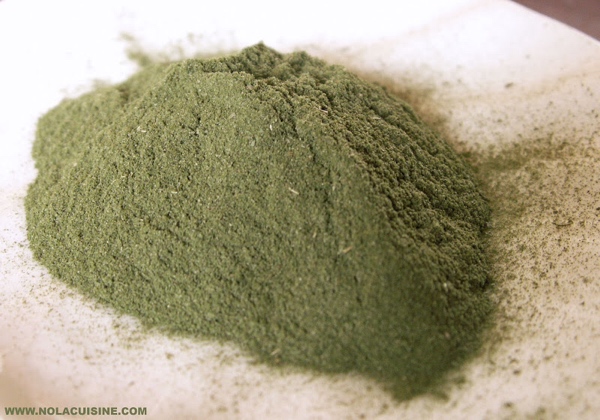
Filé, Pronounced fee-lay, the spicy thickener and spiritual heart of gumbo, is a powder made from the dried and ground leaves of that Sassafras tree (Sassafras albidum), that Jenn found in her yard. That tree is native to North America, and the use of its leaves as a seasoning goes back quite a spell. The Choctaw, who’s home turf included Florida, Mississippi, Alabama, and Louisiana, were the first to use dried, ground sassafras leaves as a seasoning. After the British kicked the Acadians out of what is now the Maritime provinces of Canada during the French & Indian War, many of these Frankish expats found their way down to Lousiana; without question, they picked up a cooking trick or two from the Choctaw along the way.
In addition to gumbo, filé may also be deployed for jambalaya or etouffé as well, again, for its distinctive, earthy flavor and thickening power. Filé powder smells kinda like eucalyptus to me, though I know more than one southern cook who swears it reminds them of Juicy Fruit gum, (I don’t get that, I’m afraid). When introduced to a dish, it’s scent has a definite root beer note, but it’s more complex and earthy than that. I’ve also heard folks say it smells like a blend of thyme and savory, and I’d say that’s a pretty apt description as well. In other words, filé is potent, complex, and adds that certain je ne sais quoi that only it can add; there really ain’t no substitute for it.
If you’re old enough, you’ll recall something about Sassafras as a beverage, and indeed, it was. Back when, root beer was flavored with sassafras root, until the FDA labelled that a possible carcinogen, (That is not a viably proven claim, as far as I am concerned, but that’s another story). The compound safrole is the guilty party, but it is not found in sassafras leaves, so fear not from your filé. By the by, I f you find a tree nearby, dig up some roots and peel back the bark, it will smell like root beer, which is most definitely cool.
Finding prepared filé is not hard; you can buy it in any decent grocery store, but as with most things, the better the source, the better the final product. As such, homemade from fresh leaves is obviously the best option. Cajun Cookbook author Tony Chachere, (who sells a very nice filé of his own), says it is best to harvest the leaves during a full moon, and there may well be something to that. Many preservers of old recommended like practice for a number of pursuits, including pickling and making sauerkraut, so why mess with success then, yeah?
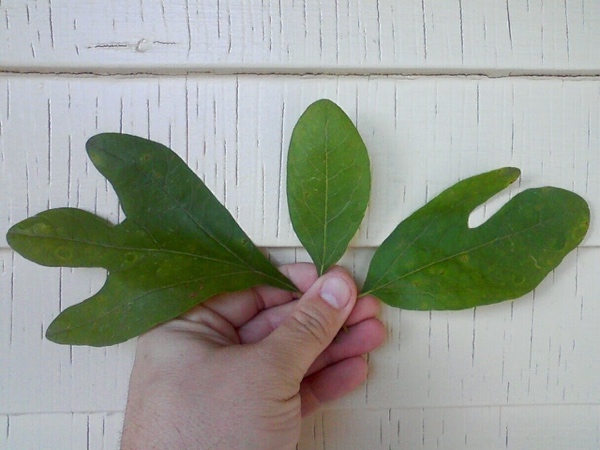
If you’re lucky enough to find your own tree, then by all means take advantage. sassafras is a deciduous tree that grows to 30′ to 40′ when mature, with distinctive lobed leaves, like this…
Once you’ve got a leaf source, harvest nice bright green leaves before fall, when they begin to dry out and turn color. Take whole, small branches for this process.
Rinse the leaves thoroughly under cold running water, then allow them to air dry thoroughly by hanging them, branch end up.
Once dried, hand strip the leaves from the branches and crush them by hand onto clean paper.
With a spice grinder or blender, process leaves into as fine a powder as you can get.
Run your powder through a fine mesh sieve, and don’t force anything through.
Store your filé in a dry, dark place as you should all your spices and herbs; sunlight and excessive moisture robs potency, smell and flavor.
Filé is properly used as a table condiment for gumbo, jambalaya, etouffe, or any soup or stew where you’d like that distinctive flavor. I love a bit on everything from chili to chicken noodle, frankly.
Just sprinkle a bit into the top of your bowl; if you let it set a spell, its thickening power will go to work for you. If you want to add filé to a dish as a thickener, do so after you’ve removed your gumbo, etc from heat and prior to serving. Add a pinch, stir it in, and let it work for a minute before you add more. It’s potent stuff, so go lightly, as a heavy hand will make things thicker and stringer than you want, guaranteed.
Now as it happens, Miss Jenn was sweet enough to do all the heavy lifting for us, so all we gotta do is enjoy – Laissez les bon temps rouler!
Homemade dressings taste, feel, look, and are better for you.
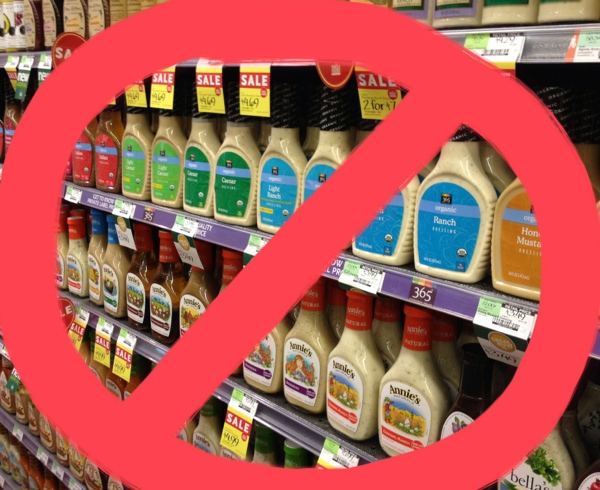
Who knows what evil lurks inside?
I have a running food joke; it’s, “I love salad bars, because you can get all sorts of bad stuff and still pretend it’s good for you.” The reality here is that the one ingredient that’s truly not good for you nine times out of ten is dressing. The reason? Because most of the time we’re using commercial dressing. Just the other day, I urged y’all to read the ingredients on something as simple as a can of black beans. Reading the label on the vast majority of store bought bottled dressing is anything but simple.
You’re going to find stuff in 99% of the commercial dressing out there that you probably don’t want to eat, even if they say ‘Organic’, ‘Natural’, etc.; big agribusiness figured out that a lot of us like foods that are better for us these days, and they’ll do anything and everything to not lose our business, including trying to make themselves look like they’re onboard the healthy food train.
The main culprits in the You Don’t Wanna Eat That pantheon are the additives. Sure, the FDA says this stuff is safe in small quantities, but there’s a couple of problems with that. First off, the FDA has a serious track record of approving stuff that turned out to not be good for us, and secondly, even if they were safe, they might well be nutritional bad juju. Remember my piece on corn a while back, how we outlined varieties that aren’t used for eating straight away, but are used in a lot of processed foods? That choice isn’t made because of superior quality. Processed food is rife with substandard, cheap ingredients because making a profit is job one. The vast majority of commercial salad dressings contain way too much fat, sugar, high fructose corn syrup, salt/sodium, unhealthy oils, and way, way too many unpronounceable chemicals.
Reading the label prompted this harangue. M checked out a bottle of Famous Label Ranch: Let’s have a look at what she found. This is not gonna be an exciting post, but it’s important; what you’ll learn here will apply to the stuff in 90%+ of the processed food out there. If it scares you, that’s good.
Commercial ranch dressing; what’s in there?!
First ingredient, (and therefore, the greatest percentage of the overall recipe), is profit, with a pinch of advertising, bottling, and production; that is, uber alles, what we’re buying, right?
Second ingredient, water. That’s the dominant note in actual ingredients. I’m not thrilled about paying $3 to $4 for water, and while we’re at it, I’d kinda like to know what water; from where, processed or filtered how? Hmmm…
Next comes soybean oil; got any of that in your pantry? No? Soybean oil is a highly refined, high heat processed fat. Soybeans don’t give up their oil easily. Far and away the most common extraction method is to employ the industrial solvent Hexane, a highly toxic petroleum byproduct. After being treated with hexane, the oil is heated enough to remove the toxin, or so they say. Next, the oil is treated with hydrogen, (hydrogenated), so that it will blend with water and not spoil quickly. Hydrogenated oils are synonymous with the term ‘Trans Fats’. Let’s just be perfectly clear that this process is done to save money and increase profit; it’s not good for us in any way, shape, or form. Trans fats increase bad cholesterol, (low-density lipoprotein, or LDL), and decrease good cholesterol, (high-density lipoprotein, or HDL). Furthermore, they block the production of chemicals that combat inflammation and benefit our hormonal and nervous systems, while simultaneously allowing chemicals to work that increase inflammation. Finally, soy is higher in phytoestrogens than just about any other food source. Phytoestrogens mimic estrogen in our bodies, and that propensity is known to be a leading cause of breast cancer, endometriosis, uterine fibroids, infertility, and low libido. In other words, we really aughta avoid this shit like the plague.
Next comes buttermilk, but again, who made it, from what source? Buttermilk is great, but it’s kinda back to the corn argument vis a vis quality, I think.
Next we have maltodextrin; this is a polysaccharide, an artificial sweetener manufactured by applying acids or other enzymes to cornstarch. Unlike simple, natural sweeteners, maltodextrin does not provide any long-term energy benefits that a natural complex carbohydrate will. Those contain vitamins and minerals that help your body use the carbs as energy; maltodextrin doesn’t. It’s also a very large molecule, so your body has to use up a chunk of its own supply of vitamins and minerals to assimilate it. The end result of eating this stuff is that it leads to depletion of important vitamins and minerals. There are also potential side effects to ingesting maltodextrin, including allergic reactions like rashes, asthma, itching and difficulty breathing.
Next two ingredients are sugar and salt, and again, I ask, what sugar and what salt and from where. Care to bet they’re not super high quality stuff?
Now we get to the rest of the things this dressing is made of, all of which are prefaced with ‘Less than 2% of’. Among the ingredients we’ll explore further, you’ll find reasonably good things like garlic, egg yolk, celery purée, carrot purée, dried onion, vinegar, onion purée, and corn oil. All of these could be good stuff for a dressing, but they’re here in tiny amounts and once again, we have no idea of the provenance or quality. Given we’re talking Big Agribiz, chances are very good that the quality sucks.
Onward; next we get ‘natural flavor (Soy)’. Sounds pretty harmless, right? No such luck. Manufacturers these days are acutely aware that a whole bunch of us don’t want Monosodium Glutamate, (MSG), in our food. Even if they say ‘No MSG’ on the label, they well may be lying to us flat out. Why? Because MSG is cheap, and very effective at adding umami taste, that mysterious savory note. Unfortunately, MSG just ain’t good for ya. Side effects can include burning sensations, weakness of the limbs, headaches, upset stomach, and hives or other allergic reactions. Ingredients labeled like the one we found here, as well as ‘yeast extract,’ or ‘hydrolyzed soy protein,’ are nothing more than MSG in disguise. And there’s another example of things the FDA lets manufacturers get away with that they maybe shouldn’t.
Next up on the rogue’s gallery, Modified Food Starch. This stuff is made by physically, enzymatically or chemically altering starch to extend its shelf life, and little else. The most common types of modified food starch are made from corn, wheat, potatoes, and tapioca. Half way decent labels will tell you what kind you’re about to eat, reading something like ‘Modified Corn Starch’. The kicker is that, unless it is derived from one of the top eight allergens as determined by the FDA, they don’t have to tell you from whence it came. You don’t need it or want it in your diet, and that’s a fact.
Next comes Soy Lecithin, which is incredibly pervasive in processed foods. It’s an emulsifier used to help blend disparate ingredients. In other words, it’s something used solely to keep things looking like they should for longer than we aughta be comfortable with. To make soy lecithin, soy oil is ‘degummed,’ mixed with water until the lecithin is hydrated and separates out. It’s then dried, and sometimes bleached with hydrogen peroxide. See above about soy, and ’nuff said.
Then we have Carrageenan. This stuff is an extract of seaweed, and the refining processes are not particularly nefarious, so this should be OK, right? Not necessarily. Although it’s allowed in almost everything over here in America, it’s restricted in the EU, due to possible health concerns regarding inflammation, gut irritation, and even cancer. It’s in here as a thickener, which I’ll point out, we wouldn’t need if they were making this stuff from real, wholesome ingredients.
On to Phosphoric Acid; got a bottle of that on your pantry shelf? It’s in this dressing to make stuff taste tangy, which real vinegar and buttermilk in proper proportion do just fine all on their own. Why is it here? Because it’s a ridiculously cheap, mass-produced chemical. It’s also commonly used for rust removal, by the way. Some Phosphorus is good for you, and fortunately, compounds containing it occur naturally at very low concentrations in milk, meat, poultry, fish, nuts, and egg yolks, (AKA, stuff you might add to real dressings if you were of a mind). Phosphoric acid, on the other hand, has been linked to lower bone density in some epidemiological studies. There are also studies that refute those claims, (Those ones were funded by PepsiCo, FYI…)
Next comes Artificial Flavor. That’s it, just ‘artificial flavor’. Neat, huh?
Next comes Disodium Phosphate, which is made by treating phosphoric acid with a sodium compound. It’s in our dressing here to enhance texture and increase shelf life, (Is that shelf life thing starting to sound like a broken record?) In addition to enhancing your dressing, it’s used in cleaning products, pesticides, and as a corrosion inhibitor.
And then we get Xanthan Gum. This fermented corn sugar polysaccharide sweetener gets its name from a strain of bacteria used during the fermentation process, Xanthomonas campestris, which happens to be the exact same bacteria that causes black rot on broccoli, cauliflower and leafy vegetables. The bacteria forms a slimy substance which acts as a natural stabilizer or thickener. Combined with corn sugar, you get a colorless goo used to increase viscosity and generate a quality known as ‘pseudoplasticity.’ That means that when the product is shaken, it will thin out, and then thicken back up after you stop shaking it.
Next we have it right there in black and white, Monosodium Glutamate; that makes a double dose.
Artificial Color is next, and again, that’s it, just ‘artificial color’.
Next, we get Disodium Inosinate, the first cousin of the Disodium Phosphate above. This junk is used to enhance the effect of MSG. It’s an artificial ingredients there to enhance another artificial ingredient.
Then we got the second cousin, Disodium Guanylate, a chemical additive that intensifies savory flavors. AKA, another artificial to enhance artificials.
Finally, we have Sorbic Acid, Potassium Sorbate, and Potassium Sodium EDTA, ‘as preservatives.’ Sorbic acid occur naturally in many plants, and is also made synthetically; the second ingredient is a salt of the first. Both of these are effective at inhibiting certain strains of yeasts and molds, but they’re not that effective against bacteria. The third member of this troika, Potassium Sodium EDTA, is another story. First off, it’s made from formaldehyde, sodium cyanide, and Ethylenediamine, none of which you should be thrilled about. Secondly, the EDTA part is short for Ethylenediaminetetraacetic acid, a chemical salt used to separate heavy metals from dyes and other industrial substances. Beyond that concern for human ingestion, EDTA breaks down in the environment into ethylenediamine triacetic acid and then diketopiperazine. Diketopiperazine is a persistent organic pollutant, similar to polychlorinated biphenyls (PCBs) and dichlorodiphenyl trichloroethane (DDT). Heard enough? Wait, there’s more… See, although your FDA has deemed this stuff safe, it has also put it on a priority list of food additives to be studied for mutagenic, teratogenic, and reproductive effects, AKA, the FDA wants to study it further to see if it is associated with birth defects, cancer or reproductive problems. This ingredient has potential side effects including cramps, nausea, vomiting, diarrhea, headaches, low blood pressure, skin problems, and fever. Too much of it can do irreparable liver damage. There, now you’ve heard enough.
There you have it. For the record, ranch, cheesy, or creamy commercial dressings are generally the worst offenders when it comes to artificial ingredients, because all that crap is needed to keep something ranchy or creamy way longer than it should be. Don’t even get me started on the fat free or reduced fat stuff; those often have more artificial ingredients in them than the regular versions. Suffice it to note that those versions will not help your body absorb all the nutrients in a fresh salad at all, which natural fats can and will do. What about those dressings kept in the refrigerated section; are they better than their shelf-stable companions? Short answer, you gotta read the labels. Several of the most popular brands are made with soybean oil and still contain a bunch of artificial crap.
To be fair, there are artisanal and organic dressings out there made with good expeller-pressed vegetable oils like canola or sunflower. Expeller-pressed means those oils are mechanically derived instead of extracted via the use of nasty chemicals. The companies that use them usually make a point of putting it on the label, so, as with all things commercial, if it doesn’t say expeller pressed, it probably ain’t.
Granted, not all food additives are bad; salt, sugar, and other naturally derived substances have allowed us to preserve and store food safely for thousands of years. I suppose that some of the artificial stuff we’ve just outlined have a place, given the worldwide food distribution system and the need for folks to eat something when they have nothing; on an occasional basis, bad food is better than starving. I believe wholeheartedly that the majority of issues folks have with food intolerance is due to the ubiquity of all this crap in processed foods. The popular thing these days is to blame everything on gluten, and fact is, that’s probably bullshit. Less than 1% of us are actually gluten intolerant. It’s not the natural stuff, gang, it’s all this artificial crap, and you can take that to the bank.
The fact remains that the whole ‘Green Revolution’ we began foisting on the world back in the middle of the 20th century has been largely a catastrophic failure. Powered by fossil fuels and chemistry, increased yields have lead to large scale poisoning of the earth, us humans, and myriad other critters. The backlash against processed food and unsustainable agricultural practices is needed every bit as much in second and third world countries, where a lack of nutritional content can mean not just obesity, but life or death.
The answer is to take back control of our food. Buy with intelligence. Buy locally when you can. Always buy quality. Make and grow everything you can at home. Not only is this absolutely much better for you, it tastes, smells, looks and feels better. Add nutrients, flavor, and health benefits, instead of taking those things away. Here’s how.
Dressings are emulsions, an acid suspended in an oil with some herbs and spices. That utter simplicity is the beauty of a good dressing. As with all things good to eat, the fresher and higher the quality of your ingredients, the better the final product. Start with nothing more than great oil and vinegar, and you’ll have amazing dressing, guaranteed. Change the oils and vinegars, and you’ve got variety right there.
First off, the good oils. We’re looking for polyunsaturated and monounsaturated varieties, and there are a good few out there. Canola, sunflower, safflower, and walnut oils are all polyunsaturated. Olive and peanut, (yes, peanut, my fave frying oil), are monounsaturated. Olive oil all by itself offers a wide variety of flavor profiles; you can and should spend years just exploring those. Use the canola, safflower, or sunflower for dressings when you want other flavors to speak louder than the oil. Opt for good extra virgin olive oil when that flavor note will contribute to the finished dressing. Naturally, you don’t want to use a highly flavored, pricy finishing oil in a complex dressing recipe.
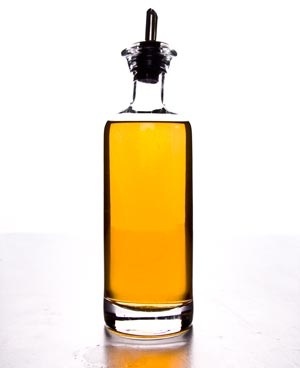
Poly and Mono Unsaturated Oils
Next, comes vinegar, and there are once again a myriad of varieties and infused options to try. And of course you can and should make your own, too. Among the common varieties you’ll find, distilled white vinegar has a sharp flavor profile that goes nicely with delicate herbs and spices. Cider vinegar has a sweet tang that compliments fruit and vegetables with a sweet note of their own. Red Wine vinegar is a bit heartier and blends well with vegetables. Malt vinegar is one of my faves, with a great balance of tang and sweet. Rice vinegar is a lighter, more delicate taste if you prefer things a bit less zippy. Balsamic vinegar is a world unto itself, enough for a future post, in fact; its richness and depth prompts me to say that you really don’t want to mix it with much more than good oil and a little salt and pepper. For daily use, a moderately priced balsamic will do just fine.
Vinegar varieties run wild, and so should you!
By the way, there are plenty of other acids to use for house made dressings. Citrus is a great alternative, so try lemon, Meyer lemon, lime, orange, blood orange, as well as pink and white grapefruit. Other tangy fruits with a dominant acidic note will work as well. Mango is one of my favorites, but tomato, tomatillo, kiwi, strawberry and blackberry are also stellar. Squeeze and strain citrus, or purée and strain the others to use them as a dressing base with your favorite oil. With flavorful options like these, you may find yourself not wanting to add much of anything else.
Acidic fruits make great dressings
Likewise, you can use booze or tangy dairy in place of vinegar. The inherent smoky wood and sugar notes of bourbon, or the sweet tang of rum make fabulous dressings. You can use booze straight away, or do a quick flambé to flash off the alcohol and concentrate the flavors. And frankly, there’s nothing like a creamy version made with fresh, local yoghurt, or genuine homemade buttermilk ranch. Contrary to popular belief and its name, buttermilk has less fat and is lower in calories than whole milk. The natural tang comes from lactic acid produced during fermentation. The curdling process also makes buttermilk thicker than milk, which is perfect for dressing.
Booze in dressing? Oh my, yes! Buttermilk & Yoghurt make fabulous creamy dressings.
Adding fresh herbs and spices yields yet more variety, as well as providing a little shot of nutrients and antioxidants with virtually no calories. Try what you like, and then branch out; sage, rosemary, marjoram, parsley, thyme, cilantro, and so on. Here again, think of the varieties of just one of these you can grow, like thyme or basil; each of those will give a totally unique finished dressing.
Don’t miss out on fresh veggies in your dressing either. Garlic, shallot, sweet onion, green onion, cilantro, parsley, lemongrass, peppers, chiles, even puréed root vegetables will make spectacular dressing. Like beets? Try my vinaigrette made with ’em.
Finally, dressings are a perfect showcase for all those varietal and smoked salts and peppers I’ve been yammering at you about. In a small batch of fresh dressing, just changing these will be a whole new ball game as well.
Finishing salts and peppers at custom zing to house made dressings.
Here are a few suggestions to get you started. With all of these versions, it’s best to blend with a fork or a whisk and then let the finished product sit for 30 minutes or longer to allow flavors to develop and marry. These are scaled for two to four folks to enjoy fresh, which for my mind is the way dressing aughta be done; if the volumes seem small, that’s because they are. Dressing should compliment the flavors of a salad, not drown ’em.
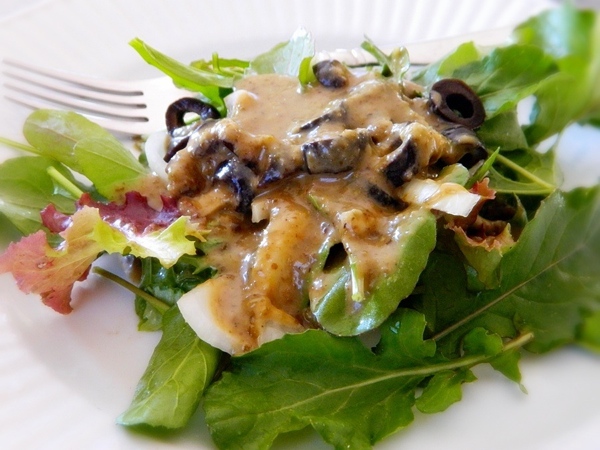
Fresh salad and dressing; hungry yet?
Dijon Vinaigrette
3 Tablespoons Extra Virgin Olive Oil
1 Tablespoon Vinegar
1 teaspoon Dijon Mustard
Pinch of Sea Salt
Variant: Add 1/2 teaspoon of good local honey or agave nectar.
Citrus Vinaigrette
3 Tablespoons Extra Virgin Olive Oil
Juice and zest of 1-2 fresh navel Oranges
Juice and zest of 1 fresh small Lime
Pinch of Sea Salt
A few twists of fresh ground Pepper
Variant: sub Meyer Lemon for oranges, add 1 teaspoon local honey or agave nectar.
Balsamic Vinaigrette
3 Tablespoons Extra Virgin Olive Oil
2 Tablespoons Balsamic Vinegar
Pinch of Sea Salt
A few twists of fresh ground Pepper
Creamy Vinaigrette
1/2 Cup plain Greek Yoghurt
3-4 Tablespoons Sunflower Oil
Juice and zest of 1 small Lemon
1/2 teaspoon dried Dill
Pinch of Sea Salt
A few twists of fresh ground Pepper
Variant: Add 1 teaspoon Poppy Seed
Mediterranean Vinaigrette
4 Tablespoons Extra Virgin Olive Oil
2 Tablespoons Red Wine Vinegar
1 Tablespoon Tomato Purée
1 teaspoon fresh squeezed Lemon juice
1/2 teaspoon granulated Garlic
1/4 teaspoon dried Basil
Pinch of Sea Salt
A few twists of fresh ground Pepper
Variants: Add chopped capers, or sun dried tomatoes.
Smoky Vinaigrette
3 Tablespoons Canola Oil
1 Tablespoon Malt Vinegar
1 Tablespoon minced Sweet Onion
1 teaspoon local Honey
1/2 teaspoon Sweet Smoked Paprika
Pinch Alderwood Smoked Salt
A few twists of Smoked Pepper
Garlic Vinaigrette
3 Tablespoons Extra Virgin Olive Oil
1 Tablespoon White Vinegar
1 Tablespoon freshly squeezed Lemon juice
2-3 cloves freshly pressed Garlic
1/2 teaspoon BasPinch of Sea Salt
A few twists of fresh ground Pepper
Variant: Add 1 Tablespoon Tomato purée.
Veggie Vinaigrette (For marinating or sautéing veggies)
Juice and zest of 1 large or 2 small Lemons
1/4 Cup canola Oil
1 Tablespoon Malt Vinegar
1 Tablespoon minced Sweet Onion
1 clove minced Garlic
1/2 teaspoon Sweet Paprika
1/4 teaspoon Sea Salt
A few twists fresh ground Pepper
Blend all and refrigerate for at least an hour prior to marinating or sautéing. Really nice over hot vegetables like broccoli, asparagus, or green beans.
Raspberry Vinaigrette
4 Tablespoons Extra Virgin Olive Oil
2 Tablespoons puréed fresh Raspberries
2 Tablespoons Balsamic Vinegar
1 teaspoon fresh squeezed Orange Juice
1/2 teaspoon Agave Nectar
Pinch of Sea Salt
A few twists of fresh ground Pepper
Variants: Sub blackberries for raspberries, lime juice for lemon. Sub blueberries and orange juice.
Beet Vinaigrette
1/2 Cup Beet Purée
1 Tablespoon Balsamic Vinegar
3 Tablespoons Extra Virgin Olive Oil
1/2 teaspoon creamed Horseradish
1-2 drops Vanilla extract
Pinch of Sea Salt
A few twists of fresh ground Pepper
Variants: try any of your favorite roots veggies in place of the beets.
Add 2 Tablespoons of buttermilk for a creamy dressing.
Honey Mustard
1/2 Cup plain Greek Yoghurt
3-4 Tablespoons Safflower Oil
1-2 teaspoons dried Mustard
1 Tablespoon local Honey
Pinch of Sea Salt
A few twists of fresh ground Pepper
Buttermilk Ranch
1/2 Cup fresh Buttermilk
2 Tablespoons Crema (creme fraîche or sour cream is OK too)
1 Tablespoon Mayonnaise
1 teaspoon minced Celery Leaf
1 clove freshly pressed Garlic
1/2 teaspoon Dijon Mustard
1/2 teaspoon Malt Vinegar
Pinch of Sea Salt
A few twists of fresh ground Pepper
Shot or two Tabasco Sauce
Whisk all like you were making whipped cream. Refrigerate in glass with an airtight lid for at least an hour and up to overnight before serving; like great potato salad, it’s actually better the next day.
Bourbon Vinaigrette
4 Tablespoons Sunflower Oil
1 tablespoon Bourbon
1 Tablespoon Cider Vinegar
1 teaspoon real Maple Syrup
Pinch of Sea Salt
A few twists of fresh ground Pepper
Variant: Add 1/4 cup plain Greek Yoghurt for a creamy alternative.
Buttermilk Rum Dressing
4 Tablespoons Safflower Oil
1 Tablespoon Dark Rum
1 Tablespoon Malt Vinegar
1 teaspoon fresh squeezed Lime juice
4-5 sprigs minced Cilantro
1 clove fresh pressed Garlic
1/4 teaspoon Habanero Chile Sauce
Pinch of Sea Salt
A few twists of fresh ground Pepper
Infused vinegars can be made safely and easily at home, and as with most things house made, they’re far superior to the commercial alternatives.
Chile infused malt vinegar
Vinegar has truly come into its own these days. Not so long ago, you might find white, cider and maybe some red in most stores; Now you can find a truly amazing assortment of varietal and infused vinegars. Here again though, its caveat emptor. Many commercial vinegars, like most other processed foods, contain stuff you don’t want or need to put in your body. Then there’s the price; typically I see $4 to $8 for 12 ounces or so of a flavored vinegar.
Here’s my guarantee; buying what you need to make these will cost a tiny fraction of that kinda dough. Make them yourself at home. Plain old white vinegar is great for making your own infused varieties, though you can and should try some others as well. Decent jugs of white, red, cider, and even wine can be bought quite inexpensively and mixed at home. Keep in mind that wine and rice vinegars contain protein that provides an excellent medium for bacterial growth, so proper storage and FIFO practices are critical when using them for home infusion.
With the recent interest in home fermenting, you may even decide to make your own vinegar at home, (But that’s a later post).
Fact is, Infused vinegars can be made safely and easily at home, and as with most things house made, they’re far superior to the commercial alternatives. There are, of course, a couple of very important caveats.
1. They are best stored in the refrigerator, and
2. Garlic, vegetable, and herbs in vinegar can still support the growth of C. botulinum bacteria.
For these reasons, vinegars should be made fresh in relatively small batches, refrigerated and used within a couple of months; no great burden there. Here’s the scoop to safely make your own at home.
Use only crack and Nick free glass jars with a good seal for infusing.
Wash your hands and other equipment well before starting any food preparation work. I like good quality, wide mouth canning jars for their ease of loading and unloading.
Sterilize your jars in a pan of water at a rolling boil for five minutes. Remove jars to a clean paper towel to dry. Fill your jars while they’re still warm. Caps and stoppers should be dropped into boiling waters, then immediately taken off the heat. Leave them in the hot water until you’re ready to use them.
Herbs and spices need to be blanched; this will help keep them safe and also makes them look downright lovely in your jars. Use only the best, freshest, cleanest leaves and flowers with no brown spots, wilt, or other lesions. Picking fresh herbs first thing in the morning is a best practice. Prepare a pan of water at a rolling boil, with an ice bath, (50% ice and water), along side. Plunge your herbs I to the boiling water for 30 seconds, then transfer I’m immediately to the ice bath for about 30 seconds. Remove from ice bath and place on clean paper towels for use. A good general ratio is 3 tablespoons of herbs to a pint of vinegar; start there and adjust as you see fit.
Fruit is wonderful in an infused vinegar; strawberries, raspberries, blueberries, blackberries, grapes, citrus, pears, mangoes and kiwis are all great candidates. The peel, (no white pith) and meat of a citrus fruit, or 1 cup of other fruit per pint of vinegar is a good starting ratio.
Veggies like onion, shallot, garlic, ginger, tomato, chiles, make great infusions as well. Of course you can always follow the Rule of Three in this pursuit as well. Garlic-Lime-Dill, Lemon-Jalapeño-Cilantro, or Juniper-Pepper-Kiwi anyone?
Try threading fruits and veggies into a thin bamboo skewer for easy insertion and removal. Thoroughly wash all fruits and vegetables with clean water and peel, if necessary, before use. Small fruits and vegetables may be halved or left whole; large ones will need to be sliced or cubed.
When choosing a vinegar for infusion, consider the flavor profile of the variety and what you want to infuse. Cider vinegar goes great with fruit. Distilled white works best with delicate herbs and spices. Red and white wine vinegars work well with garlic and tarragon. Malt or cider works very nicely with veggies.
When you’re ready to infuse, sterilize the jars or bottles you’ll use to store your vinegars in as you did the infusing jars above. I reuse hot sauce bottles for this and they do quite nicely, but new bottles are not pricy, and are a nice treat if you’re making this stuff for gifts.
Heat your vinegar to 190° F, then carefully pour over the herbs and cap tightly, (A canning funnel will come in really handy for this process.) Allow your vinegars to stand for three to four weeks in a cool, dark place for full flavor development.
Infused vinegars resting, building flavor
When they’re ready, strain the vinegar through damp cheesecloth over a colander, chinoise or double mesh strainer. As you would with house made stock, continue to filter until the vinegar runs clear. Discard whatever you used to infuse with. You can add a fresh sprig of herb, fruit, etc in the bottle if it’ll fit, but follow the ingredient prep directions above if you do. Seal tightly and store in the refrigerator for up to 2 months.
Ours pals Chris and Grant hail from northern Minnesota, land of 10,000 lakes, most of which have great fishing. Among the various options to go after, panfish are a personal favorite. They’re fun, feisty, and you can harvest a very decent catch relatively guilt free, ’cause those suckers breed like there’s no tomorrow.
But wait a minute, you ask, what are panfish anyway? Great question! The term has some wiggle room is the broadest answer; panfish mean different things to different regions and fishers. Some folks will tell you it means any species that, fully grown, fit well in the ol’ cast iron frying pan, while others claim it’s because the fish themselves are frying pan shaped. I’ve heard Crappie, Blue Gills, Sunfish, Perch, Pumpkin Seeds, and Small Mouth Bass all referred to as pan fish. To me, any of these small, plentiful species qualify for the term.
Anyway, I digress; back to why Chris got in touch. She wrote, “We caught lots of Crappies. The fillets are thin and the flesh is quite soft, but they’re nice and sweet. Any tips?”
Sure do; while a simple butter poach is lovely, or a sauté in olive oil, lemon, and dill, sometimes it’s fun to go a bit farther afield and try something new. Ceviche is the ticket. This favorite of the coastal Americas derives from an Incan dish of fish cured with salt and chiles, and marinated in passion fruit juice. The modern incarnation in its simplest form is fresh, raw fish cured in citrus juices and seasoned with chiles. Ceviche is fabulous with any white fleshed fish, and that certainly includes the pan varieties.
If you’ve never tried making or eating ceviche and are maybe a bit squeamish about it, don’t feel bad, so was Chris; she wrote, “Have never had anything like that before, so I was wary. Not anymore! I knew you wouldn’t steer me wrong!” (That’s my kinda endorsement).
Nonetheless, what makes folks nervous is the lack of cooking involved in making ceviche. Technically speaking, cooking requires heat, so ceviche isn’t cooked, but it’s not raw either; it’s fish cured in a citric acid bath. Fact is, both processes initiate a chemical reaction called denaturation, which alters the proteins in the fish chemically and physically. The end result of either method is fish that becomes firm to the touch, opaque to the eye, and a ‘cooked’ taste.
So, how long should fish be marinated in citrus juices in order for denaturation to take place? That depends on the variety of fish you use, and how well you like your fish cured. Just a few minutes in citrus juices and your fish will start to go opaque, though the interior will still look raw and the flesh won’t have firmed up yet. Just as with cooking, you can marinate too long, leading to a tough texture and an overpowering citrus note. The key to even, dependable results is to always butcher your fish down to roughly bite sized pieces. Doing so increases the fish’s surface area and makes it easier for the citric acid to do its thing. Generally, the flakier and softer the fish, the faster it will cure in citrus. Watching for the complete opaque appearance and firm feel you expect when you cook fish will give you good results.
The freshness of the fish you choose to marinate is a critical consideration, because citric acid curing doesn’t kill bacteria the way cooking does. If you’ve got any concern about this, it’s best to freeze your fillets at or below -4° F for a good week prior to making ceviche. That will kill potential parasites like tapeworms and roundworms. Alternatively, you can do a quick blanch with your fish, dropping the fillets into boiling water for a full minute, then immediately plunging them into ice water to stop the cooking process, before you marinate it. This quick shock also helps softer fleshed fish maintain a firmer texture when cured.
There’s a world of variety waiting for you to explore once you wade in. Just varying the citrus creates truly unique dishes, so try lemon, lime, blood orange, grapefruit, or yuzu. Same goes with the chiles; from light heat and fruity to truly fiery, each one creates a different finish. A touch of a varietal vinegar does the same thing. A bit of mango in your finished mix beautifully compliments the sweetness of the fish, and on and on.
Here’s the one I did up for Chris; It’s a pretty classic swing at the dish, and super easy to make
1 Pound Fish
6-8 Limes
2 medium varietal Tomatoes
3-4 Green Onions (Sweet Onion is fine as a sub)
1 stalk Celery
1-2 Jalapeño Chiles (Again, you can vary the variety as you like)
1/2 Cup fresh Cilantro
Cut fillets into bite size pieces.
Place fish in a non-reactive bowl and cover completely with lime juice.
Refrigerate covered for 6-8 hours, until the fish has turned completely opaque.
When the fish is ready, fine dice all the remaining veggies and mix well, including the olive oil.
Discard the marinating juice from the fish.
Add the juice from 2 fresh limes and the cured fish to the mix and toss gently.
Serve with fresh tortillas, crema, guac, and ice cold beer!
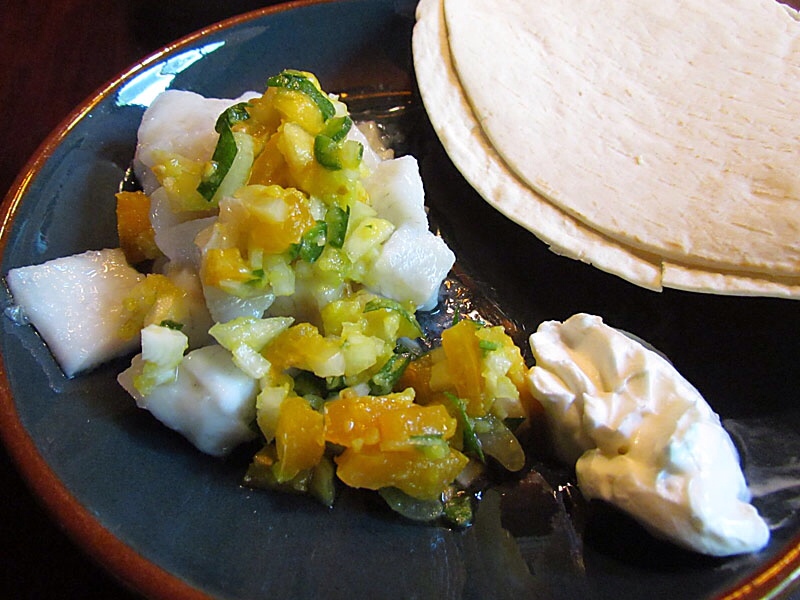
Here’s Chris’ gorgeous plate, made with Golden Jubilee heirloom tomatoes.
So, if you’re a lover of food porn TV, you have without a doubt heard the term ‘Gastrique’ thrown about by an Iron Chef or Chopped contestant. While ya might hear that term and nod sagely, do ya know what one is and how to make it? I’ll bet you do, though you might not know it.
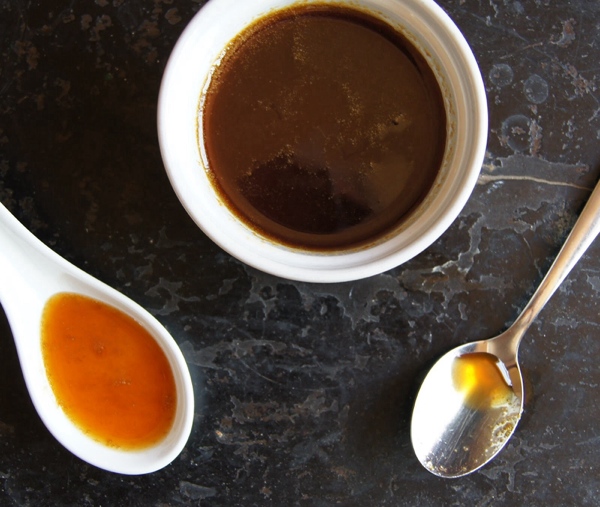
Stripped of the fancy moniker, a gastrique is just a sweet-and-sour sauce designed to compliment and coax out the bold flavor notes of a protein; they work well on beef, pork, chicken, fish, meaty vegetables like mushrooms and eggplant, and even tofu, (in fact they’re spectacular with tofu), even sweet stuff.
Gastriques are easy to make and visually stunning; they’ll make a simple dish look and taste like something turned out by a seasoned pro. Simply caramelize a sweetener and blend it fifty-fifty with vinegar, (the acid, or sour component), and you’ve formed a sauce of sublime beauty.
Gastriques are wonderfully tweakable, given the wide of sweeteners and vinegars available to us these days. Make the same one with different variants and you’ll have a bunch of distinct sauces, each with its own charm. Consider vinegar; there’s everything from the spicy, sharp notes of cider, to the amazing depth and subtlety of good balsamic. Varietal wine vinegars, sherry, champagne, rice, malt – the other day I saw blood orange and fig vinegars in the store, and all of these you can make yourself at home, too, so once again, the sky’s the limit. For sweeteners, you might choose sugar, (white, brown, dark brown, turbinado), honey, agave nectar, maple syrup, molasses, and so on.
Additional flavor notes can be supplied by a myriad of things, from booze, to fruit, veggies, herbs and spices. Gastriques can stand on their own with a main ingredient, or act as an adjunct with heavier partners like a pan sauce made after searing a protein.
Regardless of what you decide to make, the process is the same;
Combine the sweetener and vinegar in a sauce pan over low heat.
Reduce the sauce, stirring occasionally, until you’ve got roughly 50% of your original volume.
When you’re just about to the volume and consistency you like, add your additional flavor notes, heat through, and reduce a bit further if need be.
When the gastrique is right, it should nicely coat a spoon.
Take a taste, and that’s it, you’re done.
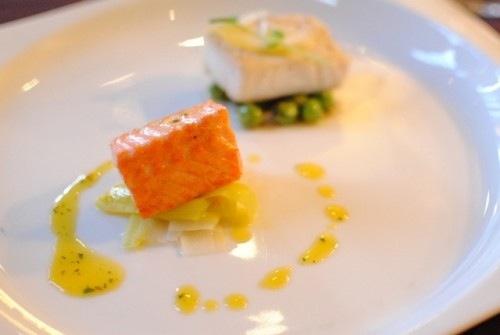
Gastriques are pretty but potent, so use them sparingly. You don’t have to get uber fussy, but this is one of those cases where you want to pour or brush a little line across your plate, or around your entrée; a big ol’ puddle of gastriques is too much. Also, you need to pair wisely. It’s like with like, so a stronger flavored protein like duck or game will like a strong gastrique, like brown sugar/malt vinegar/blackberry. Likewise, something more delicate like chicken will go better with agave nectar/champagne vinegar/kiwi. Citrus or herb variations go great with seafood and veggie dishes. Don’t forget cheeses; from Brie to Myzithra, a gastriques can turn cheese into a serious appetizer just like that. And that ain’t all; try a slightly sweet favored fruit gastrique over homemade ice cream, on a fresh granita, or crepes. You can even use a gastriques in a cocktail where you might normally opt for bitters. Once you get hooked, the sky is the limit.
As I mentioned above, gastriques can also be combined with other sauces; when you want to try this, think of the gastrique as specifically providing a tangy element to your overall presentation. For instance, you might use a honey/malt vinegar/tomato/lemon gastrique to provide that function for a pan sauce made from a whole roasted chicken.
Gastriques will keep for two or three weeks refrigerated in an airtight bottle. Repurposed hot sauce bottles are perfect for the task. That said, I like them fresh best, so I build in small batches that will get used pretty quickly.
Sherry Gastrique is great for chicken, fish, and veggie dishes and sides. Just blend all three ingredients from the get go and reduce accordingly. Raspberries also go great with this combination of sweetener and vinegar.
1 Cup Champagne Vinegar
1 Cup Amber Agave Nectar
1/2 Cup Dry Sherry
Blackberry Gastrique is seasonal, of course, but if you pick ’em, then freeze ’em so you’ll have them year round. This goes great with beef, pork, and meaty mushrooms like porcini. Blueberries and cranberries also are great with this combination of sweetener and vinegar.
1 Cup Malt Vinegar
1 Cup dark brown Sugar
1 Cup fresh Blackberries
Purée the blackberries in by blender, then add them when your sugar/vinegar reduction is roughly 60% of initial volume. Continue to reduce until you hit 50%.










 UrbanMonique