I post this about once a year, and probably should more often than that. I looked at the national weather map and saw that spring has indeed finally taken hold, and summer is on its way. That got me to thinking about the Number One Thing we stress each and every day in restaurant work – Food Safety, because it is intrinsically linked to temperature. While it’s a must in the business, it’s all too often lacking at home, so I thought we’d better revisit the ground rules and spell ‘em out in big letters. In this day and age when more and more foods are making folks sick and even killing some, you simply must take matters into your own hands.
You can and should print this one out and stick it to your fridge with one of those goofy magnets.
The Golden Rules
Understand and Respect the Food Temperature Danger Zone.
Bacteria love temperatures between 40º F and 140º F, so naturally, we want to strictly limit food from hanging out in that range. The mantra is ‘Keep cold food cold and hot food hot,’ and yes, it is that simple. Couple temperature with time, and you’re ahead of the curve. Don’t let anything hang in the zone for longer than 60 minutes, and that’s a total running time. Think about this: Between shopping, prep, and finally cooking, how much time has elapsed with food in the temperature danger zone? You buy a steak first thing at the store, and you’re doing a good sized shopping, comparing, saving, all that proper stuff. By the time you get that steak home and in the fridge, how long has it been in the danger zone? For most of us, I’ll bet you’re real close to an hour, and you haven’t even started prepping and cooking yet. Before we fix that issue, let’s look a bit closer at the spectrum itself.
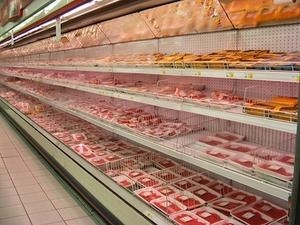
Cooking, Prep, & Storage Temperature Ranges
165°F+ – Most bacteria die within seconds
141°F to 164°F – Safe range for holding hot foods. Bacteria aren’t killed, but don’t multiply.
40°F to 140°F – Food Temperature Danger Zone: Bacteria thrive and multiply. Perishable foods spend NO MORE than one hour here, period.
33°F to 39°F – Fridge range. Bacteria aren’t killed, but they multiply relatively slowly. Food is safe here for a limited time.
32°F – Freezer zone. Bacteria aren’t killed but don’t multiply. Note that, gang; freezing does not kill bacteria, it just puts them into suspended animation. If ever there was a reason to follow safe food handling practices at home, this is it, since this is the long-term food storage method the vast majority of us use.
Here are the specific methods you need to adopt.
1. Prep potentially hazardous food like the professionals do, which is ice to ice.
When you pull potentially hazardous foods out to prep, place them in a double pan or bowl, with a thin bed of ice beneath the one holding your food. Do the same with the plate, pot, or bowl you’re prepping into. This simple process will truly help keep you and yours much safer.
2. Cook smarter, not harder.
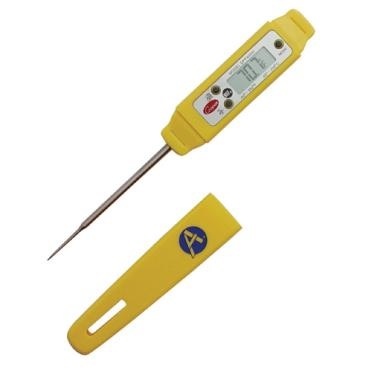
Use a thermometer when you cook, so you’re cooking to temperature, not to time. If you’re not using a thermometer and you’re not a seasoned cooking pro, how do you know what temperature you’re cooking something to? Fact is, you probably don’t, and that’s not good for food safety or quality. The top end of the Food Temperature Danger Zone, 140º F is not the temp at which bacteria die, it’s just the point at which they more or less stop multiplying. You need 165º F to kill most things that can hurt you, like salmonella and e. coli, and that’s 165º F internal temperature. No thermometer equals not sure, and not sure equals not good, so fix that. You’ll want a thermometer that allows recalibration, and you’ll need to read the directions on how to do so. Here’s a link to the model I use at home and at work; it’s the fastest, most accurate, reasonably priced model for home use I’ve found.
3. Get cooked food out of the danger zone ASAP.
Within the food safety danger zone, the temperature range between 125° and 70°F allows for the most rapid growth of microorganisms. As such, you’ve got to get leftovers that have been cooked out of that range as quickly as possible. The 2-stage cooling method is what we use in professional kitchens. That means you want to,
Cool from 140°F to 70°F with two hours, and then
Cool from 70°F to 41°F or below within four hours.
That initial two hour cool is the most critical time period, since that’s when the food is passing through the most dangerous temperature range. Here’s the hard and fast secondary rule you’ve got to strictly abide by:
If food has not reached 70°F within two hours, it must be reheated to an internal temperature of 165°F for 15 seconds and then properly cooled again, or thrown away.
Keep in mind the unassailable fact that food needs help cooling down quickly; it can’t do it on its own. Critical factors that affect how quickly foods will cool down include,
Size of the food item being cooled, (thickness, or distance to its center, plays the biggest part in how fast a food cools).
Density of the food, (the denser the food, the slower it cools).
What the storage container you use is made of. Glass and stainless steel transfer heat from foods faster than plastic. If you’re using plastic wrap, leave it loose at first, to allow cold air to freely circulate around the food; once it’s cooled, tighten up the wrapping to keep air away and avoid drying out and cross-contamination.
Size of the container. Shallow pans, (depth less than two inches), allow heat from food to dissipate faster than deeper ones.
And here is a concept you absolutely must embrace wholeheartedly – Food will not move through the temperature danger zone fast enough if it is still hot when placed in the fridge or freezer. In fact, sticking hot food straight into the fridge can actually raise the temperature of everything in there, putting a whole lot of your food into the temperature danger zone. Sound crazy? Ever put a big pot of soup or stew into the fridge, including the steel pot? I rest my case… Here’s how to properly handle things.
* Reduce the size. Cut large hunks of food into smaller pieces for storage. Take that soup out of the pot and transfer it to smaller containers.
* Use an ice-water bath, (50% each, ice and water), and stir foods that are stirrable for fast, even cooling.
NOTE: The only way to accurately know that time and temperature requirements are being met is by actively monitoring the process. That means that you need to use your thermometer for cooling as well, (Look closely at your favorite cooking show; I’ll bet you’ll see that the real chefs all have pocket thermometers). Get used to regularly check temperatures and monitoring the time.

4. Keep it all clean.
Wash your hands with hot, soapy water, actively, for at least 20 seconds. Do it before and after you work with food that has greater potential for bacteria, like meat, poultry and fish, and do it again before you move on to prepping something else. Wash and sanitize your cutting boards (Use a mild bleach solution on those; they’re semi-porous, so you really need to pay attention to cleaning them), knives, and anything else that touched potentially high risk foods before you prep something else with them. Does your sponge stink? If it’s not dirty and worn out, toss it into your microwave for 30 seconds; it’ll come out smelling much better, because you’ve offed some bacteria. If it is worn out and dirty, toss it and use a fresh one; same goes for kitchen towels.

5. Don’t defrost or marinate at room temperature.
Best practice is to defrost in the fridge. If you must defrost quickly, fill a bowl big enough to hold what you’re working with the coldest water you can get from your tap, immerse the food in the water and let it run as low as you can get it until it’s ready. NOTE: If you cannot get water colder than 70º F, do NOT use this method, period!
6. Use your senses and resources.
When food spoils, is it dangerous? The answer is, not always but quite possibly, so err to the side of caution, (Making cheese is basically controlled spoilage, as is fermentation). Bacteria like the same things we do, from food to comfy conditions, so always keep that in mind. When food spoils, rots, etc, it looks, smells, tastes and feels off; respect your senses and let it go if it ain’t right. I can guarantee you won’t get sick if you don’t eat it. Bacteria need pretty specific conditions to thrive, involving the temperature, moisture and PH level of the things they live on, AKA, our food. Know the attributes of the food you’re cooking and storing and act accordingly. Use the section of your fridge meant for butter, cheese, eggs, veggies and fruit; modern fridges really can help control moisture levels as well as temp, so allow them to do their thing.

7. Reheat properly.
When reheating hot food, get it back up above 165º F internal temperature before you serve it. Sad as it may seem, you only get one shot at it – No second reheats – So plan, portion and cook accordingly.
Follow these rules religiously. Take care when you buy; always look for quality and freshness, get to know your purveyors, buy locally whenever possible. Make it at home whenever possible.








 UrbanMonique