Apples 2015


Apples are easily among the most beloved, and most maligned fruit out there. They’re beloved because of all they were and could be, and maligned predominantly because of the crap that mass production, grocery store apples have become.

  
Malus domestica is a member of the Rose Family, grown worldwide, with more than 7,500 known cultivars. Apples come from Central Asia, where its wild ancestor, Malus sieversii, can be found to this very day – here in the U.S., you can find starts for that very tree if you wish.


Yet not so long ago, most grocery chains carried maybe five varieties, two of which were delicious, (Red and Golden, neither of which actually are delicious…), along with Granny Smith, Gala, and Fuji. There are deep problems with all of these, and here’s why. These varieties, all of them that you find in the store, are bred not so much for flavor as they are for the ability to withstand storage, travel, and stocking – Those are not attributes we’re wanting in an apple, frankly. Nowadays, there are more varieties in most stores, but we still have the problem of freshness. 90% of the time, what you’re buying is last year’s crop, or maybe this year’s from New Zealand, that travelled thousands of miles to show up in Your Town, U.S.A. Neither of those options brings apples at anything close to peak freshness.
Apples grown in this country are a late summer, early fall crop. For large scale commercial purposes, apples are picked slightly green and then, since 2002, sprayed with 1-methylcyclopropene, a chemical meant to prolong use storage. They’re then waxed or shellacked, boxed, crated, and stored in an low temp/high CO2 environment to discourage ethylene production. There they stay for an average of nine to twelve months. They may, (and often are), also treated with fungicides while in storage.
It’s important to note that buying organic may not save you from all these ills. Much large scale organic farming has been bought out by mega-corporations, and they can and do still use the same 1-methylcyclopropene, wax, shellac, and extended storage techniques as non-organic fruit.

1-methylcyclopropene, trade name SmartFresh, is supposedly not toxic to humans or the environment, but there’s a distinct problem with those claims. According to an article published by the American Society of Horticultural Science, “1-MCP is being used on 16 horticultural products, but much commercially relevant research on its effects is proprietary. For example, research using 1-MCP to increase potential for shipping longer distances or increasing market share of various fruit is being undertaken around the world under confidentiality agreements.” Meanwhile, PesticideInfo.org basically notes that most specific information regarding the potential effects of SmartFresh are “not available,” which is disappointingly in keeping with the ASHS’s findings.

Add to all that a Canadian study that shows that much of the good stuff in apples is seriously degraded after only 3 months of storage, and you’ve pretty much got the big picture view of why store bought apples suck. Fresh apples provide notable dietary fiber, simple, easily digestible sugars, and lots of polyphenols, a potent antioxidant. Yet stored for 9 to 12 months, pretty much all that antioxidant is gone.


But enough doom and gloom: All is not lost – in fact, there’s much light at the end of the tunnel; heirloom apples are making a broad come back, and some cool new varieties are coming available as well. From New England to the Pacific Northwest, and much in between, new-to-most-of-us varieties are finding their way to market. From Community Supported Agriculture, (CSAs), small scale farms, renewed interest by long time growers, and robust university level agricultural programs, variety is returning. Just yesterday, we got notice from our local CSA that one old variety, (Gravenstein, introduced to the U.S. in 1822), and two new varieties were available for as long as they last. A couple weeks ago, in northern Minnesota, I was introduced to the Oriole variety, developed by the University of Minnesota, (as was one of the varieties we were offered here, the Zestar). The Oriole was marvelous; tart, crisp, with just the right sugar balance – Perfect for munching or cooking.
  

Find and read Rowan Jacobsen’s Apples of Uncommon Character; you’ll find your spirit buoyed, and your interest piqued. Do some research for your neck of the woods – Google heirloom apples and your town, then go out and find them. Hit your farmer’s market or local CSAs. Once you’ve scored, preserve apples the way it’s been done for centuries – can some, dry some, freeze some, and enjoy it all.

  
Now, let’s cook with some – Here’s what I did with those Orioles in Minnesota, as well as a couple more favorites. Use whatever varieties you find that float your boat – Ask the producers which varieties making for good cooking, and go with those.

Urban’s Apple Crisp
10 Cups fresh Apples
1 Cup Bakers Sugar
1 Cup Quick Oats
1 Cup Dark Brown Sugar
1 Cup plus 1 Tablespoon Whole Grain White Flour
1/2 Cup local ESB Ale
1/2 Cup unsalted Butter
1 teaspoon real Cinnamon
1/2 teaspoon Vanilla
1/4 teaspoon Coriander
1/4 teaspoon Baking Powder
1/4 teaspoon Baking Soda
Pinch Sea Salt

Preheat oven to 350° F and set a rack square in the middle.
Rinse, core, seed and slice apples about 1/2″ thick, (I like the skins on, you can peel them if you wish)
Pile sliced apples into a 9″ x 13″ baking pan, glass preferred.
In a small mixing bowl, thoroughly combine bakers sugar, tablespoon of flour, cinnamon, coriander, and pinch of sea salt.
Hand sprinkle that blend over the apples, then pour the ale over all.
Melt butter.
In a larger mixing bowl, combine flour, brown sugar, baking soda and powder, and melted butter. Blend thoroughly by hand, then pack that evenly on top of the apples.
Bake at 350° F for 40 to 45 minutes, until topping is nicely browned.
Allow to rest for at least 15 minutes prior to serving.


Belgian Waffles with Apple Compote, Bacon, and Cheddar

Heat oven to Warm, add plates for each person, the bacon, and the waffles.
Make the recipe for Belgian Waffles here – 2 to 4 per person, depending on iron size – set in warm oven to hold.
Fry 3-4 slices of fresh, local bacon for each person – set onto paper towels in warm oven.
Slice extra sharp, aged Cheddar very thin and set aside.

For the compote, (enough for 4 to 6)
6 fresh Apples
4 Tablespoons Butter
1 Tablespoon Grape Seed Oil
1 Tablespoon Agave Nectar or local Honey
1/4 teaspoon True Cinammon
1/4 teaspoon Vanilla paste or extract, (If using beans, scrape seeds from 1/2 bean).
1/8 teaspoon Allspice
Pinch Sea Salt

Rinse, core, seed and slice apples to about 1/2″ thickness
In a sauté pan over medium heat, add oil and butter, allow to melt and heat through.
Add sliced apples, agave or honey, and all spices, toss to combine thoroughly and coat with the oil and butter.
When the blend starts to simmer, reduce heat to medium low and sauté for about 15 minutes, until apples are very tender.
Remove from heat and allow to rest for 15 minutes prior to serving.
To serve, lightly butter waffle, add strips of bacon, then compote, then top with cheddar.

  
Then there’s the savory side…
Chutney is a favorite of mine since I was a kid, making it with my Mom each fall. The combination of fruit and savory elements is a big winner; apple chutney goes great with pork, chicken, wild rice, even soufflés, believe it or not. It’s easy to make and stores well; it’ll last 2 weeks refrigerated, and much long if you decide to water bath can it. Spicier, more piquant apple varieties make for better chutney than the overly sweet ones do.

Apple Chutney – About 6 Cups
10 to 12 fresh Apples
2 fresh large Navel Oranges
1 large Sweet Onion
1 Cup Live Cider Vinegar
1/2 Cup local Honey
1″ piece fresh Ginger Root
1 teaspoon Sea Salt
1/2 teaspoon fresh ground Pepper
1/2 teaspoon ground Coriander
1/4 teaspoon ground Turmeric
OPTIONS:
1 Cup Golden Raisins
6-8 Cherry Tomatoes

Rinse, core, and seed apples, then rough chop.
Rinse, peel, stem and dice onion.
Rinse, peel and mince ginger root.
Rinse and pat dry oranges; zest and juice both, set that aside.
In a large sauce pan over medium high heat, combine all ingredients thoroughly, then bring to a simmer, stirring occasionally.
Reduce heat to medium low and allow to simmer, stirring occasionally, for 45 to 50 minutes, until the mix has thickened notably and most of the free liquid is absorbed.
Remove from heat, transfer to a non-reactive bowl and allow to cool thoroughly. Store in clean, glass canning jars, refrigerated, for up to 2 weeks.
And of course, I wouldn’t be me without including an apple salsa. Rather than a cooked or blended version, good apples lend themselves especially well to a pico de gallo style salsa. Again, pick a tart, spicy variety when you make this one.

  
Urban’s Apple Salsa
4-6 fresh Apples, (about 2 Cups volume)
2 fresh, firm Tomatoes
1/2 small, Sweet Onion
1-3 Jalapeño Chiles
1 fresh small Lime
6-8 stalks fresh Cilantro
Drizzle Agave Nectar
Sea Salt and fresh Ground Pepper to taste

Zest and juice the lime, set both aside
Rinse, core, and seed apples, then uniform dice.
Toss apples into a large mixing bowl, then add lime juice and zest, and toss to incorporate.
Peel and stem onion, then fine dice.
Rinse, core and seed tomatoes, then fine dice
Peel, seed, and devein jalapeños, then fine dice.
Chiffonade cilantro.
Add all veggies to the mixing bowl and toss to incorporate.
Add agave, pinch of salt and a couple twists of pepper; taste and adjust seasoning.
Allow salsa to rest in a non-reactive bowl for at least 30 minutes, refrigerated, prior to serving.


Lamb Merguez & House Made Harissa – North African Specialties

Great North African specialties you can make at home.


My friend David Berkowitz is a true renaissance guy; on any given day, he might be mixing sound at Wolf Trap, or building guitars of truly sublime beauty and power; often enough, he follows that up with some very inspired cooking. I’ve seen great dishes with influences from French, through Middle Eastern and North African come from his talented hands. The former launched this question the other day.

“Do you have a good recipe for lamb merguez? The ones I’ve found around here are mostly beef and then end up having kind of a gritty texture. Not sure why that is.”

As always, big thanks for asking; first, let’s look at that grainy issue. Merguez is highly spiced, and on top of that, if those makers close to Dave are using mostly beef, I can see a few potential issues. My first suspect would be not processing at cold enough temperatures – With as much dry spice as merguez boasts, you need to make sure that everything is really cold – Meat semi-frozen, spices fully chilled, and all vessels frozen throughout production. If those steps aren’t taken, then I’d think the chance of ingredients separating is quite high, and that’s the number one reason sausage will get grainy. Secondly, beef is quite marbled compared to lamb, or at least the most common sausage making cuts are, so potentially one could have a meat/fat ratio issue there. And finally, for a relatively heavily spiced sausage like this, you pretty much gotta add a bit of liquid after grinding and work that into the mix before stuffing.

Merguez is a French derivation of the Berber word for sausage, mirqaz. This is a fresh sausage, bright red before cooking, made from mutton or lamb, and heavily laced with North African spices – chiles, garlic, fennel, and cumin are dominant notes. The characteristic red color comes from paprika and harissa, a Tunisian chile paste. While some recipes just add chile flake or powder, as far as I’m concerned it’s not the real deal unless it includes harissa, and that too should be home made. We make ours with roasted red Hatch and Serrano chiles, and it’s got all the heat you need – Knowing David as I do, I’ll bet his version will have Habaneros in it, if not ghost chiles – He’s that kinda chile head…

Traditionally, Merguez is stuffed in lamb casing, and you can get those online from Butcher & Packer, Amazon, etc, but frankly, there’s nothing wrong with using beef or even synthetic if that’s what you like. Served with a nice couscous and a cucumber salad with yoghurt sauce, you’ve got a truly fabulous meal.

First off, here’s the harissa; refrigerated, it’ll last a couple weeks in an airtight container. It’s great with all kinds of meats, veggies, and even eggs.

Harissa - Tunisian Chile Paste

Urb’s Harissa

5 red Hatch New Mexican Chiles

5-7 fresh Serrano Chiles

3 cloves Garlic

2 Tablespoons Avocado Oil

1 teaspoon Coriander

1 teaspoon Caraway Seed

1/2 teaspoon Cumin

1/2 teaspoon Sea Salt


Set oven to broil and a rack on the highest setting.

Place whole chiles on a dry sheet pan and roast, turning steadily, until skins are blackened uniformly.

Pull chiles from oven and set aside to cool.

Combine coriander, caraway, and cumin in a spice grinder and pulse until uniformly blended and powdered.

Remove skins and stems from cooled chiles. If you’re a heat weenie, use gloves when processing them, and you might want to remove some or all of the seeds, (but you should feel shame for doing that, because this stuff is meant to pack a punch.)

Smash garlic, peel, and remove nibs from both ends.

Load all ingredients but the salt in a blender or processor and pulse to a uniform paste.

Add half the salt, pulse again and taste; adjust salt as needed.

Store refrigerated, in an airtight, glass container.


And here’s the sausage. If you have access to local grass fed lamb, that’s what you want; the benefits of that far outweigh commercially packed stuff. Whatever you get, make sure it’s as fresh as can be. Lamb gets a bad rep for being funky, but to be honest, that has far more to do with how the animal is raised and fed than it does the meat itself. Lamb fat is more piquant than beef, but the beauty of lamb is that the fat isn’t marbled into the meat nearly as much, so when you trim, you can remove exactly as much of the fat as you like, and end up with beautiful, lean meat to work with. Lamb fat is traditional for Merguez; you can add some pork or beef as well, if you like. I use 50% – 50% lamb and pork fat; that balance makes a sausage that many folks really enjoy.

NOTE: I use a Kitchenaid grinder and stuffer attachment, so I’ve got a stand mixer basically set up when I build this sausage. If you have a dedicated grinder, prep your stand mixer with a paddle blade attached before you start.


Real Deal Merguez Sausage, (Makes 4 pounds of pre-cooked sausage)

3 Pounds Lamb Shoulder

1 Pound Lamb, Pork, or Beef Fat

1/2 Cup Harissa

1/4 – 1/2 Cup Ice Water

6 cloves Garlic (pick uniformed sized ones)

2 Tablespoons hot, sweet Paprika

2 Tablespoons Sea Salt

2 teaspoons Fennel Seed

2 teaspoons Cumin

2 teaspoons Coriander

1-2 teaspoons Sumac

Natural Casings, 28mm to 32mm

NOTE: Sumac has a tart, citrusy flavor that is potent and complex. Try a dab on your fingertip and decide how much you like it, then add either 1 or 2 teaspoons.


Have all spices and Harissa refrigerated and thoroughly chilled.

Meat needs to be semi-frozen prior to production; I usually trim and size it, then lay it on a small sheet pan and put that in the freezer. All bowls need to be frozen as well.

Trim all gristle and connective tissue from lamb and fat.

Trim meat to size so that it’ll feed smoothly through your grinder.

Set grinder up with a coarse plate for your first run.

Casings should be thoroughly rinsed, inside and out, then soaked in warm water for 30 minutes prior to stuffing.

In a heavy skillet over medium heat, add fennel, cumin, and coriander; toast spices, (staying right with it, ’cause they can burn really quickly), mixing with a fork for 1 – 2 minutes until their fragrance tells you they’re done. Transfer to a small bowl to cool.

Smash, peel, trim ends from garlic, then mince and set aside.

Transfer cooled spices to a grinder and process to a uniform powder.

Transfer ground spice to a small mixing bowl, add sumac, paprika, and sea salt, blend thoroughly, and set aside.

Set one of your chilled bowls up inside a slightly larger bowl with plenty of ice in it – snug your receiving bowl down into the larger so it’s well iced.

Run fat and meat through your grinder.

Add spice blend, harissa, and garlic to ground meat and combine thoroughly by hand. Return grind to freezer.

Set your grinder up for a second run with a fine plate, with the same iced set up for your receiving bowl.

Set a small sauté pan over medium high heat.

Transfer bowl with sausage grind to your stand mixer with a paddle blade attached. Add half the ice cold water and process at fairly low speed, (2 or 3), until you’ve fully incorporated the water, about 1 minute. Sausage should be moist and slightly sticky; if it’s not quite right, continue mixing and add more water, a tablespoon at a time, until you get there.

Hand form a small patty of the sausage, (about 3″ around and 1/4″ thick), and return the rest to the fridge. Cook the patty through, 1 – 2 minutes per side. Taste and adjust seasoning as desired. If you add more seasoning, blend with the paddle on the mixer. You can add another teaspoon or so of water, if needed.

Set up your grinder for stuffing; fill about 3/4 full and twist into 6″ links. Coil and refrigerate for at least 4 hours prior to cooking.

Merguez - Spicy North African Sausage
Merguez stands out with its bright red color

Merguez should be cooked over wood or charcoal. Once you’ve got nice, glowing coals and a preheated, brushed, and lightly oiled grate, grill to an internal temperature of 155° F. Allow a 5 minute rest prior to serving.

Merguez - Spicy a North African Sausage


That ain’t how we play…


I tweak and republish this post annually; I think you’ll see why when you read it.

See, I’m not out to be tragically hip, in fact quite the contrary. Or maybe Matthew Selman said it best; “I wish there was another word than foodie; how about ‘super food asshole’, or ‘pretentious food jerk’?” I just don’t wanna go there.

Granted, there are a lot of great food blogs out there, but right now, many are judged ‘Great’ because somebody took a really, really nice pic of some food, or is on the fast track to be the next Food Channel Super Food Asshole. Frankly, when the ‘best’ food blog sites reject people because they don’t meet criterion such as that, I’m more than not interested, I’m actively turned off. 

I write about food from some pretty simple perspectives. I’m interested in sharing recipes, methods, processes and such. I’m interested in sourcing, using wisely, and preserving food that is good for you, in a world where much of what we are offered to eat is not very good. I’m interested in the science behind cooking, because I’ve never liked simply being told to ‘do it this way.’ I trust that if you’re reading this, you’re interested in these things as well. To be honest, if no one read this blog, I’d write it anyway, because I do it for me first and foremost; I gotta share what I love. That’s just how I’m wired.

So, when I look at ‘real’ food blogs, I see the stuff that, fairly often, folks ask me about here, or more to the point, ask me why I don’t do these things. There are three oft repeated comments, and they are,
Why don’t you list nutritionals and calories,
Why don’t you post prep and cooking times, and
Why do you post exotic ingredients that I’m not likely to have?

So, in a nutshell, here’s why;

Frankly, listing nutritionals means, more than anything, that I am determining what kind of portion size you and yours eat, and frankly, I don’t have any idea about that. If I list a casserole recipe and you make it, how much do you eat? How about your partner? Do you have seconds, are there leftovers, and on and on. This ain’t a restaurant, and I’d bet your house isn’t either; neither of us needs everyone to eat the same portion. For the record, I predominantly do recipes for two, with planned leftovers, the idea being general efficiency, and the fact that anything good will be great the next day. Other than that, you’re kinda on your own. I mean I can give you a great biscuit recipe, but how big you make ’em, and how many y’all wolf down is kinda your gig, right?
Don’t get me wrong, nutrition IS important and should be monitored in some way, shape, or form. The best way to this is to buy carefully and thoughtfully. Buy locally whenever you can. Read the labels on food and avoid the stuff that’s truly bad for you. Grow anything and everything you can. Preserve what you buy or grow so that you can notably extend the time it is available to you. Make everything you can, from scratch, at home. That may sound more intensive than what you do now, but if you really care about nutrition, you’ll do it. And as far as we go, whenever you need or want detailed nutritionals on our recipes, just click on our link for Calorie Count and go to town. There’s a mobile version out for your Apple or Android smart phone as well now.

Next comes prep and cooking time.


Weeeeeellllll, how do I say this? Listing prep time is, in my not even remotely close to humble opinion, one of the dumbest things I’ve ever read. The problem is actually pretty obvious. Listing prep time says we all prep at the same level, and nothing could be further from the truth. Heck, I have three preppers in my cafe and they all perform differently… So really, the question is who’s prep time are we talking about? Mine? Yours? Emeril’s? I’ve been cutting things for decades and have pretty damn good knife skills; do you? I can stem, seed and core a tomato blindfolded, without cutting myself, in about 15 seconds; can you? I don’t even think about process and procedure any more, it just comes naturally; does it for you? And if your answers are ‘No’, does that make you slow? If I can prep Dish A in 10 minutes and you take 20, should you not make that dish? Of course not! And really, that’s just the tip of the iceberg. How about what ingredients you have right on hand when you start your prep, how well equipped your kitchen is, how your day went, how many rug rats are flying around your feet, or how many critters need to go out right NOW?! Get the picture? My bottom line is simple – Who gives a rats ass how long it takes if you have the time and want to make it? If you’re cooking regularly, you either already have a decent sense of what you can and will accomplish in a given time, or you will develop one in time. If you really do like cooking and want to do it, you’ll do it.

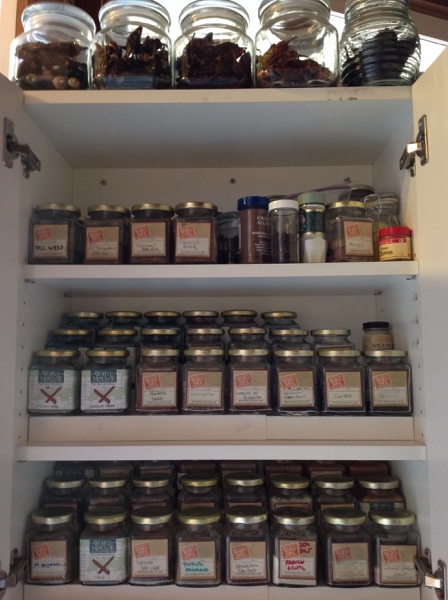
Finally, there’s the exotic ingredient thing. Yes, I have a whacky spice cabinet. You may or may not have a pantry like ours, but I really don’t think that matters. We have all this stuff because we dedicated lot of time and energy into developing and perfecting recipes to share with y’all. Whether or not you need that much stuff is up to you. Does a couple avocado leaves and a little annatto really make or break good chili? If you’re asking me, I think the question is rhetorical. And frankly, I don’t buy the ‘why do you use ingredients I’m not likely to have’ complaint for a second; in this day and age, almost anyone in this country, and many others, can get anything they want. I recently shared a bacon recipe with a pal from South Africa. He ended up having to go all over creation to find several ingredients, but he did it, ’cause he really wants to try my recipe. Kinda like that last discussion on prep and cooking, huh? Ive mailed corn meal to Australia and mustard seed to Israel; if you can’t get something you wanna try, hit me up, I’ll help. I’ve also gotta point out that we constantly encourage and desire experimentation, so if you’re making it, put what you like in it: Give us credit the first time, and then it’s yours…
I say that if you love cooking and great food, maybe you should check out Tasmanian Pepperberry, or Urfa Bebir; who knows what you’ll do with them?

We do this because dear friends who love to grow, cook, preserve and explore as much as we do asked us to. We do this because we have a love for good food and cooking shared. We do this because we hope to inspire such in y’all. If that ain’t good enough, so be it.