Pesto to the People!


Spring done sprung down here and so has our cilantro; not where we planted it last year, interestingly enough, but in a bed where it hung out 2 years back – What they hey, never look gift herbs in the mouth, right?  We’ve been using at best we can, but as you can see, it’s gotten really leggy and flowered out, so what to do with it?

A recon trip by M to the freezer found some nice skinned chicken boobs that need to get used, so how about a shotgun wedding for those two?  Pesto it is, then!

Pesto? You say; I thought pesto was made with basil?

It is, I nod sagely, (Pun intended),  but that’s only one popular permutation, truth be told:  Let us consult our handy pocket dictionary where we find, and I quote:

“A sauce typically made with basil, pine nuts, olive oil, and grated Parmesan blended together and served hot or cold over pasta, fish, or meat. Origin: 1935–40; upper Italian, (compare Genoese dialect pésto):  noun derivative of pestare; to pound, crush.”  (Notice how close the root sound of the word is to pestle, as in mortar and?)

There you have it; think of pesto as a combination of veg, something from the Alliaceae family, (AKA garlic, shallot, onion), a hard cheese, a nut, an oil and a little salt and you’re there.   Basil pesto is wonderful, as is cilantro; hey… Cilantro!  We’ll do a nice cilantro pesto sauce for the chicken, and marry that with some beautiful Asparagus M found at the market, and we’re talkin’ serious bounty – So let’s!

Cilantro Pesto

1 bunch fresh cilantro, (roughly 2 lightly packed cups)

1-2 cloves garlic, minced, (And you can roast them first if you like a milder, smokier taste!)

1 tablespoon white wine vinegar

¼ cup grated Parmesan cheese

¼ teaspoon ground chile (I like Tabasco for this)

½ cup pine nuts, (Sub Hazelnuts for a very cool taste)

½ cup olive oil

salt to taste

Add everything but the oil to quisinart or blender and zap it all into a nice dry paste.  Slowly add up to ½ cup of olive oil, while blending constantly, until you get the thickness you like for pesto.

Store pesto in a sealed glass container in the fridge for at least 20 minutes to allow all those flavors to get to know one another:  You can store it long term in the freezer in an airtight container for a few months without losing much flavor.  When you’re ready to use it, you can either add it to, say, pasta that you’ve tossed into a medium sauté pan until well coated and serve right away, garnished with a little more cheese and a cilantro sprig, or, for what we’re gonna do, just pull it out of the fridge, stir it a bit to re-blend and top a piping hot chicken breast with it just like that.

We’re gonna braise our chicken, so we get nice, juicy meat for that cilantro to land on:  We rinsed and patted dry two nice breasts, then threw them into a sauté pan on medium high with a couple shots of olive oil therein; we seared the breasts on both sides, then tossed ‘em into a glass baking pan and added;

½ cup white wine

½ cup chicken stock

A shake or two of salt, pepper, and ground Tabasco chiles.

We put the ol’ temp probe equipped thermometer to use and shoved that into a preheated oven at 350º F; we’ll cook that, (I’ve said it before and I’m fixin’ to say it again), to temperature, not time – Done chicken breasts should reach 170º F, then be pulled and allowed to rest for 5 minutes or so; they’ll continue to cook and seal in all those juices so they don’t bleed out when you cut ‘em, leaving you with nasty, dry chicken jerky, (Which nobody wants, right?  Right!) Let me point out at this juncture that this recipe will work GREAT for any poultry, including wild game; as Pheasant, Grouse, Dove, etc are all quite lean, searing and braising as we have seals in moisture and delivers very tender, juicy birds indeed.

Our Asparagus was hand chosen by M at the market; as you can see, it’s beautiful stuff, indeed!  She did the standard test; choose firm, smooth stalks with nice tight flower heads.  Give the bunch you like a sniff, it should smell lightly of fresh veggies, nothing funky or heavy.  Don’t wash your asparagus, or soak it:  If you’re not going to use it right away, trim the ends and stand the bunch upright in a glass or dish with enough water to cover the freshly cut ends, and don’t wait too long to enjoy it!  The sugars in Asparagus convert pretty quickly to starch after it’s been harvested, the results being woody stalks and accompanying lousy flavor… When you’re ready to cook, pull out and quickly rinse the bunch. Gently bend each stalk and allow it to snap where it will; toss the ends and cook the good stuff. You want to cook Asparagus pretty quickly to a slightly al dente consistency; just a bit of snap to the bite, and certainly not mushy! We chose to roast ours, so we gave it a light coating of olive oil with a splash of white balsamic vinegar, then added freshly chopped rosemary, thyme, and salt. We roasted for 10 minutes in a 400º oven, and since we had that, we decided that there should be some nice buttermilk biscuits to keep ‘em company, (Another time for that recipe, honest!).

All that went nicely onto the plates and voila, dinner fit for a queen!

Vegan Chili, Anyone?


>My old friend Darcy writes, “Got any suggestions for an easy vegan meal? I am sick of my own cooking.”
We discovered she had some nice white beans about, so I suggested chili! Vegan sometimes gets a bad rap, but the fact is, it’s great cooking and eating – Read the ingredients and you’ll see there’s nothing weird or funky about it; just simple, good ingredients well married!

Vegan Chili

2 cups each white, kidney, pinto, black, or garbanzo beans, (the more the merrier; I like at least three varieties, and white/black/garbanzo is my fave combo)
2 cups tomato, diced, crushed, or pureed as you prefer
1 sweet onion, diced
1 or 2 cobs of sweet corn
1 carrot, diced
2 cloves of garlic, fine dice
1 each red, orange, or yellow bell pepper
1 or 2 hot chile of your choice.
½ cup cilantro, chiffenade cut.
1 teaspoon Mexican Oregano
½ tsp Cumin
½ teaspoon ground pepper, (I like a blend of black, red, white and green)
2 cups vegetable stock, (And if you don’t make this yourself, then more on that down the line)
2-3 cups of water (start with 2 cups and see if you need more)

Put beans, 2 cups of water, and the tomatoes into a crock pot or large soup pot over medium heat. Stir often, and as soon as this comes up to heat, reduce so that it is on a low simmer.

Lightly brush your bell peppers, chiles, and corn with olive oil, salt and pepper. Place ‘em on a baking pan whole and slide that onto a fairy high rack with your oven on broil. Keep an eye on the peppers and chiles and rotate them as they blacken and blister; don’t let your corn burn; it needs to be turned faster and pulled before the chiles are done! When the peppers and chiles are done all around, pull them out and let them cool enough to touch. Remove stems, seeds and veins and rough chop; slice the kernels off the corn and use your cob for compost.

Pour a few tablespoons of olive oil in a skillet or sauté pan and let it get nice and hot. Toss in your carrot first, let it sauté for a couple minutes and then add your onions and sauté until starting to caramelize. Reduce your heat to medium and add the garlic, cilantro, diced and roasted peppers, chiles and corn. Add the veggie stock and all spices to your liking, (Those amounts are a decent starting point to middle ground volume; do more or less as you please!)
As this gets up to a simmer, throw it all into the big pot and let the flavor marriage begin!

Vegan Cornbread

2 cups coarse yellow corn meal
1 cup unbleached all-purpose flour
2 teaspoon baking powder
1/3 cup canola oil
2 tablespoons honey
2 cups soy milk
2 teaspoons apple cider vinegar
½ teaspoon salt

Preheat your oven to 350. Lightly oil a 10 x 10 baking pan.
Whisk soy milk and vinegar together well.
In a second bowl, combine the corn meal, flour, baking powder and salt.
Add oil and honey to the wet mix. Whisk for a few minutes, until air bubbles form in the mix.
Pour wet into dry and blend gently but thoroughly with a spatula.
Pour batter into your pan and bake for 30-35 minutes, until a toothpick inserted into the center comes out clean.

That’s Wild Rice with a Capital W, Boyo…


>There’s a lot of stuff out there that gets called wild rice, but a facts a fact, and here’s the fact about that, jack: For the real skinny on wild rice, I turned to my friend and supplier, Christy Hohman-Caine from the great northern wilds of Minnesota, eh? She explains thusly:

“Wild rice (Zizania palustris) is an annual grass that ripens about the end of August and into Sept. Processing requires drying the rice, then parching it, then removing the hull. It can be done strictly by hand, using a kettle (big ceramic pots pre-euro trade) and a paddle to parch and taking the hull off by “jigging” or “dancing” the rice in a pit. More industrial processors around here are not exactly high tech, but they may use propane to heat big metal barrels that have paddles (instead of people) to keep the rice tossing. Even then, the rice man checks each batch as it parches, because each strain is different and the amount of moisture may be different too. You gotta know what you’re doing.

Here’s a good article on the process showing the range from family processing to larger processors. Even the largest around here is not like the processing that commercial processors do (for paddy rice, like ol’ Uncle Ben’s). Check the slideshow with this after you read it. In spite of the names, these are all Indian people.”

By the way, she just tossed that off as a quick email response, gang – See why I love that girl?

So there ya have it! Chances are, if you’re looking to get the genuine article at your local Safersons, it ain’t happenin’. A little poking around online should net what you’re after though.

Suffice it to say that this stuff, real wild rice, is like nothing you’ve ever had before; it’s like good ale versus Super Lite beer; and it’s addictive, once you’ve had it, you’ll never wander yonder again.

We’re gonna do up a nice dish with this as an opener, and then segue into some follow up meals; why, ‘cause if you’re like us, you’ll make too much rice for the first meal and then have a container sitting around that can either get thrown out after a week, or be put to further good use as it should be!

So here goes: Today we cover the Big Kahuna knock out first meal, then on to the leftovers down the line.

Urb’s Chicken Breasts with wild rice, dried cranberries and crushed hazelnuts.

We took some nice natural chicken breasts, skinned and boned ‘em, butterflied ‘em out, and then pounded them a bit so they’re a nice, even thickness. Two points to consider here: One, this may look like fancy pants cookin’, but it ain’t; you could do this in the field if you wanted, (Seriously – Platt and I ate REAL well during our deer hunt – Being out and about does not mean you have to sacrifice good cooking, that’s what chuck boxes were made for…) Secondly, this recipe works even better with wild game; Quail, Pheasant, Partridge, or Dove would all rock with this – The wild rice, dried fruit and nuts with animal is simply the best, (Ever heard of Pemican?). OK, onward!

After the flesh is pounded out, (And yes, you should have a meat hammer if you don’t already), we put it in a nice little marinade of white wine, orange and grapefruit juice, with a little salt, pepper, onion powder, and celery seed. Let it sit for about ½ hour, then pull the breasts out and reserve the marinade.

NOTE: As with ALL poultry, always follow safe handling practices with the flesh and everything you use to contain and handle it!

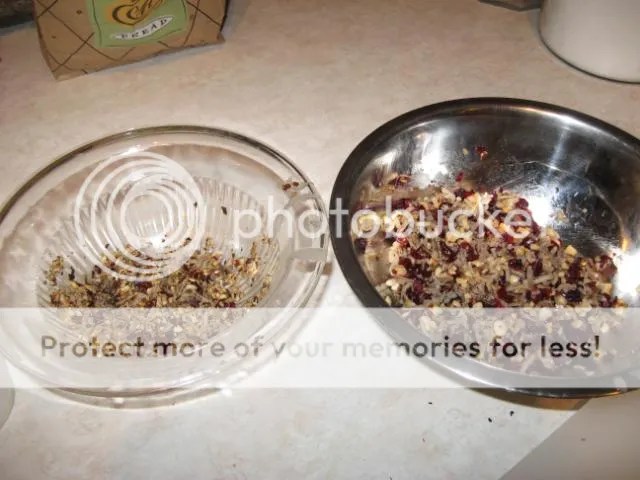
We cooked the wild rice to the slightly dry side, then mixed equal portions of rice, dried cranberries, and chopped hazelnuts, (The hazelnuts were out of season, so we toasted them to get ’em back to a nice, perky condition). I put a spoon or so of bacon fat in the mix, (Everybody’s favorite cheat!), since chicken is lean and a little fat helps everything get together cozy-like; I also rehydrated a couple of our home grown smoked cherry peppers and chopped them into the mix for a nice, smoky taste with a touch of heat. Spread an even layer of the mixture over the meat, and then grab your kitchen twine. Roll the breasts into nice logs and tie them off.

The meat goes into an oiled pan on high heat and is evenly browned; once that’s done, pop ‘em into a baking dish, cover it with foil and toss that into a 350º F oven to finish. We use our schmancy thermometer to make sure we achieve 170º F internal temp, rather than using a timer. We took the remaining rice/cranberry/nut mix and tossed it on top of the breasts.

Once it’s done, pull it out and let it rest at least 10 minutes, as it will continue to cook and get to the magic done temp – Remember, NEVER cut flesh that’s just come out of the oven, you’ll guarantee dry and nasty if you do!

While the chicken is cooking, grab your marinade and use it to deglaze the pan you browned the breasts in. Mix all that up nicely and get the naughty bits off the pan bottom, and then set it on a low simmer to reduce; we took our down to roughly 25% and then added a couple tablespoons of butter, making it syrup-thick so it coats a spoon nicely when tested.

Our accompaniment for this wonderful stuff was nice, fresh green beans with lemon butter, and some Texas toast. Cut nice thick rounds of the rolled breast, (Remembering to take the twine off…), arrange and drizzle with the reduced sauce, and go wild! We had ours with a nice, dry white wine and a cooking show on the tube – fact is, ours looked a LOT better than theirs, and so will YOURS!

Enjoy!

Quiche a la Urban Monique


Welcome, friends, welcome to 2011! M and I have been blessed this holiday season with each other’s company for 2 whole days in a row, not only at Christmas but here at New Years as well. For me, that means amble reasons to cook for the love of my life; who could ask for anything more?

Breakfast is what we love best and that’s where I do some of my best work. So, for the first entry of 2011, I’m going to share a recipe-in-progress with you that I’ve been working on for the better part of a year. This is not the final form it will take, but it is incredibly good, fun to make, very impressive visually and unbelievably delicious. Ladies and gents, I give you the potato crusted quiche.

Quiche is a member of the custard family, of course, home of everything from crème brûlée to, the savory breakfast sub-species, which includes frittatas, tortas and quiche, among other goodies. Eggs are quite simply a perfect food, and quiche is the best possible savory application I can think of.

As with all things custard, there are a few little touches that will make the difference between good and great; they are:
1. Bring your eggs and cheese out with enough lead time to have them pretty close to room temperature before you mix and cook.
2. Scald your milk before you mix – In a sauce pan, medium high heat, until tiny bubbles form right around the very edges of the milk, then take it off the heat and let it cool a bit
3. Blend, blend, blend! When you combine your egg-milk mixture, the more it is blended, the smoother your custard will be – Use a boat motor if you’ve got one, or a stand mixer or blender of you don’t.


Urban’s Potato-Crusted Quiche

Pre-prep for the crust, the night before you’re gonna cook this up, grate about 2 cups of your favorite hash brown potato; Russets are most traditional, but any high-starch potato will do fine. Put your spuds in a glass storage container and throw that into your freezer overnight.

To make the crust, preheat your oven to 450º F. Take your spuds out and break up any clumps; put ‘em in a stainless bowl. Add a cup or so of grated cheese; Swiss or Mozzarella seem to work best, as they seal up the holes better than most others I’ve tried. Finally, whisk 2 eggs well and add them to the mix. Season as you see fit, with a minimum recommendation of salt, pepper and a shot or shake of Tabasco; (for this one, I used those spices plus onion powder, celery seed, garlic, and oregano.)

Mix everything well, and then sling it into a lightly oiled pie pan. You want a layer about ¼” thick, with no holes; raise your sides about ½” higher than the sides of the pan, to account for shrinkage during blind baking.

Bake the crust for 15 minutes; remove it from the oven, leaving the temp as it was. Check your crust and fill any holes, build the sides back up, etc, as needed to assure that it will hold the filling well.

Minor aside: Y’all will recall I’ve spoken of cook books that I use often? Well, those are the ones that get to hang right by cooking central – And here they are…

Filling: Scald 2 cups of milk, (Or, as you can see here, I used 1 ¾ cups of 2% milk augmented with ¼ cup of sour cream, to make it as rich and naughty as I think it aughta be – When I have it, I’ll do 3 parts milk to 1 part heavy cream for the same reason). Let your milk cool for a while, (And if you’re impatient, put it in a stainless bowl and roll it around the full perimeter every now and again, which will let the heat absorbing capability of the bowl to your advantage).

Whisk your eggs well; once the milk has cooled enough so that it won’t instantly cook your eggs, slowly and evenly pour the eggs into the milk, whisking constantly, until you have a nice blend. Motorboat/blend/mix the whole shebang for a good couple of minutes. Season your blend as you see fit; again, salt and pepper are a must – I added Tabasco, garlic, oregano and sage to this one.

Prep your filling goodies – Classic Quiche Lorraine is simply bacon, Swiss cheese and maybe some chive – I’m working on a southwest theme, so I’ve got Alderwood smoked bacon, aged Washington State University Creamery cheese, jalapeño, cilantro, onion, and dried tomato, (A note on tomato in quiche, etc – I LOVE tomato, but the fact is, even if you core and seed ‘em, they tend to add a lot of water to the mix, and raise a very real possibility of your final product ending up too watery, which is very unappealing – Dried is the answer – They’ll reconstitute beautifully, and add that perfect flavor note without making a swamp outta things.)

Mix all your goodies into your custard and shove it into the oven. Turn the temp down to 350º F as soon as you load ‘er in. Bake for 40 minutes and then take a look – With a good heavy oven mitt, give ‘er a shake – If the center ain’t jigglin’ like jelly, she’s done; pull it out and let it rest for 10 minutes at stove top. Serve with a spoonful of sour cream and a dash of salsa – You can thank me later…

Birds of a Feather


Every Thanksgiving, someone says something to the effect of, “Why don’t we cook turkey more often?” Usually, I think it’s left at that, but for us, a few years back, we started to and we still do: Often enough, however, we find a turkey of any size just a bit too much for the two of us, so we’ve taken to downsizing with a nice chicken. I’m sure most of us have walked into the store and seen the ubiquitous pre-cooked chickens sitting there getting old, but since they’re on sale for $3.99, (Such a bargain!), we buy one, right? The problems with these things are myriad, but among the chief violations are these:
1. We have no idea where this bird came from or how good it is as raw product, and
2. We have no idea when it was cooked, and
3. The ‘seasoning’ is commonly barbaric

So, next time you’re tempted, pass the pre-cooked crap, head over to the poultry section, and check out whole roasting chickens.

We have a very nice, natural, no weird crap injected or fed, non-antibiotic filled brand available here and I’d bet you do too; that takes care of concern number one. You’ll notice, while reading the label to assure quality, that a very nice sized bird goes for roughly the same price as the pre-cooked junk, so there’s your bargain.

We’ll cook this ourselves, with fresh herbs and citrus, and that’ll take care of concerns two and three.

One other common concern we’ll address here is this: It goes something like, “OK, I get one good meal and maybe some sandwiches, but that gets boring after a few times…” This, of course, is the absolute wrong answer; stay with me and I’ll explain why.

First off, yes, you should start with a really nice meal. That bird is simply divine, as far as I’m concerned, and the joy of the whole shebang as we do it, a la that Thanksgiving feast, with turkey, dressing, gravy, cranberry, Brussels sprouts, crème brûlée, is just too good to only do once a year. Light that menu up any month you like and you’ll have diners lining up at your door. That said, you needn’t go so whole hog to do a really great fresh chicken dinner; simple is best, so start there.

Unwrap, rinse and unpack your bird when you get it home, (how many embarrassing tales of cooked birds with the giblet packet tucked neatly inside must we hear, anyway?).

Follow all your standard safety precautions for handling poultry – Use separate tools, cutting boards, etc, and wash everything, including you, thoroughly afterwards.

Preheat your oven to 375º F.

Now raid the fridge; grab whatever citrus you have, oranges, lemons, limes, grapefruit all work great. Use maybe a large orange, or a couple of smaller lemons or limes, as you like and have on hand: Cut the fruit into 8ths or thereabouts and throw ‘em into a large mixing bowl. Add a splash of olive oil, a few more of white wine, half a rough chopped onion, then rosemary, thyme, salt and pepper. Mix all that up, put your bird on a rack in a roasting pan and stuff the bird with it. Grab the ends of the bird’s little legs, (AKA drumsticks), and tie them together with kitchen twine, (You DO have kitchen twine, right?!)

Now take a couple tablespoons of butter, a couple more of olive oil, a little more rosemary and thyme and salt and pepper, and mix ‘em all together. Slather the skin of your bird liberally with the mix.

Anything left over from stuffing or slathering? Throw it all in the roasting pan along with 3 or 4 cups of water.

Throw that sucker into the preheated oven.

OK, now a few words about cooking poultry, (Actually, damn near any flesh, truth be told). If you’re a seasoned pro who cooks for a living, I will believe that you can look at and touch a hunk of protein and tell when it is not only done, but properly done to rare, medium, well, etc. If that sentence does not describe you, then you can’t tell just by looking or poking, OK? One of the greatest crimes against good food is improper cooking, so get a leg up, face facts, jump into the 21st Century and buy a decent cooking thermometer. Actually, get several, seriously… I have a candy thermometer and an instant read, both of which are dirt cheap, as well as a nice, probe-equipped digital beast that reads both internal food temp and oven temp; got the latter online for about $20 and it’s well worth it.

Going back to that pre-cooked store bird, let me ask another question; with all the potential; liability of selling cooked poultry, which side of done do you think they’re gonna lean to? If you answered “Grossly, obscenely overdone,” then in the words of Ed McMahon, you are correct sir! For properly cooked whole poultry, we’re looking for an internal temp of 165º F, measured in the thickest part of the bird; once again, take the guesswork out, get a good thermometer and start cooking chicken that makes folks’ mouths water, OK?

Pull your bird out when it hits 165 and let it rest for 10 to 15 minutes before you cut it; second greatest crime with the preparation of good meat is carving into it right after it’s pulled out of the oven; what that does is virtually guarantee that all the juices are gonna pour out, and you end up with nasty, dry flesh, just like the store bought version – Be patient, let it rest, and you’ll get the juicy, tender stuff you’re after!

Serve this bird with whatever you like; you can’t go wrong with a nice, crisp salad and some spuds. You really must, however, make gravy, right?

Heat a sauté pan to medium high. Pour in an ounce or so of bourbon, and let the alcohol flash off. You do NOT need to light the stuff on fire, gang, just let is simmer and use your nose; when you smell the nice, smoky smell without the booze smell, you’re there. With a baster or ladle, take some of those lovely pan drippings out of your roaster, (And yes, we do want fat, gang, that is what makes gravy great), and pour it into the sauté pan. Let the liquids incorporate and get nice to a nice low simmer; adjust your heat accordingly. Add a couple tablespoons of flour, slowly and gradually, and whisk constantly as you do, to blend everything smoothly and avoid clumps of flour. Stop adding flour when your gravy is a bit thinner than you care for and allow the mixture to thicken by heat alone. Add a little salt and fresh ground black pepper to taste and bring it on!

The variations for this kind of thing are endless – How about southwestern style, with cilantro, onion, garlic, green chile and apple for stuffing and rubbing? Italian, go with shallot, basil, thyme, and balsamic vinegar – Get the picture? As with spice rubs and blends, pick some flavors that you like and that seem complimentary and experiment – The next great blend should come from YOUR kitchen, OK?

Now, place yourself in the not-too distant future. That wonderful meal has been eaten, the leftovers wrapped and boxed and stuffed in the fridge – What happens now?! Well, as we mentioned back a ways, there always is sandwiches; Warren Zevon, shortly before he died, gave this advice: “Enjoy every sandwich.” Indeed we should, Mr. Z… My dad was a sandwich artist, and I like to think I inherited some of his passion and talent – There are few things better than a chicken or turkey sandwich with fresh cut bird, fresh bread, crisp veggies and homemade pickles; do the sandwiches and thank me later.

But there is so much more waiting in the wings, Gang! (Sorry, couldn’t resist). First and foremost, you have the perfect source for stock, and stock means soup or stew, and, well.. Nuff said, right? Take that carcass out, remove the remaining meat by carving or, as I prefer, simply ripping big old chunks off. Throw the remains into a big ol’ pot. Add water to cover, a volume of mirepoix appropriate to the size of your bird, (Remember mirepoix? 50% onion, 25% each carrot and celery, rough chopped), a couple bay leaves, salt, pepper, and put it all on a simmer. Let it do its thing for as long as you can, the better part of a day as a good measuring stick. When you can’t stand the incredible rich smell any more, strain out the remaining carcass and mirepoix, and return the stock to a large pot on medium low heat.

Raid the fridge again, and add what floats your boat; carrots, potatoes, peas, green beans, black beans, cilantro, garlic, corn, white beans, (or kidney, red, pinto, garbanzos – Get the picture?), rice, small pasta, (Boil first and strain well), chicken meat, a little bacon – Viola; homemade soup that puts everything else to shame. Maybe do up some French baguettes while it’s simmering, or fresh corn bread, (More on those later if that thought gave you a ‘Huh?’ moment…)

If you don’t feel like soup, fine – Let the stock cool, pour it into glass containers or plastic bags if you must and freeze it for later use – Nothing makes homemade soup, stew, or gravy better than homemade stock. Pour some of it into ice cube trays and freeze it; then when you’re ready to do up some great green beans you found at the market, pop out a cube, melt it in a sauté pan, add a little butter, and coat your steamed beans in that prior to serving – that’ll generate a wow moment for your diners, guaranteed!

Finally, how about what do afterwards if you DO do the whole Thanksgiving enchilada? How does one avoid the boring doldrums here? Easy, and one word for ya; terrine… The art of Garde Manger is the art of creatively using leftovers, and this is one of my favorites; I think I came up with this one, but I doubt it, frankly; it’s too easy and to good not to have been done before.

Preheat your oven to 350º F. Grab a loaf pan and lightly oil it. Now pull out all your Big Dinner leftovers; spuds, carrots, Brussels sprouts, dressing, cranberry, turkey, the whole shebang. Take your dressing and, by hand, line the loaf pan all around with a thin layer of that wonderful stuff. When you’ve done that, start layering the goods inside; turkey, spuds, carrots, everything except gravy, (Which will make things swim – Not good…) When you’re all layered up, cover the whole shebang with dressing. Pop it in the oven and let it do its thing for 30 minutes. Pull it out and let it rest for 15 minutes, minimum. Carefully cut a slice of the terrine and using a spatula, throw ‘er on a plate; add gravy and maybe some more cranberry; yum yum noises are optional but likely.

P.S. to loyal readers: Notice a diff on this entry? No standard recipe formats with exactly this much of this and that? Exactly; we’re starting down the road to cooking intuitively. Go with peace in your hearts, friends and neighbors! Look, if you’re not up to winging it 100%, OK, but you want to be and you will be and you have to get there somehow – Dive in, use your best judgment and trust that you’ll do fine; worst case scenario is a few learning experiences followed by a lifetime of joy and pleasure.

Smoke ’em if ya got ’em


Just a quick rejoinder to the salsa thread regarding smoking chiles. I should point out that, according to true smoking gourmands, I probably already blasphemed with my take on process; so be it. Cooking is as rife with The Right Way and the Only Way as guitar making, and that’s saying something. While some things do need to be done a certain way to get the right result, there is plenty of wiggle room left for the most part; smoking is, for my mind, one of those gray areas.


Freshly roasted Hatch chiles cooling

When I wrote up directions for smoking chiles, I made a broad assumption that everyone has or wants to have access to a smoker, and it ain’t necessarily so. As such, I thought I might offer some viable alternatives to the rest of y’all who want the flavor but not the additional stuff!

If you watch food TV, you probably have seen some variation on the stovetop smoker; all I can say is this; I wouldn’t go there unless you are cool with a house full of smoke. Pro kitchens can move air at a volume we can’t even touch and that’s that…

If you own a grill, you’re in business however. That said, it’s already time for a digression: Down here in the south, barbecue is almost religion, and how one gets there is near and dear to a cook’s heart. Hence, a little terminology is in order, and yeah, this is one of those things where it needs to be done a certain way!

A lot of folks say, “We’re gonna barbeque,” when what they mean and do is, in fact, grilling. In essence, true barbeque requires, first and foremost, indirect heat, and secondly, the ability to cook low and slow. With what you’ve read thus far about smoking, you might note that these two methods sounds a lot alike, and in fact, they are; true smoking also requires indirect heat and low and slow, and as such, the two are indeed intrinsically linked. Grilling, on the other hand, is cooking relatively quickly over direct heat, as we know and love with burgers, dawgs, corn on the cob, veggies, and the like. This is why you’ll see a barbeque/smoker and a grill in many a backyard.

Ok, so back on track. No smoker, but want the taste; no problem. There are a lot of wood products made for adding smoke to a grill these days; I’d bet your grocery has ‘em, and if they don’t, or don’t have what you want, head on over to Butcher and Packer online; they have everything in very high quality and very decent prices. The products made for the grill are cheap, ready to use and allow you to get some flavors you might not have readily available, like Mesquite, Apple, or Hickory.

If you do, on the other hand, have a decent smoking wood at hand, then small pieces and chips, soaked in water for a half hour or so prior to cooking, will do the trick just fine.

Take whatever wood source you’ve chosen, make a bag roughly 6” to 8” square with a double layer of aluminum foil, put your chips, etc in that, seal it up, and poke a good few holes in the top. Place your smoker bag on your flame deflector/above your burner with the heat on low, and put your chiles right above that, (Or use one for each burner if you’re doing a big batch process), close the lid and let ‘er rip. You should get a decent +/- 10 to 15 minutes of smoke from such a rig and that’ll do the trick just fine.


Homegrown chipotles on the grill…

And last but not least, how about if you don’t own a grill, don’t want one, don’t have room, etc? Still, no problem: Get online with Butcher and Packer again and look up their powdered hickory smoke. It is great stuff, all natural, packs a wallop and I defy dang near anyone to tell the difference on the finished product as to where the smoke flavor came from. This stuff is great in the dead of winter or spur of the moment. Mix the powder with a little olive oil, rub it on your chiles and roast ‘em in your oven; great flavor, great smell while cooking and no smoke filled home!

Smoking is not limited to chiles either, of course; you can use these methods for tomatoes, onions, garlic, potatoes, and on and on! Try smoking something you’ve not done before, like fresh cherries, apples, or limes – You’ll be surprised what great things you can and will do!