Stuff Them Peppers!


I love peppers, and I love chiles. Notice I separate chiles and peppers? Lots of us do, even though that’s technically incorrect; sweet peppers are the same genus and species, (Capsicum Annuum), as the hot peppers referred to as chiles.

When it comes to cooking, I most often use chiles for heat and the fruity, earthy flavors they provide. Sweet peppers to me are for salads and stir-fries, soups and breakfasts, (I love them with eggs), and especially for stuffing. Sweet peppers certainly do have flavor, even if it’s a relatively minor note compared to the knockout punch of a hot chile.

Just as hot chiles have expanded in variety over the last couple of decades, so have the sweets. If you’re my age or older, then you probably remember back when you might find green bell peppers in the grocery and nothing else like it, (and their flavor was, uh, shall we say, lacking… ) Now you can find sweet bells in green, red, orange, purple, yellow, and even brown and white, as well as some great non-bell sweet types. My favorite options lately are the bags of small, sweet peppers we’re seeing quite often in stores. They’re perfect for salads, salsas, roasting and even stuffing.
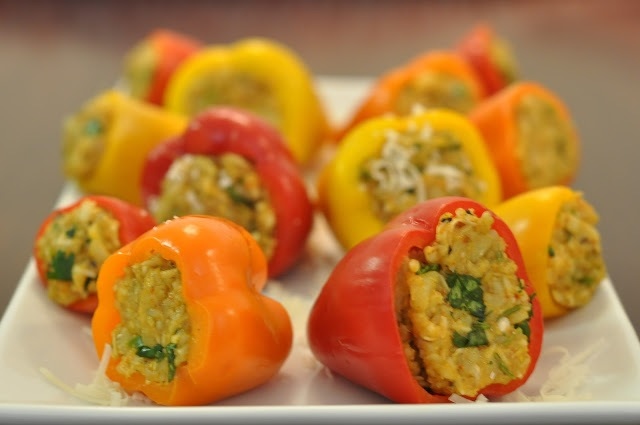
Sweet peppers are not only tasty, they’re good for you. In addition to containing notable amounts of Vitamins C and E, they pack abundant carotenoids, including alpha-carotene, beta-carotene, lycopene, lutein, cryptoxanthin and zeaxanthin, (Trust me, those are all good things).

Here’s a little primer on what’s out there these days, both for shopping and growing.

Green Bells.
These are the peppers so many of us grew up with. They too have grown up, and there’s a bunch of varieties out there to grow and enjoy. From the store, they have a slightly bitter, grassy flavor that goes great in salads, or as part of an aromatic base for sauces, stews and soups.

Purple & Chocolate Bells.
The least sweet of the bells other than green. They’re great raw in salads and probably are best left to raw uses, as that pretty purple hue turns to mud real quick when they’re cooked. They also tend to be wildly expensive, so if you love them, grow them.

Yellow & White Bells.
Mildest flavor of the bells. You may see whites as either a Bell variant, or referred to as a Hungarian Stuffing Pepper, (note that the white bells are often silly expensive…). Lightly sweet, with a nice hint of the grassy notes greens are prized for. These are great as part of an aromatic base, and for stuffing and roasting.

Orange Bells.
A bit less sweet and slightly more tangy than a red, orange bells are great raw in salads or roasted and stuffed.

Red Bells.
Far and away the most popular sweet peppers. Reds are genuinely sweet and fruity in flavor, and are fabulous in salads, with rice, or roasted.

Mild Hatch or Anaheims.
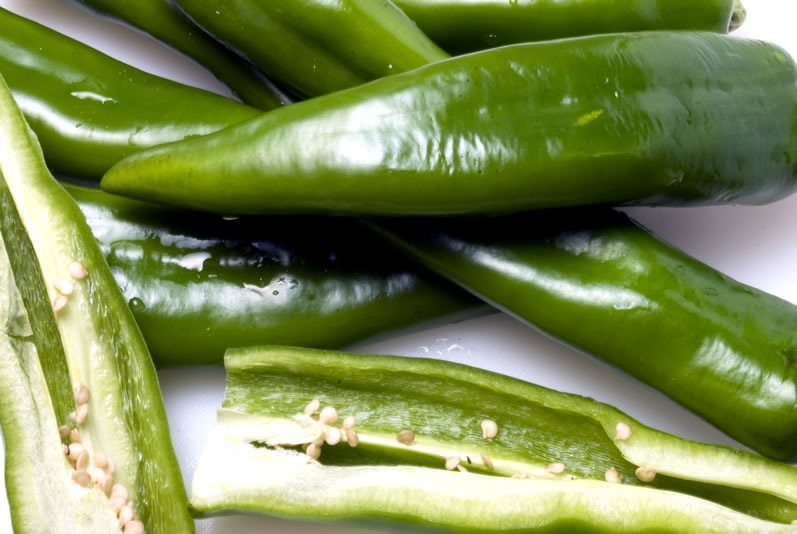
If a New Mexican chile lover reads that heading, I’m gonna get roasted…. Fact is, these long green and red chiles do come in mild form, but again, you need to take care when cooking with them, because hot ones can sneak in there. They’re wonderful for roasting, stuffing, salsa, and especially green sauces.
Red Pimento:
Sweet, yes, but some of these can be as much heat as sweet, so ask and try before you buy! Pimentos have an intense flavor base that holds up beautifully to roasting and preserving, (pickled peppers). They also are fabulous in aromatic bases, given their depth of flavor.

Sweet cherries.
While called sweet, these little round guys can also pack a bit of fire in them, so if you’re not a lover of such, taste before you cook! They have a dense sweetness that is perfect for roasting, salsa, and other Mexican sauces.

Sweet Cubanelles.
These long, slender chiles look a bit like a Serrano or an Anaheim, but are a notable lighter pale green color, (If you’re growing them, they will turn red if allowed to mature on the plant.) Cubanelles have a light, grassy sweetness that is great for roasting and stuffing.

Sweet Banana.

Same warning as the other non-bell varieties; there are hot bananas as well, so be careful, and test before you eat. They have a nice veggie flavor with a hint of heat, which makes them great for stuffing.

Notice how many of those guys up there I noted were great for stuffing? All the glory a sweet pepper has to offer comes out when you stuff ’em with wonderful things. Doing so and then slow roasting deepens the sweetness and intensifies minor flavor notes. And don’t make the mistake of thinking that this only works at home; you can slow roast on coals with aluminum foil, a Dutch oven, or a cast iron skillet. The sky is the limit on what you stuff with, but here’s a couple of my favorites to get the creative juices flowing.

1 Pound ground protein, (Beef, Chicken, Pork, Ground Turkey, Tofu, Cheese, or any combination thereof)
1/2 Cup Wild Rice
1 Cup Water
6 Sweet Peppers, (Bells, more if you’re using Cubanelles, Anaheims, etc)
2 large Tomatoes
1/2 Sweet Onion
1-2 cloves Garlic
1 Tablespoon extra virgin Olive Oil
1/2 teaspoon Oregano, (Hungarian is my favorite, it’s sweeter and milder than Mexican)
1/2 teaspoon smoked sweet Paprika
Splash of wine for deglazing, (Anything you’re drinking is fine, and if your drinking bourbon, etc, that’s fine too, if you’re willing to spare some…)
Sea Salt and fresh ground Pepper

Place rice and water in a saucepan over high heat and bring to a boil.
Reduce the heat, cover and simmer for 20 minutes.

Cut protein into bite sized chunks.
Lightly salt a large skillet or sauté pan over medium-high heat, and cook the protein until evenly browned.

Set the protein aside and leave the pan as is.

Field strip the peppers and keep the tops if you’re using bells. Arrange the peppers hollow side up on foil, or in a baking dish or Dutch oven. You may need to even out the bottoms a bit if you’re using a pan; thats just fine, but don’t cut through the peppers.

Dice tomatoes and onion, and mince the garlic.
Toss the olive oil into the pan you cooked the protein in. Once it’s heated through, toss in the onion and sauté until they’re starting to get translucent. Add the garlic and sauté for a minute or so, until the raw garlic smell is gone.

Time to deglaze. Splash whatever booze you’re drinking into the pan, (and it’s high proof and you’re cooking over flame, step back so you don’t burn your face off). Get a fork and work all the little bits of this and that loose in the pan; that’s some serious flavor you want in whatever you’re making. Any time you sauté an ingredient and then add that to a dish, deglaze, otherwise, you’re leaving good stuff out.

Add the tomatoes, rice, and protein to your pan and mix well.
Add oregano, paprika, salt and pepper; taste and adjust seasoning.

Remove the pan from heat and spoon the mixture evenly into your peppers, then pop the tops back on the peppers.

Roast in, ideally, 325° F heat for about 45 to 60 minutes, until the peppers are fork tender. If you’re doing this on a campfire, put the pan or foil bundle over low coals and let them work. If you’re on a grill, spread the coals or adjust flame and place your roasting pan on the side of your grate.

Serve with crusty bread, a green salad, and maybe a nice Wollersheim Prairie Sunburst Red. This winery is in Wisconsin and grows all their own stuff. Yes, Wisconsin, and they rock!

If you prefer a stuffed pepper with a little more pop, try our recipe for classic Oaxacan Chiles Rellenos. Trust me, it’ll knock your socks off in a good way!

Indigo Grafted Tomatoes


Ah, spring, the time when all garden fancier’s thoughts turn to planting. Here in the Great Northwet, the snows are receding, rains are nourishing the soil, and it’s time. Our planting beds, resting under straw all winter, are begging to be turned and filled.

If you’re a lover of great tomatoes, then fact is, you simply must be a grower of great tomatoes. Whether you occupy acres or square feet, there’s always room for your favorites and if, as for many of us space is an issue, tomatoes that bear well in a compact space are best yet. Which brings us back to the love of those little globes of wonder. Enter the Indigo grafted tomato.

First and foremost, one wonders, why grafted? The simple answer is, because it works. Grafting is neither new nor done as a novelty; it’s sound practice with a long history of success. The technique, as applied to these Indigo tomatoes, involves mating the root stock of one variety with the leafy stem of another.

My hands down favorite college horticulture course focused on grafting. That was back in the late ’70s and I hate to admit it, but even though our back yard apple tree is a grafted wonder offering four distinct varieties, I’d not thought much of the technique in terms of tomato plants until these Indigos came along. My Professor at the University of Washington, fondly referred to as Master Nishitani, explained that the Japanese had been successfully experimenting with grafting herbaceous edibles since the early 1900s. Still, grafted veggies been slow to catch on in this country, due predominantly to the supposed greater advantages offered by green revolution dependence on chemistry and standard hybridization techniques. Thankfully, a general return to sound environmental practices has lead naturally back to grafting as well

What grafting provides, in a sustainable and eco-sensitive manner, is the marriage of hearty rootstock to a bearing variety chosen for flavor and high yield. The rootstock variety offers a larger, more vigorous root system bred with greater resistance to fungi, bacteria and parasites; truly a godsend, given many tomato varieties susceptibility to such ills. Customized rootstock furthermore yields plants that can and will thrive in a myriad of environmental conditions, a gift any gardener can appreciate.

Indeed, and so it is with these wonderful little Indigos. Monica and I were blessed with several plants from our dear friends at Log House Plants. We picked them up and admired healthy, happy starts, but apparently nothing out of the ordinary, yet… It was after planting and those tenuous weeks of waiting for things to happen that we first noticed a difference; not just blossoms, but lots and lots of blossoms! As fruit began to form, these compact plants, topping out at about 2 1/2′ here in our little USDA Zone 7b garden, were absolutely loaded. I place purposeful emphasis on the word compact; regardless of the space you dedicate to tomatoes in your garden, these Indigos will provide enviable bounty and variety.

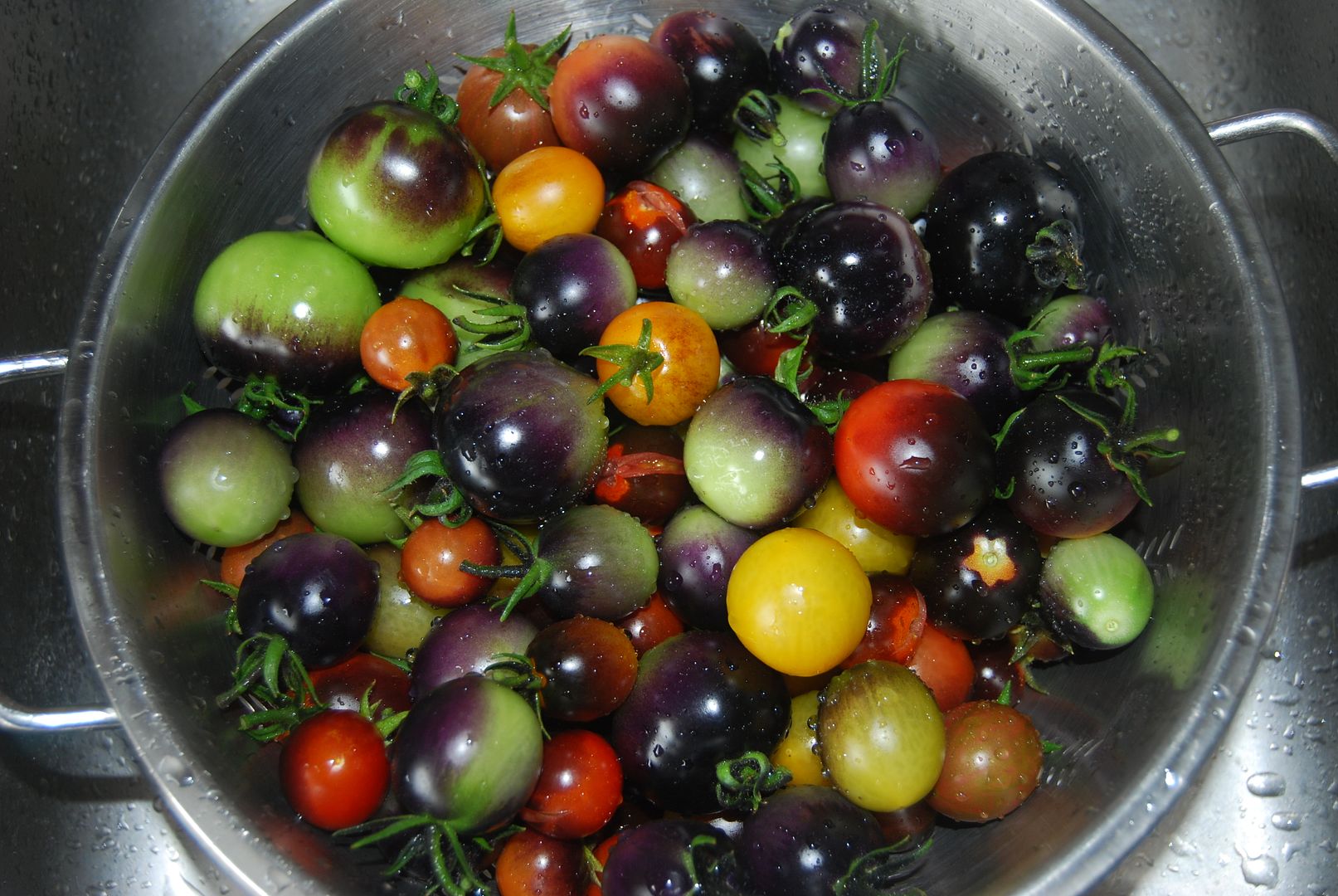
And such fruit! The Indigo varieties are named for that hue, naturally occurring in tomatoes, fully expressed in these little guys. Right away the colors just floored us; perfect little globes of deep purple-black, yellow-gold and seriously rich reds. Any honest lover of tomatoes will admit that color and shape have darn near as much to do with desirability as taste. These things were like candy as they matured, the colors becoming deeper and glossier as the days progressed. Photographing them wasn’t a chore, it was a treat.

Our favorite thus far is the Indigo Rose, a stunning blend that starts out purple-almost-black with brilliant green highlights, and matures into a deep purple-red with stunning crimson flesh. This first true purple tomato also contains anthocyanins, a potent antioxidant found in blueberries, raspberries and cranberries.

The real treat, of course, is the taste. These Indigo varieties are simply amazing. Plucked off the vine and popped into your mouth on a cool, quiet morning, this is the kind of rich, complex taste that forms lasting memories. cooking, preserving and eating these beauties is a joy, and therein lies the only other impetus you should require for growing your own Indigos. Variety is indeed the spice of life; these hardy, high-yield varieties offer the perfect home grown, home cooked solution.

Do yourselves a favor, and look these little guys up by name. Chances are a nursery near you will have them, and if not, you can find an online source to hook you up. If you have any problem finding them let us know and we’ll get you squared away.

So, type in the search terms ‘tomato’ and ‘green tomato’ up there on the little search box to the right; you’ll find lovely recipes featuring these wonderful Indigos, including a tomato and onion tart, chutney, relish, and some ideas on preserving your bounty as well.

Happy planting, harvesting, and cooking!

Indoor Herbs


 photo image-15.jpg

Basil, Sage, Rosemary and Thyyyyyyyyyme,
And Oregano, too!

When it comes to great home cooking, herbs are the key to separating the ho-hum for the UH HUH! And when it comes to great herbs, fresh beats dried hands down.

Having what you love as indispensable herbs available year round means growing your own, especially when a sort-of-but-not-really little plastic thingy of herbs from the store runs $5…
Fortunately, it’s not hard to grow your own, doesn’t take much room, and is well worth the time and money needed.

 photo image-11.jpg

You do not need to make this a fancy or expensive venture, but you can get as elaborate as you like. Let your imagination be your guide on a cold weekend and have some fun: All you really need is a decent sized pot, some potting soil, and a few seeds or starts. You should also have a nice sunny spot, of course; herbs dig direct sun and warmth, just like us.

 photo image-13.jpg

You may want to go to a decent nursery to find a decent selection, and your chances are better for finding starters there, which have obvious speed of enjoyment benefits over seed.

Choose a variety of herbs that you like to use most. The five choices I opened with are our faves, but get what floats your boat; nowadays, you’ll not just find thyme, for instance, but varieties like lemon, lime, or lavender. Same goes for Basil, Oregano, Sage, Marjoram and a bunch more great herbs.

Buy a large, deep plant pot, 12″ to 18″ around and a good 8″ to 12″ deep. Keep in mind the growing habits of your choices when you select pot size; sage grows tall, basil and oregano fairly bushy, while thyme is a creeper. Make sure its got drainage holes in the bottom and buy a nice deep saucer to handle runoff.

Get a bag of decent quality potting soil big enough to fill your pot and have some left over.

 photo image-12.jpg

Scrounge some gravel, river rock, or pot shards to line the bottom of your pot; they’ll aid in drainage by making sure the holes don’t get clogged with soil.

 photo image-14.jpg

When you get everything home, fill the pot up with soil, stopping about 3″ inches from the top.

Moisten the soil lightly but thoroughly and mix it well by hand.

If you bought starters, make your holes about 1 1/2 times the size of the soil the plants came with. Gently pull the plant from its container and carefully loosen the soil around its roots. Don’t tear the roots, just give them some breathing room. Plant your starter, pack about 1″ of your potting soil over the dirt and roots and press everything down gently but firmly. Give each plant a couple of inches room from each other. Water thoroughly when you’re finished planting but don’t drown the little guys.

If you’re planting seeds, follow the directions for starting them, as to depth, water, germination time, etc.

Set your pot on its drainage saucer and pick your best growing spot; again, most herbs like full sun, and in the cold months, they’ll take as much of the weaker weak winter sun as they can get.

Don’t overwater; when your little buddies look parched, (droopy dull leaves are a sign), give them a nice drink. You do not want the soil saturated, nor should there ever be standing water in your drip tray. You can certainly give them a little plant food if you like. We find that herbs dig Superthrive, which is a great, well established growth supplement.

Speaking of growth, keep an eye on that and trim as needed for meals and to keep things fair in the jungle. When you want some herbs for cooking, cut top leaves first. If you trim to a junction rather than just in the middle of a stem, you’ll encourage better health and regrowth.

 photo image-16.jpg

Once it gets warm again, you can set plants outside or leave them in as you see fit. Personally, the closer the ingredients to the pot, the happier I am.

Enjoy!

Tomato & Caramelized Onion Tart


We’ve been graced with some amazing tomatoes through our friend Alice at Log House Plants; these are Might ‘Mato grafted varieties and they are simply stunning in taste, appearance and yield. Trust me when I say get you some!

We’refeaturing several recipes that take advantage of these lovely things; here’s a savory, sweet to-die-for tart, if we do say so ourselves!

For the Tart:
2 cups Flour
1/2 tsp. Salt
1/4 tsp. Sugar
12 Tbs. Unsalted Butter, well chilled & cut into 1/2″ cubes
6 to 8 Tbs. Ice Water

Combine flour, salt and sugar thoroughly.

With your fingertips, blend the butter into the flour mix until its has the even consistency of coarse corn meal.

Add water a tablespoon at a time and mix gently with your hands. Continue until the dough is thoroughly blended and moist but not sticky; STOP messing with it as soon as it gets to that stage.

Flatten the dough out into a disk about 6″ round, then cover with plastic wrap and refrigerate for at least 1 hour, (And up to overnight).

Roll the dough out to roughly 16″ round and about 1/8″ thick.

Carefully transfer the dough to a parchment-lined 12″ tart pan. Double back the rim to about 3/4″ high and trim away any excess, (Roll the excess back out, sprinkle with a little sea salt, garlic, pepper and hard cheese for a lovely little amuse bouché)

Stick the pan back into the fridge for at least 30 minutes.

Preheat oven to 425 F.

Remove the crust from fridge, fill with marbles or dry beans and blind bake for 15 minutes. Remove from oven, remove marbles/beans and get ready to fill ‘er up.

For the Caramelized Onions:
Slice a medium sweet onion into 1/4″ rounds.

In a large sauté pan, add 2 tablespoons each of extra virgin olive oil and butter over medium heat. Toss in onions, add salt and pepper to taste, reduce heat to medium low and Caramelized onions until golden brown and soft. Turn heat to high, briefly allow pan to heat through. Add two Tablespoons of Sherry, flame and allow the alcohol to burn off. Set onions aside in a non reactive bowl.

For the Tomatoes:
Add 1 fresh Tablespoon of butter and olive oil to sauté pan over medium low heat.

Slice about 24 small cherry or varietal tomatoes in half.

Mince two cloves of garlic.

Toss garlic and into pan and allow to caramelize slightly. Add tomatoes, blend with garlic for about 2 minutes. As soon as you see the tomatoes showing signs of getting soft, remove from heat, drain excess oil and set aside.

Set oven to 375 F.

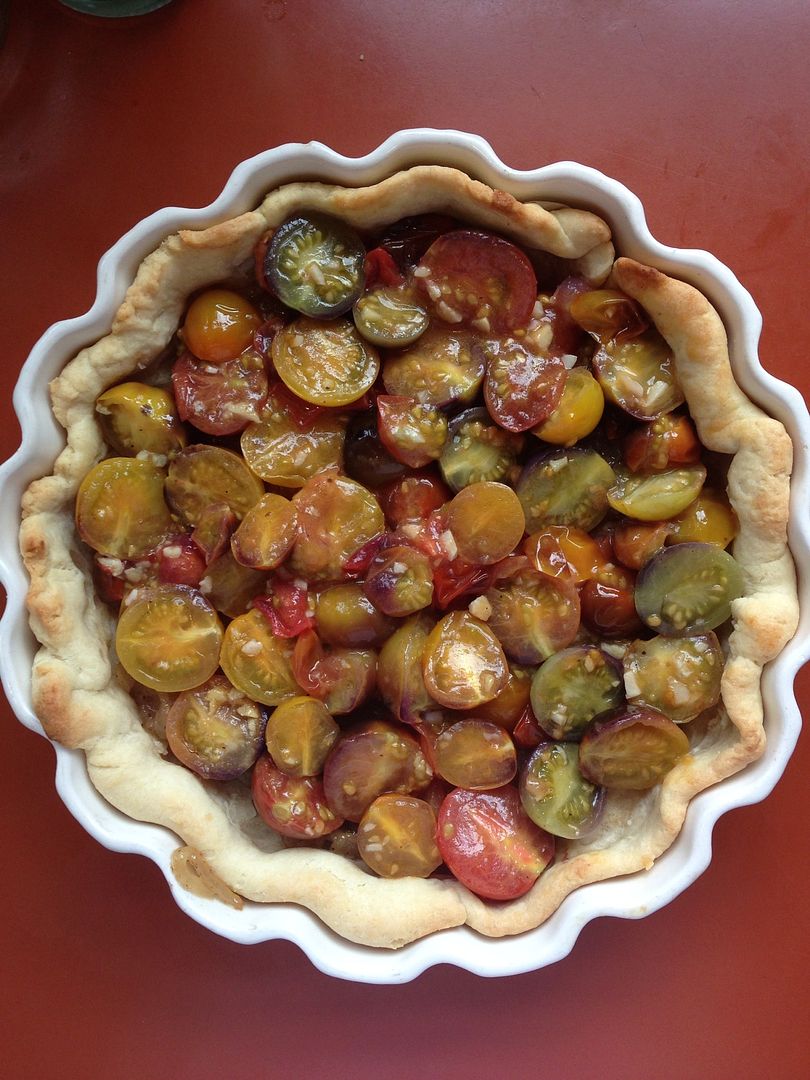
Layer onions evenly over tart, then add an even layer of tomatoes.

Set oven racks at lower and upper third positions.

Bake tart for 15 minutes on lower rack, then spin 180 degrees and bake another 15 minutes on top rack.

Remove from heat and allow to rest for 10 minutes before serving.

Garnish with creme freche or Crema and fresh cilantro.

Be sure to pop over to this post for some truly wonderful Green Tomato Chuntney!

Lovely Variation:
Replace the lightly sautéed garlic with oven roasted garlic; gives a sweeter, deeper and more complex garlic note to the dish.

Preheat oven to 400°F.

Peel away the outer layers from a whole bulb of garlic bulb skin, (leave individual cloves skins intact). Do as many as you like this way – 1 large clove is enough for this tart.

Slice about 1/4″ off the top of the cloves.

Set garlic head up in a garlic roaster, (you can use a muffin tin if you don’t have a roaster; just cover each head with aluminum foil before roasting). Drizzle a bit of extra virgin olive oil over the top, then rub it in to the whole head by hand.

Bake at 400°F for 30-35 minutes, or until the cloves tops are caramel colored and feel soft to the touch.

Remove from oven and set to cool on a wire rack. When they’re cool enough to handle, you can grab a clove and squish the roasted garlic right out. Do that into a with as many as you like for your tart.

Spread the roasted garlic onto the tart crust prior to layering on the onions.

E & M

Pesto über alles


Pesto – Say it and you get a love it or hate it reaction not dissimilar to oysters. The naysayers assumptions are that pesto is overbearing and hard to make, neither of which is true. Fact is, pesto is much more than you think it is and ridiculously simple to make. Let’s dig in.

OK, so classic pesto, the basil driven version, is in fact a delight and super simple to make. The potential variety is as broad as the options for the basil you grow. From Genovese to Holy, blue to Thai, the variety is broad indeed – African Blue, Purple, Red Rubin, Spicy Globe, Lemon, Lime, and Cinnamon all are readily available and truly speak to their names in taste and appearance. If you make identical batches changing just the variety of basil, each one will be completely distinct, and that’s just messing with the basil.

Toast the pine nuts, or don’t. Switch pine nuts for sunflower seeds, almonds, peanuts, Spanish peanuts, cashews, or brazil nuts and again, each and every one is completely unique.

Change garlic for sweet onion, red onion, shallot, or chive – Same deal.

Switch Romano to Parmiagano Regianno, Asiago, or Mizithra and again, totally new worlds.

So, here’s the basic:

Classic Pesto
1 Cup fresh basil leaves
1/4 cup freshly grated Pecorino Romano cheese
1-2 cloves garlic
2 Tablespoons pine nuts
1/3 cup extra-virgin olive oil
Sea salt and freshly ground pepper to taste

Combine basil, garlic, and pine nuts in a food processor or blender and pulse until coarsely chopped.

Now, with the processor or blender running, add a thin, steady stream of oil to the mix and continue until you reach the consistency you like – ‘Pesto’ is paste, so you can go from runny to stiff, as you see fit. Finally, add salt and pepper sparingly, to taste.

If you’re eating it now, chuck everything into a mixing bowl, add the cheese and combine thoroughly by hand.

If you want to freeze your stuff to use later, which you sure can do, then leave the cheese out, put the pesto into an air tight container, drizzle a bit more oil onto the top and you’re good to go for at least a couple months. Just thaw, add the cheese and you’re there. Consider putting pesto into ice cube trays for the freeze; just pop out however many you need and off you go.

What to do if, regardless of variety, basil just don’t float yer boat? No worries; again, ‘pesto’ is just a paste, and you can make it with a bunch of alternatives – Here’s a few to getcha started.

Use parsley instead of basil, (Preferably home grown!) and walnuts instead of pine nuts, (Cheaper if nothing else) and you’ve got yet another new world to explore.

This is one of our personal faves; sub Cilantro for basil, pistachios for the pine nuts, and Queso Fresco for the Pecorino. Try it, you’ll like it.

Wanna try the Greek version? Sub Myzithra for the cheese and walnuts for pine.

Got the idea? I knew ya would – Here’s a raft of others for you to explore. All the procedures are the same as for the basic recipe.

Sub spinach for the basil, with any nut and cheese combo you like.

For a Great Northwet variation, try this.
1/2 cup fresh sage leaves
1 1/2 cups fresh parsley leaves
1/2 cup Hazelnuts
1/2 cup Parmiagano Regianno
1/2 cup Extra Virgin Olive Oil
2-3 Cloves Garlic
Sea salt and freshly ground pepper to taste

Finally, here’s a great Thyme variant.
2/3 cups parsley, chopped
1 tablespoon fresh lemon or lime thyme
1/4 cup pine nuts
1/4 to 1/3 Cup Extra Virgin Olive Oil
1 Tablespoon grated lemon peel
1 Tablespoon lemon juice
Sea Salt and Fresh Ground Pepper to taste

There’s enough to get y’all started; beyond that, you’re on your own, but share the good ones, OK?