OK, I admit it;
Spending a couple hours on a carrot website probably sounds a bit on the OCD side…
Nonetheless, a couple hours here at The World Carrot Museum is time well spent, far as I’m concerned.
Jump in and get educated!
E
Where and how to find it, and what you’re looking for….
OK, I admit it;
Spending a couple hours on a carrot website probably sounds a bit on the OCD side…
Nonetheless, a couple hours here at The World Carrot Museum is time well spent, far as I’m concerned.
Jump in and get educated!
E
Check out the newly published Fresh Herbs Page! It’s about time I got off my duff and did something there…
Our ample spice rack is predominantly fueled by the great folks at World Spice down below the Pike Street Market in Seattle. They ship anywhere, and never send anything but the freshest and best and no, I do not get a deal for so saying; check ’em out here.
The entries you’ll find there and on the pages to come are not meant to be all inclusive; they are derived, quite frankly, from my sitting in front of the spice rack and noting what we actually have there and use. It’s certainly not a static list, so as we add stuff, you’ll find more entries on the corresponding pages. Of course, if you don’t see something you use and love, please do let us know!
Note also that we’ve finally added a number of categories for the many posts herein; we trust this’ll make things much easier for you to browse and find just exactly what you’re after!
Dried Herb and Spices, and Spice Blends pages are soon to follow, so stay tuned!
Almost nothing about moving from Texas to The Great Northwet struck as deep as chiles, or rather, the sudden lack thereof…
Used to growing a veritable cornucopia of our own, as well as being able to find damn near anything in the store, we were faced with no crop and slim pickings up here.
As the first hints of fall drift in the morning air, we contemplated accepting what was and heading for Whole Foods to grab some long-distance Hatches for a bare bones tied-me-over.
Imagine then our surprise and delight when a package from our dear friends at Neighborhood Gardens arrived from Hackensack MN; we truly had no idea what they’d sent, but knew that every care package was delicious to a T. The Squees moniker, BTW, comes from the fact that our pals Grant and Christie who own and run NG live on Squeedunk Lake up there in Cass Co., MN.
When I cut the first line of tape and the scent of fresh chiles escaped, I couldn’t believe my nose! Digging in further, here we’re bags of Hatch, Jalapeño, Super Chile, Cherry, Poblano, Serrano, and Pasilla, all gorgeous and ready to preserve – Heaven!

How they knew I don’t know, but bless their hearts! If ever there was a ringing endorsement of Community Supported Agriculture, this is it – Fresh, organic, varietal and right on time!
We got busy ASAP, and divided things up for storage; large chiles went to the grill for roasting, and then were vacuum sealed and sent to the freezer. the vacuum sealing virtually assures that no freezer burn will dim the flavor or appearance of these beauties over the long winter months, and they take up a lot less freezer room processed this way. A basic vacuum sealer is very affordable, and even better, this is one of those kitchen gadgets that’s often bought or received and never used, so you can find them cheaper yet on eBay, Craig’s List, etc.


The smaller varieties went into the dehydrator with the thermostat set for 145 F and were dried thoroughly. The chiles can then be vacuum sealed if not needed in short order, or stored in glass jars, out of direct sun; they’ll last a year or two easily.


To use frozen, roasted chiles, just pull them out and let them reach room temperature. It’s generally best to seed, strip membranes and skins prior to use, but if we’re making a sauce that will be blended and strained and the variety isn’t too hot, we’ll just pull the stems and seed base and call it good.
Dried chiles can be tossed into the spice grinder and processed into anything from a rough grind to a powder depending on what you’re making. We keep shakers of fine ground Tabasco and Jalapeño chiles handy at all times, as we find they add a very nice brightness to a myriad of dishes.
If your proposed dish needs the chiles whole and/or reconstituted, just plunk the desired amount into clean, tasty water and allow them to return to their natural state. Depending on how hot the chosen chile is and your desired heat level, you may want to remove stems, seeds and veins prior to soaking. By the same token, you might want to use the tea you infused while rehydrating your chiles as part of a sauce or salsa as well.
As always, be careful when handling hot chiles. Everyone has a different threshold, but prudent and cautious are always the bywords when handling a hot variety like Habanero or Ghost chiles. Always jeep in mind that damn near any variety can and will produce the occasional mutant, so even mild varieties can sometimes back a wallop. It’s always better to be age than sorry, so use gloves, keep your hands away from sensitive body parts after handling, and thoroughly clean any and all tools used in processing chiles.
Google CSA (Your town) and see what’s out the waiting for you!
Thanks again Squees, we love y’all!
After 11 years, M and I arrived back home in the Northwest, specifically, the Seattle area. After getting moved and settled, our first outing together was, naturally, food based.
We headed for downtown Seattle and started at Salumi for lunch; since we were going shopping and had been absent for so long, getting fortified beforehand is always wise…
Salumi is famous for their sausage and rightfully so. That said, it’s tiny and easy to miss; here’s the store front:

The way you find it is by looking for this; the big line out front.

What you get is simply perfect. Go ahead and just try to go without taking some snausage home with you.

Truth be told, there’s just been a pregnant pause while I headed for the fridge to snag salumi, bread and dijon mustard…
Fortified, we headed for, naturally, the Pike Place Market. “Tourist trap!” you yowl? Yeah, I s’pose so, but on the other hand, if you lived downtown and didn’t shop here on a daily basis, what kind of twit would you be? So suspend your disdain and dive in; there’s a reason some of these vendors have been here for many decades. And besides that, it’s gorgeous.


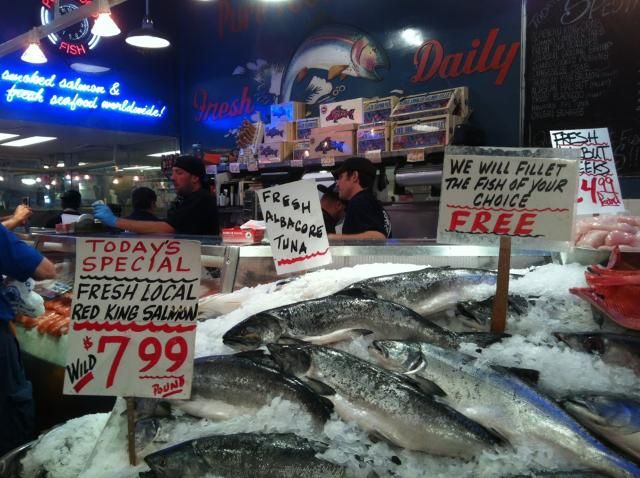
We were after fish, of course, as anyone in their right mind deprived of great seafood for a decade plus would be. Pure Food Fish Co., here since 1911, is an example of all that is great about the market. Super fresh, friendly, and absolutely willing to do as much or as little to your catch as you want them to.


We were after Salmon, naturally, so it was time to choose. In the Pacific northwest, you have five primary varieties of Salmon; King, Sockeye, Coho, Pink, and Chum. They can also be called, in the same order, Chinook, Red, Silver, Humpback and Dog.
What does all this stuff mean and are there genuine differences between them, you ask? Yeah, there are, and they do mean something worth knowing.
King is just that, the best tasting, fattiest flesh with the most melt-in-your-mouth texture there is, hands down. Sockeye is not far behind, truth be told, and there are plenty of folks who chose this variety first every time. Silvers, which run quite shallow in the fall and fight like all get out, may be “Middle of the Pack” salmon, but for me they’re #1. Pink and Chum are not the top of the heap in terms of taste, color, or texture, though Chum roe is highly prized for sushi and likely the most oft harvested.
After looking everybody over, we went with local, wild caught red King. Planning, as usual, to do several meals with this gorgeous fish, we bought a whole and had it fileted. Had we more fridge and kitchen space, we’d have asked to have the rack and head bagged up and taken it home to make stock with.
<img src="http://i2.photobucket.com/albums/y24/AerieGuitars/Food/Photo10.jpg
Having accomplished so much so quickly, (Ahem…), we stopped into a peaceful Uli’s Famous Sausage and Bierstube for a refreshing lager. And speaking of snasauge, had we not done Salumi, we sure would’ve dove in here, as you better if you’ve not already!

Next came Frank's Produce yielded new potatoes, Walla Walla sweet onions, fresh green beans and lemons. Off we go!

A final stop at Pears for a bottle of Mountain Dome bubbly and we’re good to go.
So, back at the ranch, simple rules the roost.
The veggies are rinsed and dried, tossed in extra virgin olive oil, diced shallot, salt and pepper and then roasted.

A filet goes on a broiling rack, then gets a simple baste of unsalted butter, lemon juice, brown sugar and bourbon. Into a 350 oven, we allow 10 minutes for each inch of thickness, measured at the thickest part of the filet. The thinner end is turned to the slightly cooler side of the oven, thick part to the middle.


With lightly toasted local sourdough to sop up juices, that, as the saying goes, is that.

Next time, round 1 of leftovers!
Check out this last post on my Sis’s blog – For any and all of us concerned about undo manipulation of food stocks, this is good info, and I too gotta admit I didn’t know the diff ’till now – Thanks Annzie!
Here’s a perfect example of why M and I toil at this here blog!
Back in April, we slung up a post about stew that also had a recipe tagged onto the end of it for cheesy corn bread. We didn’t think too much of it really until we got an email from Kym and Nerida of South Australia. Seems the Bells, fellow foodies who love Tex Mex, caught the blog and got intrigued by the cornbread recipe.
The catch, (There’s always a catch), was that they couldn’t find genuine corn meal in their neck of the woods. They’d tried the best alternative, which turned out to be corn grits used to make polenta. Their note finished with the comment that, while good, they weren’t sure that what they’d made was what we intended. M and I, quite sure that it wasn’t, and wanting Kym and Nerida to enjoy the real McCoy, snagged a bag of locally milled corn meal, threw in some of our homegrown dried chiles and sent a box winging it’s way literally across the globe.
About a month later, Kym let us know that the Eagle had landed, noting that he was “probably now on all sorts of watch lists, after receiving a couple of pounds of mysterious powder from the Americas.”
Shortly thereafter, they got to try the recipe as intended and had this report.
Sorry for the delay in getting back to you with our corn bread experiment. This documentation of preparing a meal is much more complicated that we thought and we have a new appreciation of folk like you who do this as a regular process.
I’ve attached some photographs to an email which follows this (I wasn’t sure about your bandwidth). These were taken with my phone and we were in the kitchen after dark with artificial light, so the quality is not high. Nerida was actually doing the real stuff and I was trying to record it without dropping me or my phone into anything wet or hot.
We used your recipe as outlined on the blog site, with only a single substitution, which was using oil instead of shortening. We had no solid shortening in the house with the exception of butter, which didn’t seem appropriate here. Nerida bakes regular French style bread with oil, so we thought that was OK.
The pan we used is a muffin pan, and we had an idea of how many holes we could fill with the batter from our previous experiments. We’re going to look out for an appropriate pan that is similar to the one you use, so that we get something more like a mini loaf shape in the future.
First up: when we originally decided to try the corn bread recipe we found various websites run by expat US folk who said that fine ground polenta works well for the main ingredient, cornmeal. (Polenta is common in Australia in the Italian community in particular.) We would disagree. It could be that we haven’t yet tracked down the right brand of polenta, but we used the finest grind we could find, and got quite different results compared to the cornmeal you sent us. The main issue, which was quite disconcerting, was that in the soaking phase you recommend our polenta and milk mixture turned into almost a solid mass, a bit like sand after the tide has gone out. It still worked once the other stuff was mixed in, but it wasn’t what you would call a pouring batter and the crumb of the finished product was quite coarse. (Still tasted good!)
As a side issue, it seems that what normal folk do with ‘grits’ in the southern states of the US is what happens with polenta here. The difference is that polenta (outside Italian households) is a staple of fine dining restaurants, we regularly see main courses served on a shallow bed of polenta or wedges of fried polenta used as a garnish.
The stuff you sent was much better than polenta, and behaved exactly as you outlined in your recipe, right down to being easy to pour into the baking pan.
We had a bit of running to the computer to convert quantities and temperatures to metric, but aside from that the instructions were clear.
The end result was lovely: plenty of that corn taste, a nice and delicate crumb and an excellent texture. Good for dipping into sauce, too. Our vegetarian daughter certainly thought they were pleasant. Mind you, they are fairly solid little things which pile up on you quickly, so we got to try leftovers the next day. We were surprised how well they kept, given that they are unleavened. We now have an appreciation of the part of corn bread in cuisine from areas where corn is common.
By the way, we served it with our version of ‘a pot of red’, which gets around the beans or no beans controversy by putting a layer of beans on the bottom of the pot, on top of which the chili meat mixture itself is ladled before heating in the oven.
Thanks again for the very generous gesture in providing us with the raw material.
I’m going to experiment with your dried chiles in our next Tex Mex venture, and we have some ideas for using them in some SE Asian dishes we prepare, too. We’re thinking of trying to dry our own home grown chiles when we plant out later this year: normally we just use them up fresh and end up oversupplied.
Now we have to find out if there is some variety of similar cornmeal available here, and if so under what name it is hiding.
Kym and Nerida
Here’s Kym’s great pics of their adventure –


Was that a ball, or what? We’re absolutely thrilled to have taken part in this long-distance foodie adventure, and even more so with making new friends down under!
 UrbanMonique