
Be sure to check out the latest edition of American Boomer magazine, featuring our primer on herbs and spices!
Category: Spice, Seasoning, Etc
Rocket fuel for your next meal…
Chile Time, Y’all!
OK, this one is not a gratuitous repeat, hear? It is the time of year when we need to look for chiles and do what needs to be done to preserve them.
So go here and get acquainted with the real deal chiles, first and foremost, ‘K?
Now, for some of the best and brightest basic things you really must do with chiles, go here and make them all, hear?
Be of good chile!
E & M
This just in from the It’s About Time Department!
Check out the newly published Fresh Herbs Page! It’s about time I got off my duff and did something there…
Our ample spice rack is predominantly fueled by the great folks at World Spice down below the Pike Street Market in Seattle. They ship anywhere, and never send anything but the freshest and best and no, I do not get a deal for so saying; check ’em out here.
The entries you’ll find there and on the pages to come are not meant to be all inclusive; they are derived, quite frankly, from my sitting in front of the spice rack and noting what we actually have there and use. It’s certainly not a static list, so as we add stuff, you’ll find more entries on the corresponding pages. Of course, if you don’t see something you use and love, please do let us know!
Note also that we’ve finally added a number of categories for the many posts herein; we trust this’ll make things much easier for you to browse and find just exactly what you’re after!
Dried Herb and Spices, and Spice Blends pages are soon to follow, so stay tuned!
Kitchen Reduction
Howdy from the Great Northwet!
We’re almost settled in our new digs, a process which immediately made an impression, AKA going from 1650 sq ft to 910 sq ft does make a difference!
This is especially true when you’re foodies, have a working food blog, and realize that a very significant chunk of that space reduction comes at the expense of your kitchen…
We went from a square design roughly 8′ x 8′ with a 4′ x 4′ x 8′ pantry, lots of cabinets, and a 21 sq ft double door fridge to a roughly 4′ x 6′ galley with a tiny fridge and way less storage space all around: Everybody moving boxes on day one knew all that stuff marked ‘Kitchen’ wasn’t gonna make the cut!
So, first things first, we reevaluated our stuff, identified just what we really need and use, and then gave away the remainder.
Then a few additions and tweaks later, we had a kitchen that will get ‘er done;
the laundry closet became our pantry

Here’s the basic kitchen layout, which we modified with a couple of small shelves and simple baskets;


Pans had to be stored up high; a small step stool makes ’em M accessible!

A couple of book shelves were re-tasked to add yet more kitchen storage.


Kitchen view from the dining room pass.

And finally, this table had been in my guitar shop under years of sawdust and equipment. A good sanding, a few coats of Tung oil and a final coat of paste wax reveals a very nice dining room table that will do great double duty as a production space.

Next came familiarizing ourselves with local shopping options. Several recon trips revealed a great little farmers market located quite close, along with a decent variety of grocery stores that will work just fine for us. Although the selection of fresh chiles we found was pitiful at best, local produce was abundant and very reasonably priced. We’ve found fantastic coffee and local bread, lots of northwest dairy and cheese, and there’s even a real, live butcher a few minutes away. We’ll shift our shopping pattern to a more Eurocentric model of more often/less stuff, which suits us just fine.
So there’s the transition for y’all! We’re looking forward to rejoining the Northwest stream of life and food. There’re a few more boxes to put away, pictures to hang, storage to square away, but stay tuned, we’ll be back cooking in no time!
Al Carbon y Verde
For anyone familiar with Tex Mex, Tacos Al Carbon will prolly induce a serious bout of mouth watering. Al Carbon literally means ‘the coal,’ the obvious implication being that the meat for this dish should rightfully be done over charcoal, and it should. Aficionados will also argue that the only correct cut for the dish is skirt steak; that can and should be argued, however. The dominant notes of lime, cumin and garlic used for this wonderful marinade lend themselves equally well to chicken, pork, lamb, goat, venison, buffalo, and even shrimp or snapper. In other words, just as fajitas have transmogrified from a particular cut of beef to a ubiquitous Tex Mex dish, it’s not entirely unreasonable to assign the term Al Carbon to the seasoning/marinating blend used on this wonderful dish. That’s my excuse and I’m sticking to it. Oh, and you can easily do a great job on this cooking it inside in a pan if you’re unable or unwilling to fire up the grill, so we’re gonna do that too.
Al Carbon Marinade

3 Limes for juicing
2 – 4 cloves of garlic, peeled
1 – 3 fresh Chiles, (Jalapeno is wonderful, but Serranos work great too)
Handful of fresh Cilantro, (About a 1/4 cup, chopped)
1 teaspoon Cumin
1 teaspoon Sea Salt
1 teaspoon Black Pepper
Juice your limes, of course, keeping the pesky seeds out.

I use whole Cumin seed and Pepper berries, so zap them up if you do too

Throw everybody into the blender and zap ’em until evenly blended and liquified

Cut your flesh into appropriately sized strips and arrange it in a glass pan. Note: If you are using skirt steak, DON’T slice it up first! It’ll need to marinate and cook and rest whole before being sliced or it will come out like shoe leather. I used cheap sirloin, because we had it and needed to use it, so I sliced it to allow the marinade to penetrate better…

Slather on your marinade and leave refrigerated for at least 2 hours and as long as overnight; as far as we’re concerned, the longer the better!

Pour off the majority of your marinade and saute in a hot pan until done to your liking.

Now, you simply must make a fresh salsa for something this good, so do so! When I was at the store I saw that the Tomatillos looked pretty good and managed to pick out about a pound that were indeed as you want ’em; that is, with skins intact and the flesh firm with no blemishes or soft spots. So Tomatillo Salsa it is!
If you’re not familiar with Tomatillos, then as a lover of Mexican and Tex Mex cuisine, you’ll want to be. Contrary to all too common belief, Tomatillos are not related to the Tomato very closely at all: They come from the Nightshade family and are closer to a Cape Gooseberry than they are to tomatoes.
You’re most likely to find green tomatillos in the market, but when ripe they can be yellow, red, green, or even purple. The ripened red and purple guys find their way into jams and jellies down south; like a Cape Gooseberry, they have a ton of pectin and therefore lend themselves well to such condiments.
If you choose carefully and don’t intend to cook with ’em right away, tomatillos wil keep refrigerated for a week at least; remove the papery husks, wash the sticky sap off the outsides and store them in a sealed container in your veggy drawer. You can also freeze them, either whole or processed and they’ll hold up for a few months.
Roasted Tomatillo Salsa
1 Pound of fresh Tomatillos
1 – 2 Fresh red tomatoes of your choice
2 – 5 small cloves of Garlic
2 – 4 fresh Chiles, (Again, Jalapeno or Serrano are our go-to choices)
1/4 of a medium sweet Onion
1/4 to 1/2 cup chopped Cilantro
1/2 teaspoon of Salt
2 cups water

Wash and prep tomatillos by removing husks, stems and sticky sap. If you don’t want a hot salsa, field strip the seeds and membranes from your chiles, (And as always, follow our common sense rules for chile handling, please!)
Arrange tomatillos, tomatoes, chiles, garlic and onions on a pan suitable for broiling.

Roast or broil the gang until skins on tomatillos are browned to charred and tomatoes are soft.

Throw everybody into a pot with the water and bring to a low boil; allow to simmer for about 10 minutes, until veggies are starting to come apart and the mixture has reduced a bit. If you like a thicker salsa, allow it to go a few minutes more.

Throw everybody into the blender and let ‘er rip until you reach your desired consistency, kinda like this here…
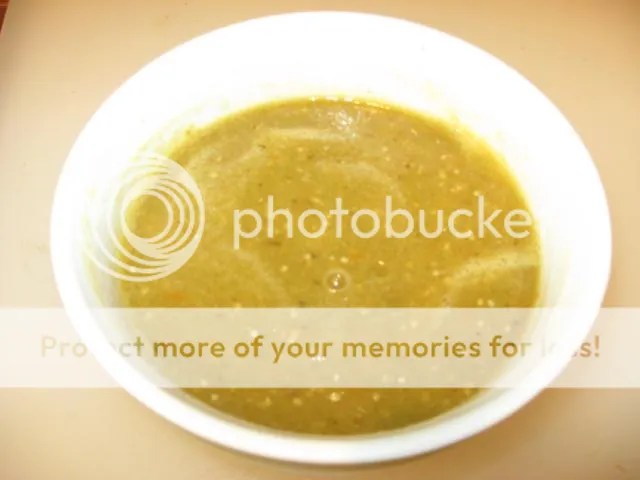
Et viola! Keep in a sealed glass container in your fridge, and the salsa will be good for about a week, (And it gets even better the day after you make it…)
We used local flour tortillas for our feast, since I was too lazy to make fresh. We garnished with fresh tomato, onion, coleslaw and aged pepper jack from WSU. And yeah, in fact, they tasted even better than they look!


Rubbin’ Basics
DISCLAIMER: Yes, I live in Texas. Yes, I own both a grill and a smoker. Yes, I understand the fundamental differences between grilling, smoking, and barbequing. That said, no, I ain’t a know-all expert on this stuff. There are plenty of gen-yoo-wine experts out there though, so if you hanker after the exact right way to make a Memphis style rub, get online and look it up! That said, keep in mind that you’re gonna find probably 20+ genuine Memphis rub recipes out there, each one claiming to be the right one, (Which First National Bank is the real one again?) Take it all with a grain of salt, (Pun intended…)
We love cooking flesh, we truly do. As you’ve probably noticed, there’s a fair amount of chicken, fish, pork, and beef running through these pages. You’ve probably also noticed that we rarely leave them alone. Some kind of rub, some form of herbs and spices, is almost always present, ‘cause that’s what we like. Now, as fate would have it, we feed quite a few other folks too, and it turns out they love what we do in this regard as well. So, thought we’d share some basic thoughts on the subject.
My bottom line on rubs is this: One or two dominant notes, with as many other minor notes as needed or desired, with a caveat – Don’t add so many or so disparate as to overwhelm the blend. That may seem an obtuse statement, but if you think about it, it makes sense. Garlic, onion, smoke, sugar, pepper, chile heat, clove, cinnamon, coffee, citrus, sage, rosemary, and on and on – They’re all great flavor notes, but any one out of proportion can and will muddle the mix at best and wipe it off the map at worst.
When we were up cooking in Walker, MN, recently, a regular stream of folks were coming by, and every few minutes one would say “You don’t measure.” It’s true, I usually don’t. Nothing unusual in that, many folks who cook a lot don’t use a spoon or cup much anymore. I can put a teaspoon if something into a bowl or grab 6 ounces of a protein by hand and be very close to right on, but I do this many times every day for a living: If you can do that comfortably too, then feel free to do so. If you can’t, then keep measuring until you can and want to, it’s no big deal either way. The point of this ramble is ratios and portioning. I don’t think of rub recipes in terms of making a cup, etc, I think of making enough for what I need it for, and that’s what I’d encourage you to do as well. The secondary benefit of this method is allowing experimentation. When you find something you like, write down, right away, what you used in what ratios and save it. Then you can recreate the recipe at will. I am not a fan of doing big batches of rubs, because it’s my feeling that anything stored like that will lose some oomph by being premixed for a long time. I always advocate buying spice and seasonings in whole form whenever possible and then grinding/mixing your own as needed. Doing so gives you bolder, fresher flavors and a more potent rub. You can therefore use less and gain more, which makes good sense for economy as well as flavor.
When composing a rub, pick your dominant notes and portion them 50% – 50% as a start point. Next consideration is how much to use. Make the amount big enough to count. If we’re going to prepare a rub for 3 or 4 nice 8 oz. T-Bone steaks, fer instance, I’d go with about 2 tablespoons each of my dominant notes and a teaspoon each of the minor notes.
Here’s my go-to basic beef rub, just the bare bone essentials.
2 Tablespoons Sea Salt
2 Tablespoons Pepper Blend
1 teaspoon Onion powder
1 teaspoon granulated Garlic
Put all that in a grinder, give it a whirl and off ya go. I’ll rub the flesh with a light coat of olive oil and then work the rub into it, coating thoroughly, about 30 to 45 minutes prior to grilling. Let it sit in the fridge and get comfy, then let there be fire…
Once again, depending on the meal desired, you could add a bunch more to that rub if you wanted. Subtract 1 teaspoon of sea salt and sub smoked salt. Add a teaspoon of smoked paprika. Add a ¼ teaspoon of chile powder. Add rosemary, sage, thyme, oregano, etc. Sub lemon juice for the oil as a rub adherent. Get the idea?
Notice the lack of sugar in that rub? Why is that? Simple question, simple answer – Cooking method. With steaks, we’re gonna cook hot and fast, so sugar is probably not what ya want, ‘cause it can and will burn under those conditions, and we don’t need to ruin good meat. Low and slow is the place for sugar, so let’s go there.
How about for pork? Pork is a prime low and slow cooking candidate. It also has a pretty good salty note to begin with, so sugar is a good candidate for a dominant note, as is a mild, red chile powder.
Here’s my basic rub for pork.
¼ Cup dark brown Sugar
¼ Cup mild red Chile powder, (We use Hatch and highly recommend it)
3 Tablespoons Pepper blend, (We like Black, Red, Green, White)
1 teaspoon granulated Garlic
½ teaspoon Onion powder
½ teaspoon Celery Seed
Into the grinder with them and give ‘em a spin. Same treatment as beef for application.
Again, there are bunches of variations, so use your imagination and go wild. From pulled to roast, that combo won’t let ya down.
How about chicken? Love, love, LOVE putting a nice rub on a bird and roasting that thing! Chicken lends itself to many variations of rub or marinade, so you almost cannot go wrong. If you google basic rubs for chicken, you’ll find most have sugar in them and that’s where I veer off slightly and lean toward citrus for sweet-tart notes instead. I feel the sweet notes are already there in the basic flesh, hence the other path…
Here’s my go-to chicken blend.
2 Tablespoons Sea Salt
2 Tablespoons mild Green Chile powder, (Hatch again!)
1 Tablespoon Pepper Blend
1 Tablespoon Smoked Paprika
1 teaspoon dried Lemon Peel
1 teaspoon dried Orange Peel
Grind, oil the bird and massage that rub right in!
OK, so basic fish rub? No can do, I say – Too much diversity! We can do a couple variations though. First off, what fish would you rub versus marinating? Good question! When I think of applying a rub to fish, it’s fish that we would grill, smoke, or barbeque, so we’re talking about salmon, fresh tuna, swordfish, and the like – Dense, firm fish that can stand up to bold flavors and those cooking methods. The one everyone loves best and wants to do most is Salmon, of course. M and I hail from the northwest, so we’ve had some exposure here. Salmon rubs, like regional barbeque, are dangerous turf; there are many variations and all of them are the best, capiche?
Here’s our go-to wet rub for Salmon:
2 Tablespoons dark brown Sugar
2 Tablespoons unsalted Butter
1 teaspoon Bourbon Whiskey
Juice from one Lemon
¼ teaspoon granulated garlic
¼ teaspoon sea salt
Slather onto your salmon work rub in and allow to marinate for 15 to 20 minutes prior to grilling.
For Firm fleshed white fish, (Swordfish, tuna, snapper, cod, etc), we like this rub a lot.
1 Tablespoon Sea Salt
1 teaspoon ground Pepper blend
1 teaspoon lemon peel or zest
½ teaspoon granulated garlic
¼ teaspoon dill
¼ teaspoon thyme
Lightly coat fish with olive oil and then work rub in and allow to marinate for 15 to 20 minutes prior to grilling.
Well, there ya have it – Enough ammunition to keep ya rubbin’ from here to Labor Day – Enjoy!
 UrbanMonique