Makin’ Bacon


Love bacon? Love good bacon? Seen the prices lately? Us too! That little revelation led us to home made, courtesy of Michael Ruhlman.

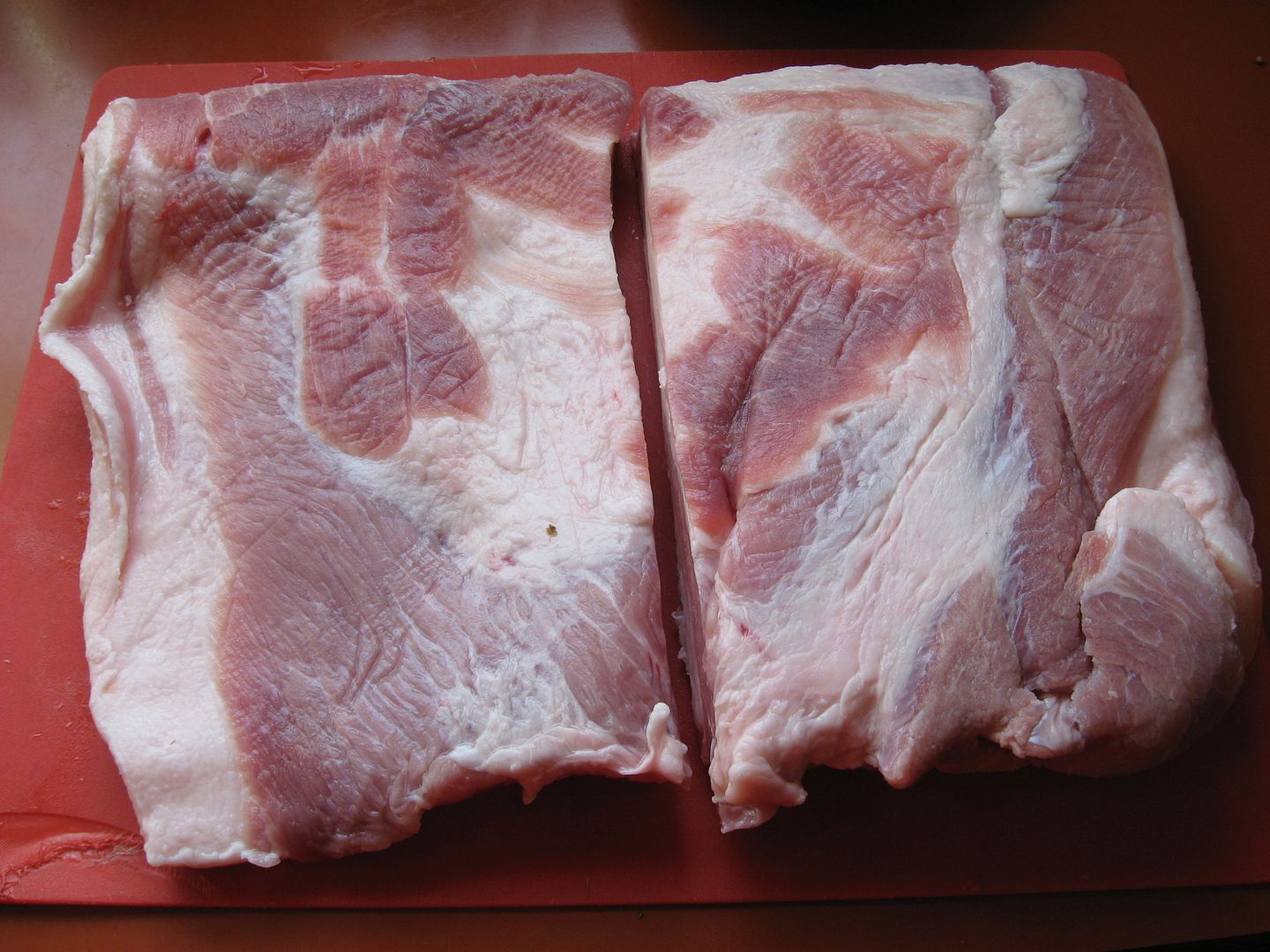
I started our odyssey with a search for pork belly locally, which wasn’t as easy to find as I thought it’d be. Eventually, we found roughly 15 pound packs at Cash and Carry for $3.15 a pound. We took that home, divided it into 2 1/2 pound batches, and went to town.

 photo IMG_0931.jpg

Our first batch was made straight from Ruhlman’s recipe. It turned out great, but it wasn’t exactly what I want in my perfect bacon. Having no doubt that experimentation is almost always a good thing, we analyzed the results and decided that Ruhlman’s would be, for us, perfect lunch and dinner bacon, but not breakfast. We found Michael’s recipe a touch salty, even when we’d carefully weighed the pork belly and salt; further, we felt that while the bay leaf, nutmeg, garlic and thyme in that recipe added glorious floral notes perfect for lardons, and stellar for carbonara, it was a bit much for our breakfast palate, so we set out to build our perfect breakfast bacon.

While one needs to stick pretty closely to the 1.5:1 salt to curing salt ratio for proper bacon, you have relative freedom with the other ingredients, so we revamped with our chosen notes, less salt, more sugar, Grains of Paradise for that unique pepper note we love, brown mustard seed for the tang, and a little smoke.

The results were spot on, and we’re happy campers!

2.5 pounds Pork Belly
1/4 Cup Dark Brown Sugar or real Maple Syrup
1 Ounces Flaked Salt
1.5 teaspoons Pink Curing Salt, (Sodium Nitrite)
2 Tablespoons Grains of Paradise, coarsely ground
2 teaspoons Brown Mustard seed, coarsely
1 teaspoon Smoke Powder

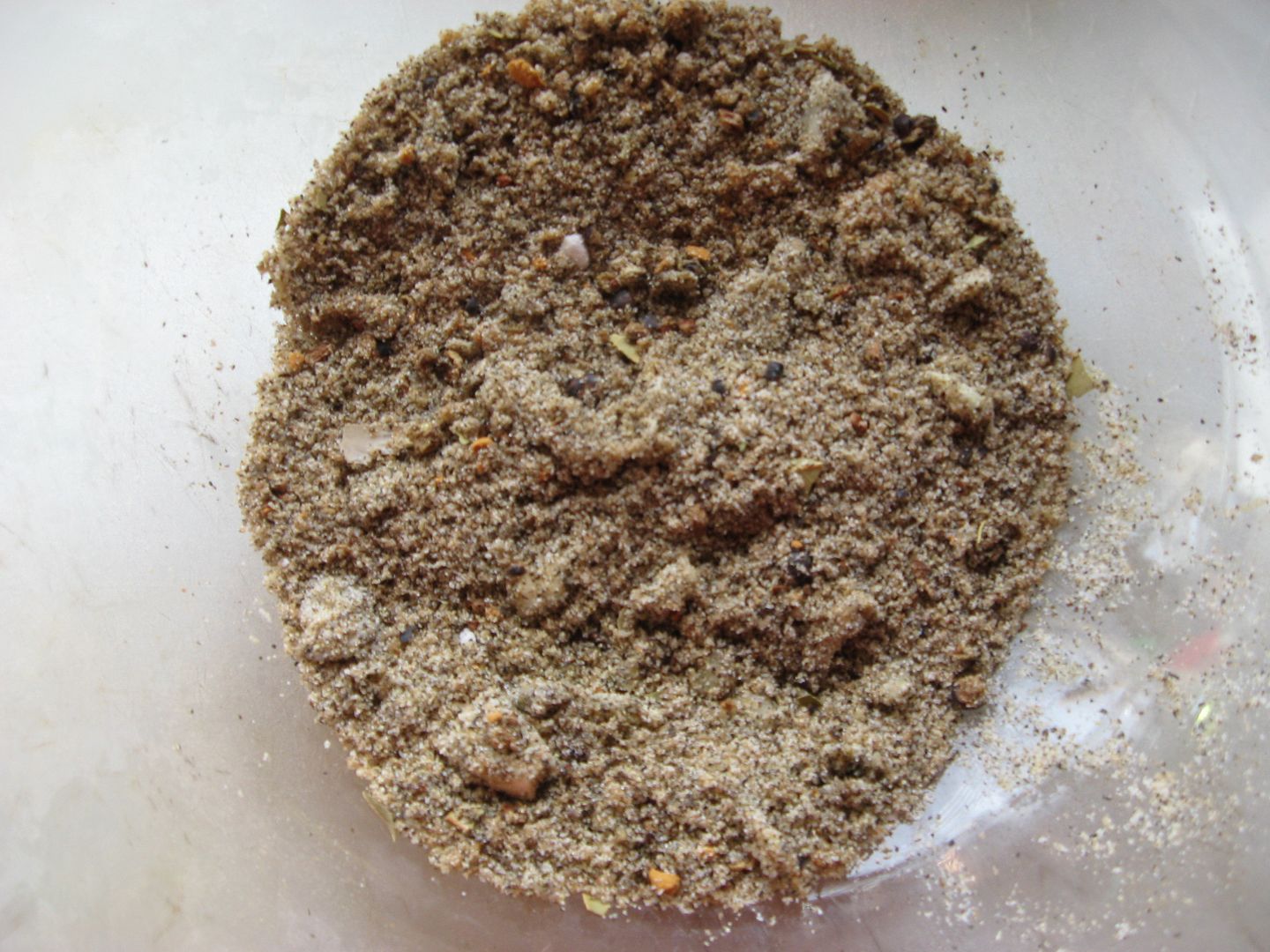
Mix all dry rub ingredients except the smoke powder together in a bowl.

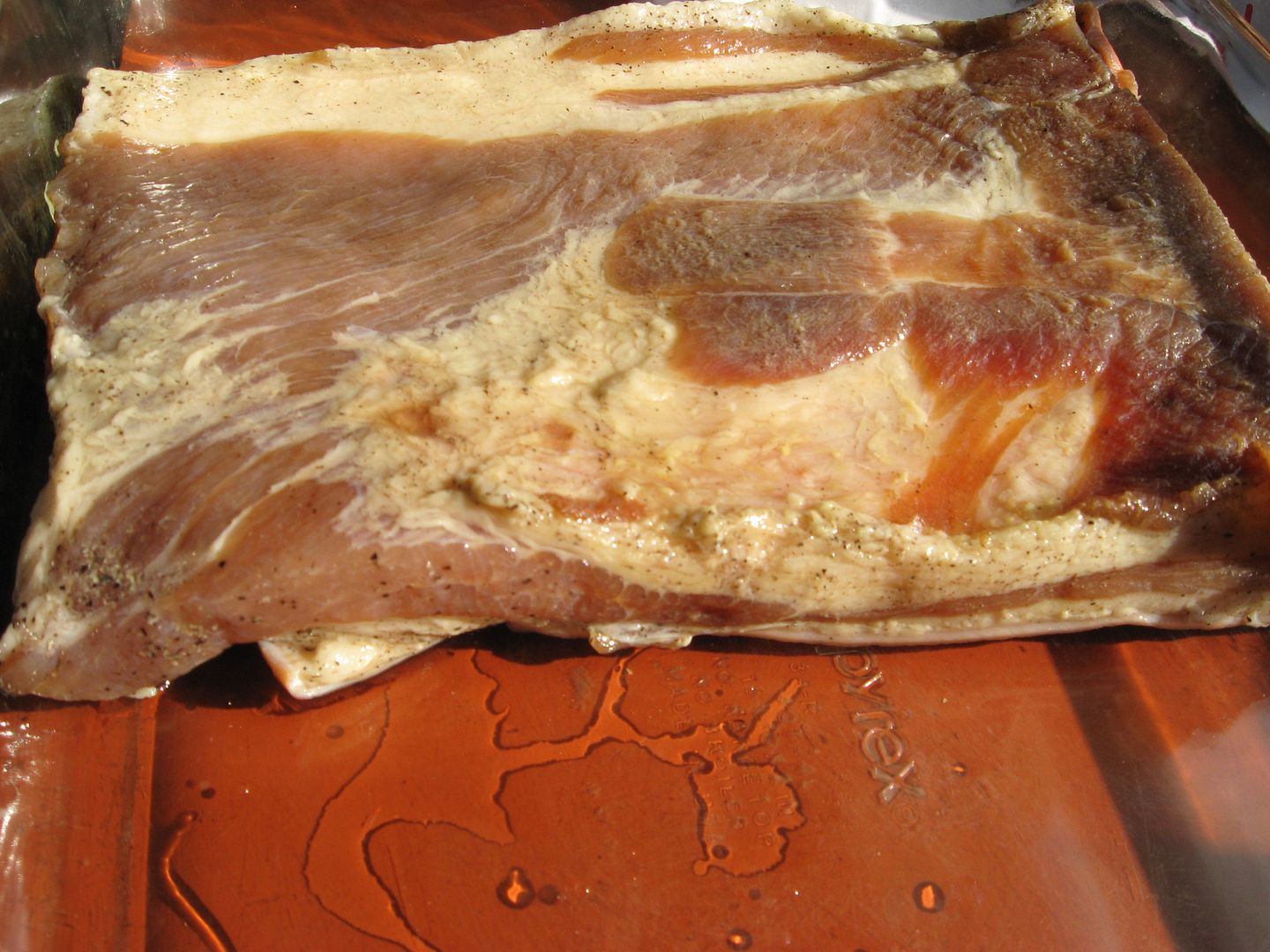
 photo IMG_0930.jpg

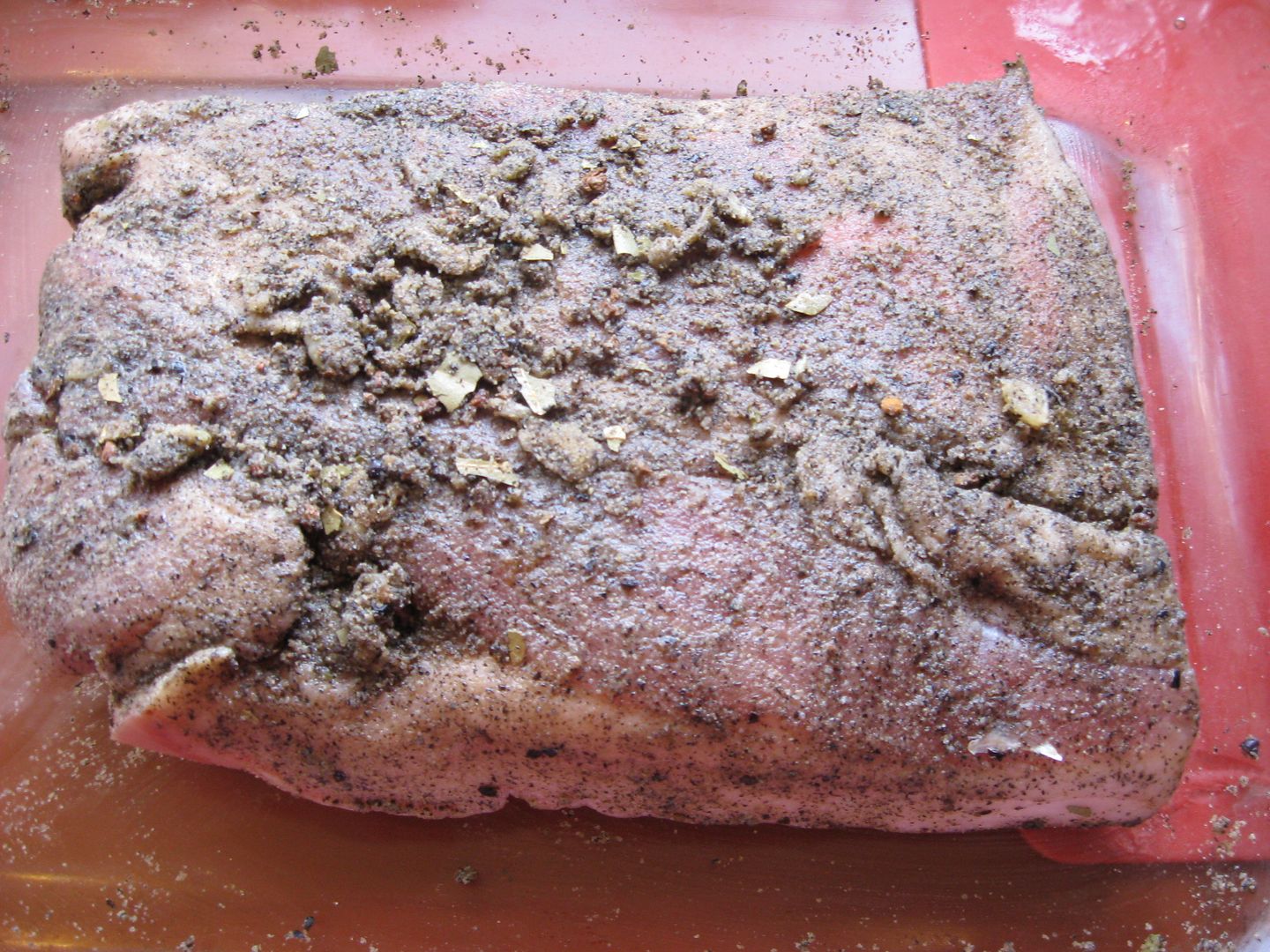
Set your belly on a baking dish or sheet tray.

Rub the cure onto and well into all surfaces of the belly. Take your time and work it right in there evenly and completely.

 photo IMG_0932.jpg

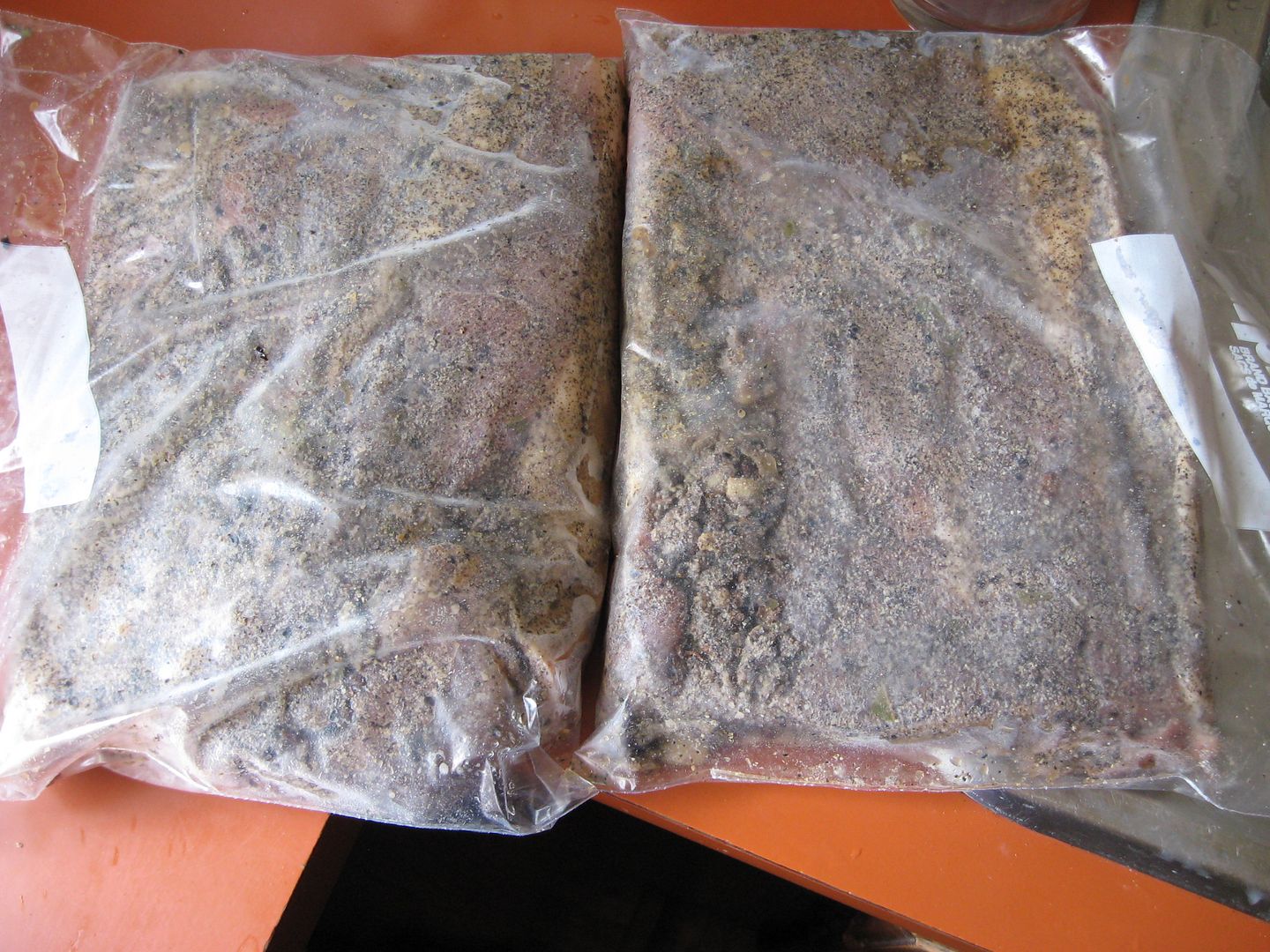
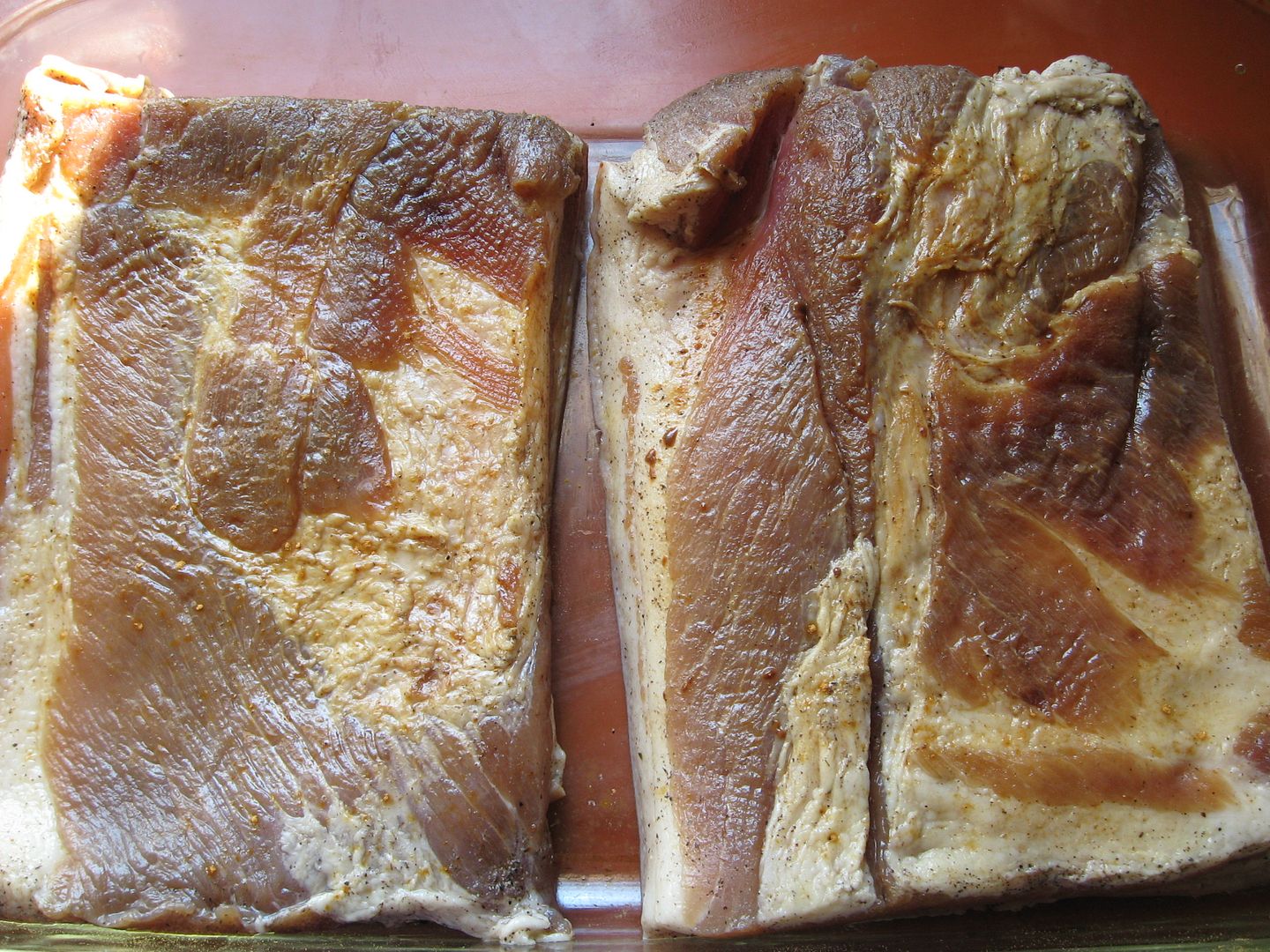
Place your belly into 1 a gallon Ziplock bag, press the excess air out, and set it in the back of your fridge for 3 days.

 photo IMG_0938.jpg

On day 4, pull out your belly and rub everything back into the flesh again. Set ‘er back into the fridge for another 3 days.

And on the 7th day, there be bacon…

Pull your belly outta the bag, rinse your sink well and then stick the belly under nice, cold running water and rinse all the cure off, giving it a good rub as you do.

 photo IMG_0939.jpg

Preheat oven to 200 F.

Pat your belly dry with paper towels and set into a glass baking dish or a sheet pan.

Rub the smoke powder evenly and thoroughly into your belly.

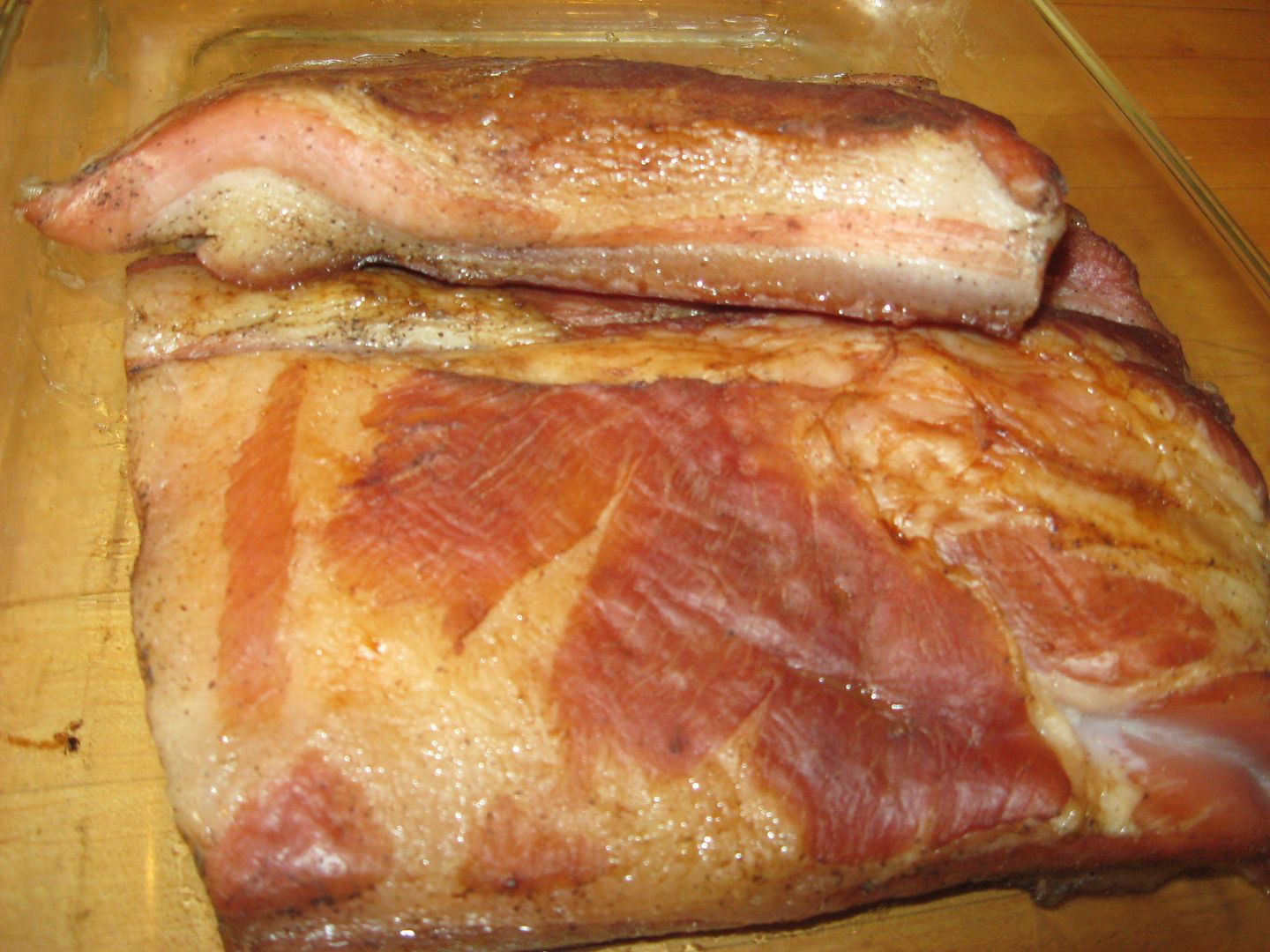
 photo IMG_0940.jpg

Roast for 90 minutes, or until your internal temp reaches 150 F.

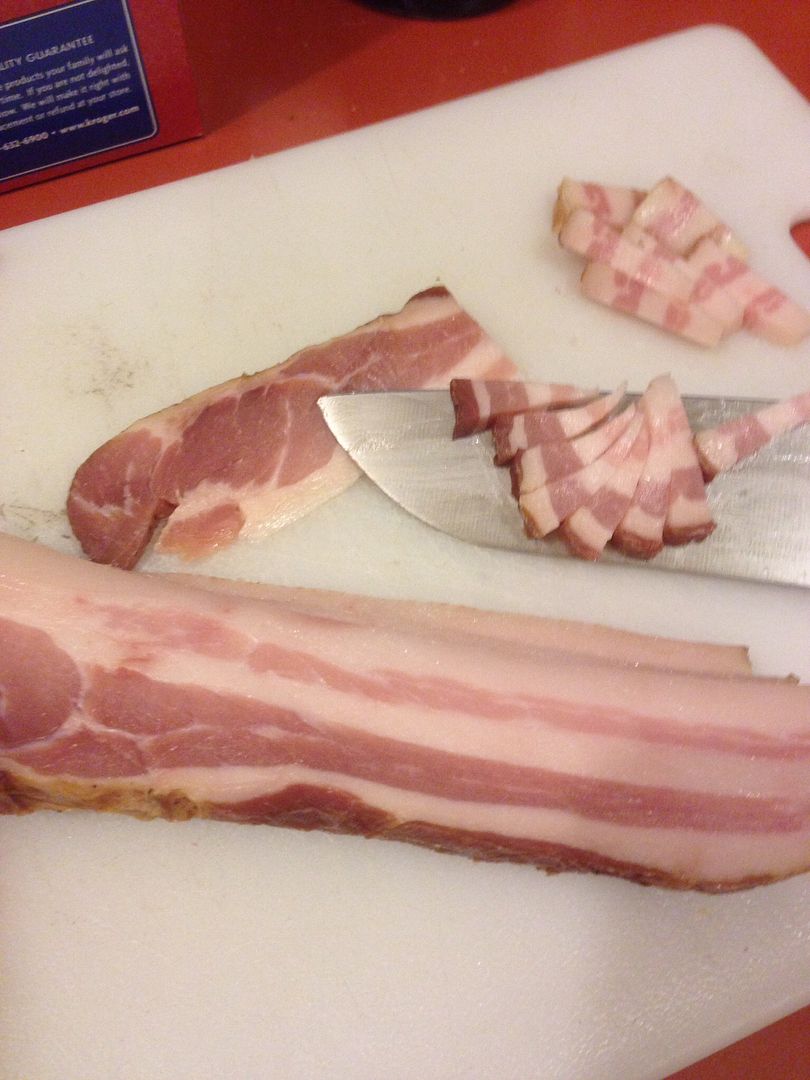
Remove from oven, allow to cool, and then repackage in a ziplock in the fridge. It’ll last as long as store bought, or maybe a bit less, since it has less bullshit stuff in it; anyway, I’d bet that after you try it, lasting long won’t be an issue…

 photo IMG_0944-1.jpg

 photo image.jpg

You can freeze bacon, but not for more than about a month. If you do freeze it, you’ll want all the air you can out of the bag so, again, vacuum sealing is best.

You can also sub Honey or Agave Nectar for the sugar and get some pretty nice flavor variations. Our family also likes peppered bacon, and for that we’ll layer on a bit of olive oil and ground, black pepper for the roast.

Big thanks to Michael Ruhlman for a wonderful charcuterie book, and for encouraging experimentation. Now it’s your turn, and make sure you try his recipe, because it rocks and it just might be your all-around fave!

Enjoy!

 photo image-1.jpg

Brine That Turkey!


Truth or dare time – How many of y’all, when it comes to your Thanksgiving turkey, do not show the bird the proper love? Tell the truth, now… Do you simply throw a bird in to the oven? Do you fill it with stuffing? Thought so… truth be told, even if you rub it with something nice, you’re still not giving that poultry it’s holiday due. If you want to serve the best bird, you’ve got to brine that turkey. I’m gonna tell you how, but first, here’s why.

Turkey is an extremely lean protein. If you doubt that, buy some ground turkey, do nothing to it but cook it, and see what you get – unlike good, fresh hamburger, there’ll be no moisture in the pan, and the taste will be, well… less than optimal. Let’s face it, we don’t need fat from our bird, ‘cause we’re gonna get that from all the sides we make. What we do need is a tender, juicy bird, and again, brining is the way to get there. Now, I know there are some of you out there thinking, ‘yeah, but if I cook it right and season the skin nicely before hand, it’ll still be great,’ right? Well, no, no it won’t – it might be good, maybe even really good, but it won’t be great.

Seasoning right before you cook, or even an hour or two before you cook, doesn’t allow the salt you’ve added enough time to do its thing. It won’t penetrate the flesh at all, really, especially with a hunk of meat as thick as a turkey breast. It’ll do a bit of work on the surface, but no more. Truly, the only way to allow seasoning to work is to give it the time it needs – And that means you need to brine that bird.

Traditionally, brining is a wet process. We submerge the bird completely in a brine, and give it anywhere from eight to twelve hours to do its thing. That works great, frankly, and it really isn’t hard. Brined birds weigh more after cooking than a dry bird does – Up to 8% more, and that’s virtually all added moisture, which is very good indeed. The wet brine process also acts chemically to break down some of the tougher proteins within the bird’s muscle fibers, leading to tender flesh – Also good. So, if you’re of a mind to wet brine, here are some basics.

If you buy a frozen bird, you can thaw it while brining, which saves you some time, (if you buy a fresh turkey, you don’t need to worry about that.)

Proper brining is a function of both brine strength, the weight of the bird, and brining time. What you’re doing at home is technically called gradient brining – That is, putting food in a higher salt concentration brine than you really want in the food, because you don’t have the time to do what’s known as equilibrium brining – That’s when you use a lower salt concentration and allow the time needed for the salt content in the brine and the food to equalize. When you see or read about something like pastrami being brined for a week or longer, that’s what they’re doing, and that’s also why the Pro’s make stuff that consistently tastes better than what we do at home. All that said, don’t fret – What we do at home is safe, and it really does make a better bird. So, for reasonable gradient brining, we brine whole turkeys for about an hour per pound, in a 5% to 6% brine concentration.

Basic brine ratio is often shown as ‘1 cup salt to 1 gallon of water’, but not all salt weighs the same – what we really want is about 7 ounces of salt per gallon. When you brine, use kosher salt – The larger crystal size means it dissolves faster in water than fine grained stuff, and there’s nothing in there but pure salt, so it wont taint your brine. If you don’t have a kitchen scale, (And frankly, you should), then Morton Kosher weighs 7.5 ounces per cup, and Diamond 5 per cup. For the record, there’s nothing wrong with adding herbs or spices to a brine – If you like it, do it.

Basic Wet Poultry Brine
For each Gallon of water, add
7 Ounces Kosher Salt
1 Tablespoon crushed Sage
1 Tablespoon Lemon Thyme

For a nice twist,

Cider Brine for Poultry
For each Gallon of Apple Cider, add
7 Ounces Kosher Salt
1 Tablespoon ground Black Pepper
2-3 dashes Tabasco sauce

For a 15 to 18 pound turkey, you will need a couple of gallons of cider or water, and a clean, food grade 5 gallon plastic bucket. You don’t need to heat the water or cider. Just make sure all the salt has completely dissolved before you proceed.

You need to plan ahead for wet brining. You’ll want an additional 6 to 12 hours between the brining and the cooking, so, if you’re thawing and brining, your process needs to begin nice and early on the day before turkey day.

Pay attention to food safety procedures during brining, without fail! Your brine and bird must remain under 40° F at all times, period; if you need to add a little ice, do so. If you need to add a lot, compensate with a bit more salt. When your brining period is done, pour out the brine, (NEVER reuse it.) Gently rinse the bird in clean, cold water, then pat it dry with clean paper towels and then transfer to a roasting pan.

Now comes the secret to gloriously golden, crispy skin. Allow an air rest for your bird, by letting it sit, uncovered in the refrigerator, for 4 to 6 hours after brining. This will help moisture evaporate from the skin, and allow the meat to reabsorb some moisture as well.

Now, if all that makes you paraphrase George H. W. Bush, ‘Not gonna do it, not gonna go there,’ then here’s an even easier option that works just as well. And it’s funny that, right at this point, literally right at this point in today’s narrative, I got this text from my friend John Joyce, a fine guitar maker from the Twin Cities in Minnesota – ‘Hey E what do you think: dry brined or wet brined turkey. I’ve done wet for years but I’ve read a lot of good stuff on dry brining.’ Yep, dry brining is exactly what I was about to type, so, here ya go JJ.

While the term ‘dry brining’ might seem kinda oxymoronic, i assure you it’s not. In restaurants, this has been done for a long, long time. Often called ‘pre-salting,’ it acts on a protein more or less as a wet brine does, albeit without the water, equipment, or hassle. Think of it as a dry rub, like we use on poultry, ribs, and the like, and it’ll come to light for you.

The chemistry here is very cool, too. When we first apply a dry brine, osmosis occurs, meaning the moisture within the bird is drawn toward the higher salt concentration rubbed on the skin. As that moisture reaches the surface, it dissolves the salt and sugar in the brine. In the final stages, the liquified brine is draw back into the bird as things equalize. There, the solution acts as a wet brine does, breaking down those tough muscle proteins and acting as a tenderizer – Pretty cool, huh? And to top it off, all this is done in your fridge, during a simultaneous cold rest, so you get that crispy skin, too – Two birds with one rock, if you will.

Dry brining does require time, and in fact, more time than wet, usually. Since there’s no added water, you’ll need two to three days to let the process do it’s thing, so once again, plan ahead.

It’s also important not to get a bird that’s been pre-seasoned in any way, since that can and will upset the balance of things – Avoid anything that says kosher, re-seasoned, or self-basting. You’ll also want a fresh bird, or at the very least a fully thawed one.

Basic Dry Turkey Brine
5 Ounces Kosher Salt
1 teaspoon crushed sage
1 teaspoon Lemon Thyme
1 teaspoon ground Black Pepper

Sweet Dry Turkey Brine
5 Ounces Kosher Salt
2 Tablespoons Dark Brown Sugar
1 teaspoon Smoked Paprika

Prep your bird by removing any of the extraneous bits, then pat it dry with clean paper towels.

Gently gently separate skin from flesh over the breast area, taking care not to rip the skin. It’ll work much better in direct contact with the meat.

Rub a teaspoon or two of the mix into the bird’s cavity, then do the same all around the drumsticks. Rub 3-4 tablespoons of the mix onto the breast meat, and use the rest evenly across the skin.

Ct a small slit in each side of the bird about half way along the wing tips and then slide the tips into that cut.

Put the bird on a roasting pan or rimmed baking sheet, and into the fridge for at least 2 days, and 3 is better.

When the time’s up, you’re ready to cook. You can roast, deep fry, whatever floats your boat.

Keep your bread stuffing in a casserole dish, and prepare a nice juicy cavity filler for the bird.

1 Apple of your choice
1/2 Sweet Onion
1 stalk Celery
Tablespoon Canola Oil
1/2 teaspoon Sage
1/2 teaspoon Sea Salt
1/2 teaspoon ground Black Pepper

Rough chop the orange, onion, and celery, (and if you have celery leaves, use those!). Throw those in a mixing bowl, then add oil, Sage, salt and pepper, then combine thoroughly. Stuff your bird’s cavity thoroughly. Place the bird on a rack in a roasting pan, and add 2 cups of clean water to the pan. Insert an internal thermometer to the thickest part of the breast.

Preheat your oven to 350° F.

Standard roasting times, stuffed, at 350° F follow; that said, the only real way to know when the bird is done is by internal temperature, and we’re looking for 165 F.

10 to 18 pounds 3-3/4 to 4-1/2 hours

18 to 22 pounds 4-1/2 to 5 hours

22 to 24 pounds. 5 to 5-1/2 hours

Start your roast with the bird uncovered, then cover loosely with foil for the last hour. Basting isn’t necessary, but it sure doesn’t hurt.

When the bird is done, remove it from the oven and let it rest for 15 minutes prior to carving – That rest is vital to allowing juices to equalize throughout the cooked bird, so don’t cheat!

Carve, admire, enjoy, and get ready for leftovers,

Later in that text, JJ wrote, ‘I like those ingredients. I usually do two birds. I’ll do one dry and one wet. Is the cider recipe on your site?’ It’s right here for ya, Buddy! He ended with this – ‘I’m also making your ginger ale recipe. So I guess that means you’ll have a virtual seat at our table. ?’

I told him I was honored and pleased by that to no end, and I truly am.

Scaling, Converting, and Planning for Leftovers


Well, if you’re a regular here, you know we have a real passion for leftovers. It is damn near criminal to waste good food and it happens way too often. To some degree, this is our fault, ‘our’ being foodies and bloggers who exhort others to cook. I say that because a lot of what I find in out there are recipes offered in quantities that demand leftovers. And it goes without saying that restaurants in the US routinely offer ridiculously huge portions, the lions share which is thrown out as well.

So something needs to be done about it, right?

Right.

You can do your part by learning to scale recipes when they’re designed for more folks than you’re going to reasonably feed. Scaling is especially useful if a recipe is complex or involves expensive ingredients; in any case, most of the time, you just don’t need or want to cook at larger volumes. While it sounds easy, it isn’t always such, (I found this out taking a homebrew recipe to barrel volume…) Scaling definitely involves a bit of art in addition to straight math.

Take, for instance, a recipe that catches your eye, but is shown for 10 when you need it for 4.

Knocking it down mathematically is straightforward: You take the quoted measure of each ingredient and divide it down to where you want to be. So in this case, we’d divide 4 by 10, yielding 0.4; each of the stated measurements would then be multiplied by 0.4 to reach your goal.

Lets say the recipe calls for 4 cups of all purpose flour. Take the 4 cups, multiply by 0.4.

4 cups × 0.4 = 1.6 cups of flour for your 4 person conversion, and so on down the line of ingredients.

As a guitar maker, I can tell you that I spend a fair amount of time converting fractions to decimals, so don’t feel even a little bit bad for squinting at 1.6 cups for a second or two. Truth be told, for the vast majority of home cooking, eyeballing 1.6 cups is going to work out just fine. Yes, things like a teaspoon are gonna end up 0.4 but again, almost a half, more than a third; you’ll get the idea.

For any and all of this that seems to funky to do, drop over here to this handy Cooking Conversion Tool at About.com. For those of you who actually use your smart phone or tablet for cooking as I do, there’s a very decent app called Kitchen Calculator Pro that works great.

One of the things we do here is to test conversions for you. As I mentioned, scaling recipes isn’t always as simple as the math. Sometimes things have to be tweaked to come out just right. That said, this is often a case of personal taste; it’s nothing to worry about on the big picture view, but if you’re wanting to impress your new date with a great home cooked meal, you might wanna test that conversion first, right?

A lot of the secret of cooking well has to do with ratios; it could be reasonably argued that, next to good ingredients, nothing is more important. Author and Chef Michael Ruhlman has put out a few tools and books about this stuff. I own both his Bread Baking and ratio apps for iPhone and iPad, and I use them both. They’re good common sense stuff and a handy reference when you’re experimenting.

Now, all that said, there are times when you’re going to build food at larger volumes. You’ll notice that a lot of what we do here starts out fairly basic; consideration of multiple meals is a primary reason for that. We, like most of y’all, are not exactly wading in spare time, so prepping one primary meal that can become two or three saves work and is much more efficient.

When you’re doing that, you may well build dishes that are sized for much more than your one-meal needs. Of course quite a few things like soup, stew, chili, roasted or broiled meats, potato dishes and many veggies, really do taste better the next day. It makes sense if you think about it; good ingredients, well married, seasoned and cooked – It should taste better, right?

To close this post, we’ll give you a lightning round example of what we’re talking about.

Day 1; we’re both off, so we bought a big ol’ pork roast and paired it with gnocchi, seedless red grapes and a nice salad.

Day 2: Sky’s the limit; we could do cold sandwiches, Mex, what’ll it be? It was a bit nippy, so digging into the fridge, we found some great veggies, soaked and added some beans and made a wonderful soup. The prep for this took maybe 15 minutes, then we just stuck it in the pot to get happy. Paired with sourdough garlic bread and some more grapes, life is good.

Day 3: We sure could have soup again, but why not throw 30 minutes prep time into the mix and make a pot pie, right? Kitchenaid pie crust recipe, 15 minute rest, blind baked in a baking dish, thicken the soup with a little roux, and off you go…

There’s three distinct, easy meals from one pork roast. Efficient, fun, and delicious.

What are you gonna make tonight?

E & M

That ain’t how we play…


I tweak and republish this post annually; I think you’ll see why when you read it.

See, I’m not out to be tragically hip, in fact quite the contrary. Or maybe Matthew Selman said it best; “I wish there was another word than foodie; how about ‘super food asshole’, or ‘pretentious food jerk’?” I just don’t wanna go there.

Granted, there are a lot of great food blogs out there, but right now, many are judged ‘Great’ because somebody took a really, really nice pic of some food, or is on the fast track to be the next Food Channel Super Food Asshole. Frankly, when the ‘best’ food blog sites reject people because they don’t meet criterion such as that, I’m more than not interested, I’m actively turned off.

I write about food from some pretty simple perspectives. I’m interested in sharing recipes, methods, processes and such. I’m interested in sourcing, using wisely, and preserving food that is good for you, in a world where much of what we are offered to eat is not very good. I’m interested in the science behind cooking, because I’ve never liked simply being told to ‘do it this way.’ I trust that if you’re reading this, you’re interested in these things as well. To be honest, if no one read this blog, I’d write it anyway, because I do it for me first and foremost; I gotta share what I love. That’s just how I’m wired.

So, when I look at ‘real’ food blogs, I see the stuff that, fairly often, folks ask me about here, or more to the point, ask me why I don’t do these things. There are three oft repeated comments, and they are,
Why don’t you list nutritionals and calories,
Why don’t you post prep and cooking times, and
Why do you post exotic ingredients that I’m not likely to have?

So, in a nutshell, here’s why;

Frankly, listing nutritionals means, more than anything, that I am determining what kind of portion size you and yours eat, and frankly, I don’t have any idea about that. If I list a casserole recipe and you make it, how much do you eat? How about your partner? Do you have seconds, are there leftovers, and on and on. This ain’t a restaurant, and I’d bet your house isn’t either; neither of us needs everyone to eat the same portion. For the record, I predominantly do recipes for two, with planned leftovers, the idea being general efficiency, and the fact that anything good will be great the next day. Other than that, you’re kinda on your own. I mean I can give you a great biscuit recipe, but how big you make ’em, and how many y’all wolf down is kinda your gig, right?
Don’t get me wrong, nutrition IS important and should be monitored in some way, shape, or form. The best way to this is to buy carefully and thoughtfully. Buy locally whenever you can. Read the labels on food and avoid the stuff that’s truly bad for you. Grow anything and everything you can. Preserve what you buy or grow so that you can notably extend the time it is available to you. Make everything you can, from scratch, at home. That may sound more intensive than what you do now, but if you really care about nutrition, you’ll do it. And as far as we go, whenever you need or want detailed nutritionals on our recipes, just click on our link for Calorie Count and go to town. There’s a mobile version out for your Apple or Android smart phone as well now.

Next comes prep and cooking time.


Weeeeeellllll, how do I say this? Listing prep time is, in my not even remotely close to humble opinion, one of the dumbest things I’ve ever read. The problem is actually pretty obvious. Listing prep time says we all prep at the same level, and nothing could be further from the truth. Heck, I have three preppers in my cafe and they all perform differently… So really, the question is who’s prep time are we talking about? Mine? Yours? Emeril’s? I’ve been cutting things for decades and have pretty damn good knife skills; do you? I can stem, seed and core a tomato blindfolded, without cutting myself, in about 15 seconds; can you? I don’t even think about process and procedure any more, it just comes naturally; does it for you? And if your answers are ‘No’, does that make you slow? If I can prep Dish A in 10 minutes and you take 20, should you not make that dish? Of course not! And really, that’s just the tip of the iceberg. How about what ingredients you have right on hand when you start your prep, how well equipped your kitchen is, how your day went, how many rug rats are flying around your feet, or how many critters need to go out right NOW?! Get the picture? My bottom line is simple – Who gives a rats ass how long it takes if you have the time and want to make it? If you’re cooking regularly, you either already have a decent sense of what you can and will accomplish in a given time, or you will develop one in time. If you really do like cooking and want to do it, you’ll do it.

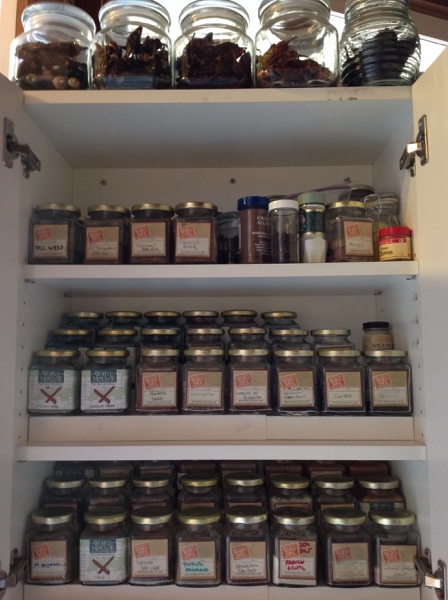
Finally, there’s the exotic ingredient thing. Yes, I have a whacky spice cabinet. You may or may not have a pantry like ours, but I really don’t think that matters. We have all this stuff because we dedicated lot of time and energy into developing and perfecting recipes to share with y’all. Whether or not you need that much stuff is up to you. Does a couple avocado leaves and a little annatto really make or break good chili? If you’re asking me, I think the question is rhetorical. And frankly, I don’t buy the ‘why do you use ingredients I’m not likely to have’ complaint for a second; in this day and age, almost anyone in this country, and many others, can get anything they want. I recently shared a bacon recipe with a pal from South Africa. He ended up having to go all over creation to find several ingredients, but he did it, ’cause he really wants to try my recipe. Kinda like that last discussion on prep and cooking, huh? Ive mailed corn meal to Australia and mustard seed to Israel; if you can’t get something you wanna try, hit me up, I’ll help. I’ve also gotta point out that we constantly encourage and desire experimentation, so if you’re making it, put what you like in it: Give us credit the first time, and then it’s yours…
I say that if you love cooking and great food, maybe you should check out Tasmanian Pepperberry, or Urfa Bebir; who knows what you’ll do with them?

We do this because dear friends who love to grow, cook, preserve and explore as much as we do asked us to. We do this because we have a love for good food and cooking shared. We do this because we hope to inspire such in y’all. If that ain’t good enough, so be it.