Why Does American Produce Suck?


Got this message the other day, from Mike and Sally Poutiatine,

Hey Food-Dude,

Sally and I have a query – we noticed recently in Ireland that the produce there is SO much better than we get in our restaurants or stores in Spokane. We found eating either in a hole-in-the-wall pub or a 4-star Castle dining room the greens were equally good and way better than we find most of the time in Spokane. The veggies in general in Ireland were much better (though they tended to cook them about 10 times as long as necessary) – We found the same thing before when traveling in Italy, Japan and the UK in term of quality. Is it as simple as faster, more direct farm to table? Or do other countries just take green veggies more seriously than we do? Why is that?

My immediate response was this, ‘Oh, I am SO making this the next blog post – Great question!’

Simple salad with real lettuce - A whole ‘nuther animal
Simple salad with real lettuce – A whole ‘nuther animal

The serendipitous part of the question is this – Earlier, while watering our very bountifully producing little veggie and herb garden, (a daily ritual I not only love, but seem to need), I was contemplating the same thing. Our stuff tastes so much better than 90% of what we find for sale – The only thing that rivals it is found in trips to our local farmers market, and through good CSA operations. And therein lies the short answer – While M and I choose not to accept the produce status quo here, most Americans accept (and have been indoctrinated to expect), relatively shitty produce. That is not good, and it needs to change.

Typical Grocery Store Produce - Bletch!
Typical Grocery Store Produce – Bletch!

The first thing that comes to most folks minds when they experience this is the natural assumption that some combination of basic factors are better over there – Better soil, environmental conditions, and so on – But truth be told, that’s a bunch of hooey – writ large, there’s demonstrably nothing special about european soil, etc, that makes their produce taste better than American produce. This has been pretty well studied, and it comes down almost solely to the fact that most world food cultures other than ours value flavor and taste in their produce more than we do – That’s it. That said, we could be, (and more and more folks are), growing stuff every bit as good – it’s just not often sold in mass market grocery stores.

Mighty ‘Mato’s - Not your typical grocery store fodder
Mighty ‘Mato’s – Not your typical grocery store fodder

Let’s take tomatoes as an example – Many will cite the famous Italian San Marzano as the ne plus ultra of tomatodom, but truth? There are a lot of shitty San Marzanos, gang. Like anything else that gets wildly popular on a worldwide scale, production needs outstrip high quality real quick – And by the way, those things are basically Roma’s, a paste tomato variety – They’re great for sauce when grown right, but for other stuff – Not so much. Here on this side of the big pond, (where tomatoes originally come from, after all), you can bet there are some amazing ones. We make a point of planting Mighty ‘Mato grafted tomatoes each year – They’re a thing developed by Dr. Jim Baggett of Oregon State University. Grafting makes them stronger, more disease resistant, and boy oh boy, do they yield – And they’re stunningly lovely. Yet despite all that, they don’t lend themselves well to being sold en mass, so… Or take the case of horticulture Professor Harry Klee, of the University of Florida, creator of the Garden Gem. That’s an incredibly tasty, hearty, disease resistant variety with a great shelf life – But at roughly half the size of the ‘average’ grocery store tomato, virtually nobody appears interested in bringing those to you and me. And here’s the kicker – The Italians have ordered tens of thousands of Garden Gem seeds – Insult to injury for American consumers.

Lettuce, real lettuce, just doesn’t ship, store, or last all that well...
Lettuce, real lettuce, just doesn’t ship, store, or last all that well…

How about lettuces? Well, M and I grow those, and let me tell ya, those are exactly what I was thinking of when I was watering the other day – A simple salad we’d made had taste and texture, because of the lettuce – Shut up! Ah, but those aren’t nice, uniform, large, tough, resilient heads you can ship and display and sell for days, so, they’re out too.

Real Celery isn’t insipid - It’s flavor packed and seriously crunchy
Real Celery isn’t insipid – It’s flavor packed and seriously crunchy

Celery, maybe? Celery?! Tasteless, boring celery? Well, in the store, yes, that’s exactly what it is. Our plants are anything but. They have bold flavor to match a crisp, crunchy texture – The leaves alone are potent and complex – But they don’t grow in big, tight, uniform bunches either so again, no go.

Herbs should never come in plastic containers...
Herbs should never come in plastic containers…

Whatever you name – Chiles, peas, cucumbers, radishes, and any herb there is – You’ll find them in the store, but what you’ll find in this country is chosen for the unholy trinity of shipability, shelf life, and the appearance of relative bounty – Three things you and I definitely do not need.

Wanna take a guess at how many folks know that this is how artichokes grow?

Mike followed up with this thought, ‘I have always assumed that the produce we get from our stores is tasteless because the distance from producer to table is so far – and I am sure that is part of it. But your observation that we have grown used to bad produce is insightful. We eat bad produce because we just don’t care about produce.’

Sad but true, my friends. There’s a local garden here in our area, much beloved, and big enough to regularly supply local grocery stores with produce in season. It’s pretty, and it’s fresh, but frankly – It’s a local version of the same stuff we always see – It’s chosen for those three criterion I mentioned – And as such, there’s really no magic there.

Produce magic begins at home

The good news is that things do seem to be changing for the better. Folks of many generations here are growing tired of paying for crap, which is forcing Big Agro to change, some anyway. We see far more varieties of apples than days of old – Same goes for lettuce, onions, chiles, and so on – And there is stuff therein that is quite good, if we choose wisely. More and more stores are stating straight out where stuff comes from, which is good, and if you do your due diligence, there’s quite a bit more to be sussed out.

A lot of that process means really, truly checking out what you’re choosing – Do you squeeze, poke, prod, and sniff what you’re buying? Do you find a produce person and ask pointed questions? That might be anything from, where is this from and when did it get here, to what’s the harvest date on this, (there is damn near always a harvest or packing or production date), to ‘I don’t know how to tell a good (your selection here) from not – how do you do that?’ In any store worth your hard earned dough, they’ll be able to answer those questions – And if they can’t, (or you don’t ask), shame on you – You get what you pay for.

Mike’s next query was, ‘So what do we do in the US that shows the care and quality that we found in the seemingly universal high quality of Irish produce?’

The good news is that there are things to be found here, and that trend is slowly but surely growing, all over the country – If you read the Rancho Gordo bean post, there’s a shining example. Try those, and suddenly you’re thinking, ‘why am I buying these plastic bags and cans full of tasteless crap when these are out here?’ I’ve seen it first hand with stuff from our friends CSAs in Minnesota as well – How folks react when they have celery that has taste, what good lettuce is like, and so on.

That’s what fresh produce looks like, gang

As for a specific answer to Mike’s last question, I’d say this – If they come here planning to cook, and have facility for such and then go to an average grocery store, what will they get? Mostly crap, unfortunately. If they’re smart, which I think many are, they’ll seek out and find farmers markets – those are the gold standard here these days. In our relatively little town, there are dozens of producers offering gorgeous produce, grown with genuine love and care, just as we do here at home – I’ve had everything from rainbow carrots with amazing taste and crunch, to tiny fingerling potatoes that were melt in your mouth delicious, with a slight tang of the earth they came from as a back note.

So if there’s a unified field theory as to how we go about changing the status quo, this would be my three cents worth.

1. Always grow a garden. You can do this, damn near no matter where you live or what you live in. From window sill to big ol’ plot – Do it – You’ll get better produce, and perhaps more importantly, tending a garden and playing in dirt is good for your soul.

2. Find a Farmers Market near you and patronize that. You’re supporting the little, local folk, and nobody deserves that more – And again, you’ll generally get far superior produce to anything in a chain grocery store.

3. Find a CSA operation Netra you and patronize that. That’s Community Supported Agriculture – we’re the community, and the growers can be anything from those same folks who sell at farmers markets, to larger scale folks who do most of their selling through CSA – Again, no one I know is more deserving of your patronage, and frankly, no one I know is more deserving of great produce than you are.

That ain’t how we play…


I tweak and republish this post annually; I think you’ll see why when you read it.

See, I’m not out to be tragically hip, in fact quite the contrary. Or maybe Matthew Selman said it best; “I wish there was another word than foodie; how about ‘super food asshole’, or ‘pretentious food jerk’?” I just don’t wanna go there.

Granted, there are a lot of great food blogs out there, but right now, many are judged ‘Great’ because somebody took a really, really nice pic of some food, or is on the fast track to be the next Food Channel Super Food Asshole. Frankly, when the ‘best’ food blog sites reject people because they don’t meet criterion such as that, I’m more than not interested, I’m actively turned off.

I write about food from some pretty simple perspectives. I’m interested in sharing recipes, methods, processes and such. I’m interested in sourcing, using wisely, and preserving food that is good for you, in a world where much of what we are offered to eat is not very good. I’m interested in the science behind cooking, because I’ve never liked simply being told to ‘do it this way.’ I trust that if you’re reading this, you’re interested in these things as well. To be honest, if no one read this blog, I’d write it anyway, because I do it for me first and foremost; I gotta share what I love. That’s just how I’m wired.

So, when I look at ‘real’ food blogs, I see the stuff that, fairly often, folks ask me about here, or more to the point, ask me why I don’t do these things. There are three oft repeated comments, and they are,
Why don’t you list nutritionals and calories,
Why don’t you post prep and cooking times, and
Why do you post exotic ingredients that I’m not likely to have?

So, in a nutshell, here’s why;

Frankly, listing nutritionals means, more than anything, that I am determining what kind of portion size you and yours eat, and frankly, I don’t have any idea about that. If I list a casserole recipe and you make it, how much do you eat? How about your partner? Do you have seconds, are there leftovers, and on and on. This ain’t a restaurant, and I’d bet your house isn’t either; neither of us needs everyone to eat the same portion. For the record, I predominantly do recipes for two, with planned leftovers, the idea being general efficiency, and the fact that anything good will be great the next day. Other than that, you’re kinda on your own. I mean I can give you a great biscuit recipe, but how big you make ’em, and how many y’all wolf down is kinda your gig, right?
Don’t get me wrong, nutrition IS important and should be monitored in some way, shape, or form. The best way to this is to buy carefully and thoughtfully. Buy locally whenever you can. Read the labels on food and avoid the stuff that’s truly bad for you. Grow anything and everything you can. Preserve what you buy or grow so that you can notably extend the time it is available to you. Make everything you can, from scratch, at home. That may sound more intensive than what you do now, but if you really care about nutrition, you’ll do it. And as far as we go, whenever you need or want detailed nutritionals on our recipes, just click on our link for Calorie Count and go to town. There’s a mobile version out for your Apple or Android smart phone as well now.

Next comes prep and cooking time.


Weeeeeellllll, how do I say this? Listing prep time is, in my not even remotely close to humble opinion, one of the dumbest things I’ve ever read. The problem is actually pretty obvious. Listing prep time says we all prep at the same level, and nothing could be further from the truth. Heck, I have three preppers in my cafe and they all perform differently… So really, the question is who’s prep time are we talking about? Mine? Yours? Emeril’s? I’ve been cutting things for decades and have pretty damn good knife skills; do you? I can stem, seed and core a tomato blindfolded, without cutting myself, in about 15 seconds; can you? I don’t even think about process and procedure any more, it just comes naturally; does it for you? And if your answers are ‘No’, does that make you slow? If I can prep Dish A in 10 minutes and you take 20, should you not make that dish? Of course not! And really, that’s just the tip of the iceberg. How about what ingredients you have right on hand when you start your prep, how well equipped your kitchen is, how your day went, how many rug rats are flying around your feet, or how many critters need to go out right NOW?! Get the picture? My bottom line is simple – Who gives a rats ass how long it takes if you have the time and want to make it? If you’re cooking regularly, you either already have a decent sense of what you can and will accomplish in a given time, or you will develop one in time. If you really do like cooking and want to do it, you’ll do it.

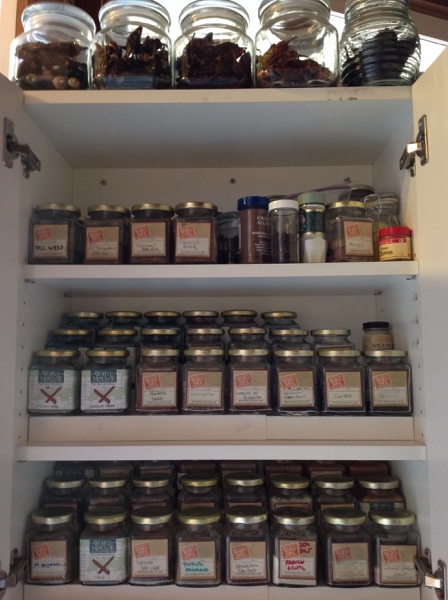
Finally, there’s the exotic ingredient thing. Yes, I have a whacky spice cabinet. You may or may not have a pantry like ours, but I really don’t think that matters. We have all this stuff because we dedicated lot of time and energy into developing and perfecting recipes to share with y’all. Whether or not you need that much stuff is up to you. Does a couple avocado leaves and a little annatto really make or break good chili? If you’re asking me, I think the question is rhetorical. And frankly, I don’t buy the ‘why do you use ingredients I’m not likely to have’ complaint for a second; in this day and age, almost anyone in this country, and many others, can get anything they want. I recently shared a bacon recipe with a pal from South Africa. He ended up having to go all over creation to find several ingredients, but he did it, ’cause he really wants to try my recipe. Kinda like that last discussion on prep and cooking, huh? Ive mailed corn meal to Australia and mustard seed to Israel; if you can’t get something you wanna try, hit me up, I’ll help. I’ve also gotta point out that we constantly encourage and desire experimentation, so if you’re making it, put what you like in it: Give us credit the first time, and then it’s yours…
I say that if you love cooking and great food, maybe you should check out Tasmanian Pepperberry, or Urfa Bebir; who knows what you’ll do with them?

We do this because dear friends who love to grow, cook, preserve and explore as much as we do asked us to. We do this because we have a love for good food and cooking shared. We do this because we hope to inspire such in y’all. If that ain’t good enough, so be it.

This is Our Tribe


It’s Gathering time. Every year at this time, we head sixteen hundred miles due east, to the shores of Squeedunk lake, in north central Minnesota. There, at the home of Grant and Christy, we meet with friends old and new to celebrate stringed instruments, and much more – This is our Tribe.

Our office for the week

We own www.luthiercom.org, a site dedicated to the building of stringed instruments, and the sharing of that arcane knowledge with anyone and everyone who wants to take part. The Gathering is an unusual thing for a modern day social networking site – A dedicated time for friends from the ether to actually meet in the real world, at a truly magical place. There is much talk, much sharing of special skills, much music played and sang, and very, very much food and drink. Monica and I are Co-Hosts and designated event Chefs, and it couldn’t be more fun to do – The Gathering is a magical place to cook.

Shopping, Squeedunk style

Grant and Christy grow much of what they eat, so virtually all the produce we use in 5 days of cooking comes from their gardens. So do the hops with which Grant brews gallons and gallons of beer for the event. Everything else we cook with is local – This year, Ron brought a gift from Winona LaDuke – some fresh buffalo meat for us to work with, as well as his family’s Georgia sourwood Honey, (He’s also brought some amazing moonshine back from there over the years, I can tell you!) We had 14 dozen of the most amazingly fresh, local eggs as well, with deep yellow-orange yolks and true substance to them. Grant’s son Jim and his partner Shel made incredible cheddar bratwurst from venison they’d harvested last year, right on the property.

Fresh walleye, cornmeal and tempura

A neighbor contributed a whole bunch of fresh walleye fillets – It being Friday night, they got fried two ways – in cornmeal and tempura. Donna did panfish ceviche that was to die for. Mitch brought his rightfully famous slow cooked, pulled pork with Carolina mustard sauce, and Lis brought amazing puerco pibil, cooked in banana leaves from the tree in Grandt and Christy’s living room. This is pretty typically how it goes.

Incredibly fresh, local eggs

In the last couple of years, we enjoyed a ridiculous excess of shiitake mushrooms, but the weather didn’t cooperate this year, (fear not – We had all the dried and roasted/frozen we needed, as well as some fresh chicken of the woods Bonnie foraged and brought along, which is good, ’cause we feed a healthy crop of vegetarians too!.

Freshly foraged Chicken of the Woods

We did, however, have a bumper crop of beautiful poblano chiles, and lots of traditionally harvested wild rice, so we paired those with Winona’s buffalo – They were, of course, a big hit.

Fresh poblanos
Fresh poblanos

We cook three meals a day, but they’re timed and spaced specifically to accommodate the laid-back atmosphere of the gathering. Brunch gets eaten right around noon, the midday meal slides to somewhere around 4 PM, and dinner to between 8 and 9 PM.

The Round Heeled Woman Speakeasy - Its underground, folks!
The Round Heeled Woman Speakeasy – Its underground, folks!
The back door to the Speakeasy - Leads to our room, no less!
The back door to the Speakeasy – Leads to our room, no less!

After that, it’s music on the main stage, and maybe a trip down to the Round Heeled Woman, the underground speakeasy – Yes, there’s and underground speakeasy, and in fact, the back door that establishment is a ladder down from the room we stay in – I told you, this is truly magical – It’s not uncommon for music and even lutherie activities to go in well into the wee hours, (and that’s why brunch is at noon).

Friday Dinner - Fish, of course!
Friday Dinner – Fish, of course!
It's time for grub!
It’s time for grub!
The view from the main stage
Brunch time
Brunch time

Our work ranges from brunch for a dozen, to lunches and dinners for 50 or more. Folks volunteer to pitch in, and we cheerfully put them to work on prep and cooking as needed. Chris and M and I do some planning, and most years, we more or less follow the gist of that, but as the saying goes, no plan ever survives first contact with the enemy – We’ve planned to do a coffee roasting demo for 2 years now and have yet to get around to it, and we never did salt cure egg yolks, but hey, just wait until next year.

Salt potatoes were a big hit

We did two batches of salt potatoes that the crowd went nuts over, paired with fresh chimichurri. And our Yakitori Sauce marinated a couple of wonderful pork tender loins – Hmmm, this was a very pork-centric year, huh? There was amazing fruit, so blueberry, raspberry, kiwi, and mango Pico de Gallo all made a showing, along with mango butter and granita. Biscuits and pie dough were about as deep as the baking got, ’cause it was kinda warm this year.

Blueberry, raspberry, kiwi, and mango Pico de Gallo
Mango butter is a special treat

We didn’t take enough pictures, but, hey you get the idea, right? It was another fabulous time with friends old and new – The new ones are a gas to watch – John Joyce came up from the twin cities for the first time, arriving on Thursday evening into the middle of our chaos. At first, folks can be a bit intimidated with the craziness, intimate relations, and long running jokes and shtick, but those who get it are quickly drawn in. John brought some beautifully made instruments, number 13 being his newest – She’d only been strung up for 4 days before he arrived, but she sang like an angel. I’m glad to report that JJ is now hooked and is expected back next year.

And that’s how it goes. Interested? Wherever you are, you’re welcome to join us. I guarantee you’ll be blown away in the best sense of the words. Stay tuned for next year’s dates.


Cascade Hops, close to ready
Crisp and tart pears at perfect ripeness
Chiles at the store
Chiles at the store
Gotta have tomatoes, right?

Sugar, and Spice, and Everything Essential


Sugar, and spice, and everything essential. That’s no nursery rhyme – That’s what needs to be in every home pantry, if spontaneity and discovery are to happen in your kitchen. Fact is, without a decent assortment of staples – Sweeteners, flours, herbs, spices, oils, vinegars, and the like, it can be awfully hard to successfully create on the fly. At the same time, its easy, (and pricy!), to go overboard on this stuff. What’s the happy medium, and what are the must haves? Let’s dive in and see.

Here at our kitchen, we have, well, pretty much everything. We have to, in order to do what we do for y’all – researching, creating, and testing recipes requires a ridiculous amount and variety of resources. Thankfully, your kitchen needn’t be quite so whacky to be well equipped. That said, you may want more than you’ve got currently, so how to decide what’s necessary? Let’s use our place as a guide, and pare things down to manageable for the average home kitchen. That should allow a cook to do as much as reasonably possible from scratch, and also encourage spontaneity.

Spice & Herb Overflow - It happens...
Spice & Herb Overflow – It happens…

Before we dive in to specifics, a note on organization. Some manner thereof is, of course, absolutely necessary. How that takes shape is up to you. The most common sense approach is to consider what you use most, and have those closest at hand. As far as I’m concerned, the Season As You Go rule is non-negotiable, so the core stuff needs to be close at hand. We keep our go-to salts and peppers front and center, right on top of the stove. Oils, vinegars, and other common sauces shouldn’t be much farther away, ditto for herbs and spices. Flours, sugars, canned, boxed, and bagged stuff is pantry fodder, if you’re fortunate enough to have one.

The fundamentals, salt and pepper, center stage.

In any case, make arrangements that make sense to you. Once you establish an order that works for you, keep it – In a professional kitchen, having things in the same place every time is a necessity, given the time constraints under which we cook. That rule really isn’t any different for us at home – Sometimes cooking is leisurely, but more often than not, it’s home at five and dinner needed around six, or some version thereof – So having everything where you expect to find it is imperative for efficiency and peace of mind. All that said, be open minded about change, if down the road your best laid plans don’t thrill you any more. Quarterly reviews of your resources and where you have them is a very good plan to follow. That gets you looking at expiration dates, freshness, amounts on hand, and what you haven’t used in forever on a regular basis – Include your fridge and freezer in that survey as well.

Why not start with those essentials, your go-to seasonings. As savvy cooks everywhere know, the core secret to great cooking is seasoning as you go. That means that the stuff you rely on for that process should be, as noted, closest at hand. This needn’t be complex. Salt and pepper really are all you need. Were one to pick a single version of each, what should they be? I’ll advocate for a sea salt, one with a moderate grain size – For this, you don’t want either really chunky stuff or super fine – Real sea salt contains a wealth of trace minerals that taste good and are good for you. There’s a bunch out there – I like the Bob’s Red Mill a lot, as well as the Celtic brand. For Pepper, you’re hard pressed to do better than a genuine Tellicherry berry, and that requires a little explanation.

Tellicherry Pepper - Size matters.
Tellicherry Pepper – Size matters.

Contrary to popular culinary myth, Tellicherry Pepper does not come from its namesake city in India. Tellicherry berries are defined by size, not location or heritage, per se. Pepper berries, Piper Nigrum, are harvested in February and March, then dried to become what we recognize as a pepper corn. In order to be called Tellicherry, pepper corns need to be 4.25 mm or larger, (and there’s actually a jumbo version, at 4.75mm and up). In any given crop, maybe 10% to 15% of the berries reach Tellicherry size, so it’s a bit rarer and a bit pricier, but well worth it – You’re getting the literal cream of the crop. As for other pepper, a look through our spice cabinet finds long, Tasmanian, grains of paradise, smoked, Szechuan, Lampung, Aleppo, white, green, and red, so yeah – You can go pretty ballistic on those. As far as I’m concerned, Tellicherry is all you really need.

Culinary Salts now run the gamut from A to Z

There are many more options for salts these days, as well – and you may or may not want or need them. Some of the legendary ones, like Malden, Sal de Mer, Himalayan pink, Bolivian Sunrise, and the like are truly spectacular, but they’re expensive – Really better suited as finishing salts for a special touch. I counted fourteen salt varieties in our spice cabinet, including kosher, flaked, smoked, and a raft of those fancy varietals – Again, you really don’t need most of those. If I had to pick a must have selection, it’d be sea, kosher, and flaked – That’ll cover the vast majority of uses you’re likely to want to mess with – And if the others catch your fancy, I say try those too, but sparingly. Salt and pepper don’t have an endless shelf life, so buy in small quantities, and use them up before adding more.

Essential oils, vinegars, and sauces get the same storage treatment as herbs and spices.

Next up, oils, and here too one can be complex or simple. For eons, what you could get was corn oil and olive oil, and little else. With the rising popularity of home gastronomy, the variety of oils available to cooks has blossomed considerably. For basic cooking, you can now find a number of relatively heart healthy oils in almost any store – canola, peanut, safflower, and sunflower, for instance. As with fancy salts, there are a bunch more fairly exotic oils – walnut, grape seed, coconut, hazelnut, avocado, and infused olive oils. While the latter bunch are delicious indeed, they’re really more for finishing or making vinaigrette than for cooking – And they’re fabulously expensive to boot. What you need is genuine Extra Virgin Olive Oil, for sure, and then a go to veg oil – Those will do the trick for 90% of your daily cooking chores. I’ll add one caveat, and that’s avocado oil. It’s become our go to, for several reasons – It’s got a light, buttery taste, it handles heat well, and is high in monounsaturated fatty acids.

For all thing flour, I’ll refer you to our Flour Power post from a while back – It’ll probably tell you more than you need to know.

Pantry is for bulk storage of staples.

Sweeteners are a bit more complex than refined white sugar, and should be – There are tastier, more potent options worth your shopping dollar. That’s not to say that you shouldn’t have white sugar on hand – You should, and maybe even a couple variants – Regular white is a go to for many things, and the finer cut Baker’s sugar dissolves much faster, for baking or other cooking. Honey, real honey, local whenever possible, not only has greater sweetening power than sugar, it has the added benefit of subtle flavor notes that reflect the terroir your local bees worked to bring you their joy. Regulars here will know we’re also big on agave nectar. In addition to a lovely, light taste, like honey, agave has a lower glycemic index than white sugar, so here again, you can use less to obtain a commensurate level of sweetening power. Other sugars, brown, raw, and the like, carry a molasses flavor note white refined doesn’t, and some folks like that. If you bake, you’ll likely want some of those on hand. Molasses and corn syrup might also find favor with bakers. Alternative molasses, like Pomegranate, sorghum, carob and date, are popular for cooking Middle Eastern cuisine, and can add an exotic touch to many dishes and sauces.

Vinegar is a must as well, for everything from house made vinaigrettes to sauces and shrubs. Depending on what you like to do, you may need one or more variations on the theme. A few years back, I wrote a little primer on the basics – You can find that here. The one caveat I’ll underline is this – Infused vinegars are expensive, and they needn’t be. You can make great versions at home for next to nothing, and you should. Here are some ideas for that project.

There are a bunch of ready made sauces out there, so what do you really need? For my mind, a hot sauce or three is a necessity – A few drops of Tabasco, for instance, wakes flavor much as salt does, and adds a nice backbone note to soups and stews. Jalapeño based sauce has a milder, fruitier profile that goes great with everything from veggies to eggs. What else? Soy sauce is a must, (though beware, there are a slew of gourmet and ‘premium’ varieties that can get really pricy and aren’t really all that spectacular. There are now an abundance of dark and light varieties. Preference comes down to taste, so try a few until you find something you like, and then stick with it – The lighter version, by the way, differs mostly in color, the idea being not to turn things muddy when that’s not appealing. Fish sauce is another must have, and here you do need to be careful – There’s a lot of crap, even among the pricy stuff. Red Boat is the real deal – You can’t go wrong with a small bottle of that, and since this is added literally by the drop, a small bottle goes a long way. Obviously there are a bunch more sauces, and you may accumulate a few over time. Hopefully, you don’t get as crazy as we are, but then you never know…

Oils, vinegars, and sauces will break down in the presence of direct sunlight and heat, so store them in a cool, dark spot, in glass containers, and always read the label to see if something belongs in the fridge after opening.

Herbs and spices need dark, cool temps, and airtight glass jars.

And lastly, we come to herbs and spices. Here’s a place where, as you can see from our cabinet, a cook can go seriously off the deep end – That’s a blessing and a curse. Almost everything in a spice cabinet is sensitive to conditions and age – The volatile compounds that make herbs and spices do what they do mean that they can and will break down and degrade if stored improperly or kept too long. For dried herbs and spices, there are important caveats. First, sourcing – All herbs are not created equally – Provenance and proven quality matter. Although things are improving in terms of variety and quality, getting herbs and spices from the average grocery store isn’t what you want to do. A simple test illustrates why – A generic, store bought jar of oregano versus real stuff from a quality source like World Spice, or Penzeys, will prove the point. Open both and take a nice, long sniff. The sheer power and complexity of the good stuff quickly overwhelms the relatively insipid generic version. What you’re experiencing is ‘oregano’ against Mexican or Turkish oregano, with known sources of high quality – Game over. Everything you get from a good purveyor will perform like that. If you needed further motivation, what you get in the grocery is often more expensive than what the good providers charge. You’ll also have a choice as to how much of what you want to buy, and you can opt for whole or ground/mixed as well. Overall, it’s a no brainer if you’re serious about your cooking, (and if you’re here, you are.)

Onwards to storage – If your spices are in little jars in a spinny thingy on your counter top, and you got that stuff as a wedding gift and are still using it, you seriously need to repent, and soon. Sunlight, oxygen, and warmth are our friends, but for dried herbs and spices, not so much. Your stuff needs to be in a cabinet, out of direct light, away from extremes of temperature, and stored in small, airtight glass jars. That will safeguard your hard won goodies. Even so, age creeps up on us all, and spices are as susceptible as anything. This means that limiting how much and what you store is the best plan. We buy our staple, go to stuff, by the pound, but again, that’s because we do a lot of cooking to make this joint run – There are few, if any things in the spice world that the average home kitchen needs by the pound – An ounce of lemon thyme goes quite a long way, and you can have another in your mailbox in a matter of days. Buy quality, buy enough for maybe three months of use, and you’re good to go.

Of course, some herbs just beg to be used fresh, and if ever there’s an indoor gardening task you should undertake, a fresh herb window box is it. Check out our page on what we call the essentials, here. Between that and an annual herb and veggie garden, you can grow and then dry of freeze home grown stuff – There’s nothing finer, frankly.

This isn’t meant as a comprehensive kitchen analysis, but as a good starting point from which to learn and grow. Always be open to change, embrace what works and tastes good, and you’ll be hard pressed to go wrong. What we’ve outlined here should be sufficient to allow decent spur of the moment creativity on your part.

Calling All Vegans & Vegetarians!


Check out this absolutely delicious post on vegan/veggie sushi by my über talented Sister, Ann Lovejoy. I may be an avowed omnivore, but these dishes are genuinely mouth watering.

If you’ve not done so, subscribe to Annie’s blog while you’re reading her latest post.